Mali Junta Loses Anéfis: Russia's Failures
Mali's junta loses key territory to insurgents, exposing Russian limitations.
Model Diplomat8 min readAfrica
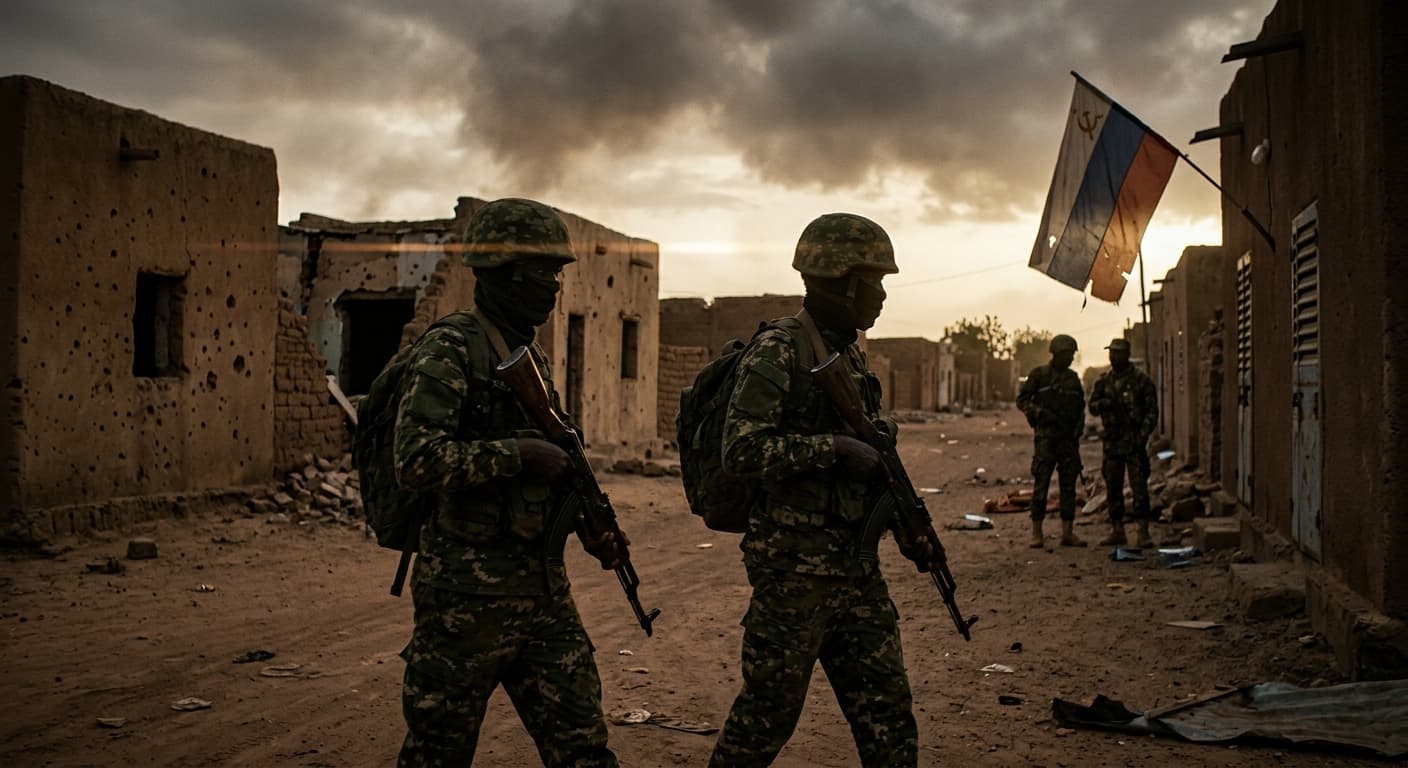
The Russian Partner Loses Anéfis: Mali's Junta Runs Out of Northern Ground
The FLA-JNIM offensive of July 4, 2026 stripped Bamako of its last foothold in the Kidal region — and exposed Russia's Africa Corps as a garrison force it cannot defend.
The Azawad Liberation Front's claimed capture of the Anéfis military base on July 4–5, 2026 is not another skirmish in a decade-long insurgency — it is the moment Mali's junta and its Russian security partner ran out of northern territory to defend. Anéfis was the fallback line drawn after Kidal fell in April; losing it in seventy-two hours converts the FLA-JNIM alliance from a raiding coalition into the effective sovereign of the Kidal region, and forces Russia's Africa Corps into the same operational posture it holds in Libya and the Central African Republic: regime protection in the capital, not counter-insurgency in the country. That shift, if it holds, ends Bamako's five-year bet that a Russian military partnership could substitute for a political settlement with the north.
What actually happened, in precise detail
Between the pre-dawn hours of Saturday, July 4 and Sunday, July 5, the FLA and Jama'at Nusrat al-Islam wal-Muslimin (JNIM) attacked at least seven positions across three axes — Anéfis and Aguelhok in the north, Gao in the northeast, Sévaré, Konna and Somadougou in the centre, and Kénieroba's prison complex in the south. Mali's General Staff (DIRPA), in a communiqué reported by BBC Afrique, initially confirmed simultaneous attacks on five garrisons and later claimed "the situation is totally under control," with 20 assailants killed at Sévaré and six at Gao.
The rebels tell a different story. FLA spokesman Mohamed Elmaouloud Ramadane told Al Jazeera that "several positions have fallen" inside Anéfis and confirmed the assault was coordinated with JNIM. JNIM's own statement, cited by
Al Jazeera's July 5 briefing, claimed control of seven positions. By Monday,
RFI-sourced reporting placed Anéfis under separatist control, with Africa Corps posting drone-strike footage of the town on Telegram — a tacit admission that Russian personnel were striking from the air rather than holding ground.
The geography matters. Anéfis sits roughly 100 km south-west of Kidal, on the Gao–Kidal road. After the April rout, the International Crisis Group noted that Bamako "redeployed government forces to the town of Anefis," making it — alongside Aguelhok — the last Malian foothold in the Kidal region. A convoy dispatched from Gao to reinforce Anéfis was ambushed roughly 100 km out; footage circulating on rebel channels showed destroyed vehicles and a downed Mi-24 helicopter, though
Al Jazeera has not independently verified attribution. By July 6, Al Jazeera's Nicolas Haque was
reporting from West Africa on a Russian naval weapons shipment inbound to keep the junta from collapsing.
Why this is not April 25 all over again
The instinct is to file Anéfis under "second wave" of the April 25 offensive that killed Defence Minister Sadio Camara at his Kati residence. That reading understates the shift. April was a demonstration — jihadist and separatist forces proving they could hit Bamako, Kati, Kidal, Mopti and Sévaré simultaneously. July is a consolidation. The FLA is no longer probing; it is administering. The rebels' spokesman told AFP in Paris in late April they intended to govern northern cities under "moderate Sharia" via qadis — the same governance model JNIM has piloted in rural central Mali.
Two data points anchor the trajectory. The Council on Foreign Relations tracker records that the Sahel now accounts for more than half of global terrorism-related deaths. And the West Africa Security Tracker's
January–June 2025 report logged 2,157 fatalities in Mali alone in that period, with June deaths surging to 543 and drone strikes producing 118 casualties, including children. That is the tempo Anéfis sits on top of — not a spike, but a floor that keeps rising.
The strategic picture is captured most bluntly by Alex Vines of the European Council on Foreign Relations, who told Al Jazeera that the attacks have squeezed Malian authority into "securitised enclaves and corridors." That is a polite way of saying Mali is no longer a state contesting territory — it is a set of garrisons contesting roads.
The real loser: Russia's operating model
For the Kremlin, Anéfis is the second humiliation in ten weeks. In April, Africa Corps negotiated a withdrawal from Kidal under Algerian mediation — a scene the BBC captured with Russian trucks rolling out and armoured personnel carriers left behind. The
Stimson Center concluded that "the images of Russian personnel withdrawing from contested territories under negotiated agreements further undermine the perception of strength that Moscow has sought to project in Africa." Anéfis is the sequel.
The Africa Corps is not Wagner. It is a defence-ministry force, run by Deputy Defence Minister Yunus-Bek Yevkurov and, on the ground, by Maj-Gen Andrey Averyanov — a career GRU officer whose portfolio is influence operations, not brigade-scale COIN. As ISS Africa analyst Héni Nsaibia put it, Africa Corps represents a Russian pivot "from battlefield engagement towards regime stabilisation, infrastructure protection and strategic influence." The July 4 offensive found the seam in that model: when insurgents attack in seven places at once, an "influence" force cannot be everywhere, and the airpower it does deploy — Mi-24s, drones — cannot substitute for infantry that will hold a base overnight.
The financial logic is also under pressure. Wagner, at its peak, reportedly cost Bamako as much as $10 million a month; Africa Corps operators are
paid at least $3,000 monthly. The junta is footing that bill while JNIM's fuel blockade — active since September 2025 — strangles the customs revenue it needs to pay. The Institute for Security Studies
documented that around 4,000 empty containers were stranded in Bamako by February 2026 because drivers refused the Dakar road.
What Bamako actually has left
Two things: gold and the Alliance of Sahel States (AES). Both are more fragile than they look.
Gold is Mali's leverage. The country produced roughly 100 tonnes in 2024 — Africa's second largest — generating some $4.3 billion in exports, according to figures compiled by Al Jazeera from US Commerce Department and IMF data. A 2023 mining code took state stakes up to 35% and, per the German think-tank SWP, Bamako
recovered $1.2 billion from mining companies between 2023 and 2025, including a $430 million settlement from Barrick Gold. But the
World Bank's country brief projects the 2025 fiscal deficit widening to 3.3% of GDP on "lower-than-expected mining revenues and rising spending pressures from public recruitment" — the security build-up itself is eating the gold windfall.
The AES is Bamako's political insurance. At the December 2025 Bamako summit, Mali, Burkina Faso and Niger launched a joint 5,000-troop battalion and confederation-level structures. But Niger and Burkina Faso have their own JNIM problems. The
Council on Foreign Relations noted that they conducted joint air strikes on Malian territory after April 25, but neither has infantry to spare for a Kidal-region counter-offensive. The AES is a rhetorical shield, not a reserve force.
The UN's tools are exhausted. MINUSMA — the Multidimensional Integrated Stabilization Mission in Mali — departed in 2023 at the junta's demand, ending a decade in which 180 blue helmets died and Paris carried its extension motion in the Security Council. In April 2026, Secretary-General António Guterres
called for "international solutions" to curb violent extremism in the Sahel. There is no follow-up mechanism. JNIM remains on the
UN Security Council sanctions list as al-Qaida's Mali branch, which is now a legal footnote rather than an operational constraint.
Who benefits — and the historical parallel that matters
The FLA is the immediate winner. Founded in 2024 as a coalition led by Alghabass Ag Intalla, it has, in fifteen months, reversed the 2023 Wagner-FAMa capture of Kidal and pushed the government out of every Kidal-region town but Aguelhok. If it holds Anéfis for a fortnight, the northern front becomes a de facto Azawad again — the very outcome the 2015 Algiers Peace Agreement was designed to prevent short of independence.
The less obvious winner is China. As the FT documented in 2024, Ganfeng Lithium opened its Malian mine while Barrick's executives were being arrested. Al Jazeera's
June 2026 analysis notes Bamako is building a state-controlled gold refinery with Russian partners — but the Goulamina lithium deposit, one of Africa's largest, is Chinese-operated. Every month the junta spends firefighting in the north, the balance of extraction rights tilts toward Beijing, whose companies operate in the safer south and whose government demands nothing about human rights.
The historical parallel is not 2012 — the Tuareg rebellion that triggered the first French intervention. It is the 2013 fall of Konna, when a jihadist advance on Mopti forced Paris to launch Operation Serval within seventy-two hours. This time no external cavalry is coming. France is out. The US, per CSIS, was reportedly negotiating to resume ISR flights before Camara's assassination collapsed the interlocutor. Algeria mediated the Kidal withdrawal but has no interest in a broader intervention. Russia is the partner Mali chose — and Russia is now the party being escorted out of towns.
Diplomat View
Anéfis is the point at which the junta's core proposition — that a Russian partnership could deliver what French and UN forces failed to deliver — becomes empirically indefensible. Expect Assimi Goïta to double down anyway: additional Russian materiel by sea, more drone strikes on rebel-held towns, and a rhetorical pivot from "neutralising terrorists" to defending "sovereignty" against Western-sponsored destabilisation, a line already piloted by Sputnik in April. The forecast: within six months, either JNIM extends its fuel blockade to a full siege of a second regional capital (Ségou or Sikasso), or Bamako opens a back-channel — likely via Algiers or Nouakchott — with the FLA, decoupling the Tuareg question from the jihadist one. What would revise this call: a decisive Africa Corps counter-offensive that retakes Anéfis before August, or a public split between Ag Intalla's FLA and JNIM over the governance of captured towns. Absent one of those, the northern third of Mali is gone.
What to watch:
- Anéfis, next 14 days: whether the FLA holds the base through Africa Corps drone strikes and a second reinforcement attempt from Gao.
- Bamako fuel supply, July–August: if pump prices spike or convoys stop, JNIM's blockade is winning; if the Russian shipment breaks it, the junta buys time.
- AES summit follow-through: the promised 5,000-troop joint battalion has no confirmed deployment date — the first operational sortie will signal whether the alliance is a force or a flag.
The Bottom Line
Anéfis is the moment Mali's junta lost the north for the second time in a decade — and this time there is no French army, no UN mission, and no functioning Russian ground force to take it back. The FLA-JNIM alliance now controls the geography Bamako pretended to hold, while the Africa Corps has been demoted from counter-insurgency partner to regime bodyguard. If the pattern of the last fifteen months continues, the political question in the Sahel is no longer whether Mali fragments, but who negotiates with the FLA first — Bamako, Algiers, or Beijing.
Discover more

US Politics
US Launches $166B Tariff Refund Portal
The US is launching a $166 billion tariff refund portal to aid importers hit by Trump-era tariffs, with major implications for trade and supply costs.
Global Politics
Xi Jinping Calls China-Russia Ties 'Precious'
Xi Jinping's description of China-Russia ties as 'precious' reflects a strategic imbalance, with Beijing dictating terms in the partnership.

Global Politics
US Naval Blockade on Iran
The US fully imposed a naval blockade on Iranian ports, escalating tensions even as Trump hinted the conflict may soon end while serious risks of war remain.

Conflict & Security
Drone Warfare Killing Aid Workers at Unprec
Over 1,000 humanitarian workers killed in three years as cheap armed drones collapse legal protections. Gaza, Sudan, Ukraine, and DRC see deliberate targeting of aid convoys and hospitals with zero prosecutions.