Malaria Funding Gap Becomes War Tool in Congo
MSF warns North Kivu will lose Global Fund malaria support for 2027–2029
Model Diplomat9 min readAfrica
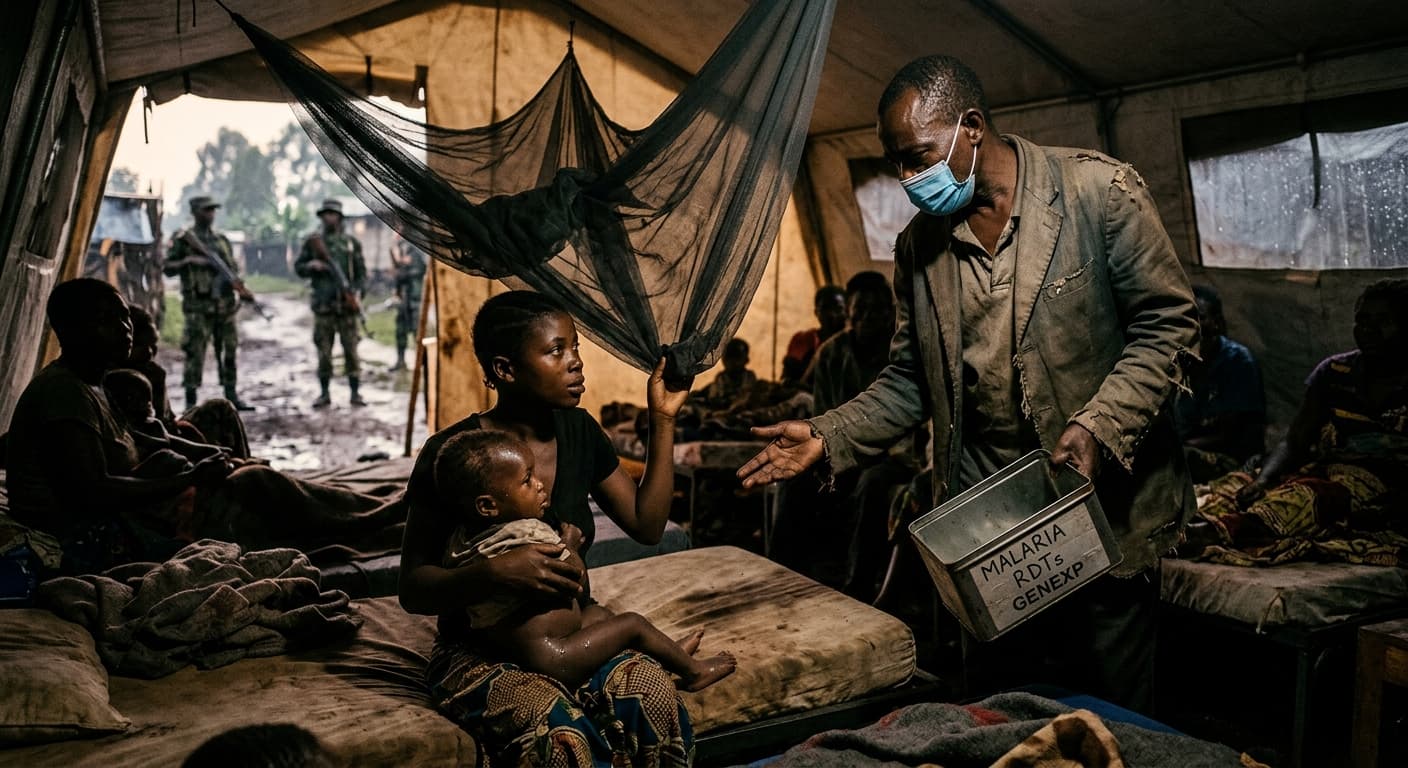
How a Malaria Funding Gap Became a Tool of War in Eastern Congo
MSF warns North Kivu will lose Global Fund malaria support for 2027–2029, exposing a structural flaw in how global health finance reaches populations living under armed-group control.
Médecins Sans Frontières disclosed on July 16, 2026, that North Kivu — a province of roughly six million people now largely controlled by the Rwanda-backed AFC/M23 rebel coalition — will be excluded from priority malaria funding under the Global Fund's eighth grant cycle (GC8), covering 2027–2029, for which applications are due by the end of July. The exclusion is not a policy decision by the Global Fund itself. It is the downstream consequence of an allocation architecture that delegates national priority-setting to sovereign governments: Kinshasa's Country Coordinating Mechanism submits the funding request, and Kinshasa no longer administers North Kivu. The leverage sits with a government that has every incentive to steer scarce health dollars toward provinces it still controls — and every reason to let a rebel-held territory absorb the cost. The result is a public-health financing system that structurally cannot reach populations living under armed-group control, at the exact moment those populations face overlapping malaria and Ebola crises.
The allocation architecture and why it fails in rebel-held territory
The Global Fund to Fight AIDS, Tuberculosis and Malaria is a financing mechanism, not an implementing agency. It allocates funds to countries based on national income and disease burden, then routes those funds through a Principal Recipient designated by each country's Country Coordinating Mechanism — a national committee that develops and submits funding requests on behalf of the entire country, as described in a WHO overview of the Global Fund's country allocation process. This country-owned model works when the state controls its territory. It breaks down when it does not.
The DRC carries the second-highest global malaria burden, with roughly 30 million annual cases and approximately 310,000 child deaths under five each year, according to a World Bank health-systems assessment of eastern DRC. The Global Fund has been the primary external financier of malaria control in the country, supplying treatments, insecticide-treated nets, and diagnostic tools. But the allocation methodology — disease burden and income at the national level — does not require that resources reach the subnational areas of highest transmission. The country dialogue process that determines which provinces are "prioritized" for GC8 funding is run from Kinshasa, through a CCM chaired and convened by the central government. That is the mechanism by which North Kivu, despite malaria accounting for between 48 and 58 percent of medical consultations in three MSF-supported health zones in 2025, drops off the funding list.
A 2025 study published in BMC Public Health by researchers at the London School of Economics found that the Global Fund's allocation methodology — largely based on economic capacity and disease incidence — does not account for structural deficiencies that limit a country's ability to efficiently absorb and distribute malaria funds, and recommended that decisions about which populations receive funding should be based on a more complex set of criteria beyond national-level metrics, as the LSE analysis of Global Fund value for money (2017–2019) documents. North Kivu in 2026 is the case study that framework was warning about.
Who holds leverage, and how they are using it
The leverage in this decision is distributed across three actors, each with different incentives.
Kinshasa benefits most from North Kivu's exclusion. President Félix Tshisekedi's government, which has been flirting with a constitutionally questionable third term, faces shrinking fiscal space and a degraded health system across the east, as a Council on Foreign Relations analysis of the DRC conflict notes. Redirecting Global Fund malaria support away from a province controlled by an armed group Kinshasa is fighting — and toward provinces where government legitimacy is intact — is a rational, if devastating, bureaucratic choice. It does not require an explicit decree. It requires only that the CCM's national priority list omit North Kivu, and that the Global Fund's Technical Review Panel accept the submission.
The AFC/M23 coalition also benefits, in a perverse way. The rebel administration has installed a parallel governance structure across North Kivu since seizing Goma on January 27, 2025, as Al Jazeera reported. M23 leaders have claimed credit for restoring basic services — water, electricity, relative security — in Goma, while banks remain shuttered and Kinshasa refuses to recognize the rebel authority, as
Al Jazeera's anniversary feature on Goma documents. The withdrawal of international malaria financing reinforces M23's narrative that Kinshasa has abandoned the population, and creates space for the rebel administration to present itself — or its external backers — as the alternative provider. Health Minister-designate figures under AFC/M23 have already declared the Ebola outbreak "eradicated" in areas they control, according to
Al Jazeera's reporting on the Ebola death toll, a claim that cannot be independently verified and that epidemiologists consider premature.
The Global Fund itself is the actor with the least direct leverage. Its allocation methodology depends on country ownership and national priority-setting. It has no field presence, no implementing capacity, and no mechanism to negotiate directly with non-state armed groups. Its "challenging operating environments" flexibility, described in the WHO technical brief for countries preparing Global Fund malaria funding requests, allows for qualitative adjustments, but these are applied at the country level, not the provincial level. The Fund cannot, under its current architecture, route malaria money directly to a health zone in M23-held Rutshuru without going through the Congolese government.
The numbers that make exclusion catastrophic
The exclusion does not land on a manageable health situation. It lands on a system already in freefall.
In three North Kivu health zones where MSF works alongside the Ministry of Health — Bambo, Kibirizi, and Rutshuru — malaria accounted for between 48 and 58 percent of all medical consultations in 2025, according to MSF's statement via ReliefWeb. Over 255,000 uncomplicated cases and 26,000 severe cases were treated across these zones by MSF, the Ministry, and partners combined. MSF alone provided 53 percent of treatments for uncomplicated malaria and 35 percent for severe malaria — a ratio MSF program manager Stéphane Doyon called "unsustainable in terms of long-term prevention and control."
"The Global Fund has been a real lifeline for people exposed to malaria, providing most of the available treatments in North Kivu. If it stops supporting the province in malaria prevention and treatment, the situation will become catastrophic. Malaria is a preventable and treatable disease. In 2026, it is unacceptable that people continue to die or develop severe forms of the disease because they lack access to prevention measures, diagnosis, and basic treatments."
Basic prevention has already collapsed. No mosquito-net distribution has taken place in Global Fund-supported areas of North Kivu since June 2023. No malaria control supplies reached the province between July and December 2025, forcing MSF to purchase and supply treatments directly. The displacement crisis compounds this: people fleeing fighting between Congolese government-allied forces and AFC/M23 are sheltering in forests and remote areas where malaria exposure is highest and healthcare access is lowest, as MSF's statement details.
The Ebola outbreak declared on May 15, 2026 — the DRC's 17th, caused by the Bundibugyo strain, which has no approved vaccine — has now spread to North and South Kivu, with confirmed Ebola deaths surpassing 500 as of July 6, 2026, according to Al Jazeera. North Kivu has reported a case-fatality rate of 57.4 percent, described as "worrying" by Congolese health authorities. The overlap matters: early Ebola symptoms — fever, headache, weakness — are clinically indistinguishable from malaria, complicating diagnosis and delaying treatment, as
BBC reporting on the outbreak explains. WHO Director-General Tedros Adhanom Ghebreyesus warned of a "catastrophic collision of disease and conflict," noting that the response depends entirely on humanitarian access that ongoing fighting routinely severs, as
Al Jazeera reported.
The historical parallel that should change the calculus
This is not the first time North Kivu's conflict has sabotaged disease response. The 2018–2020 Ebola outbreak in North Kivu and Ituri — the DRC's 10th — killed nearly 2,300 people and became the country's worst Ebola epidemic on record, as Al Jazeera's feature on the current outbreak notes. That outbreak was prolonged not by the virus's biology but by the operating environment: armed-group attacks on health facilities, community mistrust, population movement, and supply-chain disruption. Lessons from that episode, documented by responders and cited in the
World Bank's eastern DRC health assessment, highlighted the dangers of delayed responses, insufficient healthcare infrastructure, and the corrosive effect of conflict on community trust.
The difference now is the layering. In 2018, North Kivu was still under Congolese government administration, and international donors could route funds through the Ministry of Health. In 2026, North Kivu is under a parallel rebel administration that Kinshasa does not recognize, banks are closed, and the World Bank has already relocated its project coordination unit from Goma to Kinshasa because M23 occupation halted implementation, as a World Bank restructuring paper for the STAR-Est project documents. The institutional pipeline that carried health financing to the province has been physically and politically severed.
WHO's updated guiding principles for prioritizing malaria interventions in resource-constrained settings, published as a WHO technical document, state that prioritization decisions must be "guided by the basic principles of primary health care and universal health coverage," including equity and leaving no one behind. The principles recommend subnational tailoring — using local data to direct resources to where they are most needed. North Kivu's exclusion from GC8 inverts this logic: the areas of greatest need are deprioritized precisely because the national government cannot or will not reach them.
The second-order effects no one is counting
The immediate consequence of North Kivu's exclusion is a malaria treatment gap. The second-order consequences are broader.
First, MSF's capacity to substitute for the Global Fund is finite. The organization is already supplying more than half of uncomplicated malaria treatments in its intervention zones, and it cannot scale to cover an entire province of six million people. If Global Fund support does not resume, the gap will be filled by nothing — or by drug-vendor markets where artemisinin-based therapies are sold at prices most displaced families cannot afford, driving untreated infections toward severe disease and death.
Second, the Ebola response depends on a functioning malaria diagnostic system. Every fever case in North Kivu is now a potential Ebola case until ruled out, and malaria is the most common differential diagnosis. If malaria testing and treatment capacity collapses, Ebola surveillance collapses with it — not because of the virus, but because the health system cannot distinguish between the two. The Red Cross has already warned the outbreak has not peaked and could last a year, as Al Jazeera reported. MSF has stated that testing remains "one of the most significant weaknesses in the response."
Third, the U.S. withdrawal from global health infrastructure has compounded the gap. The now-defunct U.S. Agency for International Development funded the community health workers who had on-the-ground networks and local knowledge in eastern DRC; since its closure in 2025, those workers have lost their jobs and stocks of protective equipment have been depleted, as the CFR analysis reports. The U.S. withdrawal from WHO coordination has further isolated the response at the worst possible moment.
Fourth, the precedent extends beyond the DRC. If the Global Fund's country-owned allocation model can be gamed by a government to defund a rebel-held province, the same logic applies wherever armed groups control territory in high-burden countries — Sudan, Myanmar, the Sahel. The structural vulnerability is not specific to North Kivu.
What to watch
-
End of July 2026: The GC8 funding application deadline. The DRC's CCM submission will reveal whether North Kivu appears in the national malaria priority list. This is the last point at which the exclusion can be reversed administratively before the cycle locks in.
-
Global Fund Board review, late 2026: The Board's Technical Review Panel can request revisions to country submissions. Whether it invokes the "challenging operating environments" flexibility for North Kivu will signal whether the Fund's architecture has any capacity to override national priority-setting when sovereign control breaks down.
-
Ongoing Ebola trajectory: If the Bundibugyo outbreak continues to spread in North Kivu through August 2026, the collision with a defunded malaria system will produce a combined mortality signal that may force emergency supplementation outside the GC8 cycle — but only if a donor steps in with unearmarked funding, which is increasingly scarce.
-
DRC–M23 peace process: A ceasefire that holds could restore humanitarian access and reopen supply lines, but the
December 2025 Washington Accord has already failed to halt fighting, and subsequent talks in Switzerland have produced only a monitoring mechanism, not territorial reversion.
The Bottom Line
North Kivu's exclusion from the Global Fund's 2027–2029 malaria cycle is not an oversight — it is the predictable output of a financing architecture that gives sovereign governments the power to set national health priorities, even when those governments no longer control the territory where the need is greatest. Kinshasa benefits; M23 benefits; 2.8 million displaced people and the communities hosting them pay the cost. If the Global Fund cannot find a mechanism to reach populations in rebel-held territory, its country-owned model will become, in practice, a tool of the conflicts it was never designed to navigate.
Discover more

India
Yamini Aiyar on Modi's Federalism Shift
Yamini Aiyar critiques Modi's shift from equity-based to performance-based federalism, highlighting implications for India's political landscape.
US Politics
Washington's Scrutiny of Iran War Prediction
The Iran war prediction market scandal exposes political ties and regulatory challenges in Washington, as insider trading concerns rise.
US Politics
US Military Strikes Drug Traffickers Pacific
A U.S. military strike in the eastern Pacific killed two amid an anti-drug trafficking campaign, raising questions over sovereignty and regional cooperation.

Economics
Fed's Amex AML order puts correspondent banking on notice
Federal Reserve's Amex AML order requires board-level controls and a 90-day plan; OCC fined the bank $350 million over enterprise-wide deficiencies.