Saint Lucia's Visa Challenges and Diplomacy
Saint Lucia navigates visa bans while promoting CBI reforms.
Model Diplomat4 min readamericas
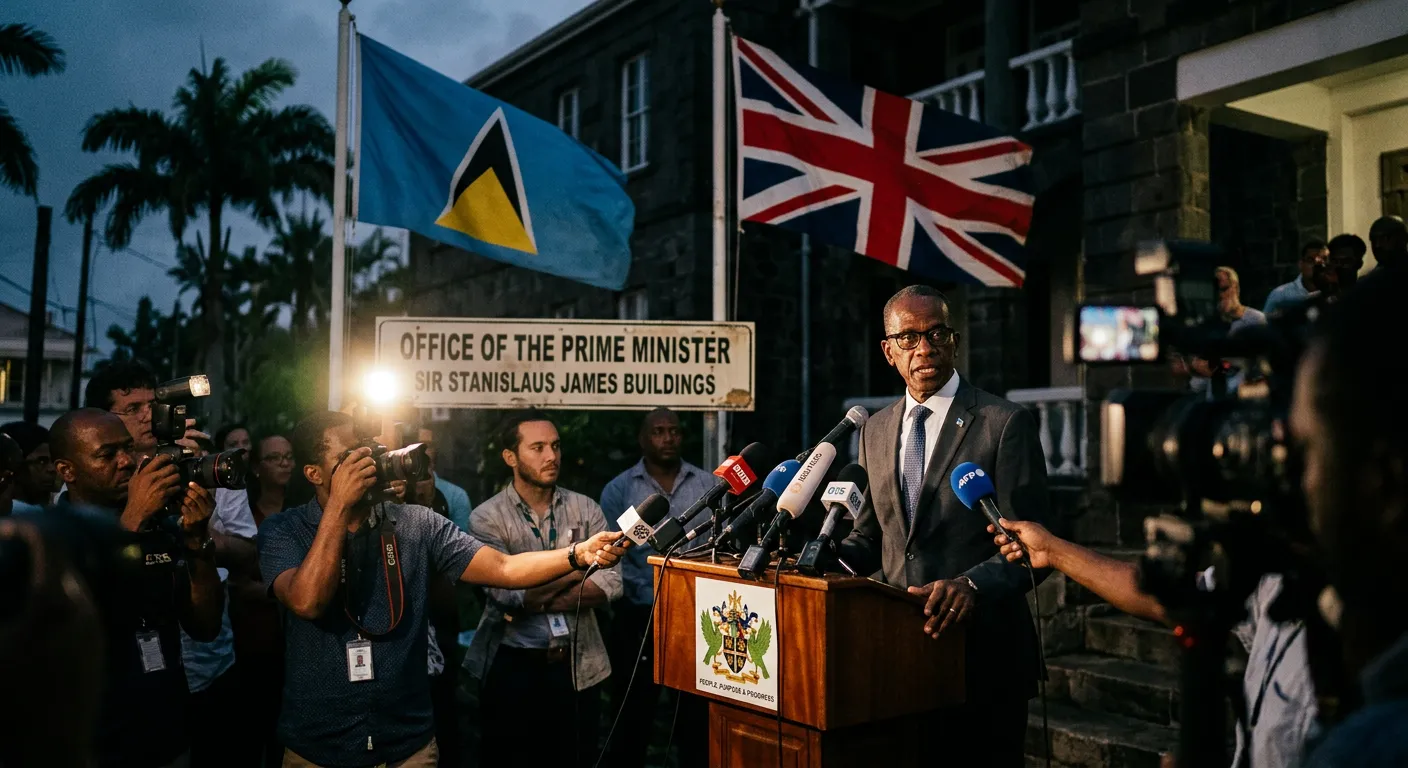
Saint Lucia Calls Itself an "Honest Broker" — But Visa Bans Are Closing In
Castries is betting on quiet diplomacy and CBI reform to retain Western goodwill, even as the UK and Ireland tighten entry rules and the EU circles.
Saint Lucia’s government is selling a story of small-state agility: an "honest broker" in a fracturing world, deepening ties with French neighbours, and reforming its citizenship-by-investment programme to hold onto precious visa-free European access. But the ground is shifting under its feet. In the span of three months, both the United Kingdom and Ireland have imposed visa requirements on Saint Lucian passport holders, and the European Union’s long-running scrutiny of Caribbean investor-citizenship schemes means the Schengen door could be next.
Deputy Prime Minister Ernest Hilaire laid out the vision in an interview with Atlantico, published via Global South World. Hilaire — who holds the tourism, investment, and commerce portfolios — described Saint Lucia as a cooperative partner rather than a confrontational actor, one that would "serve as an honest broker" in an increasingly multipolar world. The strategy leans on three pillars: defending the country’s Citizenship by Investment Programme (CIP) through reforms that satisfy European demands, building a bridge to Europe through France’s Caribbean territories Martinique and Guadeloupe, and exploiting the nimbleness that large powers lack.
It is a coherent playbook. Whether it survives the current immigration headwinds is another question.
The Visa Domino Effect
Ireland announced visa requirements for Saint Lucia, St Kitts and Nevis, and Nicaragua on June 11, effective June 15, 2026. Prime Minister Philip J. Pierre, responding at a pre-cabinet press conference in Castries, did not hide his frustration but struck a notably different tone from Hilaire’s diplomatic framing: "We have a vote in the United Nations, and we’ll use that to the best of our ability, strategically," he said, according to Caribbean News Global. The Irish government described the move as aligning its policy with "the approach taken in the United Kingdom and across Europe."
That UK alignment is the connective tissue. London had already slapped visa requirements on Saint Lucia on March 5, 2026 — weeks after the island celebrated 47 years of independence, as Caribbean News Global noted. The UK cited "migration and border security reasons." Dominica lost its UK visa-free access back in July 2023. Now Saint Lucia, along with St Kitts and Nevis, has joined the list.
The EU is the final — and most consequential — domino. The European Commission has been in talks with the five Caribbean CBI nations since 2022, and its latest Visa Suspension Mechanism report explicitly flagged investor-citizenship schemes as potential grounds for revoking Schengen visa-free access. Vanuatu already lost its status over similar concerns. A Commission spokesperson told the BBC that an ongoing assessment is examining whether Caribbean CBI programmes constitute "an abuse of the visa-free regime" or "security risks for the EU."
The Reform Defence
Saint Lucia’s response is to argue that it has already done what was asked. Following a Caribbean memorandum of understanding signed in early 2024, the five CBI nations raised minimum investment thresholds, strengthened due diligence, and agreed on a regional regulator. Saint Lucia has gone further: from 2026, new CIP citizens receive a five-year initial passport, must complete a mandatory orientation programme, spend thirty days in the country, and submit to full biometric registration.
Hilaire frames this as a partnership discussion, not a charity appeal. "Saint Lucia is a sovereign democracy of 180,000 people, facing climate vulnerability, debt constraints and limited fiscal space," he told Atlantico. "We are not asking Europe for charity: we are asking for a partnership grounded in facts."
But the facts on the ground look increasingly precarious. The IMF’s January 2026 Article IV consultation confirmed that while Saint Lucia’s economy has rebounded — buoyed by tourism and three consecutive years of primary surpluses — public debt remains well above the regional target of 60 percent of GDP, and downside risks include "geopolitical tensions, escalating trade measures and prolonged policy uncertainty." The IMF explicitly recommended "continuing to improve CIP governance and transparency."
What to Watch Next
Pierre assumes the chairmanship of CARICOM on July 1, 2026, at the 51st regular meeting of Caribbean heads of government, hosted in Saint Lucia. That platform — and Pierre's pointed reference to his UN vote — suggests Castries may shift from exclusively quiet diplomacy toward a more transactional posture. For a bloc of 15 small states whose collective UN votes matter in an era of great-power competition, that is not an empty threat.
The real decision point, however, is Brussels. The EU’s assessment of Caribbean CBI schemes is ongoing. If the Commission recommends suspending Schengen access, Saint Lucia’s "honest broker" strategy will have lost its most tangible prize — and the economic rationale for the CBI programme itself would collapse. For a tourism-dependent economy of 180,000 people already navigating UK and Irish visa restrictions, that is not a setback. It is an existential risk.
Discover more

Global Politics
US-Iran Tensions Rise
Tensions escalate in the Strait of Hormuz as Iran and the US clash over maritime control, with a ceasefire hinging on a contested MoU paragraph.

US Politics
US Launches $166B Tariff Refund Portal
The US is launching a $166 billion tariff refund portal to aid importers hit by Trump-era tariffs, with major implications for trade and supply costs.

US Politics
White House Pressures Congress for Crypto Leg
The Trump administration's push for the CLARITY Act aims to reshape crypto regulation, impacting trillions in market value and the Trump family's wealth.

Economics
Fed's Amex AML order puts correspondent banking on notice
Federal Reserve's Amex AML order requires board-level controls and a 90-day plan; OCC fined the bank $350 million over enterprise-wide deficiencies.