Lavrov's Addis Ababa Play: Russia Bets on AU
Russia's strategy in Africa amid Sahel crises and geopolitical shifts
Model Diplomat7 min readAfrica
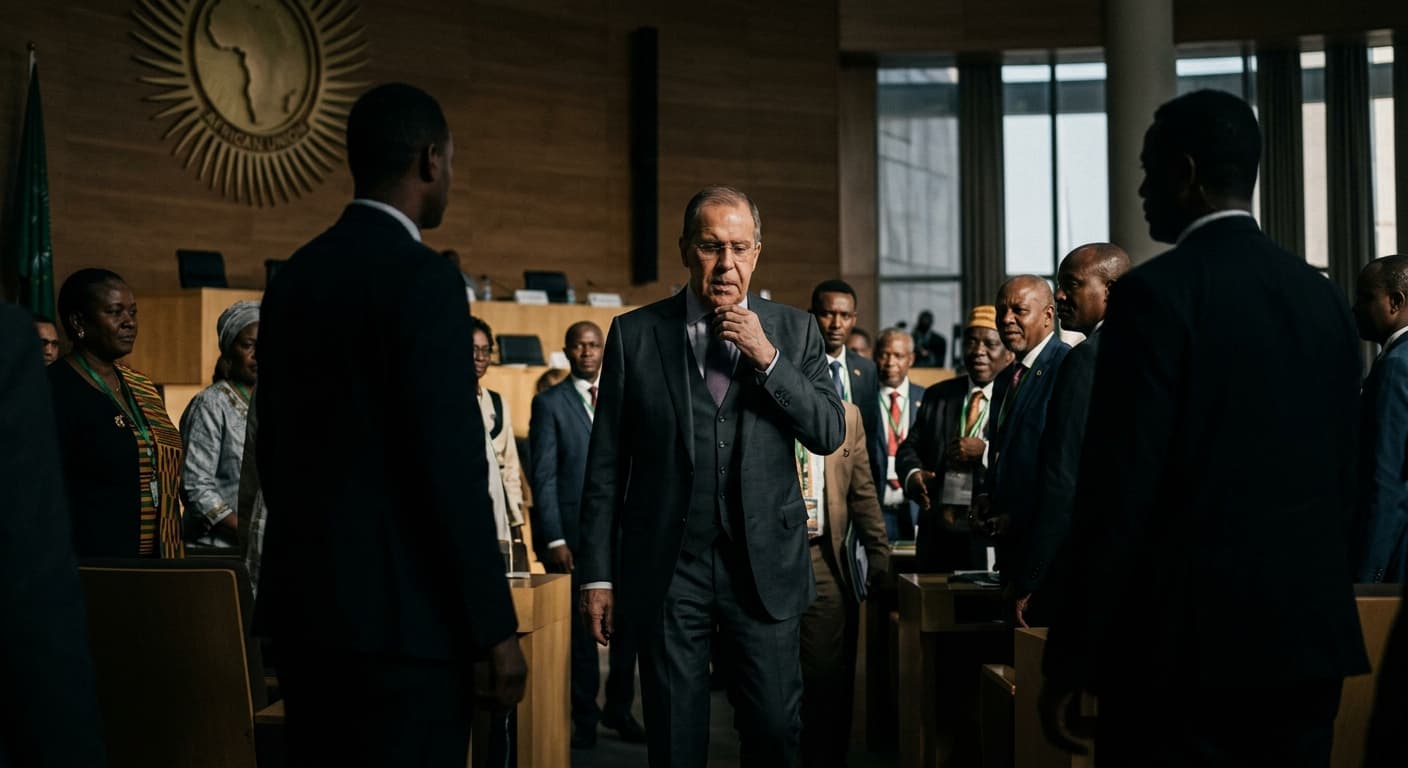
Lavrov's Addis Ababa Play: Russia Bets on the AU as the Sahel Burns
Sergey Lavrov's July 7 pledge to back "African solutions to African problems" arrives as Russia loses ground in Mali, vetoes on Sudan and props up Haftar in Libya.
Russia's endorsement of the African Union's crisis map on July 7, 2026 is not solidarity — it is triage. With Africa Corps out of Kidal, Sudan's war beyond containment, and Moscow's trade footprint stalled at roughly one-fifteenth of the EU's, Foreign Minister Sergey Lavrov used a joint news conference with AU Commission Chairperson Mahamoud Ali Youssouf in Addis Ababa to reposition Russia from a security provider — a role in which it is visibly failing — to a political sponsor of the AU's non-interference doctrine. The gambit lets Moscow keep leverage in the Sahel, the Horn and Libya at almost no cost, while daring Western capitals to prove they can do more than talk about it.
What Lavrov actually said, and why the framing matters
Lavrov listed the crises Moscow now claims to share with the AU: "the Sahara-Sahel region, the Great Lakes region, the Horn of Africa, Sudan, South Sudan, and Libya," according to the official TASS readout. Russia, he added, will help resolve them "strictly in accordance with the principle of 'African solutions to African problems.'"
That phrase is not decorative. It is the AU's own doctrine, and as a Cambridge-published study in the European Journal of International Security argues, it has repeatedly been mobilised to fend off UN Security Council interventions that African political elites — and their outside patrons — find inconvenient. By adopting it wholesale, Lavrov is aligning Russian policy with the AU Commission's rhetorical preferences while giving the Kremlin a ready-made argument against Western-drafted UNSC action on the very files it is most exposed on.
The interlocutor matters too. Youssouf, Djibouti's foreign minister for two decades, was elected AUC Chairperson on February 15, 2025, defeating Kenya's Raila Odinga on the seventh ballot at the 38th AU Summit, Al Jazeera reported. Youssouf has already told the Peace and Security Council — as ISS Africa's
PSC Report noted from a September 30, 2025 ministerial — that the AU must weigh counter-terrorism "pragmatism" against its coup-suspension regime. That is precisely the ambiguity Moscow wants to widen.
The Sahel: Africa Corps is losing, but the political product still sells
Russia's ground position in the Sahel is worse than at any point since Wagner arrived in Mali in 2021. On April 28, 2026, Russia's Africa Corps confirmed it had abandoned Kidal after coordinated attacks by the Azawad Liberation Front and al-Qaeda-aligned Jama'at Nusrat al-Islam wal-Muslimin, BBC reported. Mali's Defence Minister Sadio Camara — the architect of Bamako's Russia pivot — was killed the same weekend. Africa Corps drone footage verified by
BBC Verify showed the paramilitaries fighting within 20 kilometres of Bamako itself.
The Real Instituto Elcano argues Africa Corps has "institutionalised Russia's regime-protection model" while sidelining Europe; a March 2026 SAIIA occasional paper,
Back to the Shadows, goes further, cataloguing how the force has shifted from combat to "risk-averse missions" — training juntas, guarding elites, running information operations. This is the crucial point: Africa Corps failed at Kidal, but the political service Russia sells to the Alliance of Sahel States (AES) — regime protection, veto cover, an anti-French narrative — is intact. Fatalities linked to Islamist groups reached record highs across Mali, Niger and Burkina Faso in the first half of 2024, according to
RAND, yet none of the three juntas has moved to expel the Russians.
Lavrov's Addis Ababa message locks that in. By publicly aligning with the AU's Sahel diagnosis — while the AU itself hesitates on whether to soften its suspension regime for AES states — Moscow positions itself as the outside partner most willing to accept the coup governments on their own terms. The International Crisis Group documented in early 2024 how the Sahelian trio's exit from ECOWAS created precisely that opening.

Sudan: the veto Moscow will not walk back
The single most consequential piece of Russian Africa policy over the past 20 months is not in Mali. It is in the UN Security Council chamber. On November 18, 2024, Russia was the sole "no" vote against a UK–Sierra Leone draft that would have demanded a ceasefire, humanitarian access and protection of civilians in Sudan; all three African council members — Algeria, Mozambique and Sierra Leone — voted yes, according to Human Rights Watch. Britain's Foreign Secretary David Lammy, in remarks published by the
UK Government, called the veto "a disgrace."
Russia's justification — the same "African solutions" language Lavrov used in Addis Ababa — was that the resolution violated Sudanese sovereignty. In practice, as Foreign Affairs has documented, Moscow has switched sides in Sudan: from a Wagner-era partnership with Rapid Support Forces commander Mohamed Hamdan "Hemedti" Dagalo to backing General Abdel Fattah al-Burhan's Sudanese Armed Forces in exchange for gold-mining access and a long-mooted naval base at Port Sudan. In late 2025, per Italy's
ISPI, Burhan formally offered Russia that base plus continued gold-mining rights in return for weapons.
The AU has been diplomatically outmanoeuvred. The RSF captured El Fasher on October 26, 2025, and killed at least 7,000 people in a campaign a UN fact-finding mission described as bearing the hallmarks of genocide; the Security Council eventually sanctioned four RSF commanders, BBC reported. But the humanitarian resolution that might have saved lives 12 months earlier remains vetoed. Lavrov's July 7 gesture toward Youssouf does not change that record — it papers over it.
Libya: the base network the West cannot ignore
The Libya file is where Russia's African strategy meets NATO's southern flank. After the fall of Bashar al-Assad in December 2024, Moscow accelerated its build-out of airfields in eastern and southern Libya — al-Khadim, al-Jufra, Brak al-Shati, al-Qardabiya and Maaten al-Sarra — under an arrangement with Libyan National Army commander Khalifa Haftar. The Atlantic Council argues these bases are now more strategically important to Russia than Tartus or Khmeimim ever were, because they connect Russian logistics to Africa Corps deployments across the Sahel.
Reuters, cited by Al Jazeera, reported in April 2026 that Chinese Feilong-1 and Turkish Bayraktar TB2 drones have appeared at al-Khadim in defiance of the UN arms embargo. In April 2026, a Sentry investigation traced roughly $300 million in Emirati loans to a financier tied to Haftar, used in part to pay Wagner during the 2019–20 Tripoli offensive. Lavrov's citation of Libya on July 7 — as a shared "concern" with the AU — is doubly convenient: it lets Moscow treat its own logistical hub as a legitimate object of African-led diplomacy rather than a foreign military footprint.
Money: the strategy Russia cannot afford
Behind the diplomacy is a balance sheet that will not stretch. Trade between Russia and Africa reached only $24.6 billion in 2023, according to figures from Russian officials cited in a Valdai Club report — a fraction of the EU's roughly $400 billion and China's roughly $300 billion, per
OSW. Roughly 70% of that Russian trade is concentrated in just four states: Algeria, Egypt, Morocco and South Africa. Chatham House
noted that Putin's 2019 pledge to double Russia-Africa trade to $40 billion in five years fell backwards, not forwards. The $23 billion in cumulative African debt Moscow has written off — much of it Soviet-era paper of negligible recovery value — remains the single largest tangible Russian offering.
That thin material base is why the AU endorsement matters so much to Moscow. Lavrov cannot outspend China, outlend the IMF or outfight jihadists. He can, however, credibly claim to be the great power that will not lecture African governments about coups, elections, or human rights — and can veto those who do.
Diplomat View
The bottom line is that Lavrov's Addis Ababa performance is a defensive consolidation, not an offensive. Africa Corps has taken reputational damage it cannot easily repair; Russia's trade with the continent is one-fifteenth of the EU's and concentrated in four Arab-majority states; its diplomatic capital is being burned on Sudan vetoes that expose, rather than mask, its alignment with Burhan's SAF. What Moscow is buying with the "African solutions to African problems" framing is time — specifically, the time to keep its Libyan base network, its Sahelian regime-protection contracts and its Sudanese gold-and-port bet operational while Washington's Trump-era Africa policy stays incoherent and Europe's Sahel posture stays inert. The forecast changes if two things happen: if the AU's post-2025 peace-and-security review, chaired under Youssouf, produces a binding dialogue mechanism with the AES juntas that ties reinstatement to verifiable governance concessions, Russia loses its "we're the only ones who'll take you as you are" pitch. And if Washington closes the al-Khadim–al-Jufra logistics corridor — the explicit goal of the Flintlock 26 exercise co-hosted by Libya this spring — Africa Corps loses the airbridge that makes its Sahel deployments viable. Absent both, expect Moscow's cheap-diplomacy, high-leverage model to persist through 2027.
What to watch
- AU Peace and Security Council decision on AES reintegration — the high-level panel appointed after the February 2025 Assembly is expected to report; a soft-landing package for Mali, Burkina Faso and Niger would reduce Russia's political value to the juntas.
- UNSC Sudan file, autumn 2026 — the UK and Sierra Leone are preparing a second attempt at a civilian-protection resolution; another Russian veto would deepen Moscow's isolation from the AU's African members.
- Flintlock 26 outcomes in Libya — U.S. Africa Command's co-hosted exercise is the clearest test yet of whether Washington can pry Saddam Haftar's LNA away from the Russian base network.
Related: Global Politics.
Discover more
US Politics
Virginia's Redistricting Referendum
Virginia's redistricting referendum is drawing a flood of dark money, shaping future elections and the fight for congressional control amid party stakes.

US Politics
US Launches $166B Tariff Refund Portal
The US is launching a $166 billion tariff refund portal to aid importers hit by Trump-era tariffs, with major implications for trade and supply costs.

Global Politics
U.S. Naval Blockade Heightens Iran Tensions
The U.S. naval blockade of Iran collapsed oil exports, creating a new maritime regime in Hormuz that favors Tehran.

Conflict & Security
Drone Warfare Killing Aid Workers at Unprec
Over 1,000 humanitarian workers killed in three years as cheap armed drones collapse legal protections. Gaza, Sudan, Ukraine, and DRC see deliberate targeting of aid convoys and hospitals with zero prosecutions.