Koretsky Named Ukraine PM as Zelensky Ousts
Zelensky ousts drone-war architect Fedorov, taps energy chief Koretsky as PM
Model Diplomat8 min readEurope
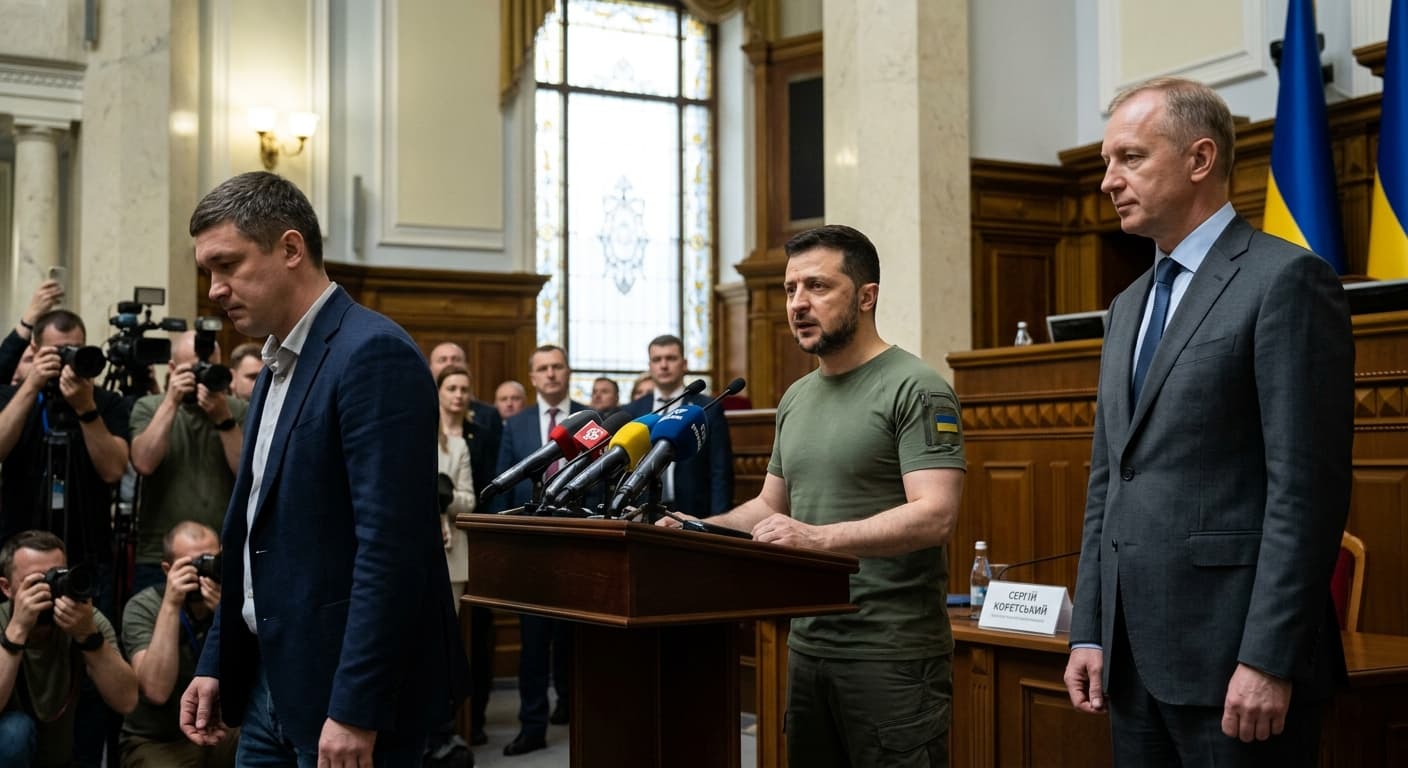
Koretsky Named Ukraine PM as Zelensky Ousts Drone-War Architect Fedorov
Ukraine's parliament approved Naftogaz CEO Serhiy Koretsky as prime minister with 289 votes on July 16, 2026, as President Zelensky dismissed popular Defense Minister Mykhailo Fedorov and reshuffled the wartime cabinet amid street protests in multiple cities.
Ukraine's parliament approved Serhiy Koretsky as prime minister with 289 votes on July 16, 2026, completing a wartime cabinet overhaul in which President Volodymyr Zelensky simultaneously dismissed the architect of Ukraine's drone-war revolution from the Defense Ministry. The reshuffle is not a response to failure but a consolidation of presidential control at the moment Ukraine's battlefield momentum is shifting in Kyiv's favor — betting that the drone-industrial ecosystem Fedorov built can now sustain itself under a police general's management rather than a technocrat's vision, and that a winter-survival energy manager can execute the €90 billion EU loan pipeline that will define the next two years of the war.
The vote margin comfortably exceeded the 226-seat constitutional threshold, reflecting Zelensky's party majority in the Verkhovna Rada, as the Cabinet of Ministers of Ukraine confirmed. It came one day after European Commission President Ursula von der Leyen stood alongside Zelensky in Kyiv, where he called Koretsky "probably the most prepared person for the position of prime minister" after extensive consultations,
Kyiv Post reported. The stated priority: preparing Ukraine for the coming winter, when Russian strikes on the energy grid will test civilian resilience for a fifth season.
From Naftogaz to the Cabinet
Koretsky, 48, is a technocrat whose career has straddled Ukraine's private fuel industry and state energy giants. He led the WOG petrol station network and founded the Idealist Coffee Co chain before taking charge of the state-owned energy firms Ukrnafta and Ukrtatnafta between 2022 and 2025, and then Naftogaz in May 2025, according to Al Jazeera. He steered Naftogaz through last winter, when repeated Russian drone and missile attacks on energy infrastructure triggered widespread power cuts and heating outages during freezing temperatures.
Zelensky framed Koretsky's appointment around energy security and EU loan execution. "The priorities are clear — preparing for winter," Zelensky said on July 15, as Reuters reported via Al Jazeera. "Therefore, following all the consultations, Sergii Koretskyi is surely the most prepared candidate for the post of prime minister of Ukraine."
The backdrop is the €90 billion ($103 billion) EU Ukraine Support Loan, adopted under Regulation (EU) 2026/467 in February 2026, which provides up to €30 billion in budgetary assistance and €60 billion in defence procurement support across 2026 and 2027, according to the European Commission. The first €3.2 billion macro-financial instalment was disbursed on June 25, and a further €3.9 billion for drone procurement began flowing on June 30, the
European Commission confirmed. Koretsky's immediate task is ensuring that pipeline reaches Ukrainian defence production without the governance friction that has plagued past ministerial transitions.
The cabinet list Koretsky submitted to parliament included 16 ministers, with Denys Shmyhal — prime minister from 2020 to 2025 — returning as first deputy prime minister and energy minister, Ukrainska Pravda reported. The reshuffle is Zelensky's second in exactly one year: Yuliia Svyrydenko, who replaced Shmyhal as prime minister on July 17, 2025, with 262 votes, was pushed out after just 12 months, as Rada voting records from the
Verkhovna Rada show. Svyrydenko had played a central role in negotiating the minerals agreement with the United States and securing the €90 billion EU financial support package,
Kyiv Post reported. Zelensky had considered appointing her as ambassador to Washington, but she declined.
The Fedorov Gamble
The most consequential — and most controversial — move was the dismissal of Mykhailo Fedorov as defense minister after just six months in the post. Fedorov, 35, was the public face of Ukraine's drone warfare transformation, having previously served as Ukraine's first minister for digital transformation before moving to the Defense Ministry in January 2026.
Fedorov's tenure coincided with a dramatic improvement in Ukraine's battlefield position. He championed what he called a "Logistical Lockdown" strategy, using mid-range drone strikes to disrupt Russian supply lines and isolate occupied Crimea, as Al Jazeera reported. Ukrainian drone strikes increased from 210 in May to 303 in June, according to the Institute for the Study of War. He also persuaded Elon Musk to switch off Starlink internet terminals being used by Russian forces — a move that caused considerable disruption to Russian frontline operations, as
NPR reported.
The stated reason for Fedorov's removal was his conflict with Commander-in-Chief Oleksandr Syrsky. Zelensky told reporters on July 15 that he wanted the Defense Ministry and military leadership to work with greater unity, appearing to acknowledge reports of tensions, according to BBC News. In a briefing in Kyiv, Fedorov confirmed the clash, saying he had proposed that Zelensky replace both Syrsky and Chief of the General Staff Andrii Hnatov "if we want to defeat the enemy asymmetrically, with minimal losses," as
BBC News Ukrainian reported. Fedorov accused Syrsky of "inventing how to split the country" and said all his initiatives were blocked by "great bureaucracy." He accepted Zelensky's decision, but added: "I believe that the president has not yet chosen Syrsky's side."
The replacement is Ihor Klymenko, interior minister since 2023 and a former police general with traditional military ideas. The Interior Ministry manages units in Ukraine's National Guard, giving Klymenko security-sector experience but no background in the drone-industrial ecosystem Fedorov built. Koretsky himself praised Klymenko during his parliamentary address, calling him "a strong, professional, and effective minister," Kyiv Post reported.
The signal is deliberate: replacing a tech-innovator defense minister with a police general tilts the portfolio toward internal security management and centralized command rather than Silicon Valley–style procurement reform. Ukraine's defense industry now makes up at least 30% of GDP, and defense tech is the fastest-growing industry in the country, according to NPR. Whether that ecosystem sustains its innovation pace without its chief advocate is the open question.
Winners, Losers, and Second-Order Effects
Syrsky is the immediate winner. He retains his command and gains a defense minister aligned with conventional military culture — a figure who will not challenge the General Staff's prerogatives the way Fedorov did. The "two different co-ordinate systems" that a witness to a July war-council meeting described to The Economist — Fedorov's Silicon Valley style versus the generals' PowerPoint orthodoxy — has been resolved in the generals' favor.
Zelensky consolidates. Two prime ministers in two years, both dismissed at his initiative, establishes a pattern: the presidency is the only fixed point in Ukraine's wartime governance. The Cabinet rotates; Zelensky does not. The annual reshuffle cadence itself is a tool — it prevents any minister from accumulating enough independent political capital to challenge the Office of the President.
The losers are Fedorov and the reformist technocrats who built Ukraine's drone-industrial base around speed, risk tolerance, and procurement transparency. Prominent blogger Serhii Sternenko, whom Fedorov brought in as an adviser, hailed his former boss as "the best minister of defence in our entire history" and bemoaned the "bureaucratic obstacles and artificial delays" he said had stood in the way of deeper reform, BBC News reported. Pavlo Yelizarov, a renowned drone unit commander, resigned as deputy commander of the Ukrainian Air Force in protest at Fedorov's sacking, calling it "a great evil for the country's defence capability." Fedorov himself said he had received supportive messages from other defense ministers and from tech leaders including Alex Karp of Palantir, who offered him a job he turned down,
NPR reported.
The domestic cost was immediate. Hundreds gathered near the Ivan Franko National Theatre in central Kyiv on July 16, chanting "Shame!" and carrying placards reading "The Russians are celebrating," Al Jazeera reported. Protests also took place in Lviv, Odesa, and Dnipro. The theatre is close to the presidential office — the site of last July's "cardboard protest," when public pressure prompted Zelensky to reverse a measure stripping Ukraine's anticorruption agencies of their independence. That precedent matters: Zelensky has shown he can be moved by street pressure, and the Fedorov protests carry a sharper edge because they come from the military and veteran community, not just civil society.
The second-order effect for Western partners is mixed. On one hand, Koretsky's priorities — winter preparation, EU integration, defense-industrial expansion — align squarely with the EU loan pipeline. "My foremost task is to fully equip Ukraine's defence forces and accelerate the expansion of its defence industrial base," Koretsky wrote on X after his appointment, Al Jazeera reported. On the other hand, the dismissal of the minister most closely associated with the drone programs that the EU's €6 billion defense tranche is funding creates a coordination question. The EU loan was designed around Ukraine's demonstrated capacity to innovate at speed; removing the architect of that capacity introduces execution risk.
The historical parallel is instructive. Ukraine has now had three prime ministers in six years: Shmyhal (2020–2025), Svyrydenko (2025–2026), and Koretsky (2026–present). The churn mirrors the pre-war pattern where prime ministers rarely survived more than two years, but it now operates under wartime constraints that make institutional memory a strategic asset. The drone-industrial base Fedorov built — with Ukraine manufacturing an estimated five to six million drones in 2026 and aiming for 10 million, as the Atlantic Council reported — is embedded across hundreds of companies and military units. It will not collapse overnight. But innovation ecosystems require champions, and the question is whether Klymenko, a police general, can sustain the velocity that gave Ukraine its battlefield edge.
What to Watch
- Rada vote on Klymenko as defense minister: Zelensky had not formally submitted the nomination as of July 16, with BBC reporting that Zelensky said Klymenko was "only one of the names being considered." The vote timing and margin will signal parliamentary appetite for the Fedorov removal.
- Syrsky's next moves: Now that his adversary is gone, the commander-in-chief faces the test of whether the Logistical Lockdown strategy and drone procurement pace continue without Fedorov's pressure.
- EU loan disbursement pace: The next Ukraine Facility disbursement is expected in September, and the MFA second instalment of approximately €3.7 billion is anticipated in the coming months, the
European Commission indicated. Koretsky's ability to meet loan conditions will be the first performance metric of his premiership.
- Protest trajectory: Whether the demonstrations in Kyiv and other cities expand or fade will indicate whether the Fedorov dismissal becomes a political liability for Zelensky or a one-day news cycle.
The Bottom Line
Zelensky's July 2026 reshuffle is a bet that Ukraine's drone-war machine has matured enough to operate without its chief architect, and that an energy-sector technocrat can manage the largest foreign aid pipeline in Ukraine's history. The gamble pays off if the ecosystem Fedorov built is now self-sustaining and if Klymenko can stabilize civil-military coordination. It fails if innovation velocity drops precisely when the EU's €6 billion drone tranche demands speed, or if the protests signal deeper fractures between the presidency and the military-veteran base that has sustained the war effort.
Discover more

US Politics
SNAP Food Assistance Faces Legal Challenges
In 2026, SNAP faces stricter eligibility rules and mounting legal challenges, threatening food assistance for the millions of Americans who rely on the program.
US Politics
Next Generation Republicans
A leaked survey shows 39% of Republicans under 30 do not identify as MAGA, revealing a split in the GOP's future leadership.
US Politics
Congress Targets AI Chatbot Access for Terror
The House passed the Generative AI Terrorism Risk Assessment Act, focusing on AI's role in terrorism and potential surveillance implications.

Economics
Fed's Amex AML order puts correspondent banking on notice
Federal Reserve's Amex AML order requires board-level controls and a 90-day plan; OCC fined the bank $350 million over enterprise-wide deficiencies.