Khamenei's Funeral Signals Iran's Decline
A pivotal moment in Iran's regional influence post-Khamenei.
Model Diplomat8 min readMiddle East
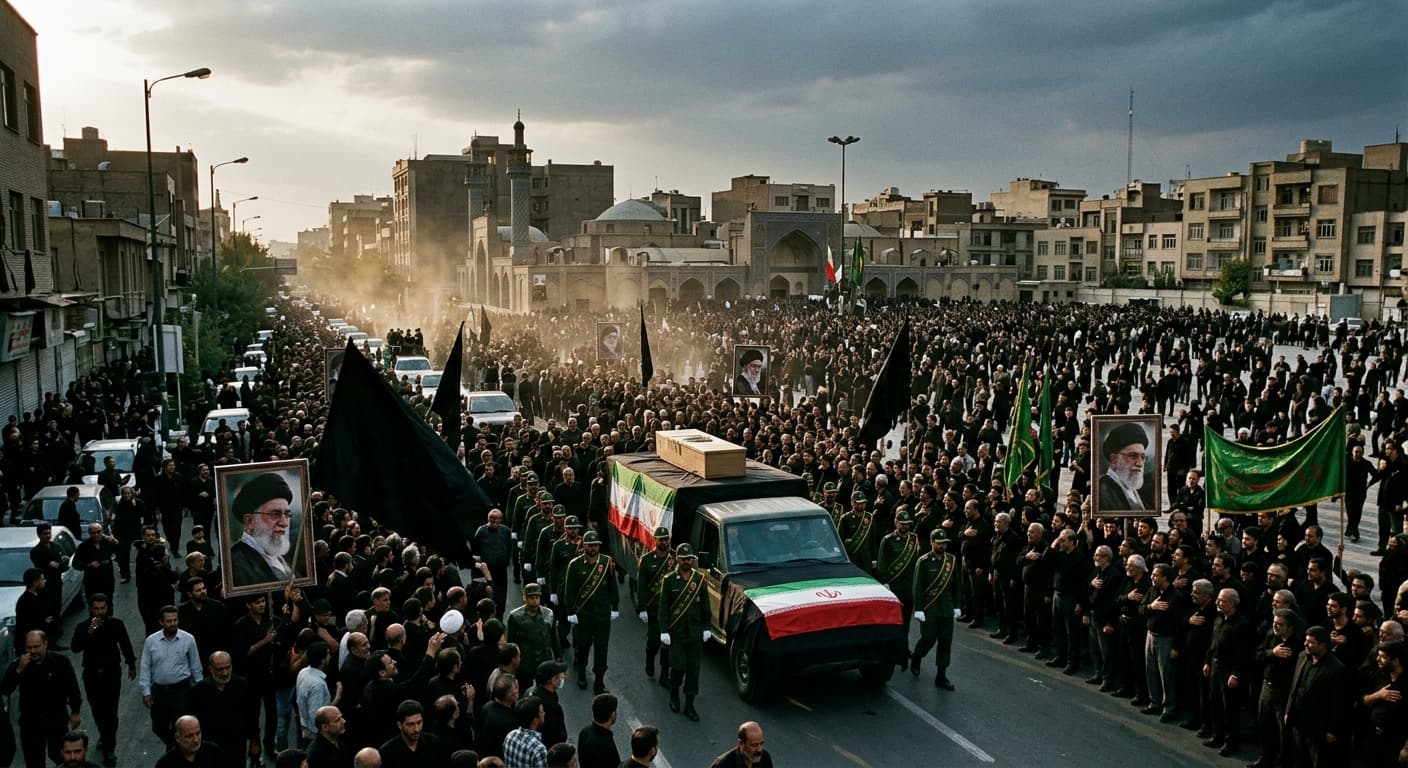
Khamenei's Funeral Marks Iran's Diminished Grip on the Gulf
Ali Khamenei's body arrived in Qom on July 7, 2026, five months after US-Israeli strikes killed him — and Iran's deterrence architecture died with him.
The flag-draped coffin of Ayatollah Ali Khamenei landed in the Iranian seminary city of Qom on July 7, 2026, the fourth day of a multi-city state funeral for a Supreme Leader killed on February 28 in the opening salvo of the US-Israel war on Iran. According to Al Jazeera, the procession will move through Najaf and Karbala before burial in Mashhad on July 9. The pageantry is real — but the balance of power it advertises is gone. Khamenei's death has ended, not paused, the era in which Tehran set the region's price of admission; the Gulf capitals now dictating the terms of Iran's reintegration — Doha, Islamabad, Muscat — are the story the crowds in Tehran are meant to obscure.
The funeral is a stage; the leverage has moved
Iran mobilised what state broadcaster Press TV called the "largest public gathering in the country's modern history" for a ruler killed 130 days ago. The delay was not liturgical. It was tactical: Tehran needed the war to end before it could bury him safely. According to the BBC, representatives from Saudi Arabia, Qatar, Oman, Turkey, Iraq and Armenia joined former Russian president Dmitry Medvedev, Pakistani Prime Minister Shehbaz Sharif and the Taliban's Amir Khan Muttaqi at the ceremonies. Al Jazeera confirmed on
July 3 that Saudi Arabia's deputy foreign minister paid respects in person — the first senior Saudi condolence visit to Tehran in a generation.
Read the guest list, not the crowd. The states that mediated Iran's surrender terms have shown up to bury the man whose deterrent posture they helped dismantle. Pakistani Prime Minister Shehbaz Sharif brokered the April 8 ceasefire after Chief of Army Staff Asim Munir made a flurry of calls to US officials in the hours before a Trump deadline to strike, Al Jazeera reported. Qatar hosts the technical talks in Doha where, per an
Al Jazeera update on July 1, Iran expected $6 billion of frozen assets released as a first step. Oman is chartered under the June 19 memorandum to help administer the Strait of Hormuz.
The historical parallel is instructive. When Ruhollah Khomeini died in 1989, Iran was economically battered but militarily coherent and ideologically ascendant across the Shia crescent. His funeral — chaotic, with mourners nearly overturning the coffin — projected raw revolutionary energy. The 2026 procession is orchestrated to the minute, with Iran's emergency services reporting thousands treated but zero fatalities. Control has replaced fervour. So has dependence.
The memorandum reads like a surrender
The 14-point Memorandum of Understanding signed at Versailles on June 19 is the operative primary document — and it reverses three decades of Khamenei-era doctrine. Its terms, as read verbatim to reporters by a senior US official, include:
"The Islamic Republic of Iran reaffirms that it shall not procure or develop nuclear weapons… The Islamic Republic of Iran will conduct dialogue with the Sultanate of Oman to define the future administration and maritime services in the Strait of Hormuz."
Read those two sentences together. Iran has, in a single document, renounced the two instruments — nuclear ambiguity and Hormuz coercion — that gave it strategic weight against wealthier neighbours. The 440 kg stockpile of uranium enriched to 60 percent that the IAEA logged before the war, detailed in Board of Governors report GOV/2026/33, is to be down-blended on Iranian soil under IAEA supervision. That report also confirmed the Fuel Enrichment Plant at Natanz, the Bushehr Nuclear Power Plant complex and the Khondab Heavy Water Production Plant all sustained damage in the February–April strikes — a level of physical degradation Israel could not achieve in the 12-day war of June 2025. IAEA Director-General Rafael Grossi told reporters in Japan that the inspections
"will indeed take place," though Iran's deputy foreign minister maintains that access to damaged facilities will be resolved only inside a final deal.
The Strait clause matters more for Gulf economics than any concession Riyadh extracted in a decade of Chinese-mediated diplomacy. According to the BBC, Brent crude — which peaked at roughly $120 during the war — has fallen back below $73, near its pre-war level of $70. About 20 percent of the world's oil and LNG normally passes through Hormuz. The waterway that once functioned as Tehran's escalation lever now flows under an Omani-administered regime with Iran as a coastal state, not a gatekeeper. Iran's parliamentary speaker Mohammad Bagher Ghalibaf has already floated the idea of charging ships transiting the strait after the 60-day window ends. Whether that threat has any credibility is the single most consequential test of whether the memorandum survives August.
The Gulf's quiet victory
Saudi Arabia's tolerance of a defanged, contained Iran had always been the tacit condition of the March 2023 Beijing-brokered normalisation. That equilibrium is now inverted. When Iranian drones hit Shaybah oilfield and other Gulf targets on March 9, 2026, Riyadh's foreign ministry called the strikes "reprehensible" — a rhetorical rupture from the pragmatic language of the previous three years. The Saudi statement went further, condemning "Iranian aggressions against the Kingdom, the Gulf Cooperation Council states, a number of Arab and Islamic countries" as unjustifiable "under any circumstances." A Riyadh meeting of Arab and Muslim foreign ministers on March 19 formulated what the Kingdom described as a
unified response asserting the right to collective self-defence.
The UAE has been more triumphant. Presidential adviser Anwar Gargash posted on X that "the UAE triumphed in a war we sincerely sought to avoid," and that Abu Dhabi would now "manage a complex regional landscape with greater leverage, sharper insight, and a more solid capacity to influence and shape the future." Translation: the Emirates' bet on Israeli integration through the Abraham Accords has paid the geopolitical dividend Riyadh's China-mediated hedge never delivered. Kuwait, which called itself "one of the nations most impacted by Iranian attacks," has demanded Tehran "immediately cease all hostile acts" as a condition for building on the ceasefire. Even Qatar — the mediator most solicitous of Iranian face — has openly noted that Doha and other Gulf capitals were struck "just maybe an hour after the start of the war."
The proxy network that once compensated for Gulf wealth is broken. In its June assessment, Chatham House called the Axis of Resistance a strategic failure: "The threat of reprisals failed to deter multiple American and Israeli attacks on the Iranian homeland." The
Stimson Center argued that even a hardline IRGC-led consolidation cannot rebuild the network, because Syria — the "state anchor" and land corridor to Hezbollah — is gone under a Turkish-backed successor to Assad. Hezbollah entered the war on March 2 and was promptly outlawed by the Lebanese government, which called for its disarmament "by force if necessary," according to
Carnegie's Diwan. The Houthis, INSS analyst Ari Heistein
observed, sat out most of the war and rebuilt ports rather than escalating — a "strategic calculus [that] pulls heavily toward restraint."
The ghost successor
The most telling image from the funeral is one that does not exist: any photograph of the man who now holds Khamenei's title. Mojtaba Khamenei, 56, has not been seen publicly since his March 8 appointment as Supreme Leader, and Al Jazeera confirmed on July 6 that people close to his circle told Reuters he suffered significant injuries to his face and one or both legs in the February 28 strike. His three brothers — Mostafa, Meysam and Masoud — attended the ceremonies. He did not, even for his wife Zahra Haddad-Adel's funeral.
Israel is not letting the ambiguity sit. Defence Minister Israel Katz threatened the successor directly on March 4, saying any newly appointed leader would be "an unequivocal target for elimination, no matter his name or where he hides." He repeated the threat on July 6, telling reporters in Hebrew that "the assassin was assassinated" and "any Iranian leader who tries to push plans to destroy Israel again will also be thwarted." As Foreign Affairs argued, Trump's public rejection of Mojtaba as "unacceptable" and Israel's assassination threats made him "the only viable option for regime survival" — a candidate chosen for defiance, not merit or clerical rank. Mojtaba holds only the mid-ranking title of Hujjat al-Islam, below the ayatollah rank his father held, and NPR
reported the US Treasury sanctioned him in 2019 for exercising "part of his father's leadership responsibilities" via IRGC and Basij ties, despite holding no formal office.
The second-order shock the region has not yet priced: an invisible Supreme Leader cannot arbitrate factions the way his father did. Ali Khamenei's authority derived from personal presence — televised sermons at Friday prayers, letters read aloud on state TV, direct intervention in Assembly of Experts deliberations. Iranian-American analyst Negar Mortazavi told Al Jazeera that Mojtaba's absence was "certainly unusual" and that "they can't hide him forever." Foreign Affairs described a plausible drift toward "a military dictatorship that discards the clerical façade but retains authoritarian power" as the IRGC fills the vacuum. That is the Gulf's most consequential worry, and the reason Riyadh dispatched a deputy foreign minister to a funeral it might otherwise have snubbed: a Praetorian Iran is more predictable than a hidden Ayatollah, but less accountable.
What to watch next
- August 18, 2026 — the 60-day MoU clock,
signed June 19, expires. Either a final deal, an extension, or the war resumes. Vice President JD Vance has warned that any Iranian attack on Hormuz shipping "would prompt a US military response."
- The Hormuz toll question — Ghalibaf's threat to charge shipping after 60 days is the single fastest way to blow up the ceasefire. Watch tanker insurance rates.
- First Mojtaba appearance — a televised address or written directive under his signature. Its content will signal whether the IRGC or the clerical establishment sets Iran's post-war foreign policy.
- $6bn frozen-asset tranche — Tehran expects this from Doha talks. Non-delivery would collapse Iranian public support for the deal.
The Bottom Line
Khamenei's funeral is not the end of an era; it is the public acknowledgment that the era ended on February 28, when the missiles hit. Iran's Supreme Leader is now a mid-ranking cleric no one has seen in four months, its nuclear stockpile is a bargaining chip to be down-blended, its Strait of Hormuz is co-administered by Oman, and its Axis of Resistance has been outlawed in Beirut, sidelined in Sana'a and buried in Damascus. The winners of this funeral are Abu Dhabi, Islamabad and Doha; the loser is the doctrine that made Tehran matter to every Gulf capital for forty years.
Diplomat View
The forecast: the June 19 memorandum will hold through the August deadline and be extended, not because either side trusts it but because neither can afford to reopen the war. Trump has told advisers he prefers diplomacy; Iran needs the $24 billion in frozen assets more than it needs a decisive test of Mojtaba's survivability. Expect a thin final deal that formalises IAEA down-blending, releases assets in tranches, and defers the Hormuz toll question. What would change this call: a confirmed Israeli strike on Mojtaba, a Ghalibaf-imposed Hormuz toll before December, or an IRGC internal purge that produces a named military strongman. Any one of those, and the memorandum is dead by year-end. The tell will be Riyadh: if Saudi Arabia moves from condolence visits to an actual Pezeshkian summit before October, the Gulf has decided the new equilibrium is real. If it doesn't, they're hedging — and so should Washington.
Discover more
Global Politics
Xi Jinping Calls China-Russia Ties 'Precious'
Xi Jinping's description of China-Russia ties as 'precious' reflects a strategic imbalance, with Beijing dictating terms in the partnership.

US Politics
US Launches $166B Tariff Refund Portal
The US is launching a $166 billion tariff refund portal to aid importers hit by Trump-era tariffs, with major implications for trade and supply costs.

US Politics
White House Pressures Congress for Crypto Leg
The Trump administration's push for the CLARITY Act aims to reshape crypto regulation, impacting trillions in market value and the Trump family's wealth.

Economics
Fed's Amex AML order puts correspondent banking on notice
Federal Reserve's Amex AML order requires board-level controls and a 90-day plan; OCC fined the bank $350 million over enterprise-wide deficiencies.