Keiko Fujimori's Policy Win with Velarde
Fujimori secures Velarde's continuity at BCRP.
Model Diplomat8 min readSouth America
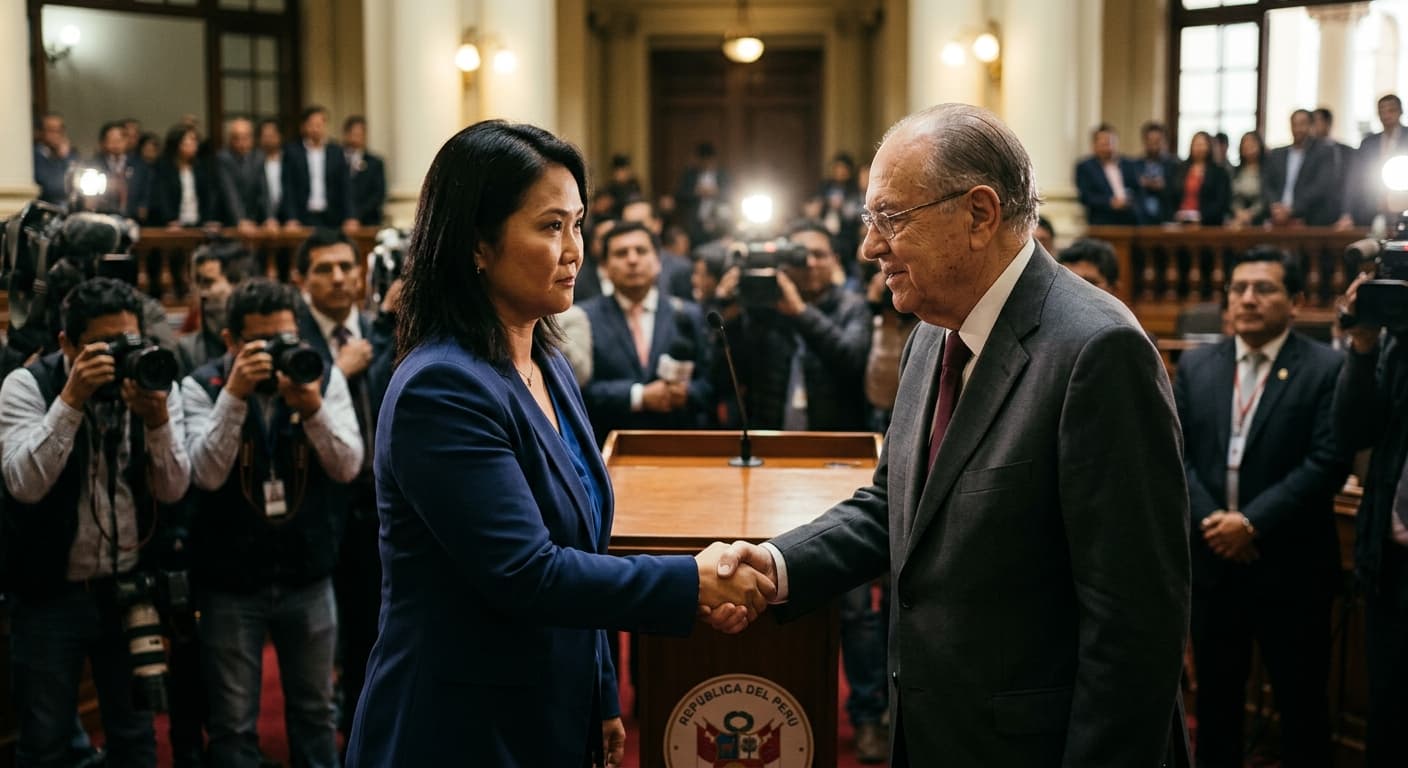
Keiko Fujimori's cheapest policy win: keeping Julio Velarde at Peru's BCRP
Peru's president-elect meets central bank chief Julio Velarde on July 6, 2026 to secure his continuity — a low-cost signal to markets that masks the real fiscal battle ahead in Congress.
President-elect Keiko Fujimori walks into the Banco Central de Reserva del Perú (BCRP) at 4:20 pm Lima time this Monday to ask an economist who has served four presidents to serve a fifth — a move that, if closed, would carry Julio Velarde past 25 uninterrupted years running the world's most durable emerging-market central bank. According to RPP, Fujimori and Velarde will issue a joint statement afterward. The retention itself is barely in doubt. The interesting question is what Fujimori is buying with it: a market anesthetic that lets her govern with a razor-thin mandate — 49,641 votes, per the
ONPE — while the real threat to Peru's macro stability sits not at Jirón Miró Quesada but three blocks away, inside the Congress her own party dominates.
The meeting is theater. The ratification is the deal.
Velarde was first appointed by Alan García in 2006 and ratified by Ollanta Humala, Pedro Pablo Kuczynski and Pedro Castillo, per BBC Mundo. His current term ends on July 28, 2026 — the same day Fujimori is sworn in. Under Article 10 of the
BCRP Organic Law, the seven-member board must be renewed on that date, "within thirty days of the beginning of the first ordinary legislature." The Executive appoints four directors, including the president; Congress appoints the other three and ratifies the chair.
As the BCRP itself notes in its official FAQ, from 2026 the ratification passes to the newly restored Senate — the first test of Peru's bicameral system approved in the 2024 constitutional reform. That mechanical detail is the whole story. Fuerza Popular holds 22 of 60 Senate seats, per pre-election reporting from
BBC Mundo — well short of a majority, but the largest bloc, and Velarde is the rare technocrat who commands cross-ideological support. Ratification is a near-certainty. Velarde himself signaled a week before the meeting that he would consider staying: "Antes me inclinaba más a dejar el cargo… pero, si me lo ofrecen, debería pensarlo, no voy a decir que no ahora ni que sí" — quoted by
RPP. Virtual vice-president Luis Galarreta told
CanalB on July 1 that the Fujimori government would seek to keep him. This is a done deal in search of a photograph.
The historical parallel matters here. In October 2021, when leftist Pedro Castillo was rattling investors and the sol was the world's worst-performing currency of the month, his government also ran to Velarde. As Al Jazeera reported at the time, then-finance minister Pedro Francke described his scheduled call with Velarde as an effort to "ensure coordination between economic policy and monetary policy." Castillo ultimately ratified him. Five years later, an ideological opposite executes the identical playbook — evidence that Velarde is not a signal about ideology but about the credibility of Peru's institutional commitment to a technocratic BCRP.
What Velarde's brand actually buys
Peru's macro credibility is, to a striking degree, one man's personal reputation. Inflation ended 2025 anchored inside the 1–3% target band; the fiscal deficit narrowed from 3.5% of GDP in 2024 to 2.2% in 2025, meeting the fiscal rule, according to the World Bank. Growth reached 3.4% in 2025, its strongest non-rebound pace since 2013, per the IMF's
March 2026 Article IV concluding statement. The current account posted a surplus of 3.1% of GDP. Public debt sits near 32% of GDP — half the Latin American average. Private investment grew 10% in 2025, per the same IMF report, its strongest pace since 2013 excluding the post-pandemic rebound, buoyed by copper and gold prices the
IMF calls the most favorable terms of trade since the 1950s.
That is the platform Fujimori inherits. It is also why the market reaction to her narrow win has been muted rather than euphoric: continuity was already priced in. Verisk Maplecroft's Eileen Gavin told BBC Mundo before the runoff that "todas las apuestas apuntan a una victoria de Fujimori y a la continuidad de la política macroeconómica y monetaria que ha consolidado a Perú como uno de los países con mayor solvencia crediticia de América Latina." Rocío Careaga of the FAES foundation,
writing from Lima, noted that the sol stopped sliding the third day after the runoff, once markets sensed the tie would break for Fujimori. Keeping Velarde is how Fujimori validates that pricing. It is the single cheapest policy signal she can send — no legislation, no coalition-building, no fiscal cost.
The parallel with Alan García's 2006 signaling is instructive. García, remembered for the hyperinflation of his first government (1985–1990), calmed spreads that year by appointing Luis Carranza — "a first-class technician," in the words of then-outgoing finance minister Fernando Zavala reported by the Financial Times. Fujimori faces a mirror-image legitimacy problem: a father's authoritarian legacy rather than a personal record of economic mismanagement, but the political function of the technocratic hire is the same — buy a discount on Peru's risk premium without spending political capital on structural reform.
The real economic-policy shift is not at the BCRP. It's fiscal.
Here the analysis parts company with the consensus. The reappointment tells you nothing about where Peruvian economic policy actually moves next, because monetary policy is not where the risks sit. Since 2020, Peru's Congress — with Fujimori's Fuerza Popular a repeated participant — has approved successive private pension withdrawals that, per peer-reviewed research in the Journal of International and Comparative Social Policy, drained roughly US$44 billion — 67% of AFP assets held in April 2020.
The Instituto de Estudios Peruanos warned in 2020 that an additional ONP withdrawal law alone would cost S/13.28 billion — "six times what the state spent on health investment" the prior year, according to IPE general manager Diego Macera. Ex-finance minister Alfredo Thorne, quoted in the same analysis, put the figure closer to S/20 billion — enough to finance three rounds of the S/760 emergency bonos targeted at vulnerable households. That is Peru's fiscal ticking clock, and it lives in Congress.
The IMF's 2026 Article IV report warns that "proposals that erode the tax base and excessive reliance on discretionary spending" jeopardize the medium-term deficit path, which requires a reduction to 1% of GDP by 2028 to hit the debt ceiling of 30%, per the IMF 2025 Country Report. BBC Mundo's
pre-election analysis is more blunt: "Los congresistas han aprovechado además su poder aumentado para aprobar una serie de gastos que pueden poner riesgo el equilibrio macroeconómico." IPE's Diego Macera, himself a BCRP board member, told the same outlet that presidents "no han llegado en promedio a los dos años de duración en el cargo" — a candid admission that the executive has become the weaker of Peru's two elected branches, and that a bicameral Senate with the power to ratify the BCRP chair is now the pivotal veto point.
Fujimori's own 2021 platform, reported by BBC Mundo, promised to double the Pensión 65 payment, generate two million jobs, cut fuel taxes, and create a "canon para el pueblo" redirecting 40% of mining income tax directly to citizens — plus explicit space to raise public debt from 36% toward 40% of GDP. Her 2026 platform, "Perú con Orden," kept the tough-on-crime spine but retained expansive social-transfer promises. On July 4, per
Altavoz, Fujimori said she would preserve "lo bueno que se ha venido haciendo." That is the diplomatic phrasing of a president who intends to keep a Velarde-labeled monetary bottle in the window while spending against the fiscal rule.
Second-order effects: who wins, who loses
The winners are foreign portfolio investors and Peru's mining exporters. With Velarde ratified and copper prices at a decade high, sovereign spreads should compress further; the Atlantic Council argues Fujimori is positioned to "accelerate economic growth at a time of great geopolitical opportunity for Peru" as the Trump administration hunts for critical-minerals allies. Peruvian sovereign bonds have historically rallied on Velarde ratifications precisely because they postpone the question of what a Peruvian president actually intends to do about the fiscal rule.
The losers are the political actors who need Fujimori to spend more. Regional governors expecting the "canon para el pueblo," retirees hoping for another AFP withdrawal, and the rural voters in Puno and Cajamarca whom, according to Universidad Antonio Ruiz de Montoya political scientist Alonso Cárdenas quoted by BBC Mundo, Roberto Sánchez failed to fully mobilize — but who still voted against Fujimori by wide margins. Velarde's ratification is a structural signal that monetary policy will remain contractionary if fiscal policy loosens: the opposite of what a redistribution agenda would want.
The quieter loser is Fujimori herself. By publicly binding her legitimacy to Velarde on day one, she surrenders leverage over him and over the fiscal rule his mere presence enforces. If Fuerza Popular's Senate bloc approves another pension withdrawal or a targeted tax cut, Velarde will say so — publicly, as he always has — and the president who ratified him will own the contradiction. Mauricio Zavaleta, cited by Al Jazeera, predicted a "mediocre presidency that ends her political career, as it has for every Peruvian leader this century." Velarde is the insurance policy against that outcome; he is also the tripwire.
What to watch next
- July 28, 2026 — inauguration and BCRP board renewal. Under Article 10 of the
Organic Law, Fujimori must present her four Executive-branch appointees (including the chair). The other three directors are the Senate's call — a first stress test for the restored bicameral system.
- August 2026 — Senate ratification vote. The Comisión Permanente no longer has jurisdiction; per the
BCRP, ratification passes to the Senate. A dissent bloc larger than expected would be the first sign Fujimori's Congress coalition is fragile.
- Q4 2026 budget debate. Watch for any Fuerza Popular-authored bill loosening the fiscal-rule path — the IMF flagged a 2028 deficit target of 1% of GDP that "in the absence of measures" will slip.
- Any new AFP withdrawal bill. The last cost the treasury S/13–20 billion. A sixth round would be the moment Velarde's brand and Fujimori's fiscal signaling actually collide.
Diplomat View
Ratifying Velarde is the highest-return, lowest-cost move Fujimori will make in her presidency — and it tells you almost nothing about what her government will actually do. The forecast: Peru holds its investment-grade rating through 2027, but the fiscal deficit misses the IMF's 1%-of-GDP path by 2028, closing nearer 1.8–2.2%, driven not by executive profligacy but by a Fuerza Popular-inflected Congress trading fiscal space for constituency payouts. Velarde becomes the polite dissenter in that story, not its author. The forecast changes if the Senate ratification vote produces a bloc of more than 15 nays — a signal that the fujimorista coalition cannot even deliver the easy wins — or if Fujimori appoints a finance minister from outside the Carranza-Thorne technocratic bench, in which case the market read of "continuity" collapses within her first hundred days. Watch the finance ministry nomination more closely than today's photo op. That is where the actual policy shift will live.
The Bottom Line
Keiko Fujimori is retaining Julio Velarde because it is the only economic decision she can make in July 2026 that costs her nothing and buys her everything — a market discount on a mandate of 49,641 votes. But Peru's next fiscal crisis will not be authored at the BCRP; it will be authored in the Senate her party leads. Velarde's fifth term is less a policy shift than a receipt for a policy fight Fujimori has not yet had to fight.
Discover more
Global Politics
Trump's Conflicting Messages on Iran War
Trump's mixed messages on Iran reflect a strategy of audience management, benefiting Tehran amid a complex geopolitical landscape.
India
Rajnath Singh's Durga Squad for 2026 Polls
Rajnath Singh's Durga Squad promised women's safety in Bengal but has since disappeared from the agenda, revealing BJP's true priorities.

US Politics
SNAP Food Assistance Faces Legal Challenges
In 2026, SNAP faces stricter eligibility rules and mounting legal challenges, threatening food assistance for the millions of Americans who rely on the program.

Conflict & Security
Drone Warfare Killing Aid Workers at Unprec
Over 1,000 humanitarian workers killed in three years as cheap armed drones collapse legal protections. Gaza, Sudan, Ukraine, and DRC see deliberate targeting of aid convoys and hospitals with zero prosecutions.