Keiko Fujimori's First Act: Velarde Stays
Fujimori signals continuity by retaining BCRP chief Velarde.
Model Diplomat8 min readSouth America
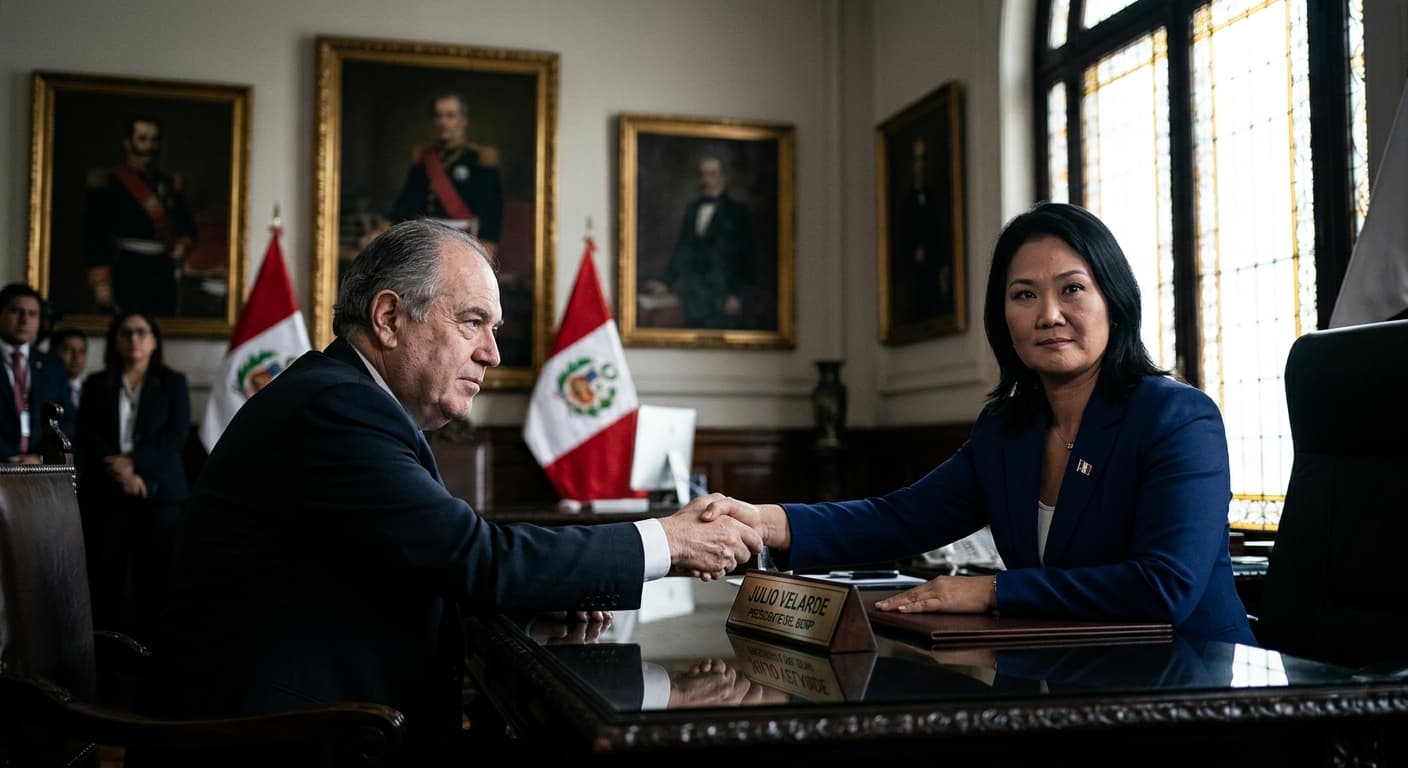
Keiko Fujimori's first act: keeping Julio Velarde at Peru's central bank
Peru's president-elect meets BCRP chief Julio Velarde on July 6 to lock in monetary continuity — a signal to markets that outweighs the razor-thin 0.27% mandate she won.
Keiko Fujimori will sit down with Julio Velarde in Lima this afternoon, July 6, 2026, three days after Peru's electoral court certified her as the country's ninth president in a decade — and her first message is not about crime, migration or China. It is about keeping the 74-year-old economist who has run the Banco Central de Reserva del Perú (BCRP) since 2006 in his chair for a fifth government. That choice, made before a cabinet is even named, is the tell: Fujimori won on "order," but she plans to govern on continuity. The economic-policy "shift" she promised on the campaign trail begins as an anti-shift — an explicit pledge that the one institution keeping Peruvian macro credibility alive will not be touched.
The meeting was confirmed by Fuerza Popular congressman Miguel Torres and framed by the president-elect herself as her first substantive act after the count. "Culminado el conteo de la ONPE, lo primero que haré es solicitar una audiencia con Julio Velarde," Fujimori told Diario Correo last week. Her running-mate and virtual vice-president Luis Galarreta had already told
CanalB on July 1 that Velarde's ratification would be "one of the first actions" of the new government. Fujimori herself told supporters on July 4 she would preserve "what is working well," per
Altavoz — a phrase whose entire content, for now, is Velarde.

The tightest mandate, the loudest market signal
Fujimori won Peru's June 7 runoff by 50.135% to 49.865%, a margin of fewer than 50,000 votes out of 18.4 million cast, according to the Jurado Nacional de Elecciones proclamation reported by
BBC. Inside Peru she actually lost: Roberto Sánchez took 50.08% of domestic valid votes; Fujimori's victory was carried by the diaspora, where she took 63.2%,
BBC Mundo calculated. Sánchez conceded only on July 6, per
Al Jazeera, after weeks of impugned tallies.
A mandate that thin ordinarily forces coalition-building and cabinet compromises before any policy signal. Fujimori inverted the sequence. By racing to Velarde before naming a finance minister, she is doing what her father did in 1990 and what Pedro Castillo was pressured into doing in 2021: use the central bank governor as the sovereign risk anchor. The Atlantic Council noted the same day the JNE result was certified that her "unapologetic defense" of the 1993 market model was the axis of her campaign; the Velarde meeting operationalizes that promise in a single photograph.
The stakes for foreign holders of Peruvian paper are concrete. The IMF's May 27, 2026 Article IV staff report attributes Peru's ability to preserve market access "on favorable terms" through eight presidencies to "very strong macroeconomic policy frameworks" — code, in practice, for the BCRP under Velarde. Fund staff project 2.8% GDP growth in 2026, a current-account surplus of 3.4% of GDP, and public debt stabilizing near 32% of GDP, per the
IMF concluding statement of March 25. Those numbers are what a Velarde ratification protects; they are also what a botched succession would put in play.
Why Velarde is not a person — he is a régime
To understand why a 20-minute meeting matters, read the BCRP's own institutional history. In a working paper for the Banco Central de Reserva del Perú, economist Vicente Tuesta built an "effective independence" index showing the BCRP's autonomy score jumped decisively after the 2002 adoption of inflation targeting, driven less by legal reforms than by the personnel who executed them. Velarde was one of the architects of that regime before he became its custodian: his 2005
Bank for International Settlements paper on dollarization laid out the "flotación sucia" doctrine — heavy but rules-free FX intervention — that has kept the sol among Latin America's least volatile currencies.
That doctrine is expensive to run and impossible to fake. As the BCRP's Diego Macera told BBC Mundo, Peru's central bank intervenes on more days than any peer in the region, sitting on reserves that reached roughly 30% of GDP. Replace Velarde with a political appointee and the intervention arithmetic still works — but the credibility premium that lets Peru borrow more cheaply than Colombia or Brazil evaporates overnight. That premium, not the man, is what Fujimori is buying today.
The politics reinforce the point. Under Article 86 of the 1993 Constitution and the BCRP's
Ley Orgánica, the seven-member board serves a five-year term aligned with the presidential cycle: the Executive names four directors, including the president; Congress ratifies three. The current board's mandate ends around September 2026, giving Fujimori — with Fuerza Popular as the largest minority bloc in a fragmented Congress — the votes to seat her own board while keeping Velarde as its face.
The real shift is fiscal, not monetary
Here is what the Velarde headline conceals. Monetary policy in Peru is already tight enough: the BCRP's rate stood at 4.25%, implying an ex-ante real rate of 2.1% against a neutral rate around 2%, per the IMF Article IV mission. Inflation is inside the 1–3% band. There is nothing for a Fujimori government to change monetarily that a status-quo Velarde would not already do.
The pressure point is fiscal — and it comes from Fujimori's own Congress. The Fund flagged that the 2024 pension reform was "significantly weakened in September 2025" when lawmakers approved an eighth round of AFP private-pension withdrawals, and warned bluntly that "recurrent withdrawals have reduced AFP portfolio yields" and "severely weakened the depth and long-term financing capacity of domestic capital markets." Fuerza Popular has historically voted for those withdrawals. Fujimori's incoming Congress is therefore likely to keep pushing spending measures that put the 1%-of-GDP fiscal-rule target for 2028 out of reach, absent revenue reforms the Atlantic Council's analysis says she has not committed to.
That is where the Velarde ratification does its real work. By locking in an unchallengeable central bank governor, Fujimori inoculates herself against the sovereign-spread punishment that would otherwise follow a looser fiscal stance. It is the same move Castillo made in October 2021, when — as BBC Mundo reported — his ratification of Velarde caused an immediate rebound in the Lima Stock Exchange and the sol. Fujimori is applying a technique the Peruvian left invented under duress; she is applying it before markets even ask.
Who benefits, who loses, what to watch
The immediate winners are Peru's mining exporters and dollar-denominated bondholders. Fujimori's BBC profile made clear her free-market pitch rests on attracting US investment into copper, silver and molybdenum at a moment when metal prices are at their most favorable terms of trade since the 1950s, per the IMF. A Velarde-guaranteed FX regime is the precondition that makes those inflows priced. Peruvian conglomerates — Buenaventura, Southern Copper, Credicorp — are pricing continuity now.
The losers are twofold. First, Sánchez's rural and Andean base, whose demand for a rewrite of mining royalties is now dead on arrival with a Fujimori–Velarde tandem in place; the Atlantic Council warned that the "structural challenges of governability" — inclusion, state presence — remain untouched by macro continuity. Second, and less visible: the medium-term fiscal picture. If pension withdrawals continue and the government does not identify the 0.4% of GDP per year in current-spending cuts the IMF Article IV mission demanded in 2025, Peru's debt trajectory bends up quietly while everyone is watching the BCRP.
There is a historical parallel Fujimori will not advertise but is clearly working from. Her father inherited hyperinflation in 1990 and imported credibility by appointing a technocratic team around then-BCRP chief Jorge Chávez, alongside the "Fujishock" adjustment. Keiko is inheriting stability, not crisis — but the mechanism is identical: outsource macroeconomic credibility to an unimpeachable technocrat, then use the space that buys for a domestic agenda (in her case, security, prisons, the military) that markets would otherwise punish. This is Fujimorismo as macro governance doctrine, refined across three defeats.
What to watch next
- July 6 read-out (today): whether Velarde publicly accepts, ambiguously demurs (as he did with Castillo in August 2021), or signals a defined retirement date. A named successor — Diego Macera and BCRP research chief Adrián Armas are the two most cited internal candidates in Lima financial press — would matter almost as much as Velarde himself.
- July 28 inauguration: Fujimori's finance-ministry pick is the second signal. Names circulating in
El Comercio include former deputy finance minister José Arista and ex-BCRP director Elmer Cuba; either would confirm the continuity thesis. A Fuerza Popular partisan would break it.
- September 2026 board renewal: the moment the president-elect has to translate the Velarde photograph into seven names. The three congressionally ratified seats are where the deal with allied benches — Renovación Popular, Avanza País — gets priced.
Diplomat View
The Fujimori–Velarde meeting is not a personnel decision; it is a preemptive bond-market intervention by a president-elect with a 0.27% mandate and no fiscal room. Our call: Velarde stays, with a public commitment to serve at least through 2027 and an implicit succession plan naming Macera or Armas. The falsifiable condition is this — if by August 15, 2026 Fujimori has not both (a) obtained Velarde's public acceptance and (b) named a finance minister with visible IMF/BCRP credibility, revise this thesis. In that scenario, Fuerza Popular is choosing a security-and-loyalty cabinet over a technocratic one, and Peru's sovereign spread over U.S. Treasuries — currently among Latin America's tightest — widens materially before her inauguration. Watch the sol against the dollar on July 7 and the BCRP's July inflation report on July 17; those are the first prices that will tell you whether the market bought what Fujimori sold today.
The Bottom Line
Fujimori's first substantive act as president-elect is a promise not to change anything that matters to bondholders — and that is the whole strategy. By ratifying Julio Velarde before naming a cabinet, she is buying the macroeconomic credibility her 0.27% mandate cannot supply, freeing her to spend her political capital on the security and prison agenda that actually won her the election. The economic-policy "shift" of the Fujimori government, in other words, is a shift toward locking in the status quo the Peruvian left spent five years trying to modify — and if Velarde says yes this evening, that project will outlast her term.
Discover more
India
Rajnath Singh's Durga Squad for 2026 Polls
Rajnath Singh's Durga Squad promised women's safety in Bengal but has since disappeared from the agenda, revealing BJP's true priorities.
Global Politics
Trump's Conflicting Messages on Iran War
Trump's mixed messages on Iran reflect a strategy of audience management, benefiting Tehran amid a complex geopolitical landscape.

US Politics
Next Generation Republicans
A leaked survey shows 39% of Republicans under 30 do not identify as MAGA, revealing a split in the GOP's future leadership.

Conflict & Security
Drone Warfare Killing Aid Workers at Unprec
Over 1,000 humanitarian workers killed in three years as cheap armed drones collapse legal protections. Gaza, Sudan, Ukraine, and DRC see deliberate targeting of aid convoys and hospitals with zero prosecutions.