Kast's Megareforma Passes Chile's Chamber
A pivotal vote for supply-side reform in Latin America
Model Diplomat10 min readLatin America
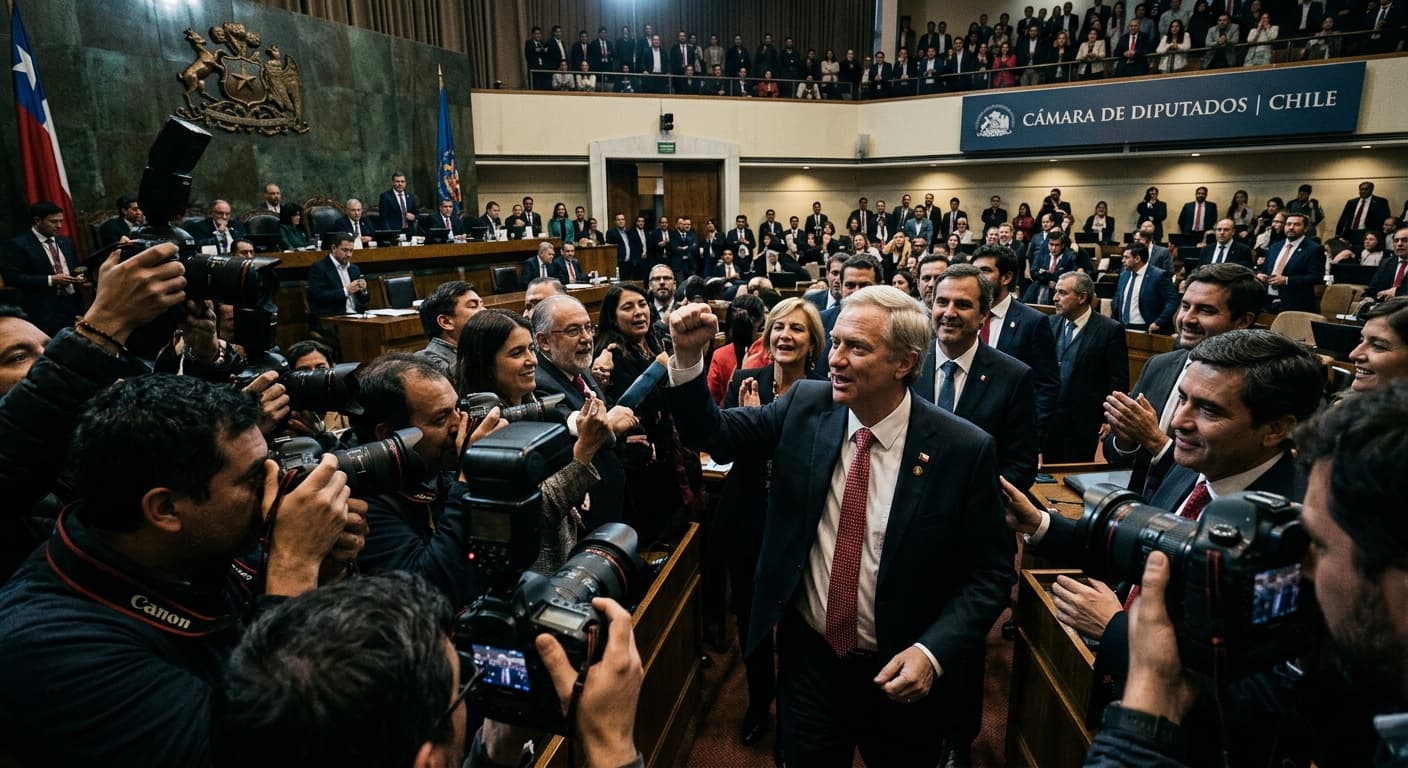
Kast's megareforma clears Chile's Chamber, teeing up Latin America's next big supply-side test
Chile's Chamber of Deputies dispatched President José Antonio Kast's Reconstruction and Development bill to the Senate on May 20, 2026 — a 90–59 vote that recasts the region's post-Boric right.
Chile's Chamber of Deputies approved José Antonio Kast's megarreforma in general terms 90–59, with one abstention, on May 20, 2026, dispatching a 300-plus-article package to the Senate that would gradually cut the corporate tax rate from 27% to 23%, lock in 10-to-25-year tax invariability for new investors, and roll back parts of the last decade's social spending. The vote matters beyond Chile: it is the first time a Latin American right-wing government since Argentina's Javier Milei has secured a lower-house green light for a full-spectrum supply-side reform through orthodox congressional bargaining rather than emergency decree — and the IMF, in its July 6 Article IV concluding statement, effectively endorsed the fiscal direction while flagging the arithmetic that could still sink the bill in the Senate.
The bill — formally the Ley para la Reconstrucción Nacional y el Desarrollo Económico y Social — is Kast's core legislative bet for a four-year "emergency government" that took office on March 11, 2026 after his 58.2% runoff victory over communist candidate Jeannette Jara. It is now the reference case that Buenos Aires, Quito, San Salvador and the incoming right elsewhere in the hemisphere are watching to see whether the Latin American right can legislate rather than merely posture.
What actually passed the Chamber
The Chamber vote came after two days of debate and roughly 1,500 opposition amendments, according to a Centro de Estudios Públicos legislative chronology. La Tercera's live coverage reported that oficialismo celebrated the general vote with chants of "Ce-Ha-I" while the Frente Amplio, Communist Party, Socialist Party and Christian Democracy signalled they would seek constitutional review at the Tribunal Constitucional, according to
La Tercera. The Christian Democracy's decision to break publicly against a business-friendly package is the most politically loaded number in the vote: it signals that Chile's shrunken centre no longer sees value in triangulating with a Republican-led executive.
The economic core is a bundle, not a single measure. The corporate rate falls from 27% to 23% in stages; a fully integrated system lets business owners credit 100% of corporate tax against personal income tax; a special statute grants 10-year tax invariability for domestic and foreign investors, extending to 25 years for projects above US$50 million, according to BBC News Mundo. A 12-month window opens for repatriation of undeclared foreign capital under a substitute tax, and a transitory instrument lets firms regularise accumulated undistributed profits at concessionary rates.
The revenue-loss side is offset by spending containment: postponing free tertiary education (gratuidad) for the top 30% of households, freezing the entry of new institutions to the scheme for two years, sanctioning fraudulent medical-leave use by public workers, expanding retirement incentives at a one-in-three replacement rate, and eliminating the SENCE training-franchise tax credit — a measure previously criticised by presidential commissions for weak employability impact, according to Libertad y Desarrollo. A parallel deregulation chapter — the war on permisología — hands the environmental evaluation service (SEA) broader discretion, narrows judicial review, and shields the state as guarantor when previously granted permits are revoked. LyD cites a University of San Sebastián estimate that permit friction cost Chile
US$2.2 billion in 2024, close to 1% of GDP — the deregulation chapter, not the tax cut, is what most excites the mining and energy lobbies.
The IMF endorsement — with a warning label
The most consequential external verdict landed on July 6, 2026. The IMF Executive Board's Article IV assessment welcomed Chile's plan to reduce the structural fiscal deficit to 1.5% of GDP by 2030 and to keep debt below 45% of GDP, and endorsed measures to "rationalize expenditures, enhance spending efficiency, and support medium-term growth."
But the same document contains a carefully worded caution that opposition senators are already brandishing. Directors emphasised, verbatim:
"Reforms under the National Reconstruction Plan should be carefully prioritized and sequenced, and that the fiscal costs and growth impact of tax and other reforms should be carefully considered to ensure fiscal sustainability."
That single sentence is the pivot of the Senate debate. It reads as an endorsement of Kast's direction and a rebuke of his sequencing — an unusual split verdict from an institution that normally either applauds or scolds. The IMF also noted that "additional measures would be needed" to hit the 2030 structural-deficit target amid rising spending pressures, language that maps almost exactly onto the domestic technical critique. Directors further flagged the need to better target the minimum guaranteed pension and consolidate fragmented social programs — a nod to the government's spending-side ambitions but also a warning that the poorest quintile must be protected as gratuidad and SENCE benefits recede.
Why the arithmetic keeps the Senate uncertain
The most damaging domestic finding is not political — it is fiscal. Working from the Dirección de Presupuestos' own financial report, the Centro de Estudios Públicos concludes that 45% of the bill's financing to 2030 comes from spending cuts and other measures that are not written into the bill itself, and a further 28% depends on dynamic revenues from growth that "may not arrive." The bill's own financial impact, on Dipres numbers, is a net negative averaging 0.3 points of GDP per year between 2026 and 2031, with the payoff only turning positive from 2040 onward.
Jorge Rodríguez, former president of Chile's Consejo Fiscal Autónomo, warned in a CEP interview that Chile is "three GDP points" from the prudent 45%-of-GDP debt ceiling, leaving no cushion if growth disappoints: "the risk that GDP growth doesn't materialise at the estimated magnitude, or arrives later, is real." His recommendation is blunt: revenue backstops and containment measures should be written into the bill, not left to a parallel spending-cut exercise. Finance Minister Jorge Quiroz has committed a US$3 billion spending adjustment for 2026, and as of mid-year had booked roughly US$2 billion — but a quarter of it is public investment cuts, precisely the line item the reform is meant to catalyse, and another quarter is Ministry of Health, which has historically overspent its budget by 18%.
The Consejo Fiscal Autónomo itself concluded that the project could "affect the sustainability of public finances" if dynamic revenues fall short, BBC News Mundo reported. A joint report by 13 centre-left think tanks with the
Friedrich Ebert Foundation went further: 43 alternative measures, and a warning that the repatriation-of-capital provisions could "weaken tax culture" by rewarding non-declaration.
The government's counter-evidence is a study by the University Diego Portales' OCEC, spanning 80 countries between 1981 and 2024, which found that a one-point corporate-tax cut lifts investment by 2.37%–4.8% and GDP by 0.38–0.78% over a decade. The Regulatory Impact Report accompanying the bill projects 8.18 additional points of GDP over ten years, unemployment falling from 8.3% to 6.5% by 2030, and 4% annual growth. Those numbers are the entire political case — and the reason the CFA's "may not arrive" carries so much weight.
The regional angle: Milei's playbook, run through a functioning Congress
The non-obvious story is not what the bill contains — most of it was foreshadowed in Kast's campaign and in Libertad y Desarrollo's primer analysis. The story is how it is being enacted. Milei governed his first year by decree (the DNU 70/2023 and the Ley Bases) and by shock. Nayib Bukele runs El Salvador with a legislative supermajority. Kast has neither.
His Republican bloc holds fewer than half the seats in the Chamber and faces an evenly split Senate, according to the Atlantic Council. Passage required the votes of the Partido de la Gente (PDG), whose caucus was granted libertad de acción, and cost him the Christian Democracy, which broke publicly to oppose the bill, as
The Clinic reported on the eve of the vote.
That is a very different template from Milei's or Bukele's. If it works in the Senate, Chile becomes the region's proof-of-concept that a supply-side agenda can be passed through ordinary majoritarian negotiation without eroding democratic guardrails. If it fails — either in the Senate or later at the Tribunal Constitucional, where the opposition has already flagged reservations on tax stability, environmental-review discretion and gratuidad — it becomes the cautionary tale for the incoming right elsewhere.
The stakes are also geopolitical. The Atlantic Council notes that the US remains Chile's second-largest source of FDI, with a heavy presence in energy, data centres and mining, and that policy predictability is what American investors "typically look for before committing capital." Kast's early alignment with Donald Trump — including his participation in the "Shield of the Americas" summit and the freezing of the Boric-era Chinese fibre-optic cable concession, as reported by BBC News Mundo — layers a strategic premium on top of the domestic economic bet. Beijing has responded pragmatically, sending Housing Minister Ni Hong to the inauguration; Santiago's likely ambassador-designate Luis Schmidt is a Piñera-era pro-business pragmatist. The megarreforma is thus doubling as an audition for a role: Latin America's most predictable partner for the United States in a region where Milei and Bukele are, in different ways, harder to underwrite.
The parallel that unsettles the government's own economists
There is one comparison the government does not invite: Chile in 2014, when Michelle Bachelet's tax reform raised the corporate rate from 20% to 27%. Libertad y Desarrollo notes this is the only OECD case of a country raising the corporate rate over the past 25 years while OECD peers cut theirs from an average 31% to 22%. The Kast government treats the reversal as overdue normalisation and points out that Boric's own finance minister, Mario Marcel, had publicly conceded the need to reduce the corporate rate as part of a pro-growth strategy — a rare piece of technical consensus that oficialismo has milked in floor debate.
The subtler parallel is with the December 2023 constitutional plebiscite, which produced a mandate for change and then two failed rewrites — the second, led by Kast's own Republican Party, rejected 55.8% to 44.2%. That defeat taught Chile's right that maximalism loses. The megarreforma is drafted in the opposite register: not refoundational, but a targeted supply-side wager built to survive judicial review and to be defended article by article on the Senate floor. Aldo Mascareño and co-authors at the CEP argue in a
June 2026 paper that Kast's first cuenta pública on June 1 confirmed a "doctrinaire" governing orientation — but one channelled through legislative instruments rather than plebiscitary confrontation.
The best evidence for that reading came from an unexpected quarter. Economists Sebastián Edwards, Alejandro Micco and Manuel Agosín — none of whom endorsed Kast in the campaign — publicly identified positive elements in the design, Libertad y Desarrollo reported in April. That kind of cross-partisan technical validation is rare in post-2019 Chilean politics and is a large part of why the Chamber majority held. The CEP's own June survey shows government approval at 34%, the highest reading in eight years, and confidence in Congress rising from 8% to 13% — a shift that gives moderate senators political cover to negotiate rather than obstruct, according to
CEP.
Winners and losers, named
The clearest winners are mining, energy and infrastructure firms with projects above the US$50 million threshold — the 25-year invariability clause is functionally a sovereign put on regulatory risk, and Chile's copper and lithium majors have been the loudest supporters in the Confederación de la Producción y del Comercio. American investors in data centres are the second cohort: Chile's data-centre pipeline sits idle behind permitting delays that the permisología chapter is engineered to unblock.
The clearest losers are three: recipients of the top-30% gratuidad benefit, whose subsidy is postponed; SENCE-linked training providers, whose tax franchise disappears; and public-sector unions, whose retirement-incentive expansion is designed to shrink the state payroll at a one-in-three replacement rate. Behind them stands a fourth loser: Chile's own fiscal ratings agencies. As the CEP noted in a July 6 analysis, Chile has already been downgraded once with warnings of further cuts if the debt trajectory drifts — the CFA's most stinging observation is that Chile ran structural deficits every year except 2022 since the estallido social, averaging −3.4% of GDP, and the megarreforma does not close that gap without external help.
Diplomat View
The megarreforma will be approved by the Chilean Senate, but not before the government concedes fiscal mitigation measures the CFA and the IMF have demanded — likely a hard-coded revenue backstop tied to the corporate-rate glidepath, and a narrower version of the 25-year invariability. That is the base case because the arithmetic is what it is: 45% of the financing lives outside the bill, and neither the IMF nor Chile's own fiscal watchdog will let that stand without a legal spine. The forecast changes if the Tribunal Constitucional strikes the permisología chapter — the opposition's strongest constitutional claim — or if third-quarter growth surprises to the downside and revives the CFA's warning that Chile is one shock away from a further credit downgrade. If Kast lands a diluted-but-real version, Chile becomes the template that Latin America's post-Boric right has been searching for since Milei: a right that can legislate. If he loses the Senate or the Tribunal, the region reverts to governing by decree and rhetoric — and the next election in Colombia in 2026 becomes far more consequential.
What to watch
- Senate general vote — expected before Chile's September 18 independence recess; the Hacienda committee sets the timetable.
- Tribunal Constitucional filings — FA, PC and PS have signalled constitutional actions on tax-invariability and environmental-review articles once the Senate dispatches the bill.
- 2027 Budget proposal — Kast must submit it to Congress by September 30, 2026; the first budget fully authored by his Hacienda team and the test of whether the US$4 billion spending cut is permanent or one-off.
- October 2026 CFA fiscal report — the next binding technical assessment against the 45%-of-GDP debt ceiling.
Discover more
India
Rajnath Singh's Durga Squad for 2026 Polls
Rajnath Singh's Durga Squad promised women's safety in Bengal but has since disappeared from the agenda, revealing BJP's true priorities.

US Politics
SNAP Food Assistance Faces Legal Challenges
In 2026, SNAP faces stricter eligibility rules and mounting legal challenges, threatening food assistance for the millions of Americans who rely on the program.
India
700 Activists Accuse PM Modi of MCC Breach
Over 700 activists allege PM Modi breached election code with a televised address attacking opposition parties just before state elections.

Conflict & Security
Drone Warfare Killing Aid Workers at Unprec
Over 1,000 humanitarian workers killed in three years as cheap armed drones collapse legal protections. Gaza, Sudan, Ukraine, and DRC see deliberate targeting of aid convoys and hospitals with zero prosecutions.