Japan's Weak-Yen Trap Cracks Takaichi's Story
Yen-driven inflation threatens Japan's growth agenda.
Model Diplomat8 min readAsia
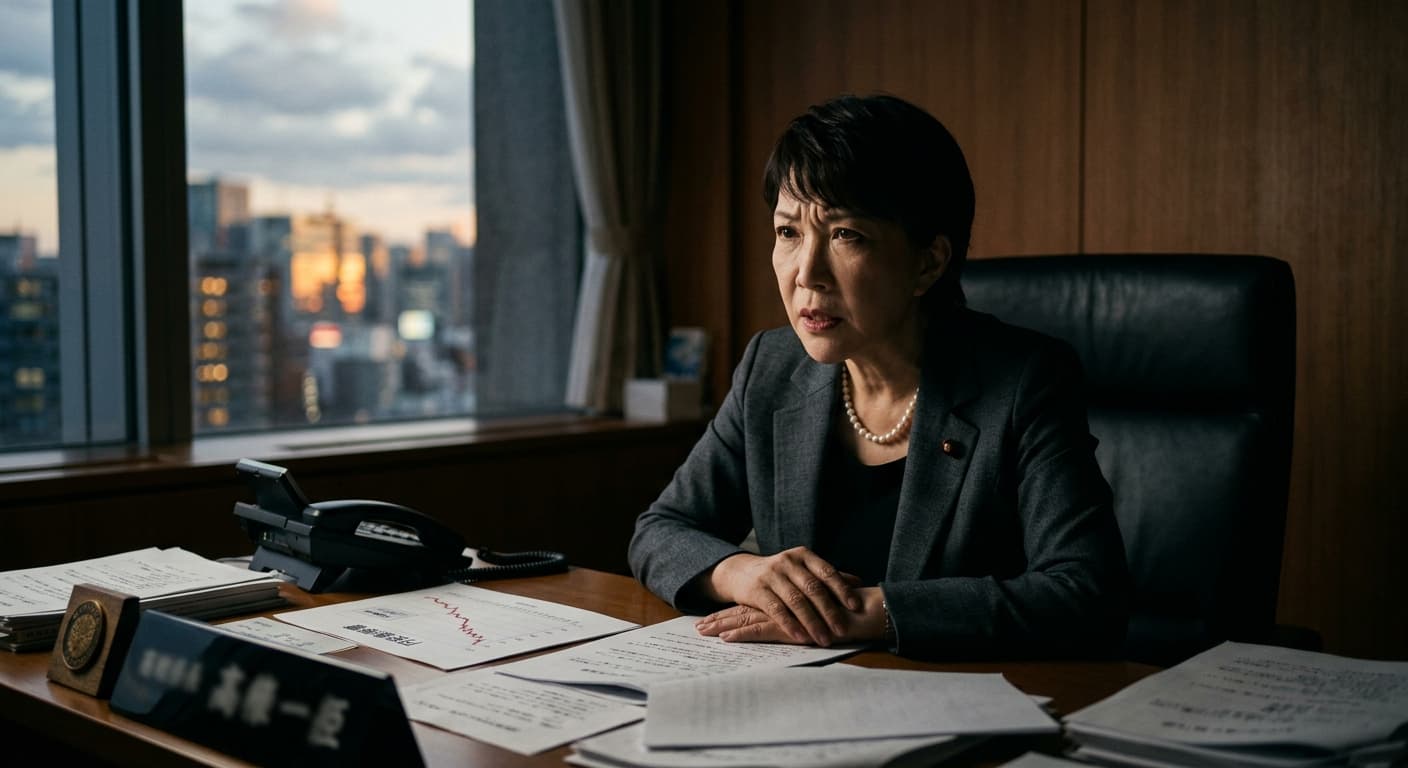
Japan's Weak-Yen Trap Cracks Takaichi's Growth Story
MUFG CEO Junichi Hanzawa warns yen-driven inflation is eating consumption, exposing the contradiction at the heart of Sanae Takaichi's tax-cut, big-spending agenda.
The most consequential warning about Japan's economy this week did not come from the Bank of Japan or the finance ministry. It came from the CEO of the country's largest lender, and it points at Prime Minister Sanae Takaichi: a yen at ¥162.66 to the dollar — a 40-year low — is now generating the wrong kind of inflation, the kind that destroys demand rather than fuels it, and that pulls the rug from under the very growth agenda the government won a supermajority to deliver. Junichi Hanzawa, chief executive of Mitsubishi UFJ Financial Group, told Reuters on July 6, 2026 that "if price rises exceed real wages, that will hit consumption. This would be a minus to sustainable economic growth. That's my greatest concern." Coming from the head of a bank that sits on ¥400 trillion of assets and benefits directly from higher rates, it is as close to an open dissent from the "Takaichi trade" as corporate Japan has yet offered.
The trap the numbers describe
Japan's macro picture in July 2026 is a study in contradiction. The BOJ has taken its policy rate to 1.0%, the highest since 1995, hiking by 7–1 on June 16 with an explicit warning that "underlying CPI inflation" risks "deviating upward" from the 2% target, according to the Bank of Japan's decision statement. Yet the yen has kept falling: from roughly ¥150 when Takaichi took office in October 2025 to ¥162.66 last week, per the
Reuters wire MUFG's Hanzawa was responding to. Rate hikes that would normally support a currency are being overwhelmed by fiscal signalling.
Real wages tell the demand story. Inflation-adjusted pay has been negative for four consecutive years through end-2025, according to labour ministry data cited by Reuters and corroborated by the IMF's 2026 Article IV report, which notes that headline inflation averaged 3.2% in 2025 — above target for more than three and a half years — with food alone contributing roughly 1.8 percentage points as rice prices at one point doubled. In November 2025, real wages fell 2.8% year-on-year, the 11th straight monthly decline,
Al Jazeera reported ahead of the February snap election.
That is the trap Hanzawa is describing. Japan imports roughly 95% of its crude oil and the bulk of its food, per data cited by Al Jazeera after the June BOJ hike; every additional yen of depreciation raises the price of a barrel of Middle Eastern crude and a kilo of imported wheat. The June rate rise itself was framed by the BOJ as a response to oil-price pass-through following the U.S.–Israel war on Iran, not to the yen. When domestic prices rise faster than wages, consumption — 55% of GDP — shrinks in real terms. That is the mechanism MUFG's CEO says will "derail" the Takaichi programme.
Why the "Takaichi trade" is quietly breaking
Sanae Takaichi won February's snap election on an unashamedly Abe-style platform: suspend the 8% consumption tax on food for two years at a cost of roughly ¥10 trillion, layer that atop a ¥21.3 trillion supplementary stimulus already approved in November 2025, and rely on ultra-loose monetary policy to grease the wheels. The BBC called it a bet that "big spending to stimulate growth and low interest rates to support investment" could still work in 2026 the way it seemed to in 2013.
Markets responded with what the Financial Times' Unhedged podcast dubbed the "Takaichi trade": buy Japanese equities, sell Japanese government bonds, sell the yen. The trade worked on the first two legs — the Nikkei is up, 40-year JGB yields breached a record 4% in January, per
Al Jazeera — but the third leg is now the problem. A yen at ¥162 is not the lubricant Takaichi wanted; it is the accelerant burning down her cost-of-living pledge. Rice prices rose nearly 68% in the year before the election, and imported coffee and chocolate have followed, according to
Al Jazeera's pre-election reporting. More than half of voters told Nikkei polling that they doubted the food-tax pause would even move the needle.
The IMF has been more diplomatic than Hanzawa but is pointing at the same fault line. In its April 2026 Article IV concluding statement, the Fund welcomed "policy continuity" under Takaichi but warned that "core inflation is expected to remain more persistent in 2026-27 than previously anticipated, partly reflecting a more accommodative fiscal policy," and pressed for a "clear fiscal consolidation" path given a debt-to-GDP ratio near 230%, according to the IMF Article IV report. Translation: stimulus is now fighting the central bank rather than helping it.
The BOJ's uncomfortable message
Read literally, the Bank of Japan is telling the government that fiscal easing is why it has to keep hiking. Board member Naoki Tamura, in a June 25 speech, argued that the neutral rate is "at least around 1 percent" and that his baseline path is "raising the policy interest rate by 0.25 percentage points at intervals of a few months toward the neutral interest rate level of 2 percent." If upside risks materialise, he added, the BOJ should "accelerate the pace of rate hikes without hesitation." The
Summary of Opinions from the June meeting echoes that: bring the rate closer to neutral "as soon as possible" to preserve flexibility.
That is a hawkish trajectory. It is also, in effect, the BOJ signalling that it will not be the instrument of Abenomics 2.0. Kazuo Ueda was recorded absent for the June vote, and the one dissenter — Toichiro Asada — objected only that Middle East shocks argued for holding, not for cutting. There is no dovish flank left. Keio University economist Keiichiro Kobayashi put the corollary bluntly to the BBC: "An increase in spending would just stimulate inflation and increase the cost of living." Takaichi's political mandate says spend; the BOJ's reaction function says the more she spends, the more it hikes; the yen, caught in between, keeps falling because bond investors doubt the fiscal arithmetic.
Hanzawa's intervention slots into that gap. MUFG has been one of the biggest corporate beneficiaries of the exit from negative rates — deposit spreads have widened, loan demand has surged, and Japanese megabanks have posted record profits. For its CEO to say publicly that further yen-driven inflation is bad for growth is a signal that the financial establishment sees the demand side deteriorating faster than the earnings side is improving.
Intervention: the option nobody trusts
The obvious question, and the one Hanzawa "declined to comment" on, is intervention. Japan spent an estimated ¥25 trillion — about $173 billion — under former vice finance minister Masato Kanda in 2022-24 to slow the yen's slide, per the BBC. That effort set temporary floors but did not reverse the trend. As the Financial Times argued in its
"limits of yen intervention" analysis, unilateral currency operations against a persistent rate-differential and fiscal-credibility problem are Sisyphean.
The difference in 2026 is that intervention is now politically riskier, not less. Japan sits on the U.S. Treasury's watchlist of potential currency manipulators. The Takaichi government is simultaneously asking Washington for tariff carve-outs and warmer alignment on China. A large dollar-selling operation from Tokyo — especially one that fails to hold — would be read in Washington as fiscal-monetary incoherence at exactly the moment Takaichi needs American forbearance. The BOJ's implicit alternative is cheaper and more credible: keep hiking, on the schedule Tamura described, until the carry trade unwinds itself.
What Hanzawa is really saying
Strip out the diplomacy and MUFG's message is a call for the government to stop fighting its own central bank. "I think it is extremely important to curb inflation so as to prevent negative real incomes," Hanzawa told Reuters. That is a line no bank CEO would deliver casually about the sitting prime minister's flagship policy. It is also the line the IMF, the BOJ's hawks, and Keio's Kobayashi have been drawing in less blunt language for months.
The historical parallel worth noting: in 2014, Abenomics briefly ran into the same wall when a consumption tax hike collided with weak real wages, and consumption cratered. Takaichi's variant is the mirror image — a consumption tax cut funded by borrowing, at a moment when supply-side inflation is doing the demand destruction the tax hike once did. The politics are opposite; the outcome, MUFG is warning, may not be.
For a country still importing 95% of its oil into a Middle East risk premium, and 60% of its calories into a weak yen, "Abenomics 2.0" without a stronger currency is not stimulus — it is a transfer from households to importers. That is Hanzawa's angle, and it is why his warning matters more than another BOJ member's speech.
What to watch next
- BOJ July 30–31 policy meeting: the first opportunity to move toward 1.25%. Market pricing after Tamura's speech leans dovish-hold, but a further leg down in the yen would put a hike back on the table. Watch whether Ueda restores the "neutral rate around 2%" language into the official statement.
- Shunto 2026 wage data settlement rounds: The IMF's baseline that real wages "turn positive in FY2026" hinges on nominal-wage momentum from spring negotiations feeding through. If the
labour ministry's summer real-wage prints stay negative, the Hanzawa scenario becomes the base case.
- Ministry of Finance intervention posture: A break above ¥165 is the level analysts flagged after the last 40-year low. Verbal warnings from Vice Finance Minister for International Affairs are the tell; if they harden to "stealth intervention" language, positioning will react before any actual dollar-selling.
- Takaichi's autumn supplementary budget: The size of the next fiscal package will telegraph whether the LDP has read the Hanzawa signal or is doubling down.
Diplomat View
The evidence points to a specific, falsifiable call: Takaichi's political mandate and Japan's monetary reality are now on divergent trajectories, and one of them will bend within twelve months. Either the BOJ hikes to 1.5% by mid-2027 — closer to Tamura's stated neutral — and the yen recovers past ¥150, at the cost of choking Takaichi's growth agenda; or the prime minister leans on the central bank, the yen tests ¥170, and Japan discovers that Abenomics does not work in reverse, with a food-tax cut swamped by import-price inflation. Hanzawa's public break is a leading indicator that the financial establishment is bracing for the first path. The forecast revises if two things happen in tandem: Shunto 2026 delivers nominal wage growth above 4% and Brent stabilises below $80, in which case supply-side inflation eases enough for the contradiction to resolve without a fight. Absent that, the Takaichi trade's third leg — a weak yen as tolerable side-effect — is a bet against the country's own bank CEOs. It should not be held with confidence past year-end.
The Bottom Line
Japan's problem is no longer that inflation is too low — it is that the wrong kind of inflation is too high, imported through a currency the government's own fiscal signals keep weakening. When the CEO of Mitsubishi UFJ says publicly that a ¥162 yen threatens growth, he is telling Sanae Takaichi that the Abe playbook cannot be run with a 40-year-low currency, a 230% debt ratio, and a central bank that has quietly decided it will not be the accommodation partner. The next move belongs to the BOJ on July 31 — and to a prime minister who has yet to admit her stimulus and her currency are working against each other.
Discover more
Global Politics
Xi Jinping Calls China-Russia Ties 'Precious'
Xi Jinping's description of China-Russia ties as 'precious' reflects a strategic imbalance, with Beijing dictating terms in the partnership.
India
Rajnath Singh's Durga Squad for 2026 Polls
Rajnath Singh's Durga Squad promised women's safety in Bengal but has since disappeared from the agenda, revealing BJP's true priorities.
US Politics
House Ethics Committee Pushes Sexual Miscond.
The House Ethics Committee has shifted responsibility for sexual harassment settlement records to the Office of Congressional Workplace Rights, complicating disclosure efforts.

Conflict & Security
Drone Warfare Killing Aid Workers at Unprec
Over 1,000 humanitarian workers killed in three years as cheap armed drones collapse legal protections. Gaza, Sudan, Ukraine, and DRC see deliberate targeting of aid convoys and hospitals with zero prosecutions.