Japan's 1% Rate: Takaichi's Fiscal Challenge
Takaichi's spending plans clash with BOJ's rate hikes.
Model Diplomat7 min readAsia
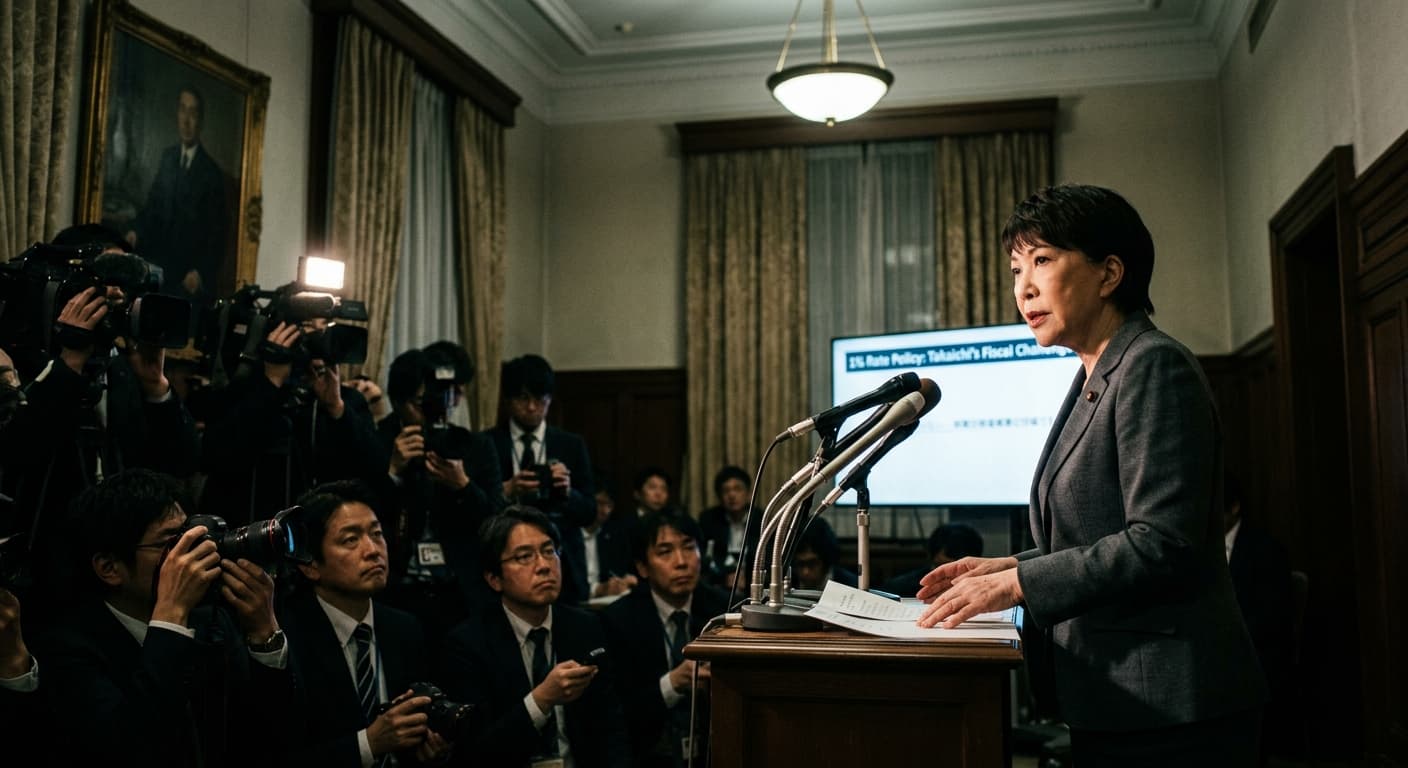
Japan Hits 1% Rates as Takaichi's Fiscal Blitz Tests the BOJ
Japan's policy rate stands at a 31-year high of 1% and Prime Minister Takaichi wants more spending. The BOJ's late-July Outlook Report is the next flashpoint.
The Bank of Japan's June 16, 2026 hike to 1% — its highest policy rate since 1995 — is not the end of normalisation; it is the moment Japan's fiscal and monetary arms began to openly work against each other, and the yield curve is where the fight is being priced. Prime Minister Sanae Takaichi's expansionary agenda has pushed 40-year Japanese Government Bond yields above 4% for the first time on record while Governor Kazuo Ueda's board tightens into the strain. The BOJ's late-July Outlook Report is now the single most important central-bank communication of the third quarter globally, because it will tell markets whether Tokyo is prepared to let real rates rise faster than the government would like to fund its cost-of-living package.
The rate move markets already have
The BBC reported that the BOJ raised its policy rate from 0.75% to 1% on June 16, with Ueda absent from the meeting while being treated in hospital for an infected liver cyst. The vote was 7–1, and the statement flagged risk that underlying CPI inflation could "deviate upward" of the 2% target — language
Al Jazeera called an unusually direct upside warning for the BOJ.
That hike was the fifth in the cycle that began in March 2024, when the BOJ ended negative rates. The IMF's April 2026 Article IV report puts the staff's estimated neutral nominal rate at 1.1–2.2%, meaning that even at 1% the BOJ is still — narrowly — accommodative. The Fund's directors "supported gradual rate hikes toward neutral" and expect the policy rate to reach a neutral stance in 2027, per the
IMF's April 2, 2026 press release.
Headline data does not obviously justify tightening. Core CPI excluding fresh food ran at just 1.4% year-on-year in April, held down by household energy subsidies. That is why the BOJ's decision to hike anyway reads as a pre-emptive move against second-round effects from the Iran conflict — wholesale prices climbed more than 6% in May — and against the pass-through pressure of a weak yen colliding with fresh fiscal stimulus.
The Takaichi problem
Takaichi took office in October 2025, called a snap election, and won a supermajority in the lower house on February 8, 2026. Her fiscal doctrine, which Brookings' Mireya Solís has dubbed "Sanaenomics," combines large-scale industrial policy with tax relief — a fundamental break from Abe-era discipline on the consumption tax.
The scale is now on the record. Her cabinet approved a ¥21.3 trillion ($137 billion) supplementary stimulus in November 2025 — the largest since the pandemic — followed by an FY2026 general-account budget of ¥122 trillion ($783 billion), the biggest ever, which the lower house passed on March 13, 2026. The Center for Strategic and International Studies notes the budget also carries a record ¥9 trillion ($58 billion) defence line, up from a 1%-of-GDP baseline as recently as 2022.
On top of that, Takaichi is pursuing a two-year suspension of the 8% consumption tax on food and non-alcoholic beverages — a step that, according to Al Jazeera's reporting on Japanese government estimates, would open a revenue hole of roughly ¥5 trillion ($31.7 billion) a year. Japan's gross debt-to-GDP ratio already exceeds 230%, the highest among advanced economies.
Markets have priced the divergence. Ten-year JGB yields rose roughly 100 basis points in 2025 to around 2.1%, per the IMF. The
Economist framed January's spike above 2.2% as a "fiscal-monetary clash," and 40-year yields briefly crossed 4% — the highest since the bond was introduced — after Takaichi confirmed the food-tax pledge.
The IMF is polite but pointed. Its staff wrote that "near-term fiscal policy should refrain from further loosening, preserving recent gains in fiscal consolidation," and warned that a consumption-tax cut is "an untargeted measure that would erode fiscal space." The Fund's own baseline sees Japan's primary deficit widening from 0.9% of GDP in 2025 to 1.5% in 2026 — the first deterioration after five consecutive years of consolidation.

Why the Outlook Report is the fulcrum
The BOJ publishes its next Outlook Report and holds its next Monetary Policy Meeting at the end of July. Three things will move markets more than the headline rate decision:
First, the underlying-inflation definition. In a June 2026 review paper, the BOJ's Monetary Affairs Department set out three approaches it uses to strip temporary factors — including government subsidies — from headline CPI. That distinction is now load-bearing. Takaichi's cost-of-living measures are mechanically pulling reported inflation below target; the BOJ's response has been to lean harder on measures that see through the subsidies. If the July Outlook explicitly raises the FY2026 underlying-inflation projection, it is a signal that the next hike is closer than the dovish CPI print suggests.
Second, the balance-sheet path. Under the extended JGB purchasing plan, the average pace of balance-sheet reduction is set to rise from around 7% of GDP in 2025 to close to 9% of GDP in 2026, according to the IMF's Article IV, which estimates this alone will lift term premia on JGB yields by roughly 9 basis points. The BOJ also began selling its ETF and J-REIT holdings from September 2025. Any softening of the taper path in July would be read — correctly — as monetary accommodation of the fiscal expansion, and would knock the yen.
Third, the tone on the yen. The Financial Times put it bluntly on July 3: "Japan's fiscal expansion puts the BoJ in a difficult spot. Without faster rate rises, the government's plans to cut taxes and increase spending are likely to push the yen down further." Ueda's board knows a weak yen is now inflationary rather than stimulative — a reversal of the Abenomics logic Takaichi was raised on.
Who wins from the fight
The non-obvious beneficiary of this policy mix is not Japanese savers. It is the Japanese state. As Brad Setser argued in the FT, the Ministry of Finance sits on roughly $1.2 trillion in reserves accumulated at yen levels far stronger than today, while the Government Pension Investment Fund holds another $1.8 trillion. When Tokyo does intervene — as former yen czar Masato Kanda did to the tune of ¥25 trillion ($173 billion), per the
BBC — it typically books a profit. The public balance sheet is long dollars against a currency the government is trying to prop up.
The clearer loser is the household. Real wages fell roughly 6% between 2022 and 2025 even as nominal spring wage settlements (shuntō) exceeded 5% for a second year, per the IMF. The Cabinet Office expects real wages to rise only around 1% in FY2026. That is the political engine behind Takaichi's tax pledges — and the reason the BOJ's data-dependent hawkishness carries genuine political risk.
There is also a geopolitical wire running through this. Japan's $550 billion investment commitment to the United States, part of its tariff deal with the Trump administration, has been kept intact even after the US Supreme Court struck down IEEPA tariffs, because Section 232 auto duties still weigh on Japanese exporters. A weaker yen partially offsets those tariffs but imports the energy shock from the Iran war. The BOJ is, in effect, managing a two-front problem — domestic fiscal loosening and imported cost pressure — with one instrument.
What could change the call
The base case is a hold in July with hawkish forward guidance, and a further quarter-point hike to 1.25% by year-end — the path Ueda's summary of opinions endorsed and the FT's monetary policy team has flagged. Revision triggers, in order of probability:
- A sub-1% core CPI print for June (release July 18), which would strengthen the argument that subsidies are dominating trend inflation and give the doves cover to delay.
- JGB dislocation. If 10-year yields push through 2.5% or the 40-year re-tests 4.2% in the run-up to the Outlook Report, the BOJ will slow the taper before it slows the hikes.
- A yen break below ¥160 to the dollar, which would raise the odds of coordinated MOF intervention and a faster hike, not a slower one.
Diplomat View
The consensus that Japan's rate cycle is nearly done is wrong. A 1% policy rate against a staff neutral estimate of 1.1–2.2% is not the top — it is the floor of the normalisation zone, and Takaichi's fiscal choices are actively raising the neutral rate by lifting the inflation and term-premium components. The prime minister's political dominance means she does not need the BOJ's help, but the BOJ's institutional need to defend its 2% target means Ueda cannot afford to under-tighten while the yen sits near multi-decade lows. Expect the July Outlook Report to lift the underlying-inflation projection while holding rates, followed by a hike to 1.25% at the October meeting. The forecast breaks if oil retraces sharply, if the food-tax cut is watered down in parliamentary negotiation, or if a US recession forces the Fed into aggressive cuts before September — in which case the BOJ can pause without losing face. The single biggest risk is not that Japan hikes too fast. It is that fiscal-monetary drift becomes the world's most credibly-sourced case study in why debt sustainability is a currency story, not a bond-market one.
Watch next:
- July 18, 2026 — June national CPI print (MIC).
- Late July 2026 — BOJ Monetary Policy Meeting and quarterly Outlook Report.
- August 2026 — Diet debate on the two-year food-tax suspension bill; funding source is the tell.
Discover more

US Politics
White House Pressures Congress for Crypto Leg
The Trump administration's push for the CLARITY Act aims to reshape crypto regulation, impacting trillions in market value and the Trump family's wealth.

US Politics
SNAP Food Assistance Faces Legal Challenges
In 2026, SNAP faces stricter eligibility rules and mounting legal challenges, threatening food assistance for the millions of Americans who rely on the program.

US Politics
Virginia GOP Rallies Rural Voters Against Red
Virginia Republicans are mobilizing rural voters against a Democratic-led redistricting referendum, a fight seen as pivotal to control in the 2026 midterms.

Conflict & Security
Drone Warfare Killing Aid Workers at Unprec
Over 1,000 humanitarian workers killed in three years as cheap armed drones collapse legal protections. Gaza, Sudan, Ukraine, and DRC see deliberate targeting of aid convoys and hospitals with zero prosecutions.