Jamsil Ballot Recount: South Korea's Test
Bipartisan recount of 2.47 million ballots nears completion.
Model Diplomat9 min readAsia
Jamsil Ballot Recount: South Korea's Test of Electoral Trust
South Korea's parliament nears a bipartisan recount of 2.47 million ballots from the June 3 local elections after the country's first paper shortage crisis.
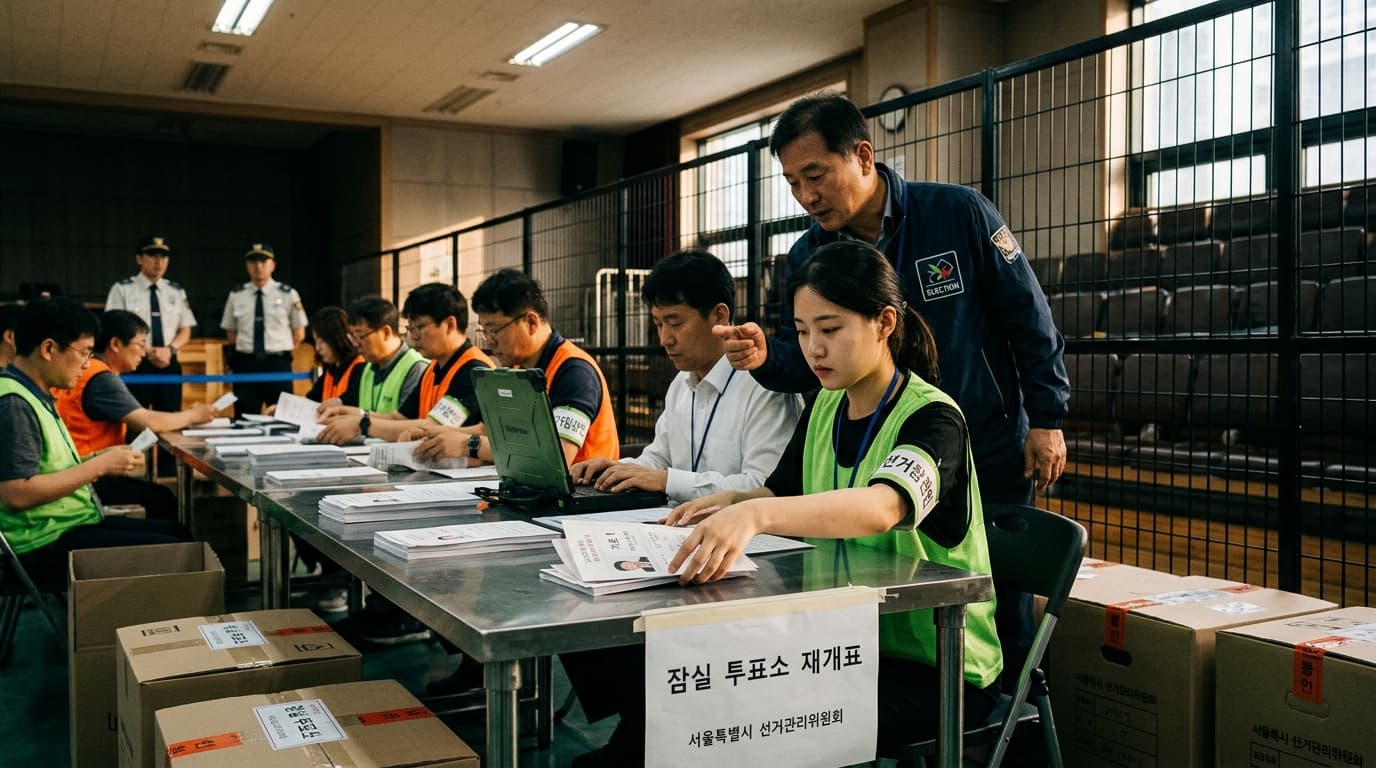
On July 7, 2026, the two largest parties in South Korea's National Assembly moved to the brink of a bipartisan hand recount of 2.47 million ballots stored at the Handball Stadium in Seoul's Olympic Park — a step without modern precedent that will decide whether an election whose count was never in serious dispute becomes the founding grievance of a new "stop the steal" movement in a country that just impeached one president for declaring martial law. According to the Seoul Economic Daily, the Democratic Party's acting floor leader Han Byeong-do told a leadership meeting that day the ruling party will "actively review a plan to pursue, through bipartisan negotiation, a recount and manual count of the 2.47 million ballots remaining at the Handball Stadium," accepting a proposal made 48 hours earlier by People Power Party (PPP) lawmaker Yoon Sang-hyun, who chairs the parliamentary special investigation committee.
The recount is not about who won. Oh Se-hoon of the PPP kept the Seoul mayoralty by roughly 53,000 votes and the ruling Democratic Party swept 12 of 16 metropolitan seats, according to BBC News Korean's tally of the National Election Commission (NEC) count. The recount is about the paper — 2.47 million sealed ballots that have been sitting inside a rented Olympic-era gymnasium for over a month while protesters camped outside the exits, and about what happens to a democracy when the losing side in a specific district refuses to accept the physical evidence of its defeat.
The shortage that broke the count
The trigger was administrative, not political. On election day, June 3, the NEC ran short of ballot paper at 91 polling stations nationwide; 26 stations paused voting altogether, according to the NEC's own tally cited by BBC Korean. The worst disruption was in Seoul's Songpa district — the wealthy, PPP-leaning constituency that includes Jamsil — where 12 stations reported paper shortages and the Jamsil 7-dong Second Polling Station kept its doors open until 10 p.m., four hours past the statutory close.
The immediate cause, per the NEC's public apology on June 3, was that the commission printed ballots for only about 50% of registered voters in Songpa, a formula built on historic turnout patterns that undershot a national turnout of 61.0% — the highest in a Korean local election since the system began in 1994. Article 155 of the Public Official Election Act mandates that polls open at 6 a.m. and close at 6 p.m., but permits voters already queued at 6 p.m. to cast ballots; the NEC ruled the shortage did not meet the statutory bar for a "postponed election" or "re-election," and the count proceeded. Protesters in Songpa physically blocked ballot boxes from leaving the Jamsil 7-dong station for 35 hours,
Al Jazeera reported, until riot police cleared them on the morning of June 5.
That is when the political geometry changed. NEC Chair Noh Tae-ak resigned on June 5, BBC Korean reported, telling a press conference: "I take responsibility for all these incidents and will step down from the post of NEC chair." Prime Minister Kim Min-seok, in a post the same evening, described the shortage as "a serious challenge to K-democracy" — a framing endorsed by both governing and opposition politicians and one that quietly pre-authorised the aggressive investigation that followed.
Why the ruling party said yes
The Democratic Party of President Lee Jae-myung has no obvious reason to recount ballots from an election it won. That it has agreed to do so is the story.
Han Byeong-do's endorsement of a bipartisan recount reversed a Democratic position, held since the ballot boxes were sealed, that a recount was legally unnecessary and politically dangerous — a concession to a PPP "election fraud" narrative that Democrats had spent weeks framing as illegitimate. Kim Seong-hoe, the Democratic floor spokesperson, told reporters July 7 that "as the Democratic Party's position is to conduct a recount if one is needed, we expect smooth negotiations with the People Power Party," according to the Seoul Economic Daily.
The calculation is economic and reputational. Yoon Sang-hyun disclosed on July 5 that the NEC has already spent about 200 million won (roughly $129,000) renting the Handball Stadium through July 10, The Herald Business reported. The NEC's own on-site briefing to the special committee estimated a full manual recount would take about nine hours and cost 50 million won — a quarter of what has already been paid to keep the ballots in temporary storage. "Rather than continuing to pay rental fees," Yoon said, "I think conducting a precise recount all at once would also give us the grounds to move the sealed ballot boxes."
There is a second, less-stated motive. The Handball Stadium has become a rallying point. According to Asia News Network, during the committee's July 2 inspection lawmakers found what they described as surveillance "blind spots" in the storage arrangement — camera gaps and access-log discrepancies that fuel, rather than settle, suspicion. Ballot boxes sitting under contested surveillance in a public gymnasium, watched over by tents of protesters demanding "verify the votes," are politically radioactive for whichever side inherits them.
The parallel machinery: audit, prosecutors, hearings
The recount is only the visible layer of a four-track investigation into the NEC — an institution that until this summer had won every constitutional battle it fought.
The National Assembly on June 18 passed a formal investigation plan 250 votes to 1 — the widest possible margin in a chamber where legislators rarely agree on the time of day — authorising a 45-day probe running to August 1, BBC News Korean reported. The 18-member special committee is composed of nine Democrats, seven PPP members and two independents, chaired by Yoon Sang-hyun. Its remit expressly covers the ballot-print calculation, the NEC's real-time response, "voter suffrage infringement" and budget execution.
Separately, the Board of Audit and Inspection announced on June 28 that it had opened its own probe into "budget planning and execution surrounding the ballot shortage," according to The Herald Business, examining the NEC head office and its Seoul, Gyeonggi and Busan regional offices. A joint prosecution-police investigation team has questioned nine local-government polling officers as witnesses and has executed search warrants against the NEC headquarters and the Seoul, Songpa, Gangnam, Seocho, Gwangjin and Dongjak district election commissions, according to legal-sector reporting summarised by
BBC Korean. Investigators are focused on whether NEC officials foresaw the shortage — internal messaging shows some polling supervisors flagged the risk at 11:40 a.m. on election day — and whether central coordination began only after 5 p.m., an hour before polls closed.
The constitutional stakes are unusual. As a background BBC Korean explainer noted, the NEC is one of only four independent constitutional bodies in South Korea, alongside the National Assembly, the courts and the Constitutional Court, and successfully argued in 2023 that it could not be audited by the presidential Board of Audit and Inspection because it does not sit under the executive branch. That firewall is now being tested in reverse: the parliament's investigation is uncontested precedent, but a criminal prosecution of sitting NEC officials would be the first in the commission's history.
The historical parallel is not America — it is 2020 Seoul
Foreign observers have been quick to reach for the U.S. "stop the steal" analogy. The parallel is imperfect. Ballot-shortage litigation has occurred in mature democracies before — BBC Korean noted the 2022 Luzerne County, Pennsylvania case, in which the county paid $30,000 to two voters unable to cast ballots after prosecutors found no criminal intent — and shortages of that scale did not destabilise the surrounding elections.
The nearer parallel is domestic. Following the 2020 general election, PPP-adjacent activists filed dozens of election-invalidity suits alleging early-voting fraud; the Supreme Court dismissed them one by one over three years. The 2026 dispute is different in a way that matters: the physical facts — that ballots ran out, that stations closed hours late, that turnout beat forecasts, that Songpa is a PPP stronghold where opposition voters had a plausible grievance about being disenfranchised — are not contested. What is contested is whether administrative failure is politically usable.
The KDI-affiliated legal analysts and defence attorneys BBC Korean consulted converged on the view that the shortage is unlikely to meet the Public Official Election Act's threshold for a re-election, because plaintiffs would have to prove not only procedural violation but that unpolled voters were numerous enough, and skewed enough in preference, to have altered a result. In the Seoul mayoralty, Oh Se-hoon led by roughly 53,000 votes in a race the PPP won — a fact that gives the ruling Democrats political cover to allow a recount they expect to confirm the certified outcome, while denying the PPP the "stolen election" framing it needs to translate the Songpa protests into a national movement.
What the two parties still fight about
Inside the special committee, the fault line is not the recount itself but who is on trial. Seo Beom-su, the PPP floor secretary on the committee, argued on July 7 that "the Democratic Party is holding only the NEC accountable and is not raising issues with the election-support departments and the Presidential Office," and demanded that Interior Minister Yoon Ho-jung and Presidential Chief of Staff Kang Hoon-sik testify, Seoul Economic Daily reported. Democratic floor secretary Yoon Kun-young countered that the Interior Ministry cannot legally intervene in NEC operations absent a request, and that the Presidential Office and NEC are "constitutionally independent institutions."
The subtext: the PPP wants a special prosecutor with subpoena power over the presidential residence. Yoon Sang-hyun told reporters July 5 he sees the special prosecutor as necessary to put the entire NEC "on the operating table" — a scope that would cover the ballot shortage but also budget waste, hiring irregularities and the 2023 nepotism scandal that already forced 58 dismissals from previous NEC hires, per figures published by the Board of Audit and Inspection and cited by BBC Korean. The ruling party has resisted that broader mandate, favouring a narrower parliamentary track under Article 61 of the Constitution.
The wider stakes
The Jamsil recount will resolve a factual question — whether the Songpa boxes contain what the NEC says they contain — but not the political one. South Korea's institutional architecture depends on the NEC's constitutional independence in a way that few peer democracies do: it certifies elections, supervises party finances and adjudicates campaign law without meaningful executive oversight. That autonomy, hard-won after the Chun Doo-hwan era, survived a decade of contested elections and a martial law crisis in December 2024. It may not survive a routine paper-supply mistake — because for the first time, both governing and opposition parties agree that the NEC needs reform.
That is the second-order effect. Whoever wins the recount, the NEC that emerges from the August 1 report will be a weaker institution: subject to Board of Audit and Inspection oversight the Constitutional Court once denied, exposed to criminal prosecution of individual commissioners, and stripped of the presumption of neutrality it enjoyed under Chairs Noh Tae-ak and predecessors. That reweighting of election administration inside the Lee Jae-myung government — a Democratic president overseeing structural reform of the body that certified his own contested 2025 victory — is the change that will outlast the Songpa ballots.
What to watch
- July 10: NEC's rental contract on the Handball Stadium expires; without a bipartisan recount agreement, the commission must either extend the lease or move the sealed boxes to Gwacheon under contested surveillance.
- July 14 and July 22: Parliamentary special committee hearings; the committee has signalled it will call Interior Minister Yoon Ho-jung and former NEC Chair Noh Tae-ak.
- August 1, 2026: Statutory deadline for the parliamentary investigation report, unless the National Assembly votes an extension. Any special-prosecutor legislation must clear the assembly before recess.
The Bottom Line
South Korea's ruling Democratic Party has agreed to recount 2.47 million ballots it has no reason to doubt, because the alternative — sealed ballot boxes sitting under permanent public protest inside a rented gymnasium — is worse for the state than any recount result could be. The Jamsil recount will almost certainly confirm the certified June 3 outcome; what will not survive intact is the National Election Commission's post-1987 constitutional autonomy, now being renegotiated in real time by a parliament that voted 250 to 1 to investigate it.
Discover more
US Politics
SNAP Food Assistance Faces Legal Challenges
In 2026, SNAP faces stricter eligibility rules and mounting legal challenges, threatening food assistance for the millions of Americans who rely on the program.
US Politics
Congress Targets AI Chatbot Access for Terror
The House passed the Generative AI Terrorism Risk Assessment Act, focusing on AI's role in terrorism and potential surveillance implications.
India
700 Activists Accuse PM Modi of MCC Breach
Over 700 activists allege PM Modi breached election code with a televised address attacking opposition parties just before state elections.

Economics
Fed's Amex AML order puts correspondent banking on notice
Federal Reserve's Amex AML order requires board-level controls and a 90-day plan; OCC fined the bank $350 million over enterprise-wide deficiencies.