Iran's MuddyWater Exploits Ransomware Tactics
Iran's MuddyWater uses Chaos ransomware as a cover for espionage.
Model Diplomat8 min readMiddle East
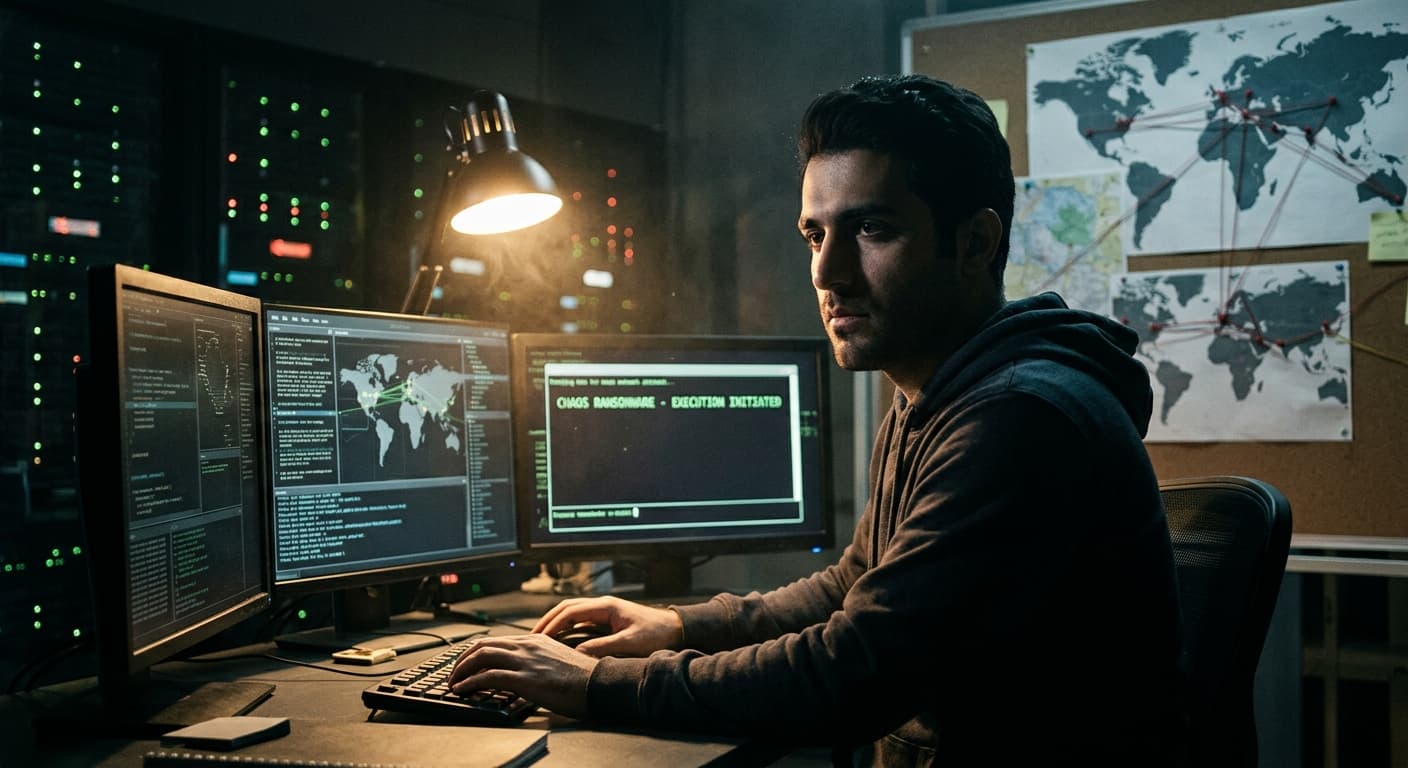
Iran's MuddyWater Used Chaos Ransomware as Cover for Espionage
Rapid7 exposed an Iran-linked APT posing as Chaos ransomware in 2026. The false flag weaponises the world's ransomware rulebook against defenders.
Iran's MuddyWater ran a fake Chaos ransomware attack in early 2026 as cover for state espionage — and the deception is quietly breaking the entire policy architecture the United States, the European Union and the 74-member Counter Ransomware Initiative have built since 2021 to treat ransomware as a criminal-financial problem. Every incentive baked into that architecture — the 24-hour Treasury reporting clock for ransom payments, the U.S. Securities and Exchange Commission's four-day materiality disclosure, the EU's NIS2 ransomware line-item, the OFAC sanctions blocklist — assumes the adversary wants money. When Tehran wears the jersey of a Ransomware-as-a-Service affiliate, victims mis-triage, disclosures mis-label, and sanctions miss the actor entirely. That is the story. The Chaos payload was a smokescreen; the real target was the West's response playbook.
What Rapid7 actually found
According to a report by cybersecurity firm Rapid7 disclosed in May 2026 and summarised by INCYBER News, the intrusion looked, at first glance, like a routine Chaos ransomware hit: a ransom note, a countdown timer, files touched. On inspection, no ransomware payload ever executed. The countdown was blind — decoupled from any encryption process — and the operators had spent weeks inside the environment using Microsoft Teams social engineering to secure legitimate access before dropping the theatrical ransom note. Security news outlet
PCRisk called the note "less a profit engine and more a strategic distraction."
Attribution went to MuddyWater, an Iranian actor U.S. and U.K. agencies formally tied to Iran's Ministry of Intelligence and Security in a 2022 joint cybersecurity advisory issued by CISA, the FBI, NSA and the U.K. NCSC. The Council on Foreign Relations'
Cyber Operations Tracker records the group targeting governments and telecoms across the Middle East, South Asia and the United States since 2017. This is a mature intelligence service, not an opportunist.
The Chaos operation is not novel behaviour — it is an escalation of a five-year pattern. In September 2020, Israeli firms Clearsky and Profero caught MuddyWater deploying malware "disguised as ransomware" that was deliberately incapable of decrypting anything, according to the United States Institute of Peace's Iran Primer. Microsoft later reported that six distinct Iran-linked groups were deploying ransomware-flavoured tradecraft to obscure intelligence and destructive operations. What is new in 2026 is the sophistication of the cover — not a homebrew wiper wearing a ransom note, but a full impersonation of a live, active RaaS brand with a functioning affiliate ecosystem.
Why this breaks the policy architecture
The Counter Ransomware Initiative and its successors treat ransomware as a financial-criminal problem to be squeezed on three axes: harden victims, choke the crypto payment rail, sanction the operators. CSIS notes the CRI has grown to over 70 countries and international organisations since its post–Colonial Pipeline launch in October 2021. Iran is not a member — and never will be. The Chaos deception weaponises every one of those assumptions.
Start with sanctions. U.S. Treasury Office of Foreign Assets Control designations against Iranian cyber actors — the September 2022 IRGC package sanctioning ten individuals and two Karaj- and Yazd-based front companies for their roles in ransomware activity, and the
April 2024 IRGC-CEC action hitting Mehrsam Andisheh Saz Nik plus four operators — target named front companies. A forensic team looking at a "Chaos ransomware" note has no reason to consult those lists at all. OFAC's own guidance holds that payment to a sanctioned Iranian entity carries strict-liability civil penalties for U.S. persons — but only if the target is correctly identified. The false flag creates a corridor of plausible deniability that Rapid7's forensic work only closes months later. In that window, ransoms can move, and any U.S. company that pays exposes itself to enforcement it did not know it was courting.
Now the reporting clock. CIRCIA, codified at 6 U.S.C. § 681b, obliges covered critical-infrastructure entities to report ransom payments to CISA within 24 hours and covered cyber incidents within 72. The
SEC's Item 106 disclosure rule requires public companies to describe cybersecurity incidents that are materially significant to investors. Both regimes were built for a ransomware taxonomy. A board that reports a "Chaos ransomware incident" to investors is factually correct and materially misleading — the true event is state espionage against a strategic target, with a different loss profile, a different remediation cost, and a different disclosure obligation to national-security regulators. The
EU's NIS2 Directive, at Recital 54, explicitly instructs member states to build national policy around the "exponential increase in ransomware attacks" and the RaaS business model. When the ransomware is theatre, the policy misses.
| Regime | Assumed adversary | How the Chaos false flag exploits it |
|---|---|---|
| OFAC sanctions (E.O. 13694, 13224) | Named criminal group or Iranian front company | Victim never checks Iran list — sees 'Chaos' brand instead |
| CIRCIA (6 U.S.C. § 681b) | Ransomware attacker seeking payment | Incident logged as ransomware; espionage angle omitted |
| SEC Item 106 (17 CFR § 229.106) | Financially motivated cyber incident | 8-K materiality assessed on downtime, not IP or state loss |
| EU NIS2, Recital 54 | Growing RaaS criminal ecosystem | State intel op invisible in national ransomware statistics |
| Counter Ransomware Initiative | Criminal RaaS operators + safe havens | Iran is not a CRI member; deception exploits siloed response |
The attribution problem, industrialised
The academic literature has been warning about this for a decade, and 2026 is the year the warning ships in production. A Cambridge study in the American Journal of International Law argued that international-law responses to cyberattacks collapse under attribution delay: by the time a state confidently identifies the attacker, the necessity element for lawful self-defence has often lapsed. A
Chatham House research paper published in March 2026 went further, warning that the high thresholds set by the International Law Commission's Articles on State Responsibility "are ill suited to the realities of modern cyber operations" and that off-the-shelf RaaS tools have "democratised" the cover story a state actor can wear.
An IISS survey published in December 2025 documents 188 instances since 2020 in which 47 states, the EU and NATO have publicly attributed cyber incidents — with at least seven states, including China, the Czech Republic, France and Singapore, issuing first-time public attributions in 2025 alone. Public attribution has become the West's preferred cost-imposition tool because sanctions and indictments are slow. Iran's Chaos gambit is designed to blunt exactly that lever: if the initial forensic picture points to a criminal RaaS brand, no foreign ministry issues a same-week démarche, no allied capitals coordinate a name-and-shame, and the diplomatic window closes before the intelligence one opens.
Worse, the tooling is converging. A June 2026 arXiv paper documenting AI-agent red-team experiments found that adversary emulation converged on identical initial-access techniques regardless of the APT profile assigned, and that "a threat actor from any nation could deploy an AI agent configured with another nation's APT profile and produce indicators consistent with that group's documented signature at 55–80% precision." CSIS's April 2026 analysis reached a compatible verdict: generative AI is not producing autonomous cyberweapons yet, but it is
compressing the tradecraft cycle — phishing lures 4.5× more likely to be clicked, exploit iteration in minutes. Impersonating Chaos in 2026 is a manual craft; by 2027 it is a template.
Who benefits, who loses
The winners are unambiguous. Iran, first — it gets espionage access to Western critical infrastructure while the incident telemetry gets filed under "criminal ransomware." Russia and North Korea, second — every muddied attribution reduces the political cost of their own operations and dilutes the CRI's central norm that states will "name and shame" the responsible actor. The Russia-based RaaS ecosystem, third — its brand equity is now valuable enough that a state actor bothered to steal it. The Rapid7 quarterly report finds Qilin led leak-site posts with 357 in Q1 2026, confirming a fragmented but well-branded ecosystem MuddyWater can graze at will.
The losers are equally specific. Cyber-insurance underwriters — actuarial models built on ransomware loss curves misprice state-espionage events, which have longer tail liabilities and no negotiation option. Corporate general counsels — a materially wrong 8-K classification is an SEC enforcement problem. CISA — the CIRCIA dataset it is building is being contaminated by mis-labelled events. And the Counter Ransomware Initiative itself, whose January 2024 joint commitment that government institutions will not pay ransoms — the initiative's signature norm — is only as strong as members' ability to identify who is really behind the note.
The historical parallel that reframes it
The closest analogue is not another cyber incident but the 2017 NotPetya operation, in which Russia's GRU disguised a destructive wiper as ransomware, generated global collateral damage — an SSRN analysis of the WannaCry and Albanian cases catalogues how state practice on cyber attribution has evolved unevenly since. NotPetya taught the West that "ransomware" could be a cover for sabotage. Nine years later, Chaos teaches it that "ransomware" can be a cover for patient, quiet intelligence collection — a subtler and, for policy design, harder problem. Sabotage announces itself. Espionage does not.
What to watch next
- The Rapid7 Q2 2026 Threat Landscape Report (expected August 2026), which will indicate whether Chaos-branded Iranian activity is one campaign or a sustained programme. Ransomware was already involved in
42% of Rapid7 MDR incident-response cases in 2025; if a meaningful slice of that is mis-classified state activity, the entire threat baseline is off.
- CISA rulemaking on CIRCIA final implementation, and whether the agency amends reporting fields to require a "suspected state-nexus" flag on ransomware incidents.
- The next OFAC designation cycle for Iranian cyber actors, which will test whether Treasury adapts its blocklist to cover RaaS brand-impersonation as a sanctioned tactic, not just a sanctioned actor.
- The 2026 CRI summit outcomes, and whether member states shift from a purely criminal frame toward a hybrid criminal-espionage frame.
The Bottom Line
Iran's MuddyWater did not just impersonate a ransomware crew — it impersonated the entire threat model that Washington, Brussels and 74 partner capitals spent five years building policy around. The forcing function is now unavoidable: sanctions lists, SEC disclosures, CIRCIA reports and the CRI's political declarations will all be gamed until they can accommodate a ransom note that is really a decoy. The country that benefits most from cyber policy staying frozen in its 2021 shape is Iran — and, second-hand, every other state that would rather its operations be filed under "cybercrime" than under "state responsibility."
MuddyWater: who they are
MuddyWater (aka Seedworm, Static Kitten, Mango Sandstorm)
Iranian state APT subordinate to the Ministry of Intelligence and Security (MOIS)
Active since2017
Formal U.S./U.K. attributionJanuary 2022 joint CISA/FBI/NSA/NCSC advisory
Primary missionCyber-espionage; prepositioning
Known cover tradecraftFake ransomware (2020 Israel; Qilin 2025; Chaos 2026)
Target regionsMiddle East, South Asia, U.S., Europe
Discover more
Global Politics
Xi Jinping Calls China-Russia Ties 'Precious'
Xi Jinping's description of China-Russia ties as 'precious' reflects a strategic imbalance, with Beijing dictating terms in the partnership.

US Politics
White House Pressures Congress for Crypto Leg
The Trump administration's push for the CLARITY Act aims to reshape crypto regulation, impacting trillions in market value and the Trump family's wealth.

US Politics
US Launches $166B Tariff Refund Portal
The US is launching a $166 billion tariff refund portal to aid importers hit by Trump-era tariffs, with major implications for trade and supply costs.

Economics
Fed's Amex AML order puts correspondent banking on notice
Federal Reserve's Amex AML order requires board-level controls and a 90-day plan; OCC fined the bank $350 million over enterprise-wide deficiencies.