Iran Protest Massacre: Six Months Later
No accountability for January's deadly crackdown
Model Diplomat8 min readMiddle East
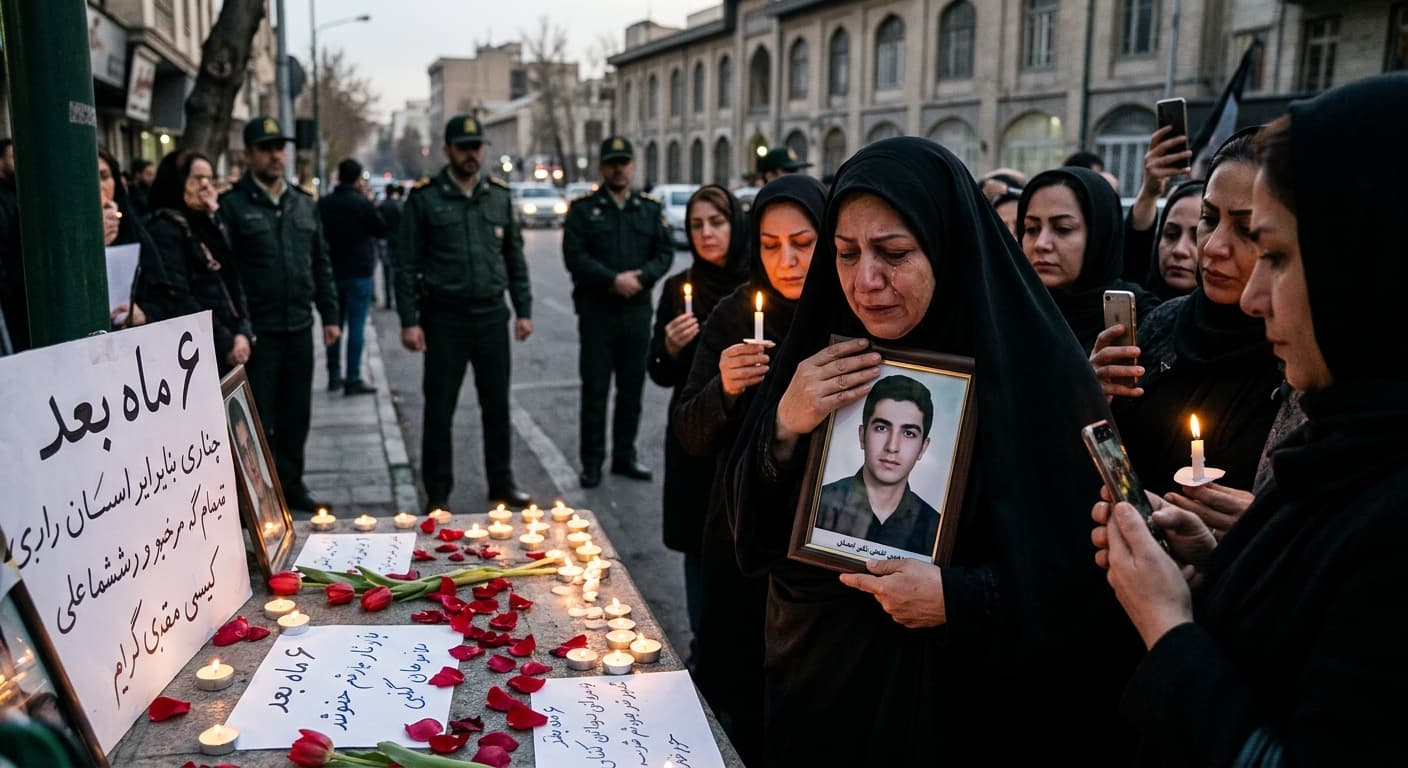
Iran Protest Massacre at Six Months: No Court, No Referral, More Executions
Six months after Iran's January 2026 crackdown killed thousands, no international court has been seized. Amnesty warns the impunity gap is fuelling a new execution wave.
On July 8, 2026, Amnesty International marked six months since Iranian security forces killed between 3,117 and more than 5,000 protesters and bystanders over 48 hours on January 8–9, 2026 — and warned that the absence of any binding international accountability mechanism has already produced a measurable second wave of atrocity, with at least 36 politically motivated executions carried out since February 28. The organisation's central claim is not that justice is slow. It is that a US-Iran ceasefire signed on June 18, 2026 has quietly written human rights out of the diplomatic agenda entirely — and the Iranian security establishment has read that omission as a licence.
That is the story here. Not the massacre, which is documented. The structured impunity that has followed it, and the specific downstream harms — mass executions, enforced disappearances, and a refugee corridor into Turkey — that flow from the international community's failure to move a single file to a court with subpoena power.
What the paper trail already shows
The evidentiary record is not thin. Iran's Supreme Council of National Security itself, in a January 21, 2026 statement carried by Press TV, put the death toll at 3,117. UN Special Rapporteur Mai Sato, speaking to media five days earlier, said the figure exceeded 5,000. The US-based Human Rights Activists News Agency has verified 6,872 deaths and is investigating more than 11,000 additional cases, Al Jazeera reported on February 5. Sato has separately said the true figure may exceed 20,000 as information trickles out despite heavy internet filtering.
Cause of death is documented with equal specificity. A BBC News Persian forensic analysis published February 9 verified that Iranian security forces deployed machine guns, sniper rifles, shotguns and machetes against protesters across more than 200 cities, with spent 7.62x39mm Kalashnikov casings recovered from streets and roughly 1,000 patients requiring emergency surgery for ruptured eyeballs from metal shotgun pellets at a single Tehran eye hospital between January 9 and 10. Payam Akhavan, a former UN prosecutor at the ICC, told the BBC it was "the largest mass killing in contemporary Iranian history and one of the largest in the world."
The institutional response followed on January 23, 2026, when the UN Human Rights Council held its 39th special session and adopted Resolution S-35/1 by a vote of 25 in favour, 7 against, 14 abstentions. The resolution extended the Independent International Fact-Finding Mission on Iran by two years and instructed it to conduct an urgent investigation into the January killings, "including for potential future legal proceedings." The Mission delivered its consolidated interim findings on March 11, 2026 as
document A/HRC/61/60, which flags "credible allegations that gross human rights violations and crimes under international law may have occurred" in connection with the protests.
That FFM report is the closest thing to a primary legal spine for future prosecutions — and also the ceiling of what the UN system has produced. No Security Council referral. No ad hoc tribunal. No universal jurisdiction case at scale.
The Amnesty finding: impunity has already produced a second wave
Amnesty's July 8 statement, delivered by Diana Eltahawy, the organisation's Deputy Regional Director for the Middle East and North Africa, is not a generic accountability plea. It is a causal claim.
"The Iranian authorities have faced no consequences for repeatedly and unlawfully using intentional lethal force on a mass scale to crush and punish dissent. The international community's failure to pursue international justice for these serious crimes has emboldened the Iranian authorities to threaten further mass killings by 'trigger-ready' security forces targeting protesters and dissidents they label as 'enemies'," Eltahawy said in the
Amnesty statement.
The claim is testable. Since the US-Israeli strikes on Iran that began February 28, 2026, Iranian authorities have executed at least 36 individuals sentenced to death "after being convicted of politically-motivated charges," according to an Amnesty urgent action document. Norway-based Iran Human Rights and Paris-based Together Against the Death Penalty
reported to the BBC that Iran executed at least 1,639 people in 2025 — the highest annual total since 1989, and a 68% increase over 2024 — and warn the figure is set to climb further because of the January-linked prosecutions. Twenty-seven people have already been sentenced to death in connection with the January protests, the NGOs said; hundreds more face charges carrying the death penalty.
The judiciary has been explicit about the direction of travel. Supreme Court Chief Justice Gholam-Hossein Mohseni-Ejei pledged on January 14 to "fast-track trials" for those arrested, Al Jazeera reported, with Tehran prosecutors filing capital charges of moharebeh — "waging war against God" — against those they classify as rioters. Amnesty documented a February case in which 18-year-old wrestling champion Saleh Mohammadi was sentenced to public execution in Qom in relation to the January protests,
per Al Jazeera reporting on diaspora rallies that same month. Sato said the "same patterns documented in those individual cases are being replicated on a mass scale after the nationwide protests."
The deal that quietly de-prioritised justice
The specific policy shift Amnesty is protesting happened on June 18, 2026, at Versailles. On that date, US President Donald Trump and Iranian President Masoud Pezeshkian signed a 14-point Memorandum of Understanding ending the war triggered by the February 28 US-Israeli strikes. The full text, released by BBC, contains no human rights conditions, no reference to the January killings, and no mention of the ICC, the Fact-Finding Mission or the Special Rapporteur.
Point 2 commits both sides to "refrain from interfering in each side's internal affairs." Point 6 commits at least $300 billion to Iranian reconstruction, though the BBC noted the US is not itself required to contribute. Point 7 terminates all US and UN Security Council sanctions on Iran on an agreed schedule — a category that includes the human rights-linked sanctions imposed after the 2022 Mahsa Amini protests.
Elliott Abrams of the Council on Foreign Relations wrote on June 18 that the non-interference language amounts to "a complete abandonment of the democracy movement among Iranians" — Trump speaking of the Iranian government in "friendly" terms at the exact moment it is executing protesters. The 60-day clock for a final deal — running to mid-August 2026 — is the operative diplomatic timetable. There is no parallel accountability clock.
This is the beneficiary map Amnesty is asking policymakers to see clearly. The winners are Pezeshkian's government, the IRGC command structure, and the US administration that gets its Strait of Hormuz reopening. The losers are the 41,283 detainees SBS News identified as facing "chilling uncertainty", the families of the roughly 6,872 verified dead, and — the group easiest to overlook — the diaspora and the border-crossers.
The refugee dimension the wire coverage missed
The impunity story has a spillover. NPR reported on March 7 that the World Health Organization estimated 100,000 people had fled Tehran alone since the war began, with Iranians "streaming across the border with Turkey," some citing the January protest killings as the moment they decided the regime had to end. UNHCR estimated 3.2 million people had been displaced inside Iran by mid-March, and Al Jazeera reported that Ankara had drawn up a
three-tier contingency plan — including buffer zones and interception operations inside Iranian territory — in case flows accelerate. Turkey shares a 530-kilometre border with Iran and already hosts roughly 3.6 million Syrians.
The second-order effect: an accountability vacuum inside Iran does not stay inside Iran. It converts into an asylum caseload on NATO's south-eastern flank and a return-migration crisis for Afghanistan, where the UNHCR recorded 86,253 Afghans returning from Iran so far in 2026.
The historical parallel that reframes the ask
Amnesty's demand — an independent international justice mechanism plus a Security Council referral to the ICC — has a specific precedent worth naming. The UN's own Independent International Fact-Finding Mission on Iran was originally established in November 2022 to investigate the "Woman, Life, Freedom" crackdown, and in March 2024 it concluded that Iranian authorities had committed crimes against humanity, including murder, torture and rape. That finding sat on the shelf. Sixteen of those sentenced to death during 2022–2023
remained at risk of execution when the January 2026 protests began.
That is the parallel Amnesty is invoking without stating: the same institutional pipeline that documented crimes against humanity in 2024 has now documented a mass killing in 2026, and neither finding has translated into a live prosecution. The Council on Foreign Relations, in its December 2025 analysis of options, called the January crackdown likely the bloodiest against civilians since 1979. Absent a Security Council referral — which Russia and China would veto — universal jurisdiction cases in national courts are the realistic route. Germany, Sweden and the Netherlands have used that mechanism against Syrian and Iranian officials before. None has yet opened a structural case tied to January 8–9.
The primary-source record versus the diplomatic silence
Assistant Secretary-General Martha Pobee's January 15 briefing to the Security Council laid out the UN's own factual baseline: a near-total communications blackout imposed on January 8, mass arrests exceeding 18,000 by mid-January, and reports of security forces killing "hundreds or possibly thousands of protesters and bystanders between 8 and 10 January." Pobee's language — the Secretary-General "urges maximum restraint" — is the diplomatic ceiling six months on. There has been no Chapter VII action. No arms embargo tied specifically to protest-related units. No sanctions listing of the commanders who deployed the Kalashnikovs the BBC forensics identified.
That gap between what the UN system has documented and what it has authorised is the operational meaning of "impunity" in Eltahawy's statement. It is also what makes Amnesty's assessment — that further atrocity is not a risk but a trajectory — hard to dismiss as advocacy language.
The accountability clock versus the diplomatic clock
The 60-day MOU deadline expires around August 17, 2026. If a final deal is signed without human rights language, sanctions relief begins flowing and the leverage question closes permanently. The Fact-Finding Mission's next update to the Human Rights Council is the one institutional moment that could shift the legal posture from "credible allegations" to a formal crimes-against-humanity determination — the threshold that opens universal jurisdiction cases in German, Swedish and Dutch courts. Saleh Mohammadi and the 27 others sentenced to death are the human measure of whether that shift happens in time. Ankara's three-tier contingency plan at Gürbulak and Kapıköy is the geographic measure of what happens if it does not.
The Bottom Line
Six months after the largest mass killing in modern Iranian history, the operative international document on Iran is a 14-point trade-and-sanctions memorandum that does not mention the dead. Amnesty's argument is not that justice has been delayed — it is that the June 18 deal has re-priced impunity as the cost of doing business, and Tehran's execution ledger since February 28 is the receipt.
Discover more
India
Congress Accuses Modi of Stalling Women's Law
Congress accuses Modi of stalling women's reservation law by linking it to delimitation, revealing a deeper electoral strategy.

US Politics
House Ethics Committee Pushes Sexual Miscond.
The House Ethics Committee has shifted responsibility for sexual harassment settlement records to the Office of Congressional Workplace Rights, complicating disclosure efforts.
India
Rajnath Singh's Durga Squad for 2026 Polls
Rajnath Singh's Durga Squad promised women's safety in Bengal but has since disappeared from the agenda, revealing BJP's true priorities.

Conflict & Security
Drone Warfare Killing Aid Workers at Unprec
Over 1,000 humanitarian workers killed in three years as cheap armed drones collapse legal protections. Gaza, Sudan, Ukraine, and DRC see deliberate targeting of aid convoys and hospitals with zero prosecutions.