Indonesia-Singapore Retreat: 26 Deals
Key agreements signal strategic energy shifts
Model Diplomat8 min readSoutheast Asia
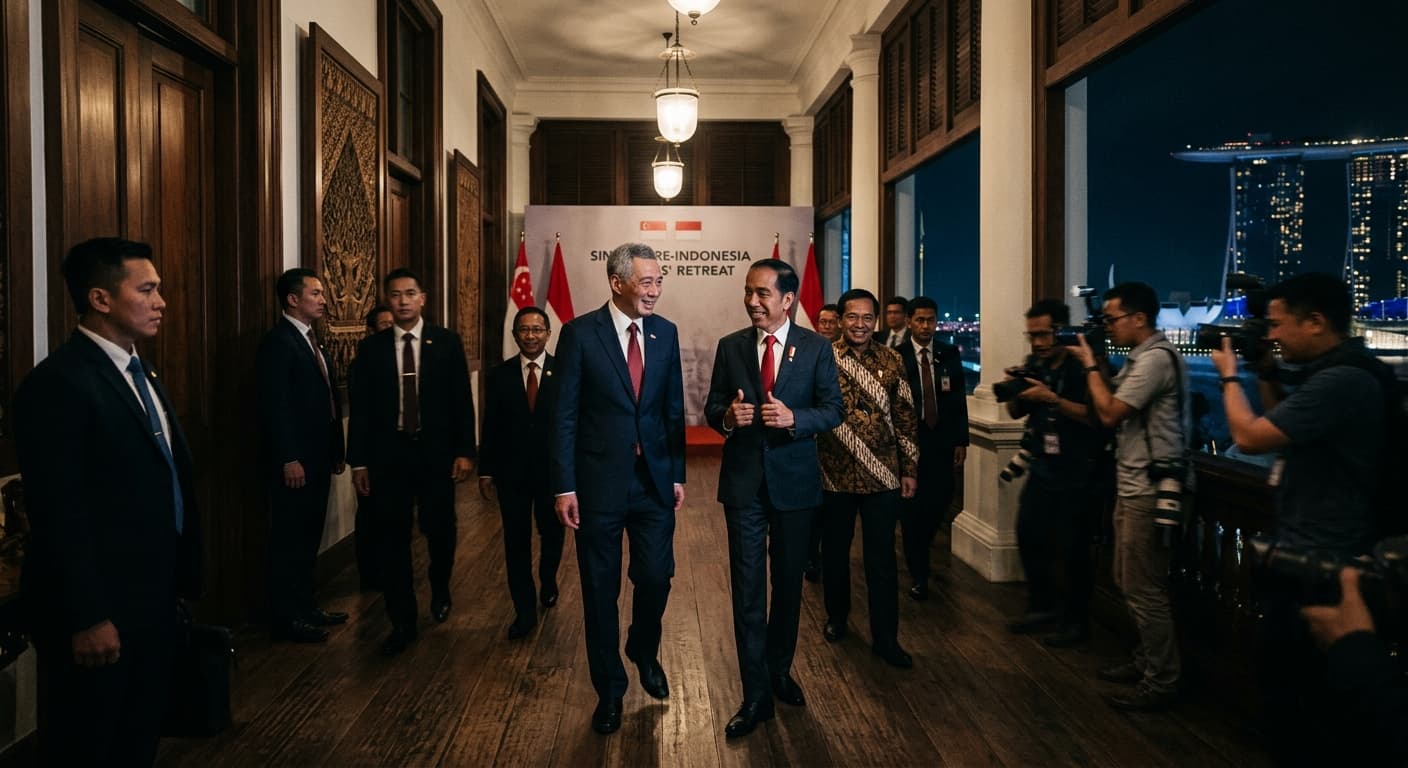
Indonesia, Singapore Retreat: 26 Deals, One Strategic Reset
Prabowo and Wong signed 26 agreements in Jakarta on 7 July 2026. The real story: Singapore locking in clean power via Danantara and reasserting a littoral-only Malacca order.
Indonesia's President Prabowo Subianto and Singapore's Prime Minister Lawrence Wong concluded 26 bilateral agreements at the annual Leaders' Retreat in Jakarta on 7 July 2026, but the substantive news is narrower than the headline count suggests: Singapore has consolidated Indonesia as the anchor supplier for its 6-gigawatt low-carbon electricity target, handed the file to Prabowo's sovereign fund Danantara rather than state utility PLN, and secured Jakarta's fresh commitment to keep the Strait of Malacca governed by littoral states under international law — six weeks after a leaked US overflight proposal nearly punctured that principle. The retreat is less a routine reaffirmation than a quiet reset in Southeast Asia's energy and maritime architecture.
According to the Presidential Secretariat of Indonesia via Indiplomacy, Prabowo said economic cooperation "remained the pillar" of ties and announced that Danantara — the sovereign wealth vehicle launched in February 2025 — would implement the cross-border electricity trade with Singapore. Wong flagged three priorities: economic growth, the green economy, and defence. Ministers who signed the deals included Coordinating Minister for Economic Affairs Airlangga Hartarto, Defence Minister Sjafrie Sjamsoeddin, Singapore Deputy PM Gan Kim Yong, and Foreign Minister Vivian Balakrishnan, as detailed by
Asia News Network.
Singapore's power play, not Indonesia's
Strip the diplomatic packaging away and the retreat's centre of gravity is electricity. Singapore has committed under its 2035 climate strategy to import roughly 6 GW of low-carbon electricity — about a third of peak demand — and its Energy Market Authority has already issued conditional licences for 3 GW of imports from Indonesia, with a further 5.35 GW under conditional approval across Indonesia, Australia, Vietnam, Cambodia and Malaysia, according to research from the Lee Kuan Yew School of Public Policy.
A 2025 study in Nature Scientific Reports sets out the pipeline: a 2-GW solar-and-battery project on the Riau Islands is intended to deliver electricity to Singapore before 2030, with a further 1.4 GW of offshore wind slated to arrive from Vietnam via 1,000-km subsea cable by 2033. Indonesian officials had already signed three cross-border electricity-trade MoUs with Singapore in 2025; the retreat converts framework into implementation.
The choice of Danantara as implementing agent is the sharp end of the story. Under President Widodo, the Indonesia–Singapore renewable export arrangement of September 2023 ran through state utility PLN and the energy ministry — an arrangement the S. Rajaratnam School of International Studies characterised in late 2024 as a test of Indonesia's balance between "authoritarian pragmatism" and market signals. Prabowo has now taken the file out of the line ministry and into the sovereign fund he chairs. According to
Danantara Indonesia, the fund successfully issued an oversubscribed US$1.5 billion international bond on 12 June 2026 — more than three times covered. The message to Singaporean off-takers: contract counter-party risk sits with the president's office, not with a heavily indebted utility.
Winners: Singaporean data-centre operators and multinationals with renewable-energy commitments, whose electricity supply is now less exposed to gas-price shocks; Riau Islands developers; and Prabowo personally, whose vehicle just gained a bankable export book. Losers: PLN, sidelined from a marquee cross-border project on its own turf; and, indirectly, Malaysia and Vietnam, which — per the LKY School — are ranked ahead of Indonesia on reliability but lack a comparable political fast-track. That paper's own verdict on Indonesia is unsparing: its export willingness is "tempered by protectionist ministerial rhetoric and an absence of operational-level policy frameworks."
The Malacca subtext
The maritime-security line in the joint press conference — that both governments would keep the Strait of Malacca "safe, secure and open in accordance with international law" — reads as boilerplate until placed against events of the previous five weeks. Roughly 24% of global seaborne trade by volume and 45% of the world's seaborne oil transits the strait, according to the
Institute of Strategic and International Studies Malaysia.
In May 2026 a proposed US–Indonesia arrangement giving American military aircraft blanket overflight rights across Indonesian airspace — a component of the Major Defense Cooperation Partnership Prabowo agreed with Donald Trump in Washington in February — was leaked by Indian media and shelved after backlash in Indonesia's parliament. ISIS Malaysia read the episode as Washington attempting to secure access to the strait through "the most receptive littoral, not necessarily the most strategic," leveraging the Prabowo–Trump personal channel. The White House statement of 19 February 2026 framed the underlying trade-and-defence package as a "GREAT DEAL" between the two presidents — a formulation that alarmed the Indonesian legislature precisely because it foregrounded the personal over the institutional.
The retreat's language does two things at once. First, it re-anchors Malacca governance to the littoral trio — Indonesia, Malaysia, Singapore — that operates the Malacca Strait Patrol (MSP) whose successful anti-piracy record led Lloyd's Joint War Risk Committee to drop the strait's "war-risk area" classification in 2006. Second, it lets Prabowo publicly recommit to a littoral-first framework without formally repudiating the shelved US arrangement. For Singapore, which has spent 50 years arguing that external powers should not police the strait, the wording is a low-cost win. For Beijing — whose Valdai-affiliated analysts have proposed a
China-ASEAN Malacca Strait security coordination centre — the retreat quietly narrows the political space for that pitch, too.
Defence: continuity with a Prabowo accent
The retreat's defence line — "expanded military training and institutional collaboration" — sits atop the 2022 Defence Cooperation Agreement (DCA), the Flight Information Region transfer and the extradition treaty concluded at the Bintan retreat between Prime Minister Lee Hsien Loong and President Widodo. As RSIS analyst Barry Desker, a former Singaporean ambassador to Indonesia, noted at the time, then-Defence Minister Prabowo's personal endorsement of the DCA was the political cover that finally let the package advance after a decade of parliamentary resistance in Jakarta.
That history matters because an earlier DCA signed in Bali on 27 April 2007 was never ratified. An academic post-mortem in the Jurnal Pertahanan attributed the failure to a split between Indonesia's executive, which prioritised the cooperation dividend, and its parliament, which prioritised sovereignty. The 2026 retreat effectively closes that loop: with Prabowo now president and his classmate Sjafrie Sjamsoeddin as defence minister — a personalised chain
RSIS characterises as "centralised decision-making alongside sustained strategic priorities" — the political cost of expanding SAF-TNI training space in Indonesia has fallen to near zero.
The catch is fiscal. RSIS notes that Indonesia's 2025 budget refocus produced a 16% cut in the defence budget, jeopardising the US$125 billion, 25-year Perisai Trisula Nusantara modernisation plan. Singapore-side training access and interoperability exercises are cheap; big-ticket Indonesian procurement is not. Expect the defence content of retreats over the next two years to lean on institutional cooperation rather than joint capital projects.
What the 26 deals actually do
Beyond electricity and maritime security, the retreat's connective tissue is Riau. As documented by the ISEAS – Yusof Ishak Institute, Batam has become one of Indonesia's key manufacturing-for-export hubs, with fresh capital arriving from Singaporean firms and Chinese investors. New Government Regulations 25/2025 and 28/2025 — analysed by
RSIS — streamline Batam's licensing while recentralising authority in Jakarta, a governance shift that dovetails neatly with Danantara's expanded remit. Expanded direct air connectivity, cross-border digital and education flows, and the Garuda Senior High School exchange programme announced at the retreat all pass through this Riau–Singapore corridor.
The wild card is the proposed Indonesia–Singapore spaceport at Biak, floated in RSIS analysis in January 2026: an equatorial launch site would give Singaporean firms guaranteed regional access to space, while Indonesia's Law No. 21 of 2013 and Presidential Regulation No. 45 of 2017 provide the legal mandate. Nothing in the retreat announcement confirms the project has advanced, but the "26 agreements" formulation is broad enough to accommodate exploratory MoUs of exactly this kind.
ASEAN and the 2027 chairmanship
Wong's undertaking to consult Indonesia as Singapore prepares for the 2027 ASEAN chairmanship is the retreat's most quietly consequential regional signal. Singapore will chair ASEAN in the same year the bloc marks the 60th anniversary of diplomatic ties with Jakarta — and in a year when regional analysts expect Prabowo's foreign-policy performance to be under sustained scrutiny. As the Australian Institute of International Affairs observed after Prabowo's February Washington visit, his diplomacy has increasingly appeared as "performance as much as policy: high-visibility positioning delivered in bursts, followed by domestic debate, institutional adjustment, and later clarification."
Singapore's calculation is straightforward. Under an ASEAN chairmanship exposed to US–China rivalry, CPTPP accession negotiations for Indonesia and the Philippines — flagged by the UK Cabinet Office CPTPP joint statement of 26 June 2026 — and a Trump administration that treats overflight and tariff files as personal deals, Wong needs Jakarta close and predictable. Locking in electricity, defence access and connectivity now, before the chairmanship year, is insurance against Prabowo's episodic freelancing.
What to watch
- Danantara's first bankable Singapore electricity PPA. Under the 2025 MoUs, both governments committed to finalise regulatory and business arrangements within 12 months — a deadline that lands during Q3 2026. A signed offtake against Riau solar is the leading indicator that the retreat's headline promise has teeth.
- Ratification of any new defence instruments in Indonesia's parliament. The 2007 DCA failed there; the 2022 package passed with Prabowo's cover. A quiet ratification calendar in late 2026 would confirm the executive–legislature alignment RSIS describes.
- The next US move on Malacca overflight. ISIS Malaysia notes Prabowo has reportedly approved the shelved US proposal "in principle." If Washington re-tables it before Singapore's 2027 ASEAN chairmanship begins, the retreat's littoral-only language becomes a hard test.
- CPTPP preparatory discussions with Indonesia, now under way per the June 2026 ministerial statement. Singapore is already a member; Indonesia's accession would give the Wong government a heavyweight fellow-signatory in the same regional trade architecture.
Diplomat View
The 26-agreement count is theatre; the substance is a two-part swap. Singapore gets an implementable, politically-underwritten electricity supply line and a fresh Indonesian endorsement of the littoral-only Malacca order. Prabowo gets Singaporean investment, defence-training continuity, and a Southeast Asian counterweight to the transactional pressure Washington applied in February and May. The forecast: expect a bankable Danantara–Singapore offtake agreement, denominated in the 500–1,000 MW range, before end-2026, and expect Singapore to use its 2027 ASEAN chairmanship to institutionalise the littoral-state framing on Malacca that this retreat has just refreshed. The forecast would change if Prabowo re-opens the shelved US overflight file publicly, or if Indonesia's parliament balks at Danantara's expanding remit — the same sovereignty reflex that killed the 2007 DCA is dormant, not dead.
The Bottom Line
The bottom line: this retreat is not about 26 deals — it is about routing Indonesia's most strategic energy export through Prabowo's sovereign fund and reasserting that the Malacca Strait is governed by its littorals, not by Washington. If both hold, Singapore will have used a routine annual summit to lock in the two pieces of Southeast Asian geometry it needs most before its 2027 ASEAN chair.
Discover more
US Politics
SNAP Food Assistance Faces Legal Challenges
In 2026, SNAP faces stricter eligibility rules and mounting legal challenges, threatening food assistance for the millions of Americans who rely on the program.
India
Rajnath Singh's Durga Squad for 2026 Polls
Rajnath Singh's Durga Squad promised women's safety in Bengal but has since disappeared from the agenda, revealing BJP's true priorities.
India
Women's Reservation Bill 2026: A Political Sh
India's Lok Sabha rejected the Women's Reservation Bill, exposing a political maneuver to redraw electoral maps favoring the north over the south.

Conflict & Security
Drone Warfare Killing Aid Workers at Unprec
Over 1,000 humanitarian workers killed in three years as cheap armed drones collapse legal protections. Gaza, Sudan, Ukraine, and DRC see deliberate targeting of aid convoys and hospitals with zero prosecutions.