India's Supreme Court Restores Merger Finalty
Court ruling reshapes foreign M&A landscape in India.
Model Diplomat8 min readAsia
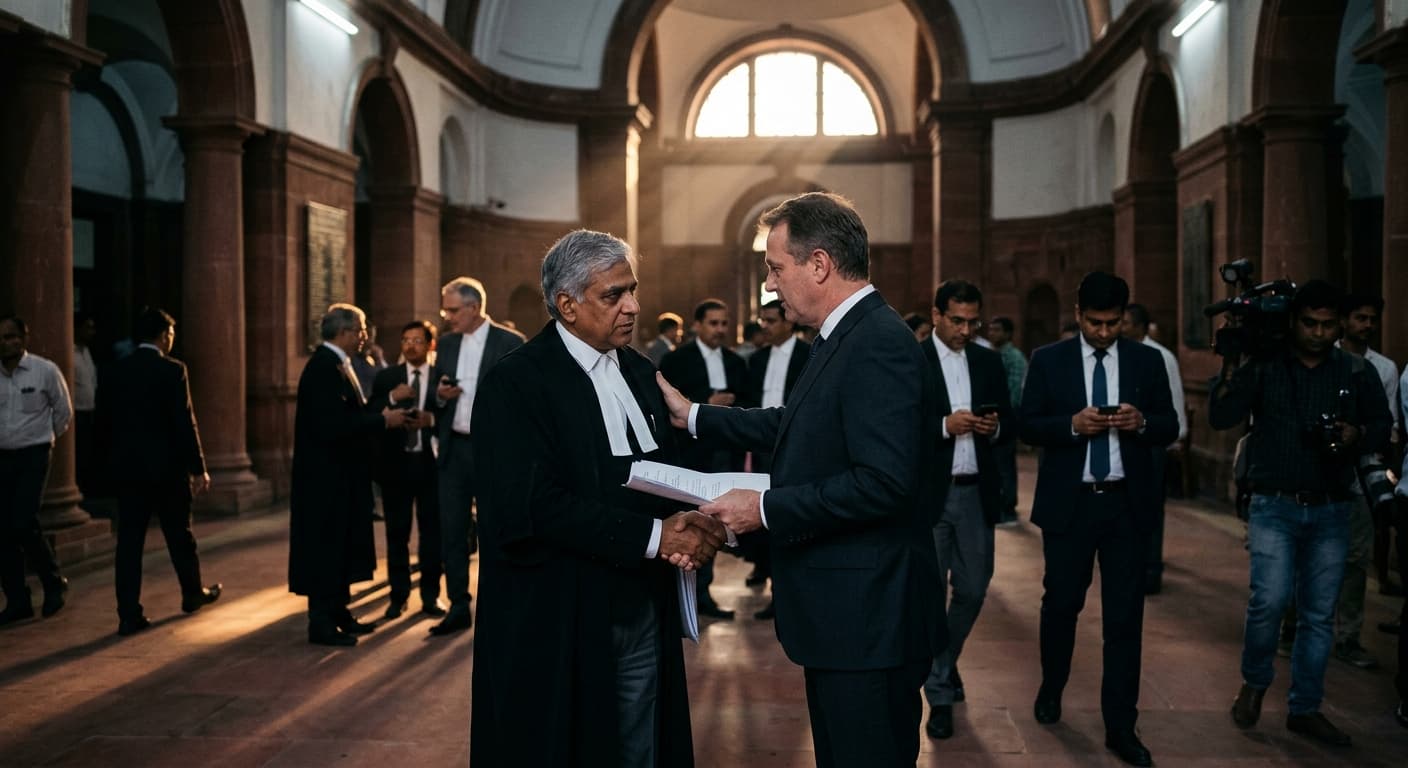
India's Supreme Court Restores Merger Finality in Amazon Ruling
India's top court struck down a $21 million CCI penalty on Amazon, imposing a strict one-year limit on antitrust reviews and resetting foreign M&A rules.
On May 27, 2026, a bench of the Supreme Court of India threw out the Competition Commission of India's INR 202 crore (roughly $21 million) penalty against Amazon.com NV Investment Holdings LLC over its 2019 investment in Future Coupons — and in doing so, quietly did something no legislative amendment had achieved. It converted the CCI's cleared merger approvals from provisional political documents back into what the Competition Act, 2002 says they are: final, time-bound, and immune from indefinite second-guessing. The immediate loser is a regulator that had grown accustomed to reopening its own decisions when the underlying transaction became inconvenient. The immediate winner is every foreign strategic acquirer contemplating an Indian deal — at a moment when India is watching net FDI slow and outbound M&A boom.
That is the story worth telling. Not the reversal of a fine, but the closing of a loophole that had turned Indian merger control into a moving target for cross-border deals — and a template other emerging-market competition regulators had been watching closely.
What the Court actually did
The judgment in Amazon.com NV Investment Holdings LLC v. Competition Commission of India (2026 INSC 576) unwound a four-year enforcement arc. The CCI had cleared Amazon's acquisition of a 49% stake in Future Coupons Private Limited on November 28, 2019 under Section 31(1) of the Competition Act. Two years later, after Future Group's own affiliate complained, the CCI issued its December 17, 2021 order, penalising Amazon INR 200 crore under Section 43A (failure to notify), INR 1 crore each under Sections 44 and 45 for alleged misrepresentation and suppression, kept its own approval order "in abeyance," and directed Amazon to refile in the longer Form II. The National Company Law Appellate Tribunal (NCLAT) largely upheld that structure in June 2022, according to a detailed procedural reconstruction by CMS INDUSLAW.
The Supreme Court rejected the entire edifice. Its ruling turns on four points, each with statutory bite:
- One-year jurisdictional bar. The proviso to Section 20(1) of the Competition Act states that "the Commission shall not initiate any inquiry under this sub-section after the expiry of one year from the date on which such combination has taken effect," according to the
text of the Act as published by PRS Legislative Research. The Court held that residuary powers cannot be used to walk around that bar.
- No abeyance power. Nothing in the Act permits the CCI to suspend its own approval order and demand a fresh Form II filing for the same combination, according to a case note by
PJ Law Offices.
- Strict construction of penal sections. Sections 43A, 44 and 45 are penal and cannot be triggered by a regulator's preference for different labelling; there must be a demonstrable, material, wilful omission.
- Natural justice. The show-cause notice did not put Amazon on notice that abeyance and re-filing were on the table — a due process breach that vitiated the order.
The Court ordered the deposited penalty refunded with interest within eight weeks, per a summary in Competition Monthly, June 2026. Amazon walks away with cash and vindication; the CCI walks away with a doctrine that will constrain its enforcement posture for at least a generation of deals.
Why this matters beyond Amazon
The CCI is not a marginal regulator. Its own press briefing reported that the Commission registered 54 antitrust cases and received 149 merger filings in 2025, per a Press Information Bureau release dated February 9, 2026. The Competition (Amendment) Act, 2023 raised penalty ceilings to 10% of global turnover — a European-style number that turns any post-hoc reopening of a cleared deal into a potentially existential event for the target, according to the
amendment text. For a company like Amazon, whose worldwide revenue puts even a fractional penalty in the billions, the calculus is not marginal — it drives the decision on whether to file, and on what.
Against that backdrop, the CCI's Amazon order had established a de facto power the statute never granted: freeze an approval, demand a resubmission, and hold the target in regulatory limbo while a downstream dispute played out. In this case the downstream dispute was Amazon's parallel arbitration battle to block Reliance's $3.4 billion takeover of Future Retail — a fight Al Jazeera reported had sent Future Group shares up nearly 20% the day the CCI order landed in December 2021. That was not a coincidence: the CCI's suspension gave Reliance a clean lane to buy Future's assets, only for Reliance to abandon the deal in April 2022 after Future's own secured creditors voted it down, as reported by
Bloomberg via Al Jazeera.
Whatever one thinks of that commercial battle, the enforcement tool the CCI improvised — suspend-and-refile — is now off the table for every combination going forward. That is the doctrinal change worth tracking, and its beneficiaries are not primarily American.
The named winners and the named losers
The direct winner is Amazon, which recovers cash and closes a five-year regulatory wound. But the deeper winners are the two categories of dealmakers most exposed to reopening risk: large foreign strategic acquirers and private equity roll-ups that stitch together interconnected transactions across group entities. Both had watched the Amazon precedent and priced Indian regulatory risk accordingly. As Whalesbook's analysis of the ruling notes, the decision "ensures regulatory finality for M&A activity, helping companies and foreign investors plan with greater certainty, though it may lead to stricter initial scrutiny of proposed transactions."
The direct loser is the CCI, whose December 2021 order was, in retrospect, the high-water mark of its willingness to be used as a lever in downstream commercial disputes. A secondary loser is Future Group itself, whose complaint triggered the CCI proceeding — the ruling reframes that complaint as a private grievance mistakenly weaponised through public enforcement. And the domestic incumbents who benefited from the abeyance strategy in adjacent industries — telecom, retail, digital payments — lose the option to invoke competition proceedings as tactical brakes on cleared foreign investments.
There is a subtler loser worth naming: the CCI's own reputation for predictability, which the Court's ruling implicitly re-anchors to statute rather than to enforcement improvisation. CSIS analysts have long argued that India's biggest deterrent to foreign investment is not tax rates or tariffs but regulatory unpredictability, warning in a policy brief that "consistent and transparent regulation is fundamental to making large investments." The Amazon judgment is a rare piece of counter-evidence pointing the other way.
The context: FDI is slowing, and courts are the swing variable
The ruling lands in a specific macro moment. India's net FDI has been under pressure, and the BBC reported in June 2026 that 162 Indian companies spent more than $18 billion on outbound acquisitions in 2025 — a 34% jump over 2024, citing Grant Thornton data — precisely as domestic private investment stayed weak. Indian capital is voting with its feet; foreign capital is watching how India's institutions treat foreign investors before it commits fresh cheques.
That backdrop makes the Supreme Court the swing variable, and its recent record is mixed. The same Court that just rescued Amazon also delivered the January 15, 2026 Tiger Global ruling forcing the US private-equity firm to pay Indian tax on its 2018 Flipkart exit — a decision the BBC reported has "raised concerns around future sales of investments for private equity funds or foreign direct investment routed through" Mauritius, whose entities accounted for roughly $180 billion in cumulative Indian FDI between 2000 and March 2025. The Court is not reflexively pro-foreign-investor; it is pro-statute. Where the statute imposes a clear limit — as Section 20(1) does — foreign investors win. Where the statute grants wide sovereign discretion — as tax treaty law does — they lose.
The pattern is worth internalising. A pending Supreme Court challenge to CCI's 2024 Meta/WhatsApp order, in which the Commission fined Meta $25 million and imposed a five-year data-sharing ban, will be the next test. The BBC reported that in March 2026 WhatsApp told the Court it would comply with data-sharing remedies by March 16, but the underlying penalty remains contested. Whether the Court applies its Amazon-style statutory literalism to the digital-competition context — or defers to the CCI on newer, less-tested provisions — will determine how much of the Amazon ruling generalises.
The historical parallel that reframes this
The closest analogue is not Indian but American: the 1969 Cargill Inc. line of cases that eventually forced the US Federal Trade Commission to accept that cleared mergers could not be reopened years later on new theories without fresh evidence of new harm. It took the American antitrust system roughly two decades to develop the doctrine of finality that the Indian Supreme Court has now imposed in a single judgment. The compressed timeline reflects an institutional reality: Indian merger control is young — the Competition Act, 2002 was enforced in earnest only from 2011 — and the CCI has been simultaneously building capacity and testing the outer bounds of its powers. The Amazon ruling is the first authoritative statement of where those bounds lie.
A parallel closer to home: the SSRN case study of the Jio/TRAI/CCI dispute traced how the Supreme Court has repeatedly had to demarcate the CCI's jurisdiction against sectoral regulators. The pattern is consistent — the Court trims CCI ambition when statute is explicit, defers when it is not.
Diplomat View
The Amazon ruling is not, as some commentary suggests, a broad rebuke of aggressive Indian antitrust. It is a narrow, textualist correction. The CCI still has all its Section 27 penalty powers, its expanded 10% global-turnover ceiling under the 2023 amendments, and its full pre-clearance investigative arsenal. What it has lost is the ability to reopen approved combinations after the one-year window, and the ability to keep approvals "in abeyance" as a coercive tool.
Our forecast: expect three concrete shifts in the next 12 months. First, Form II filings will rise as a share of combination notifications — the CCI will front-load scrutiny it can no longer perform on the back end. Second, deal timelines will lengthen at the pre-clearance stage, particularly for interconnected transactions involving multiple group entities. Third, the ruling will be cited in the pending Meta/WhatsApp Supreme Court challenge and in any future CCI proceeding that alleges post-approval defects — the doctrinal centre of gravity has shifted.
What would change this forecast: an amendment to Section 20(1) extending the one-year bar, which the Ministry of Corporate Affairs could pursue if it decides the ruling has neutered enforcement. Watch the winter session of Parliament and the CCI's next annual report for signals.
Forward look — dates that matter
- March 2026 onwards: Supreme Court hearings continue in WhatsApp/Meta v. CCI on the $25 million data-sharing penalty; first test of whether Amazon-style statutory literalism extends to digital-competition provisions.
- August 1, 2026: SEBI's amended buy-back regime takes effect, per a
- Winter session of Parliament (late 2026): Watch for any Competition (Amendment) Bill seeking to extend or eliminate the Section 20(1) one-year bar. Absence of legislation confirms the Amazon ruling as durable doctrine.
The Bottom Line
The bottom line: India's Supreme Court has not softened antitrust enforcement — it has forced it back inside the statute. For foreign acquirers, the message is that cleared deals are now genuinely cleared; for the CCI, the message is that regulatory improvisation ends where the Competition Act's text begins. That single line of doctrinal discipline may do more for India's foreign-investment climate than any budget announcement in 2026.
Discover more

US Politics
SNAP Food Assistance Faces Legal Challenges
In 2026, SNAP faces stricter eligibility rules and mounting legal challenges, threatening food assistance for the millions of Americans who rely on the program.
US Politics
Congress Targets AI Chatbot Access for Terror
The House passed the Generative AI Terrorism Risk Assessment Act, focusing on AI's role in terrorism and potential surveillance implications.
India
Rajnath Singh's Durga Squad for 2026 Polls
Rajnath Singh's Durga Squad promised women's safety in Bengal but has since disappeared from the agenda, revealing BJP's true priorities.

Economics
Fed's Amex AML order puts correspondent banking on notice
Federal Reserve's Amex AML order requires board-level controls and a 90-day plan; OCC fined the bank $350 million over enterprise-wide deficiencies.