India Supreme Court Adds 4 Judges for Justice
Four new judges added to address 93,000 pending cases.
Model Diplomat8 min readAsia
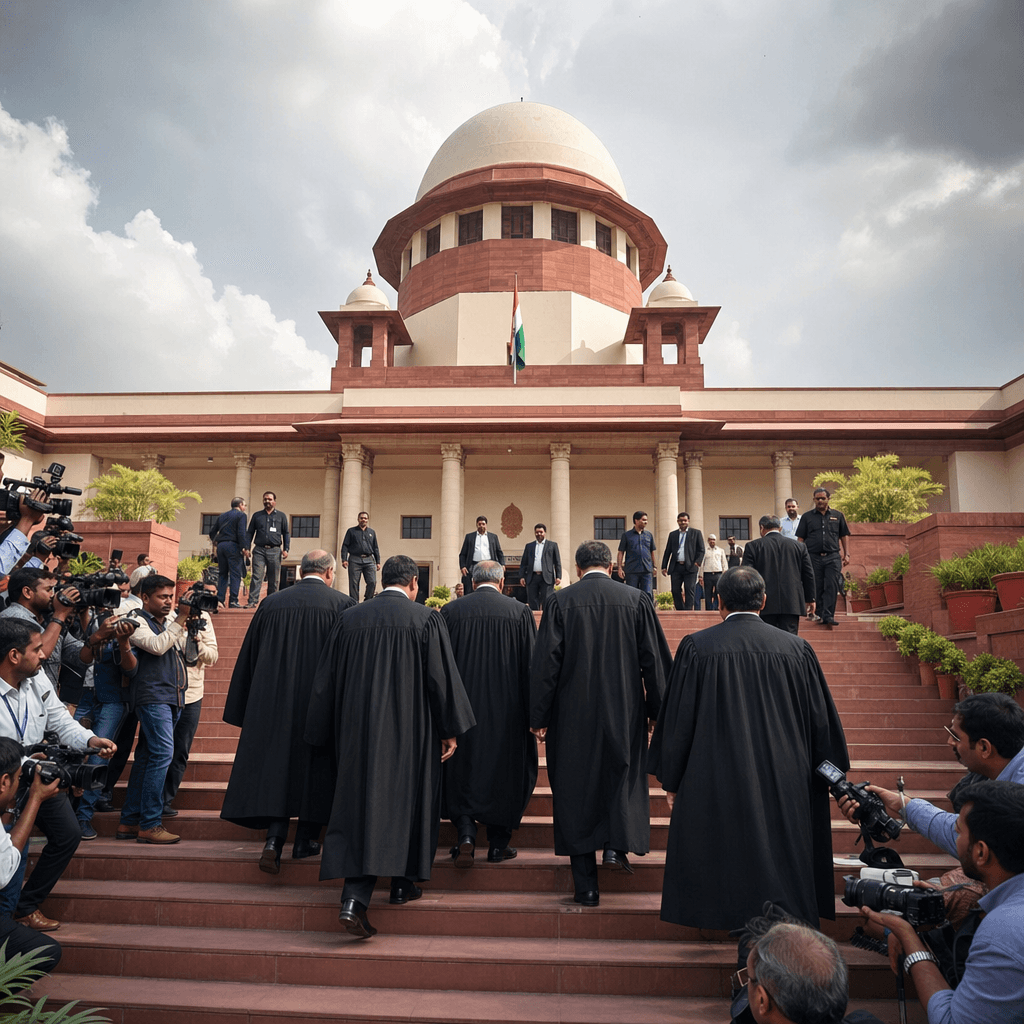
India Adds 4 Supreme Court Judges to Tackle 93,000-Case Backlog
India's Supreme Court expands from 34 to 38 seats via a May 16, 2026 ordinance — a bid to clear a 93,000-case pile-up and reset judiciary–executive relations.
The Union Cabinet's decision to enlarge the Supreme Court of India by four judges — cleared on May 5, 2026, promulgated by President Droupadi Murmu on May 16 as an ordinance, and operationalised on June 2 when Chief Justice Surya Kant swore in five new judges — is the first expansion of the bench in seven years and the largest single addition since 1986. It is being sold as case-management. It functions as something more consequential: an unspoken truce in the decade-long war between the executive and the collegium over who controls appointments, purchased with four extra seats that both sides can populate without either surrendering doctrine.
The optics are about numbers. The politics are about who fills the chairs.
What actually changed on May 16
The Prime Minister's Office statement confirms the mechanics: Cabinet approved the Supreme Court (Number of Judges) Amendment Bill, 2026 on May 5, raising puisne strength from 33 to 37 and lifting total sanctioned strength — including the Chief Justice of India — from 34 to 38. Rather than wait for Parliament, the government moved by ordinance under Article 123 of the Constitution while both houses were in recess. The Ministry of Law and Justice notified the amendment on Saturday, May 16, according to
The Economic Times, and the change took effect immediately.
Union Law Minister Arjun Ram Meghwal said the ordinance amended the Supreme Court (Number of Judges) Act, 1956, which had originally capped puisne judges at 10. That statutory ceiling has been raised in steps — 13 in 1960, 17 in 1977, 25 in 1986, 30 in 2009 and 33 in 2019. The 2026 amendment is the seventh expansion and the first under Chief Justice Surya Kant, who took office in November 2025.
Seventeen days after the ordinance, on June 2, 2026, five new judges were administered the oath, The Hindu reported, taking working strength to 37 against the new sanctioned 38 and leaving one vacancy. Justice V. Mohana was among those sworn in. The paper noted the elevation round was "expected to balance regional representation and enhance gender diversity on the Bench" — a signal that CJI Surya Kant's collegium used the expansion to place appointments that had been in the pipeline before parliamentary passage could complicate them.
The 93,000 problem
The government's justification is unambiguous. The Prime Minister's Office framed the move as necessary to "amend The Supreme Court (Number of Judges) Act, 1956 for increasing the number of Judges." The Hindu reported the ordinance was "intended to help the Court tackle its mounting backlog of more than 93,000 pending cases and facilitate the more frequent convening of Constitution Benches." That figure has climbed steadily — the
Press Information Bureau recorded 70,154 cases pending at the Supreme Court as of March 25, 2022. Almost a third has been added in four years.
The structural picture is worse. A data-driven study of over a million Supreme Court cases by Aparna Chandra, Sital Kalantry and William H.J. Hubbard, summarised by the BBC, found that by November 2018, 40% of cases at the court had been pending more than five years — up from 7% in 2004. Constitution Bench matters — the ones that decide the meaning of the Constitution itself — were on average waiting more than eight-and-a-half years; seven-judge benches, more than 16. Across the wider judiciary,
government-cited textbook data put pendency at more than 53 million cases in Indian courts.
Chief Justice T.S. Thakur made the arithmetic explicit in a 2016 plea to Prime Minister Narendra Modi, telling the BBC that each Indian Supreme Court judge processed about 2,600 cases a year against just 81 for a U.S. Supreme Court Justice. Four extra judges — or five, given the one vacancy still to be filled — will not close a 93,000-case gap on their own. Even if the new strength were fully staffed, per-judge caseload would fall by roughly 12%. The reform is directional, not decisive.
Why the ordinance route matters
The more revealing choice is procedural. Parliament's Budget Session, 2026 was adjourned sine die on April 18, 2026, according to the Press Information Bureau, and the Monsoon Session had not yet convened. Article 123 lets the President legislate by ordinance during recess when "circumstances exist which render it necessary… to take immediate action." The Supreme Court's own jurisprudence — the 2017 Krishna Kumar Singh v. State of Bihar ruling, analysed in the
Indian Law Review — held that the executive's satisfaction about necessity is justiciable and that repromulgation is impermissible. The government therefore has one shot: convert the ordinance into a statute in the Monsoon Session or watch it lapse.
Two things follow. First, the government has committed itself to legislative action within roughly six months of Parliament's next sitting — Article 123(2) provides that an ordinance ceases to operate six weeks after Parliament reassembles unless enacted. Second, by moving in May rather than in July, the Centre gave the collegium a running start to fill seats before any parliamentary debate could reshape the political frame around the expansion. Five judges were sworn in exactly 17 days after the ordinance — fast even by Indian standards, given that appointments since 2015 have averaged 285 days between vacancy and appointment.
The collegium subtext
That speed is the story within the story. Since the Supreme Court struck down the National Judicial Appointments Commission Act in October 2015 — a judgment defended in an SSRN analysis as a reassertion of judicial supremacy without global parallel — the Modi government and successive collegiums have fought a low-intensity war over who really picks India's judges. Law Minister Kiren Rijiju called the collegium "opaque and not accountable" in 2023, telling the
BBC that "across the globe judges do not appoint judges. But in India, they do." Former Supreme Court judge Madan Lokur has accused the government of "playing games" by stalling recommended names.
Four new seats defuse this fight, at least temporarily. The government does not have to block collegium names to keep its preferred candidates in the queue; the collegium does not have to escalate a public row every time a recommendation is delayed. Both sides gain slack. As Arghya Sengupta of the Vidhi Centre for Legal Policy told the BBC, "tinkering with the collegium won't do" — but tinkering with the number of seats it has to fill produces the same short-run peace, without the constitutional confrontation NJAC provoked.
That peace has a beneficiary. Chief Justice Surya Kant, who took office in November 2025 and will retire in February 2027, gets to shape the composition of the court he inherits — from the nine-judge Sabarimala constitutional bench he set up in early 2026, reported by the BBC, to the contempt proceedings he opened against NCERT over a school textbook that referenced
judicial corruption. A 38-judge bench under an activist CJI has more capacity to sit constitutional benches. It also concentrates more institutional power in one office.
Who wins, who doesn't
The clearest institutional winner is the collegium itself. Its recommendations have historically moved in batches — 81 of the last 100 Supreme Court appointees came in groups of two to five, per University of South Carolina scholar Rahul Hemrajani — and the ordinance permitted a batch of five to be cleared at once.
Litigants are the second-order beneficiaries, but modestly. Backlog reduction depends less on marginal capacity than on procedural reform. The government's own analysis has long identified frequent adjournments, indiscriminate use of writ jurisdiction, and appeals against quasi-judicial forums as key drivers of pendency — none of which the ordinance touches.
The high courts lose leverage. India's high court judges numbered 699 against 1,104 sanctioned seats in March 2022 — a 37% vacancy rate. The Allahabad High Court alone has
over a million cases pending. Expanding the Supreme Court while high courts remain gutted risks pulling more talent upward and leaves the pyramid's base thinner.
Structural reformers lose too. The NJAC judgment held that any executive role in appointments violated judicial independence. If four extra chairs quietly resolve the appointments backlog, the political case for a Fifth Judges' Case — or a constitutional amendment fixing the collegium's opacity — weakens.
Diplomat View
The 2026 expansion will be remembered less for the four seats than for the truce it purchases. The government secured a bill it can pass with limited opposition; the collegium secured space to move names it had been holding; Chief Justice Surya Kant secured a court closer to his design. What the expansion does not do is confront the two structural facts that produced the 93,000 backlog: an appellate jurisdiction the BBC-cited scholars argue should be radically narrowed, and a collegium process the
Vidhi Centre argues must be replaced, not enlarged.
Our call: the truce holds through the Monsoon Session and the bill passes in substantially the form of the ordinance. It would be revised if — and only if — the opposition uses the debate to relitigate NJAC, or if the government tries to attach a Memorandum of Procedure change that reopens the appointments question. Neither looks likely before December 2026. If pendency has not fallen materially by mid-2027, expect renewed calls to trim the Supreme Court's discretionary Article 136 appellate jurisdiction — the structural fix an expansion of the bench is designed to defer.
What to watch next
- Monsoon Session, 2026 (July–August): The Supreme Court (Number of Judges) Amendment Bill, 2026 must be enacted before the ordinance lapses six weeks after Parliament reassembles.
- Sixth appointment: With one vacancy remaining after the June 2 swearing-in, the collegium's next recommendation and the Centre's turnaround time will signal whether the détente holds.
- February 2027: CJI Surya Kant retires. His successor's approach to the Sabarimala nine-judge bench and to a fuller 38-judge court will determine whether the 2026 expansion delivered on backlog or merely on politics.
The Bottom Line
India did not expand its Supreme Court to add four judges — it expanded to buy peace between an assertive executive and an insulated collegium without either surrendering doctrine. The 93,000-case backlog is the justification; the real product is procedural détente under Chief Justice Surya Kant, purchased at the cost of deferring the structural reform of appellate jurisdiction and appointments that everyone agrees the court actually needs.
Discover more

India
India-South Korea $50B Trade Expansion Plan
India and South Korea target $50 billion in bilateral trade by 2030, focusing on industrial cooperation and strategic alignment amid US pressures.

Conflict & Security
Drone Warfare Killing Aid Workers at Unprec
Over 1,000 humanitarian workers killed in three years as cheap armed drones collapse legal protections. Gaza, Sudan, Ukraine, and DRC see deliberate targeting of aid convoys and hospitals with zero prosecutions.

Global
World Normalises Taliban as Afghan Women Eras
UN data shows Afghan women erased from public life as Russia recognises the Taliban, EU hosts officials in Brussels, and ICC warrants for gender persecution go unenforced.

Conflict & Security
West Africa Food Crisis: Three Shocks in 2026
Conflict, climate extremes, and the Strait of Hormuz closure drive a severe food crisis in West and Central Africa, with fertilizer prices surging 80% and millions displaced.