India and Japan Lead AI Ethics Dialogue
Moragoda proposes a new ethics framework for military AI.
Model Diplomat3 min readAsia
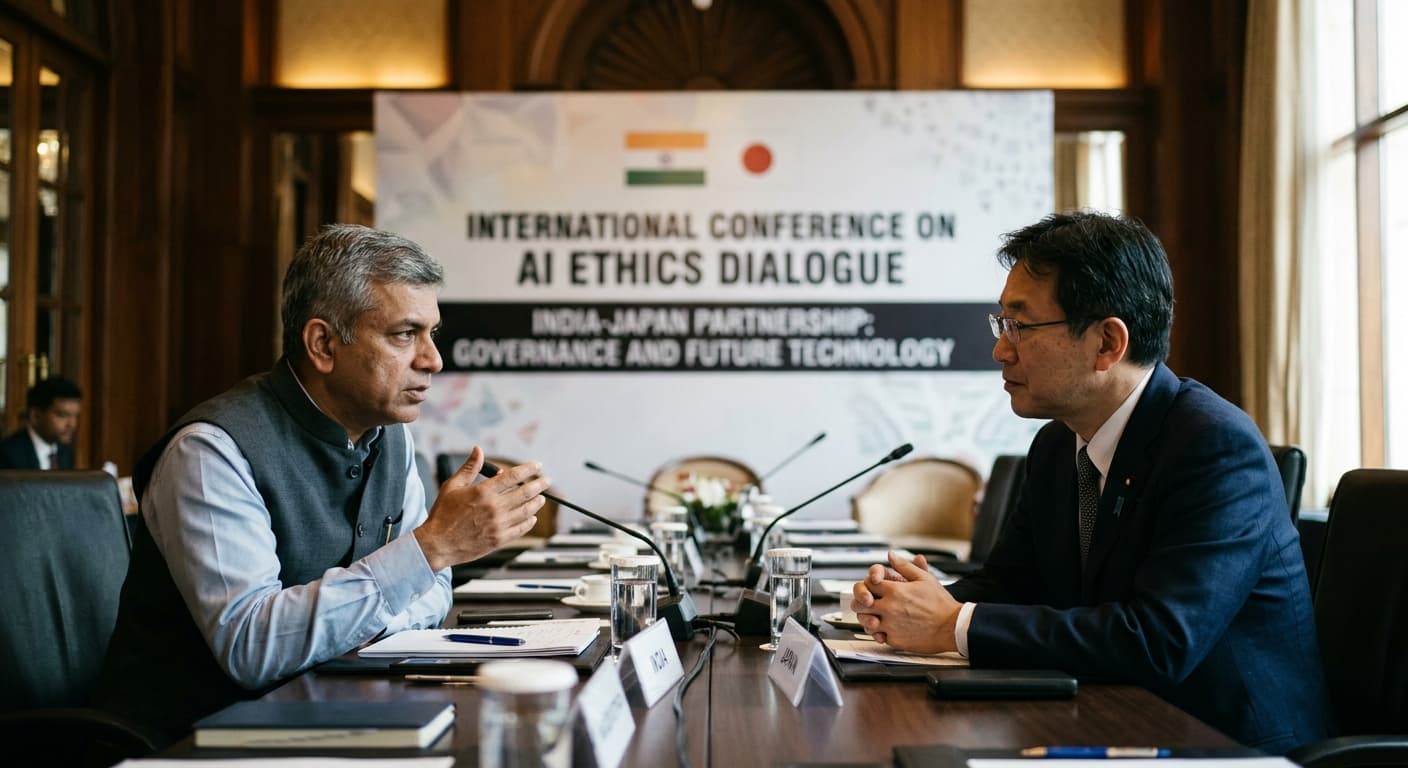
India and Japan Chart Ethics Route as AI Supplants Diplomacy
Moragoda argues AI's entry into military and surveillance systems risks moral detachment—proposing New Delhi and Tokyo lead a new ethics dialogue
Milinda Moragoda's argument in The Hindu cuts to the core of why AI governance has become a power problem, not just a technology one. The global order is drifting toward an amoral realism in which states deploy AI for lethal and coercive ends—from autonomous weapons to algorithmic target selection—without the ethical restraints that once moderated state power. The risk is not technical failure, but the outsourcing of judgment: human empathy and accountability collapsing into algorithmic efficiency.
What makes the analysis distinctive is its prescription: Moragoda calls for India and Japan to convene an international dialogue on military AI norms, humanitarian principles for sanctions and coercion, and accountability standards that keep technological competition from eclipsing human responsibility. This is not naïve; it acknowledges that great-power rivalry will persist. The wager is that legitimacy matters—that power divorced from moral constraint ultimately destabilizes the order it claims to protect.
Why This Matters Now
Moragoda's framing arrives at a moment when the AI governance conversation has shifted dramatically from principle to naked competition. Stratheia's analysis observes that AI has become "a critical determinant of national power," comparable to nuclear technology in the 20th century or industrialization in the 19th. The United States and China are locked in strategic rivalry over semiconductor supply chains, compute capacity, and frontier models—with technology policy now indistinguishable from foreign policy.
The twist: India is emerging as a third actor with unexpected leverage. Al Jazeera's coverage of India's AI Impact Summit in February 2026 documented how New Delhi repositioned itself as a "bridge between advanced economies and the Global South," securing endorsement of a non-binding "Delhi Declaration" from 92 countries, including the US, China, and the EU.
Brookings noted that India's approach emphasizes "managed interdependence"—leveraging digital public infrastructure and linguistic diversity rather than pursuing full-stack AI sovereignty it cannot afford.
Japan, meanwhile, has already adopted a "soft-law" governance model emphasizing voluntary industry compliance over binding rules. CSIS analysis notes Japan is positioning itself as a "model for the world," coordinating with the Global South through the Quad mechanism and the Hiroshima AI Process. Both countries share democratic cultures, concern for human rights, and skepticism of American unilateral dominance—and neither leads the race for AI supremacy.
The Accountability Gap
The deeper issue Moragoda identifies is the absence of human judgment in systems of state coercion. When machine-learning algorithms influence targeting decisions, classify terrorist suspects, or optimize sanctions regimes, responsibility dissolves. No engineer owns the decision. No commander bears full moral weight. The system becomes self-justifying: "The algorithm said so."
Moragoda argues this is normalized now. States deploy autonomous weapons, surveillance AI, and algorithmic intelligence analysis. The international legal frameworks that once discouraged certain uses of force rest on concepts—proportionality, discrimination, necessity—that require human deliberation. Algorithms optimize for efficiency, not ethics. The gap is widening as systems proliferate and states compete.
This is where the India-Japan partnership proposed by Moragoda gains purchase. Neither country is proposing to halt AI development or constrain great-power competition. Both are proposing to establish guardrails: norms for military AI comparable to the prohibitions on biological and chemical weapons; humanitarian criteria for economic coercion; transparency obligations that slow algorithmic automation enough for human review.
What to Watch
The proposal remains at the level of op-ed—not yet policy. But the conditions for it to gain traction are present. India's diplomatic standing on AI governance is high; Japan's experience with soft-law implementation is credible. The Paris AI summit last year was dominated by US warnings against "excessive regulation." The Delhi summit positioned Global South actors as co-authors rather than rule-takers.
The next inflection point is whether Japan-India coordinate on a concrete proposal—targeting a G20 statement, a UN framework, or a non-binding covenant that could bind voluntary participants. The challenge: the US and China are unlikely to accept constraints that reduce their strategic options. But if India leverages its bridge position and Japan its model-setting authority, they might create sufficient political cost for defection that even great powers have to negotiate the terms of their technological competition.
The deeper question Moragoda leaves unanswered: whether states will tolerate constraints on AI when they believe rivals will not. That question will define whether the 21st century becomes a concert of ethical restraint or a race to the algorithmic bottom.
Discover more

India
India-South Korea $50B Trade Expansion Plan
India and South Korea target $50 billion in bilateral trade by 2030, focusing on industrial cooperation and strategic alignment amid US pressures.
US Politics
Congress Targets AI Chatbot Access for Terror
The House passed the Generative AI Terrorism Risk Assessment Act, focusing on AI's role in terrorism and potential surveillance implications.
India
BJP's Misunderstanding of Women's Quota Needs
The BJP's linking of the Women Reservation Bill to delimitation risks delaying women's empowerment in India, misreading the aspirations of female voters.

Conflict & Security
Drone Warfare Killing Aid Workers at Unprec
Over 1,000 humanitarian workers killed in three years as cheap armed drones collapse legal protections. Gaza, Sudan, Ukraine, and DRC see deliberate targeting of aid convoys and hospitals with zero prosecutions.