IMO Halts Hormuz Evacuation After Attack
UN pauses evacuation plan after vessel hit, revealing tensions.
Model Diplomat3 min readMiddle East
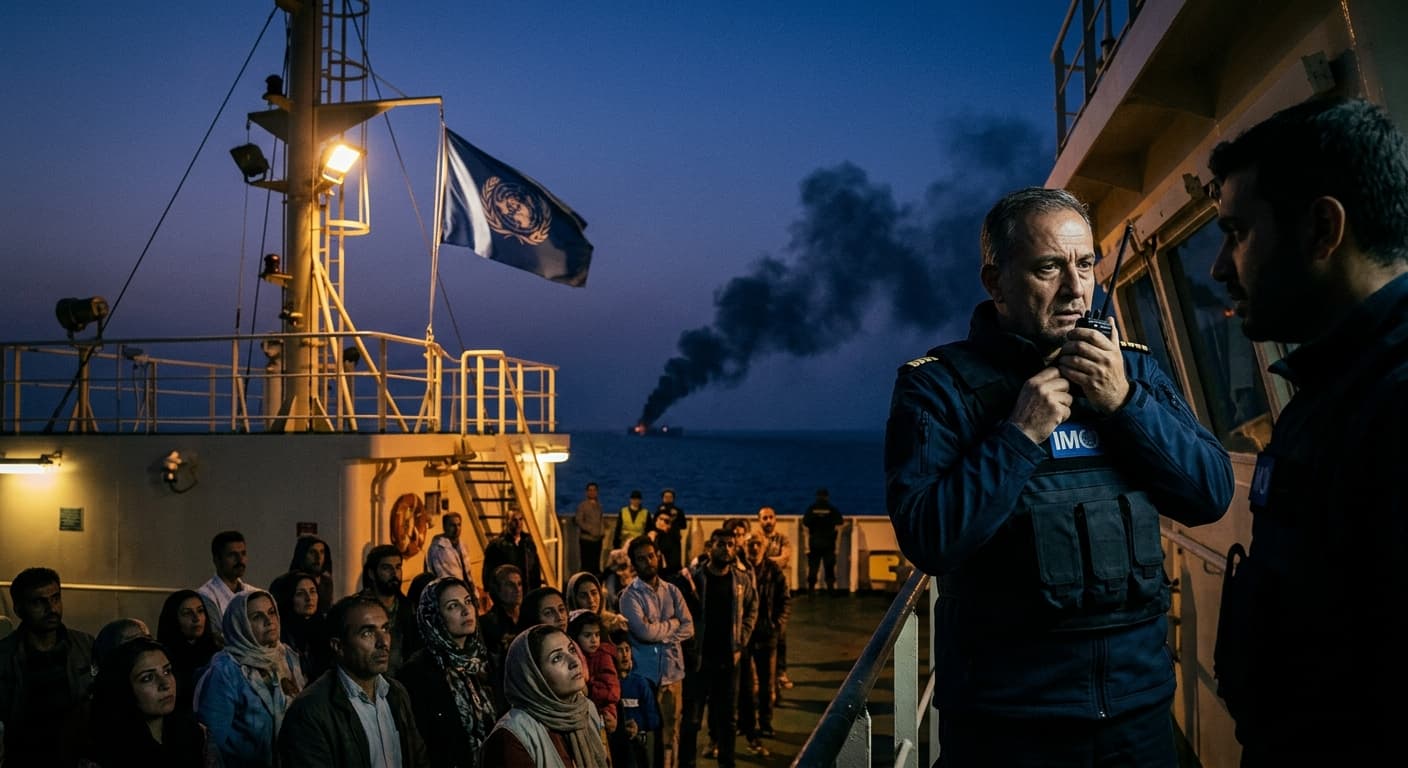
IMO Halts Hormuz Evacuation After Attack, Exposing Iran-US Deal Fracture
UN-led plan to free 11,000 stranded seafarers pauses after vessel hit; IRGC asserts exclusive route control, deepening rifts over strait's future governance.
The United Nations maritime agency has temporarily halted its emergency evacuation of over 600 vessels and 11,000 seafarers from the Strait of Hormuz after a cargo ship was struck by a projectile on Thursday, exposing fissures in the week-old ceasefire agreement between Washington and Tehran.
The International Maritime Organization paused its evacuation plan after learning that the Singapore-flagged Ever Lovely had been hit on its starboard side 7.5 nautical miles southeast of Oman's port of Dahit, according to the UK Maritime Trade Operations. Maritime security sources told Reuters the vessel was likely targeted by a drone, though the perpetrator remains unconfirmed. IMO Secretary-General Arsenio Dominguez announced the pause to "reconfirm that the necessary safety guarantees continue to be in place," though he stressed the agency had verified conditions before launching the operation on Tuesday.
The pause itself signals deeper trouble. The attack occurred as Iran's Islamic Revolutionary Guard Corps publicly rejected the evacuation framework, declaring that only Tehran-authorized routes were valid for commercial shipping and that "action will be taken against violating vessels." This directly contradicted assurances from IMO leadership, which stated the operation was conducted "in close cooperation with Iran, Oman, all other coastal states in the region, the US and the maritime industry."
The Real Dispute: Route Control and Leverage
The IRGC's move reveals a power struggle within Iran's post-war establishment. The evacuation plan offered two temporary corridors—a northern route through Iranian waters and a southern route through Omani territorial waters under US oversight. The IRGC asserted exclusive control, calling the Oman-IMO arrangement "unacceptable and completely dangerous" and issued radio warnings to vessels, with one Revolutionary Guard soldier telling a tanker: "you are in range of my missiles and maybe (I) fire on you," according to security firm Ambrey.
The Guard's opposition stands in stark contrast to Iran's own government, which had agreed to the evacuation arrangement just days earlier. The IRGC has emerged as the chief skeptic of US-Iran concessions. By unilaterally asserting route control, the Guard protects Iranian leverage over the waterway during the 60-day negotiating window for a permanent deal—the cornerstone leverage Tehran needs as it bargains over nuclear restrictions and regional security.
The stakes are concrete. Before the February 28 war began, the strait carried roughly one-fifth of global oil consumption. US Energy Secretary Chris Wright reported 72 ships transited on Wednesday, carrying 20 million barrels of crude—still far short of pre-war average transit of 130 vessels daily. Long-term control of the waterway determines not just shipping fees (which
President Trump has already called a "red line") but Tehran's strategic position in any final ceasefire agreement.
What Breaks the Deadlock
The attack on Ever Lovely may serve as a clarifying event—either a warning shot by the IRGC to demonstrate it controls the waterway, or a test to see whether the evacuation framework would hold under pressure. IMO's pause suggests it will not, absent fresh Iranian assurances. Oman, which has positioned itself as mediator and co-sponsor of the southern corridor, agreed this week to establish a joint working group with Iran over the strait's future management—a hedge against this exact scenario.
Watch for whether the IMO resumes evacuations by end of June. A resumption signals either that Iran's civilian government overrode IRGC objections or that the Guard is content to allow controlled traffic while maintaining its assertion of route supremacy. A continued pause signals that the ceasefire itself is vulnerable to collapse before negotiators reach a permanent deal. The next test: whether 600 trapped vessels remain trapped or whether the narrow Oman corridor can absorb volume without triggering another confrontation.
Discover more

Global Politics
US Seizes Iranian Ship, Tensions Surge
The US seizure of the Iranian ship Touska highlights a shift in control over the Strait of Hormuz, favoring Iran's strategic position.

India
Women's Reservation Bill 2026: A Political Sh
India's Lok Sabha rejected the Women's Reservation Bill, exposing a political maneuver to redraw electoral maps favoring the north over the south.

US Politics
Virginia GOP Rallies Rural Voters Against Red
Virginia Republicans are mobilizing rural voters against a Democratic-led redistricting referendum, a fight seen as pivotal to control in the 2026 midterms.

Conflict & Security
Drone Warfare Killing Aid Workers at Unprec
Over 1,000 humanitarian workers killed in three years as cheap armed drones collapse legal protections. Gaza, Sudan, Ukraine, and DRC see deliberate targeting of aid convoys and hospitals with zero prosecutions.