IMF Warns Nigeria's Growth Bypasses Poor
IMF's forecast highlights Nigeria's growing poverty crisis.
Model Diplomat8 min readSub-Saharan Africa
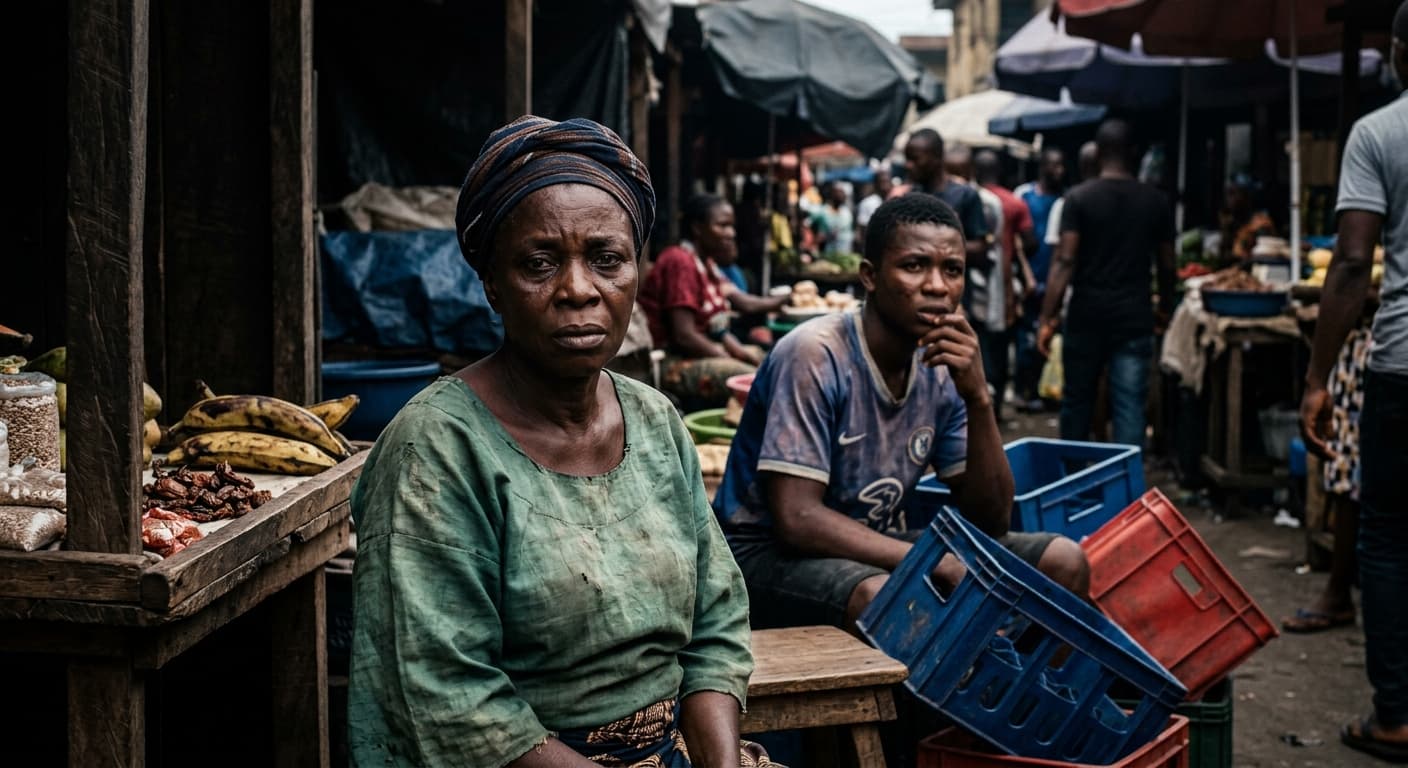
IMF warns Nigeria's macro rebound is bypassing its poor
The IMF held Nigeria's 2026 growth forecast at 4.1% but warned that higher fuel and food prices will deepen a poverty crisis already affecting 63% of Nigerians and 27 million food-insecure people.
Nigeria's economy will grow 4.1% in 2026 and 4.3% in 2027, the International Monetary Fund confirmed in its July 2026 World Economic Outlook Update released on July 8 — but the same document flagged that higher prices of essential commodities will "worsen poverty and food insecurity" in Africa's largest economy. The gap between Nigeria's headline numbers and its households is now the story: reserves are at a 13-year high, the naira has stabilized, oil is trading near $89 a barrel — and yet a fresh Cadre Harmonisé survey counts 17 million northerners in crisis-or-worse hunger, up nearly two million on the previous projection. That divergence, not the growth rate, is what President Bola Tinubu's government must now manage.
What the IMF actually said — and where the warning bites
The IMF's July update is the second consecutive report in which Nigeria appears as a case study of macro-stabilisation running ahead of welfare gains. In opening remarks at the Washington briefing, Petya Koeva Brooks, deputy director of the IMF Research Department, told reporters a renewed escalation of the Middle East war would "reignite commodity price volatility, tighten financial conditions, strain policy buffers, and worsen food insecurity in low-income countries." The Fund's global reference forecast assumes the Strait of Hormuz begins reopening in mid-July 2026 and that Brent normalises by March 2027; oil is priced at an average of $89 per barrel for the year.
For Nigeria specifically, the underlying diagnosis was set out in more detail in the IMF's 2026 Article IV Staff Report, IMF Country Report No. 26/125, released on May 7. Staff estimate that the war shaved 0.3 percentage points off Nigerian growth in 2026 and pushed projected end-of-period inflation up to 17% — about three-and-a-half points above the pre-war disinflation path. Petrol prices rose 22.5% and diesel 16% in March 2026 versus pre-war levels; food inflation rebounded to 14.3% year-on-year from 12.1% the prior month.
The paradox is that the same oil-price channel that hurts households helps the sovereign. As TheCable reported, the Fund credits Nigeria with "improved terms of trade" from higher crude prices while warning that the pass-through to petrol and food will "aggravate poverty and food insecurity." The World Bank's April 2026
Nigeria Development Update put a number on the pass-through: a "50+% surge in PMS prices since the onset of the Middle East conflict."
The northern hunger crisis is the pressure point
The IMF's warning lands on top of an already-deteriorating food-security picture. The UN World Food Programme said in a May 2026 briefing from Damasak, Borno state that "conflict is driving hunger in some northern states of Nigeria to levels not seen in almost a decade." The most recent Cadre Harmonisé analysis — the government-endorsed food-security methodology used across the Sahel — found that 17 million people across nine conflict-affected northern states now face crisis, emergency or catastrophic hunger. That is an increase of almost two million since the previous projection.
The composition of the crisis is grim. Kinday Samba, WFP's regional director for West and Central Africa, said insurgent attacks and displacement, previously concentrated in the northeast, are "spreading across a much wider area." In Borno state alone, more than three million people are acutely food-insecure, including over 750,000 in severe hunger and more than 10,000 in catastrophic hunger — the last stop before famine classification.
Funding is collapsing at the worst possible moment: WFP can now support only 740,000 of the 6.2 million food-insecure people in three northeast states, down from 1.3 million at the peak of the 2025 lean season. That drop follows the Trump administration's roughly 75% cut to US aid contributions from February 2025, Al Jazeera reported, which shuttered more than half of WFP's nutrition clinics in the northeast by August. The agency now says it needs an additional $89 million over six months just to hold the line.
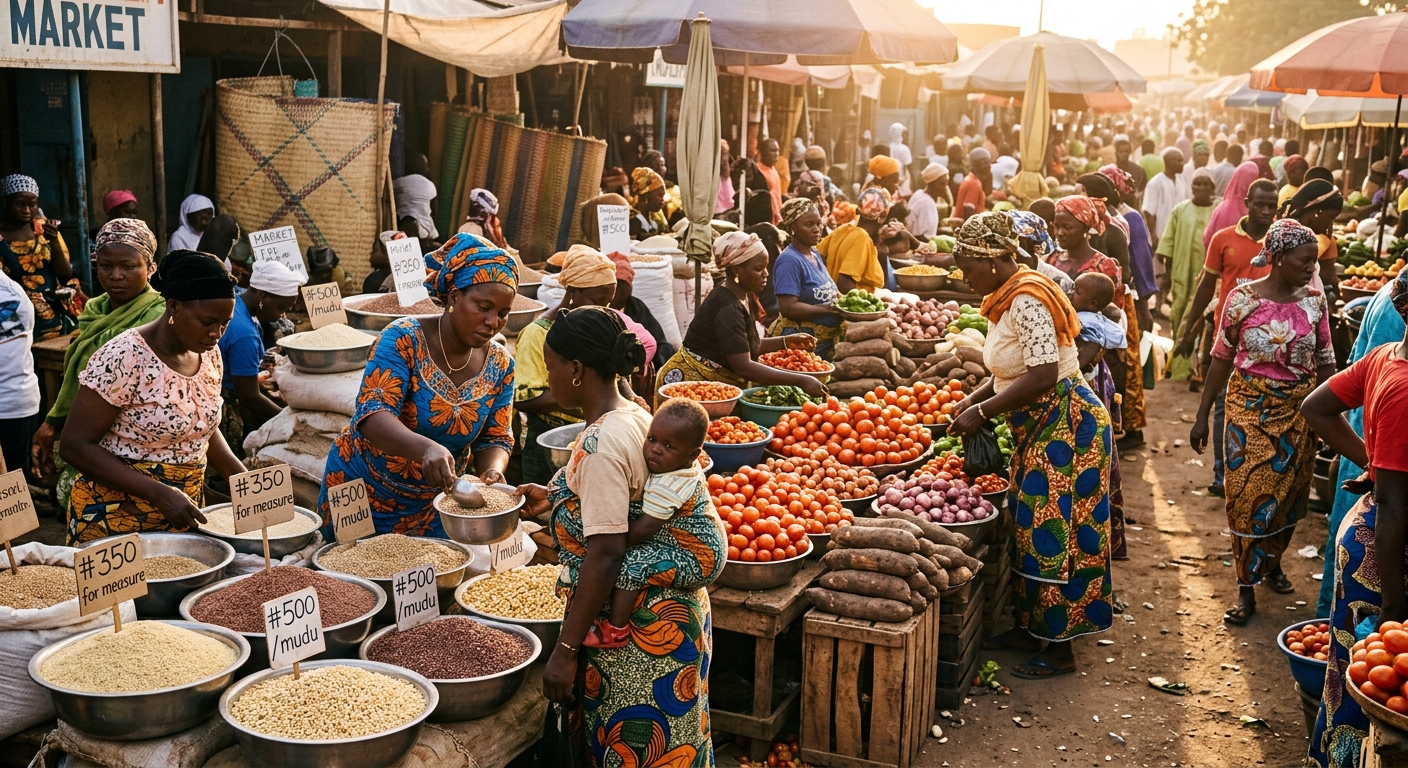
The transmission mechanism: fuel, fertiliser, food
Why does an oil-price spike hurt an oil exporter's poor? Three channels, all documented in the IMF's Nigeria Selected Issues paper published on June 9. First, the removal of the fuel subsidy in May 2023 severed the price buffer between global crude and domestic pumps. Petrol prices now track import parity in near-real time. Second, imported fertiliser has become materially more expensive, hitting agricultural yields in a country where food accounts for a large share of household spending. Third, the exchange-rate channel: as one
NARDL study covering January 2006–November 2025 found, exchange-rate movements — not the oil price itself — are the marginally significant transmitter of external shocks to Nigerian food inflation.
The Dangote refinery, which reached partial capacity in 2024–25 and is expanding towards 1.4 million barrels per day, has cut Nigeria's fuel import bill from about £8.2 billion to £4.7 billion, according to research published by LSE's Africa Centre. That has widened the current-account surplus and eased naira pressure, but domestic gantry prices at Dangote still track import parity: the refinery has re-plumbed the supply chain without decoupling it from world markets.
The fiscal squeeze is why cash transfers can't scale fast enough
The Fund's core policy prescription is to accelerate the cash-transfer program. That is where Nigeria is furthest behind. The IMF's Article IV report notes that 9.2 million households have been enrolled in the transfer system, against a target of 15 million, and those enrolled have received "at most a total of 3 transfers of naira 25,000 (~US$18) since 2023." That is roughly $6 per household per year of federally-financed relief for the median vulnerable Nigerian — while food inflation runs in double digits.
The binding constraint is fiscal. Interest payments absorbed 53% of federal government revenue in 2025, up from 41% in 2024, according to the IMF staff report. Public debt stood at ₦159.28 trillion at end-2025, roughly 39.4% of rebased GDP, per a Hequation Review paper by Olaniyi Evans. Debt-to-GDP is falling; debt-service-to-revenue is the binding constraint, and it is that ratio, not the headline stock, that determines how much room Abuja has to protect poor households from the price shock the IMF is now warning about.
President Tinubu has responded with new headline programs — the Renewed Hope Ward Development Programme targeting all 8,809 electoral wards, and a ₦50,000 uplift grant announced through the National Economic Council for 100,000 families per state, BBC Pidgin reported. The same government publicly
rejected a World Bank finding that 139 million Nigerians live in poverty, calling the figure an "exaggerated statistical interpretation." The Fund does not accept that framing: its Executive Directors' statement said bluntly that "poverty and food insecurity are likely to worsen in the current external environment."
The regional read: Sub-Saharan Africa's uneven windfall
Nigeria is the most-watched case in a broader pattern the IMF's April 2026 Regional Economic Outlook for Sub-Saharan Africa laid out clearly. Regional growth is expected at 4.3% in 2026, three-tenths of a point lower than the January projection, with median inflation ticking back up to 5.0% by year-end. Oil exporters — Nigeria, Angola, Republic of Congo — see stronger export revenues and fiscal windfalls. Oil importers and fragile states — Ethiopia, Kenya, Malawi, Sierra Leone, Zambia — face deteriorating trade balances and higher living costs.
The July update's regional refinement, laid out in the press briefing transcript, is that the shock has been "weathered better than feared," partly because renewable-energy penetration has softened oil-demand sensitivity. But the Fund's Africa desk is explicit that low-income and food-import-dependent countries retain the most downside risk — including from the parallel shock of donor retrenchment. As the IMF's own homepage now flags in its "Africa: Navigating Falling Aid" briefing, the aid cuts are "deep, broad, and driven by donors — leaving policymakers with few easy options."
What Nigeria can still do — the IMF playbook
The Fund's prescriptions, endorsed by its Executive Directors in the June 1 Article IV conclusion, are narrow and specific:
- A neutral fiscal stance in 2026. No pro-cyclical windfall spending; protect priority social outlays.
- Fund the cash-transfer system to reach the 15 million target. Staff explicitly warned that the "timing of reforms must consider the poverty and food insecurity situation."
- Complete tax reforms — VAT rate rise, telecom excises, rationalisation of VAT exemptions — to fund the transfer scale-up over the medium term.
- Sterilise FX inflows from higher oil prices to prevent second-round inflation.
- Keep policy rates positive in real terms. The Central Bank of Nigeria cut its Monetary Policy Rate by 50 basis points to 26.5% in February 2026 and lowered the Cash Reserve Requirement by 5 percentage points to 45%; the Fund signalled that path is now data-dependent.
The politically hardest of these is the tax reform, which Tinubu already had to shepherd through the National Assembly in 2025. The most operationally hard is the cash-transfer scale-up: as the World Bank's own implementation status report noted, only about 6 million households have received biometric-verified shock-responsive cash transfers under the National Social Safety Net Scale-Up as of July 2025, against a 9.2-million target for end-2025.
Diplomat View
The IMF's July 8 update does not change Nigeria's growth trajectory — it changes the political calculus around it. The Tinubu government now owns a stabilisation success that its own citizens cannot eat. Reserves at $46 billion, a 10% year-on-year naira appreciation and Dangote-driven current-account gains give Abuja unprecedented external buffers. The July WEO Update's implicit message is that those buffers must now be spent on the transfer register, not on election-year construction spending or a return to any form of blanket subsidy.
Our call: Nigeria's 2026 growth will land in the IMF's 4.0–4.2% band, but headline inflation will re-accelerate through Q4 2026 — probably to 17–18% year-on-year — before resuming its disinflation path in 2027 only if the Strait of Hormuz reopens on the Fund's assumed timeline. Poverty and food-insecurity numbers will get worse before they get better; the October 2026 Cadre Harmonisé projection is likely to show further deterioration in the northeast. We would revise this call if (a) Brent settles below $70 for a sustained period, (b) Tinubu allocates a materially larger cash-transfer envelope in the 2027 budget, or (c) a Middle East ceasefire holds beyond Q1 2027. We would not revise it on the basis of further NBS methodology changes to the CPI base.
The story is not the growth rate. It is whether an oil windfall reaches 15 million households before the next lean season begins in June 2027.
What to watch next
- October 2026 Cadre Harmonisé update — the definitive next read on northern food insecurity and famine risk in Borno.
- 2027 Federal Government budget presentation (typically late Q4 2026) — the size of the National Social Safety Net allocation is the single clearest test of the Fund's advice.
- IMF October 2026 WEO and Annual Meetings in Bangkok (12–18 October) — updated Nigeria and Sub-Saharan Africa numbers, plus the Fund's revised assumptions on oil and the Strait of Hormuz.
Discover more
India
Rajnath Singh's Durga Squad for 2026 Polls
Rajnath Singh's Durga Squad promised women's safety in Bengal but has since disappeared from the agenda, revealing BJP's true priorities.

India
Delhi CM Rekha Gupta Blasts Opposition's Delm
Delhi CM Rekha Gupta's remarks on women's quota defeat reveal BJP's strategy for the 2029 Lok Sabha elections, focusing on delimitation.
US Politics
Congress Targets AI Chatbot Access for Terror
The House passed the Generative AI Terrorism Risk Assessment Act, focusing on AI's role in terrorism and potential surveillance implications.

Economics
Fed's Amex AML order puts correspondent banking on notice
Federal Reserve's Amex AML order requires board-level controls and a 90-day plan; OCC fined the bank $350 million over enterprise-wide deficiencies.