ICC Libya Trial Validates UN Referral Pathway
ICC confirms all 17 charges against Khaled El Hishri, first Libya case to reach trial
Model Diplomat9 min readAfrica
ICC's First Libya Trial Commitment Validates the UN Referral Pathway After 15 Years
The ICC's July 16, 2026 decision to confirm jurisdiction and all 17 charges against Khaled El Hishri, the first case to reach trial in the Libya situation, proves the Security Council referral mechanism works end-to-end. The court now has enforcement leverage it has never possessed in non-State Party situations.
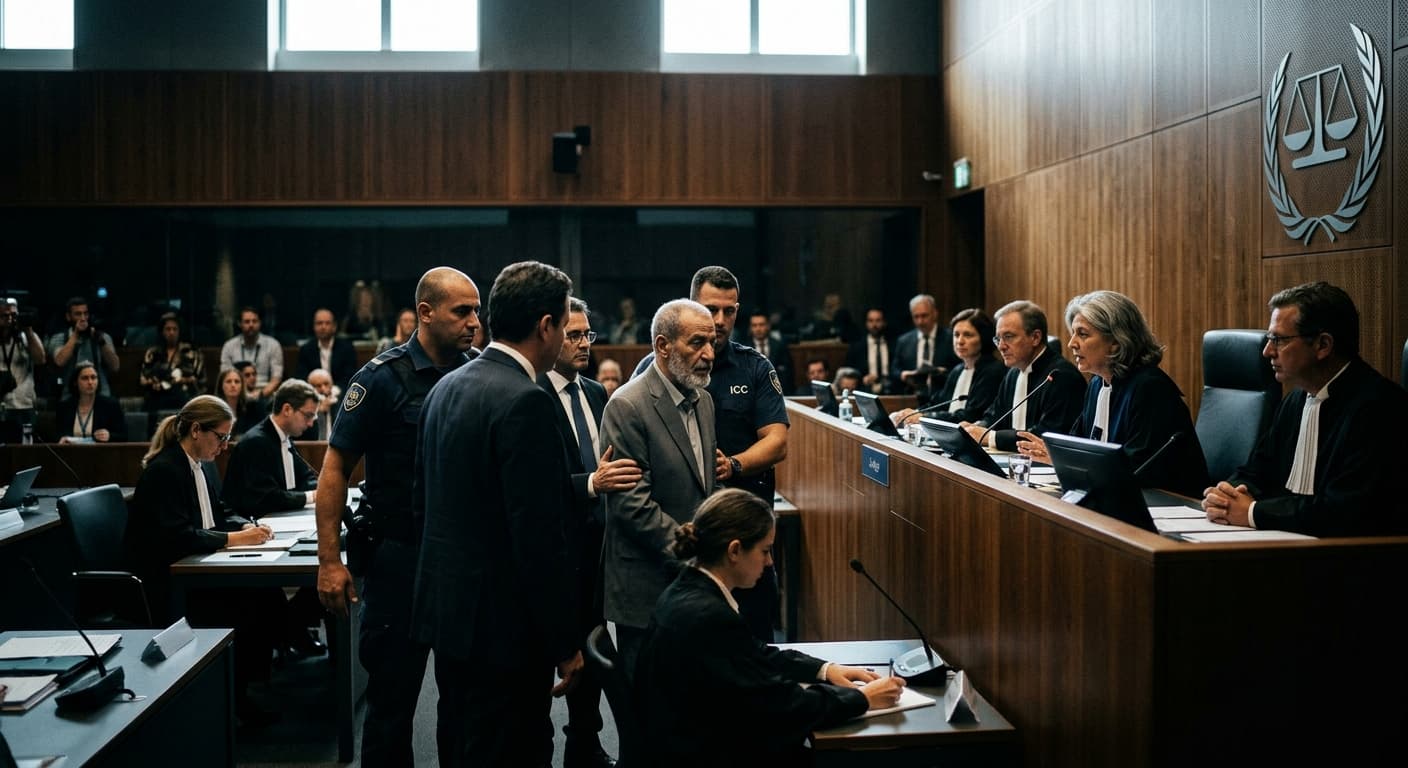
On July 16, 2026, Pre-Trial Chamber I of the International Criminal Court unanimously confirmed all 17 counts of crimes against humanity and war crimes against Khaled Mohamed Ali El Hishri and committed him to trial. It is the first case in the Libya situation to clear every procedural hurdle from arrest to trial commitment, 15 years after the UN Security Council referred the country to the court (ICC Pre-Trial Chamber I, ICC-01/11-01/25-143). The same decision rejected El Hishri's Article 19 challenge to the court's jurisdiction, which his defence filed on April 30, 2026, arguing that because Libya is not a State Party to the Rome Statute, the ICC had no authority over a Libyan national for crimes committed on Libyan soil (
JURIST). The chamber's ruling validates the most contested jurisdictional pathway in the Rome Statute, the Security Council referral under Article 13(b), and does so with a completed proof-of-concept that shifts leverage toward the court in every future non-party situation.
The El Hishri case is not a narrow procedural win. It is the first time in the ICC's 24-year history that a case originating in a Security Council referral has survived a jurisdictional challenge, passed through confirmation of charges, and been committed to trial. The Darfur referral in 2005 produced the Ali Kushayb case, but that trial began under different procedural circumstances. The Libya referral — unanimously adopted on February 26, 2011, under Resolution 1970 — has until now produced only arrest warrants, complementarity battles, and enforcement failures. El Hishri changes that arithmetic.
The jurisdictional architecture: why Article 13(b) was the only route
The Rome Statute provides three jurisdictional triggers. A State Party can refer a situation involving crimes on its territory or by its nationals (Article 13(a)). Article 13(c) lets the Prosecutor initiate an investigation on his own authority with judicial authorization. Or the UN Security Council, acting under Chapter VII of the UN Charter, can refer a situation involving a non-party state (Article 13(b)). Libya is not a Rome Statute State Party, so the first route was unavailable. The Prosecutor's proprio motu power does not extend to non-party territory. Only the Security Council referral could anchor jurisdiction, and it did, in a unanimous February 2011 vote that the United States, China, and Russia all supported (ICC Libya situation page).
The defence's Article 19 challenge tested whether that 2011 referral covered crimes committed years later, in a completely different conflict context. The charged conduct spans May 1, 2014 to June 30, 2020, long after the Gaddafi-era violence that originally prompted the referral. In substance, the chamber's answer was that the referral covered the "situation in Libya since 15 February 2011," with no temporal endpoint. The Security Council did not sunset its referral, and the Rome Statute imposes no such limit on Council referrals (Rome Statute, Article 13(b), via Cornell LII). This interpretation gives the ICC open-ended temporal jurisdiction over Libya for as long as the Council's referral stands — a reach that now extends to at least the end of 2027, the date through which Libya itself accepted the court's jurisdiction in a separate declaration filed on May 12, 2025.
That Libyan declaration matters, but it is secondary. The chamber did not need it. The Article 13(b) referral alone sufficed. Libya's acceptance of jurisdiction was a political signal — an attempt to position Tripoli as a cooperative partner — but the legal architecture was already in place. The decisive instrument remains Resolution 1970.
The enforcement story: Germany delivers where Italy failed
The El Hishri case reached trial because Germany arrested him. On July 16, 2025, German police detained El Hishri pursuant to an under-seal warrant that Pre-Trial Chamber I had issued six days earlier; the warrant was reclassified as public on July 31, 2025 (ICC Office of the Prosecutor, 30th Report to the UN Security Council). Germany surrendered him to ICC custody in The Hague on December 1, 2025 — the first surrender of a suspect in the Libya situation since the referral 14 years earlier (
ICC Office of the Prosecutor, 31st Report to the UN Security Council).
Contrast this with the Njeem fiasco. Osama Elmasry Njeem, the director of Mitiga Prison, was the subject of the first public arrest warrant for Mitiga crimes, issued January 18, 2025. Italy arrested him on January 19 but released him two days later, citing "errors and inaccuracies" in the ICC warrant. Njeem returned to Libya to a celebratory crowd. The ICC issued another warrant; Libya reportedly re-arrested him in November 2025, but the Office of the Prosecutor has received contradictory reports on whether that arrest actually occurred (ICC Office of the Prosecutor, 31st Report). The BBC reported that Italian Justice Minister Carlo Nordio told parliament Rome had no choice given the warrant's defects (
BBC News).
The contrast between German competence and Italian obstruction is the enforcement story: the ICC's reach depends entirely on which state executes the warrant, and a single defection can collapse a case. Germany's cooperation rescued the El Hishri prosecution. Italy's handling of Njeem nearly destroyed his. The court has no police force, no arrest power, no independent enforcement mechanism — a structural vulnerability the Rome Statute's drafters accepted as the price of state consent (Cornell International Law Journal, analysis of ICC sovereignty). El Hishri's path to trial proves the system can work. Njeem's path proves how easily it breaks.
Mitiga Prison and the SDF/RADA militia: who the case targets
El Hishri was a senior official of the Special Deterrence Force, commonly known as RADA, an armed group later granted an official mandate as the Deterrence Apparatus for Combatting Organised Crime and Terrorism under Libya's Government of National Accord. RADA operated Mitiga Prison near Tripoli, where thousands of individuals, Libyan nationals and African migrants, were detained for prolonged periods. The ICC Prosecutor's evidence, as summarized in the confirmation-of-charges hearing, found that many detainees were held on an unlawful basis; that male and female detainees were subjected to torture for various purposes; that detainees were raped and subjected to sexual violence; that some were killed; and that detainees were persecuted on national, racial, ethnic, religious, political, and gender grounds (ICC Office of the Prosecutor, 30th Report).
El Hishri is charged as a direct perpetrator and as a co-perpetrator who made an essential contribution to the organisation's common plan. The 17 counts cover torture, cruel treatment, imprisonment, outrages upon personal dignity, rape, attempted rape, sexual violence, murder, attempted murder, enslavement, and persecution — crimes against more than 900 detainees, with the prosecutor indicating the lists were non-exhaustive and additional incidents could be presented at trial (Human Rights Watch).
The SDF/RADA militia is the immediate loser. But the case's reach extends further. The Prosecutor's 31st report noted that "divisions in Tripoli between the GNU and the RADA militia remain in place," that RADA retreated from the civilian part of Mitiga airport but "remain in the surrounding area of Mitiga and Jdeida prisons," and that the transfer of prisons from militias to state authorities "remain a necessity" (ICC OTP, 31st Report). The El Hishri trial will air evidence of systemic militia abuse inside a facility nominally under government authority — exposing the gap between Libya's formal institutions and the armed groups that control detention on the ground.
The complementarity precedent: why Libya's domestic courts could not take this case
The ICC's jurisdiction is complementary — it steps in only when a state is unwilling or unable genuinely to carry out the investigation or prosecution (Cornell LII, complementarity). In 2013–2014, the ICC applied this principle to split the Gaddafi-era cases: Abdullah al-Senussi's case was declared inadmissible because Libya was genuinely prosecuting him domestically, while Saif al-Islam Gaddafi's case stayed at the ICC because Libya could not secure his custody or provide adequate legal representation (
Chatham House, ICC Libya analysis). In the al-Senussi case, the Pre-Trial Chamber found Libya "willing and able genuinely to carry out" proceedings but found the opposite for Gaddafi. The El Hishri case did not trigger a complementarity challenge: Libya did not claim it was prosecuting him domestically. The Prosecutor's reports repeatedly note that the Office "calls on the Attorney General of Libya to respond to its Requests for Assistance" and has received no indication of parallel domestic proceedings (
ICC OTP, 31st Report). Libya's May 2025 acceptance of ICC jurisdiction was, in part, an acknowledgment that its own justice system cannot handle these cases — the same incapacity the chamber found in the Gaddafi case a decade earlier. The difference now is that the ICC has a defendant in custody and a trial date approaching.
The US sanctions paradox: opposing the ICC while relying on its Libya work
The United States voted for Resolution 1970 in 2011. Ambassador Susan Rice called the referral a response to "the Libyan people's cry for help" and said the Security Council's purpose was "to protect innocent civilians" (Prost v. Trump complaint, S.D.N.Y., citing U.S. statements). The Obama administration supported the ICC's Libya investigation.
In February 2025, President Trump signed Executive Order 14203, authorizing sanctions against foreign persons who "directly engaged in" or "materially assisted" ICC efforts to investigate, arrest, detain, or prosecute U.S. nationals or nationals of allied countries not party to the Rome Statute. The order declared such ICC conduct "an unusual and extraordinary threat to the national security and foreign policy of the United States" (Executive Order 14203, cited in D.D.C. litigation). The sanctions target ICC personnel — including, reportedly, Prosecutor Karim Khan — and prohibit U.S. persons from providing funds, goods, or services to designated individuals.
The Libya case exposes the contradiction: the same Article 13(b) mechanism the U.S. endorsed in 2011 is the mechanism the U.S. now sanctions the ICC for using — but only when the targets are Americans or Israelis, not Libyans. The El Hishri prosecution proceeds because the U.S. does not object to ICC jurisdiction over Libyan militia commanders. The court's institutional survival may depend on keeping that distinction intact.
Who benefits, who loses
The winners are clear. The ICC Office of the Prosecutor, under Karim Khan, has now delivered a concrete result in the court's most stagnant situation — a trial commitment, not just another warrant. Germany gains diplomatic credit as the state that made enforcement possible. Victims at Mitiga Prison — more than 900 identified detainees — gain the first realistic prospect of judicial accountability in 15 years of investigation. Human Rights Watch called the decision "a milestone for justice in Libya" and "a long-awaited door to justice for victims of Libya's abusive detention system" (HRW).
The losers are the SDF/RADA militia, whose command structure now faces documented judicial scrutiny. The Government of National Unity loses the fiction that it controls prisons it does not. Italy loses face for the Njeem debacle. The United States loses coherence — its sanctions policy against the ICC sits awkwardly alongside its continued support for the Libya referral. And the eight remaining public ICC arrest warrants in the Libya situation — including those for Saif al-Islam Gaddafi, Mahmoud al-Werfalli, and Osama Njeem — become more, not less, embarrassing to the states that have failed to execute them (BBC News).
The Bottom Line
The ICC's El Hishri decision is the first proof that Article 13(b) works: a Security Council referral can carry a case from investigation to trial commitment in a non-State Party situation. Leverage from this ruling is structural. Every future Council referral now has a working precedent, and every state harboring an ICC suspect from a referred situation faces a more credible threat of prosecution. Enforcement remains the vulnerability. Germany delivered; Italy did not. The court's reach will always depend on which state holds the suspect. But the legal architecture is now tested, and the precedent is set.
What to watch
-
Trial date announcement: A separate Trial Chamber panel will set the trial commencement date. The ICC's Q&A document says "a separate panel of judges will later announce the start date of the trial" (
ICC Q&A, 16 July 2026). Watch for the scheduling order in the coming weeks.
-
Appeal of the confirmation decision: El Hishri's defence may seek Pre-Trial Chamber authorization to appeal the confirmation of charges (
HRW). The window for filing is limited; if an appeal is granted, the trial start could be delayed.
-
Njeem status: The Prosecutor's 31st report flagged contradictory reports on whether Libya re-arrested Osama Elmasry Njeem in November 2025. If confirmed, watch for whether Libya surrenders him to the ICC or attempts a domestic prosecution — a complementarity test that would echo the al-Senussi/Gaddafi split.
-
U.S. sanctions litigation: The D.C. District Court granted a preliminary injunction on May 13, 2026, barring enforcement of sanctions against a designated ICC official; the government sought a stay on May 15, 2026 (
D.D.C. filing, Case 1:26-cv-00688-RJL). The appeals ruling will determine whether ICC personnel can engage with U.S.-linked evidence and witnesses — a constraint that could affect the Libya investigation's access to intelligence-sharing channels.
Discover more
India
Rajnath Singh's Durga Squad for 2026 Polls
Rajnath Singh's Durga Squad promised women's safety in Bengal but has since disappeared from the agenda, revealing BJP's true priorities.
India
700 Activists Accuse PM Modi of MCC Breach
Over 700 activists allege PM Modi breached election code with a televised address attacking opposition parties just before state elections.

International Relations
Economist Impact Sustainability Week 2026
Economist Impact Sustainability Week 2026 spotlights the energy transition, AI in clean technology, and supply chain resilience as themes for global leaders.

Economics
Fed's Amex AML order puts correspondent banking on notice
Federal Reserve's Amex AML order requires board-level controls and a 90-day plan; OCC fined the bank $350 million over enterprise-wide deficiencies.