How Israel's Ceasefire Became Gaza's Annex
How a truce designed to prevent occupation is enabling it
Model Diplomat9 min readMiddle East
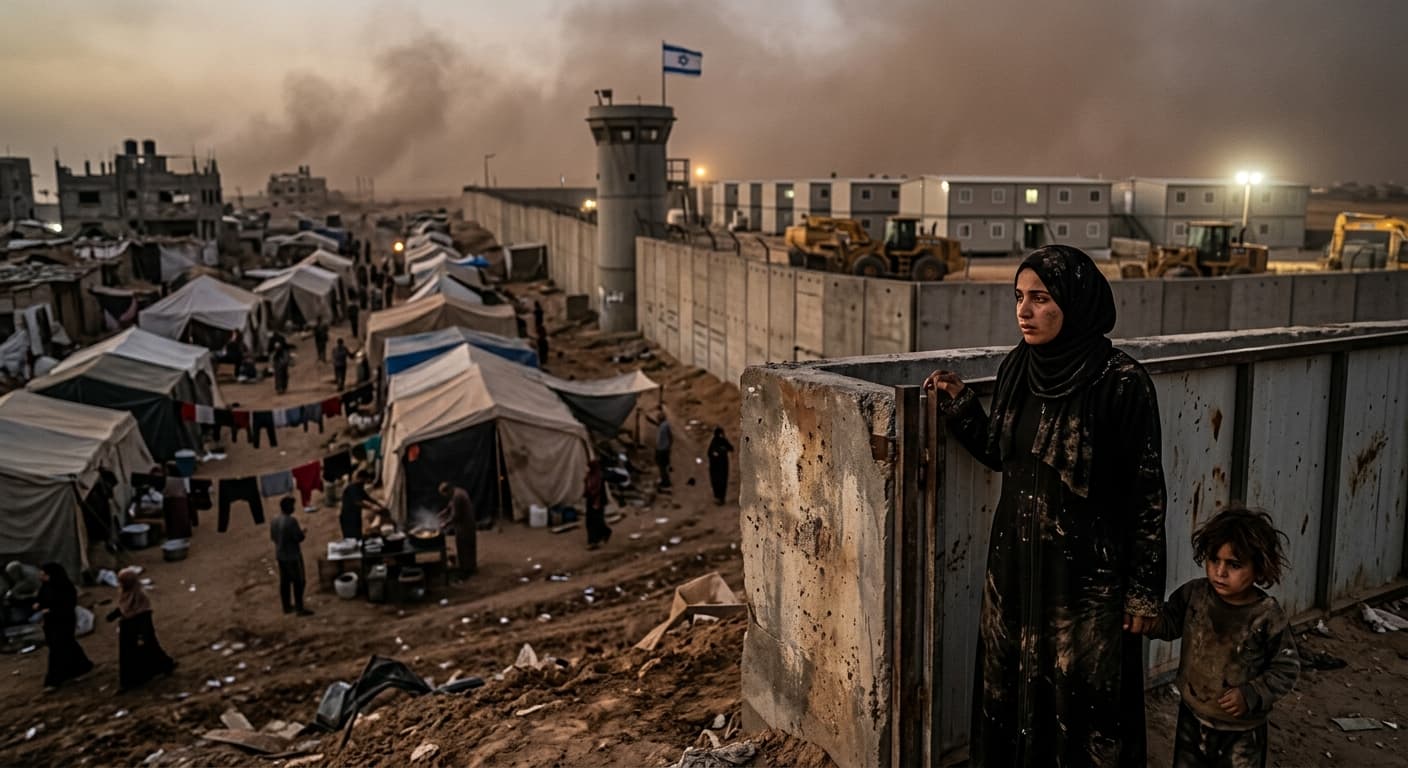
Israel's Ceasefire Is Becoming the Annexation Mechanism for Gaza
[Israel has expanded military control over 70% of Gaza since the October 2025 ceasefire, building 40 permanent outposts and planning settlements — the truce framework designed to prevent permanent occupation is enabling it.]
Israel's ceasefire-era military entrenchment in Gaza — 40 permanent outposts, control of roughly 70% of the territory, and active settlement planning — is converting a US-brokered truce framework into a de facto annexation instrument, and the international architecture designed to prevent that outcome is being used to legitimize it instead. On July 17, 2026, Ramzy Baroud argued in Common Dreams that Prime Minister Benjamin Netanyahu "has no intention of leaving Gaza" before or after Israel's October elections. The evidence on the ground makes clear this is not opinion. It is operational doctrine.
The Yellow Line as Annexation Mechanism
The ceasefire that took effect on October 10, 2025 was supposed to be the first of three Israeli withdrawal phases under President Donald Trump's 20-point plan. Point 16 of the plan, published in full by the BBC, states: "Israel will not occupy or annex Gaza. As the ISF establishes control and stability, the Israel Defence Forces (IDF) will withdraw based on standards, milestones, and timeframes linked to demilitarisation."
The initial "Yellow Line" withdrawal left Israeli forces in control of approximately 53% of the Strip, according to Al Jazeera's mapping analysis. The plan envisioned subsequent pullbacks to roughly 40% and then a final security buffer zone of about 15%. Instead, Israel moved in the opposite direction. On May 29, 2026, Netanyahu publicly ordered the military to take control of 70% of Gaza, telling a conference: "We were at 50. We moved to 60… Let's start with that," after someone in the crowd shouted "100!", as
Al Jazeera reported.
Satellite imagery analyzed by Al Jazeera's Open Source Unit through May 2026 identified 40 distinct Israeli military outposts inside Gaza, eight of which were constructed entirely from scratch after the October 2025 truce, according to Al Jazeera's investigation. The installations include vehicle staging areas, troop housing, defensive trenches, and internal military roads — infrastructure designed for long-term field endurance, not temporary observation. One base east of Gaza City expanded its surface area by an estimated 70% between October 2025 and May 2026. Three outposts guard the Netzarim Corridor, the route Israel uses to sever northern Gaza from the south.
The Yellow Line itself, marked by yellow concrete blocks placed on the ground, has shifted westward repeatedly and without notice. Residents describe a "game of cat and mouse" as the boundary moves deeper into populated areas, according to ABC News. The UN Office for the Coordination of Humanitarian Affairs reported that by late June 2026, an "Orange Line" had appeared, placing 64.9% of the Strip under "tighter and more direct Israeli control," with areas between the two lines containing dozens of humanitarian facilities and tens of thousands of civilians under pressure to leave, as documented in the
OCHA humanitarian situation report of June 26, 2026.
The strategic logic is straightforward. By entrenching permanent military infrastructure across 70% of Gaza, Israel exercises continuous control over movement, security zones, and territorial access without a formal annexation declaration. Foreign Policy analyzed this as a de facto partition, one half under IDF control and the other under Hamas, that may outlast formal negotiations. The ceasefire framework left room for progressive territorial changes through unilateral line movements rather than a clear, enforceable protection of Palestinian self-rule. As analyst Sari Jabareen told
Al Jazeera: "The political establishment announces the Yellow Line to Washington and mediators… but the military shifts it on the ground under the pretext of operational needs." Israel seeks the results of occupation without officially declaring one.
The Board of Peace: A Shield, Not a Constraint
The international architecture meant to prevent permanent Israeli occupation is the Board of Peace, a transitional administration endorsed by UN Security Council Resolution 2803 on November 17, 2025. The resolution passed 13-0 with China and Russia abstaining, as UN News reported. It authorized the Board to establish an International Stabilization Force in Gaza, with the Board and associated presences authorized until December 31, 2027, subject to further Council action.
The White House announced the National Committee for the Administration of Gaza (NCAG) on January 15, 2026, led by Dr. Ali Sha'ath, as the technocratic Palestinian body to govern during the transition, according to a White House statement. Executive Order 14375, signed the next day, designated the Board of Peace a public international organization with legal immunities under the International Organizations Immunities Act, as recorded in the
Federal Register. Trump himself chairs the Board; its executive members include Steve Witkoff, Jared Kushner, Tony Blair, and Nickolay Mladenov as High Representative for Gaza.
But the Board has no enforcement authority over Israeli military movements. Its ISF — initially projected at around 200 troops, according to BBC reporting — has not materialized as a credible ground presence. Israeli officials have dismissed the entire transitional governance track. Foreign Minister Gideon Sa'ar labeled Hamas's July 6 dissolution of its Emergency Committee and declared readiness to transfer governance a "trick," arguing a technocratic administration would merely handle municipal tasks while resistance networks persist, as reported by
Common Dreams.
The result is two irreconcilable tracks running in parallel. One is the Israeli track of military entrenchment, continued strikes, and settlement preparation. The other is the Washington-led diplomatic track, which has produced the NCAG, the Board of Peace, and the ISF concept but cannot compel Israeli withdrawal or even force open border crossings for sustained aid. Donors have reneged on $17 billion in pledges from a February donor conference, largely due to economic fallout from the regional war with Iran, as Al Jazeera reported. Without those funds, the Palestinian technocratic committee cannot function. The Board's first pilot project, humanitarian shelter compounds in the Tal as-Sultan area near Rafah, has yet to break ground.
Russia's ambassador to the UN, Vasily Nebenzya, warned during the Security Council debate that the resolution should not become "a fig leaf for unbridled experiments conducted by the United States and Israel in the Occupied Palestinian Territory," according to the UN Security Council press release. He added that "not a single one of the potential troop-contributing countries agreed to this" arrangement. China's representative called the text "vague and unclear" on critical elements, stressing that "Palestine is barely visible in the draft." Seven months later, those warnings have proved closer to operational reality than the resolution's text.
Settlements: The Final Indicator
The clearest signal of permanent intent is the settlement track. Finance Minister Bezalel Smotrich announced on June 29, 2026 that his Settlement Administration had "completed plans" for three Jewish settlements in northern Gaza and called on Netanyahu to approve them, as Al Jazeera reported. The following day, Netanyahu, speaking on Israel's Channel 14, refused to rule out Gaza settlements. "The question is whether you prefer to do or to talk," he said. "And yes, I prefer not to address it," according to
Al Jazeera's reporting.
Smotrich's Religious Zionist party is polling near the electoral threshold and may not secure enough votes to enter parliament in elections due before October. Settlement announcements serve a dual purpose: they signal permanent territorial ambition and mobilize the right-wing base that keeps the coalition alive. Hugh Lovatt of the European Council on Foreign Relations noted that since 2023, Israel has overseen "the greatest expansion of settlements since the Oslo Accords" with "very little action" from the international community, as quoted by Al Jazeera.
The historical parallel is precise. Israel dismantled 21 settlements in Gaza in 2005 under Ariel Sharon's disengagement plan. The infrastructure for their return (razed land, military corridors, settlement blueprints) is now being laid by the same political forces that opposed the disengagement. Netanyahu has spent his career avoiding genuine compromise with Palestinians. The settlement track converts that avoidance into territorial fact.
The International Law Frontier
The International Court of Justice, in its Advisory Opinion of July 19, 2024, concluded that Israel's continued presence in the Occupied Palestinian Territory is unlawful and that Israel is obligated to "cease immediately all new settlement activities, and to evacuate all settlers from the Occupied Palestinian Territory," according to the ICJ's summary. The Court found that all States are obligated not to recognize as legal the situation arising from Israel's unlawful presence.
The State of Israel is under an obligation to bring to an end its unlawful presence in the Occupied Palestinian Territory as rapidly as possible.
Israel has not formally annexed any part of Gaza — and the distinction matters legally if not practically. The 40 military outposts, the Yellow Line, and the settlement plans exist in a gray zone between temporary security measures and de facto sovereignty. Michael Becker, a professor of international human rights law at Trinity College Dublin, told Al Jazeera: "If Israel's ultimate plan is to exercise permanent effective control over the entirety of the Gaza Strip, we are talking about unlawful annexation." Defence Minister Israel Katz has separately said that "the plan for voluntary emigration from Gaza will also be implemented" — a term observers widely acknowledge as ethnic cleansing of the enclave.
The UN Secretary-General's thirty-seventh report on Security Council Resolution 2334, covering December 2025 through March 2026, documented continued Israeli settlement planning approvals, demolitions, and land-registration plans in the West Bank, according to the UN report. The same doctrine is now being extended to Gaza.
Who Wins, Who Loses
The beneficiaries of the governance vacuum are specific. Netanyahu gains a "picture of victory" for his electoral base: territorial control as a substitute for the decisive military defeat of Hamas he never achieved, as analyst Mohannad Mustafa explained to Al Jazeera. Smotrich gains a campaign platform that could pull his party above the electoral threshold. The settler movement gains its first foothold in Gaza since 2005.
The losers are equally named. Some 2.1 million Palestinians confined to roughly 30% of the Strip lose territory, access, and any prospect of self-governance. The Palestinian death toll since October 7, 2023 stands at 73,246, including 21,500 children, according to the Gaza Ministry of Health, as tracked by Al Jazeera. Since the ceasefire took effect on October 10, 2025, at least 1,123 Palestinians have been killed and 3,616 injured. Israel has violated the ceasefire agreement at least 3,689 times through air, artillery, and direct shooting attacks, according to the Gaza Government Media Office. The
BBC confirmed that the toll surpassed 70,000, with figures widely considered reliable by the United Nations.
The Board of Peace loses credibility: its NCAG cannot enter Gaza, its ISF cannot deploy, and its donor base has collapsed. The Palestinian Authority loses relevance; the plan conditions its return to Gaza on reforms it has not completed, leaving it sidelined indefinitely. And the two-state framework, already on life support, loses its territorial basis. A Palestinian entity carved from 30% of Gaza — with no corridor to the West Bank, no control over borders, and an occupying military embedded in 40 permanent bases — is not a state.
What to Watch
- Israeli elections, due before October 2026. Netanyahu's coalition depends on Smotrich's party clearing the electoral threshold. If settlement announcements intensify through September, it signals the government is committed to Gaza entrenchment as electoral strategy, not negotiating posture.
- Board of Peace six-month progress report to the Security Council. The first statutory reporting deadline under Resolution 2803. If the report acknowledges Israel's territorial expansion, it will force Council members to choose between enforcing the ceasefire terms or accepting their erosion.
- Smotrich's settlement approval decision. Netanyahu has refused to rule it out. An approval would cross from military entrenchment into civilian colonization — a line that even the Trump plan's silence on settlements would struggle to accommodate.
The Bottom Line
Israel's permanent military entrenchment across 70% of Gaza has converted the October 2025 ceasefire framework from a withdrawal mechanism into an annexation instrument. The Board of Peace, the NCAG, and the International Stabilization Force exist on paper and in UN Security Council resolutions but cannot compel Israeli withdrawal, open border crossings, or deploy credible forces on the ground. The plan's Point 16, "Israel will not occupy or annex Gaza," is being contradicted by 40 permanent military outposts, shifting Yellow and Orange Lines, and completed plans for Jewish settlements. The two-state framework is not dying of natural causes; it is being administratively dismantled, one concrete block at a time.
Discover more
US Politics
Congress Targets AI Chatbot Access for Terror
The House passed the Generative AI Terrorism Risk Assessment Act, focusing on AI's role in terrorism and potential surveillance implications.

India
Congress Accuses Modi of Stalling Women's Law
Congress accuses Modi of stalling women's reservation law by linking it to delimitation, revealing a deeper electoral strategy.
US Politics
SNAP Food Assistance Faces Legal Challenges
In 2026, SNAP faces stricter eligibility rules and mounting legal challenges, threatening food assistance for the millions of Americans who rely on the program.

Conflict & Security
Drone Warfare Killing Aid Workers at Unprec
Over 1,000 humanitarian workers killed in three years as cheap armed drones collapse legal protections. Gaza, Sudan, Ukraine, and DRC see deliberate targeting of aid convoys and hospitals with zero prosecutions.