Hormuz Shipping Halts as Iran Cements Grip
Iran tightens control over Strait of Hormuz shipping routes.
Model Diplomat9 min readMiddle East
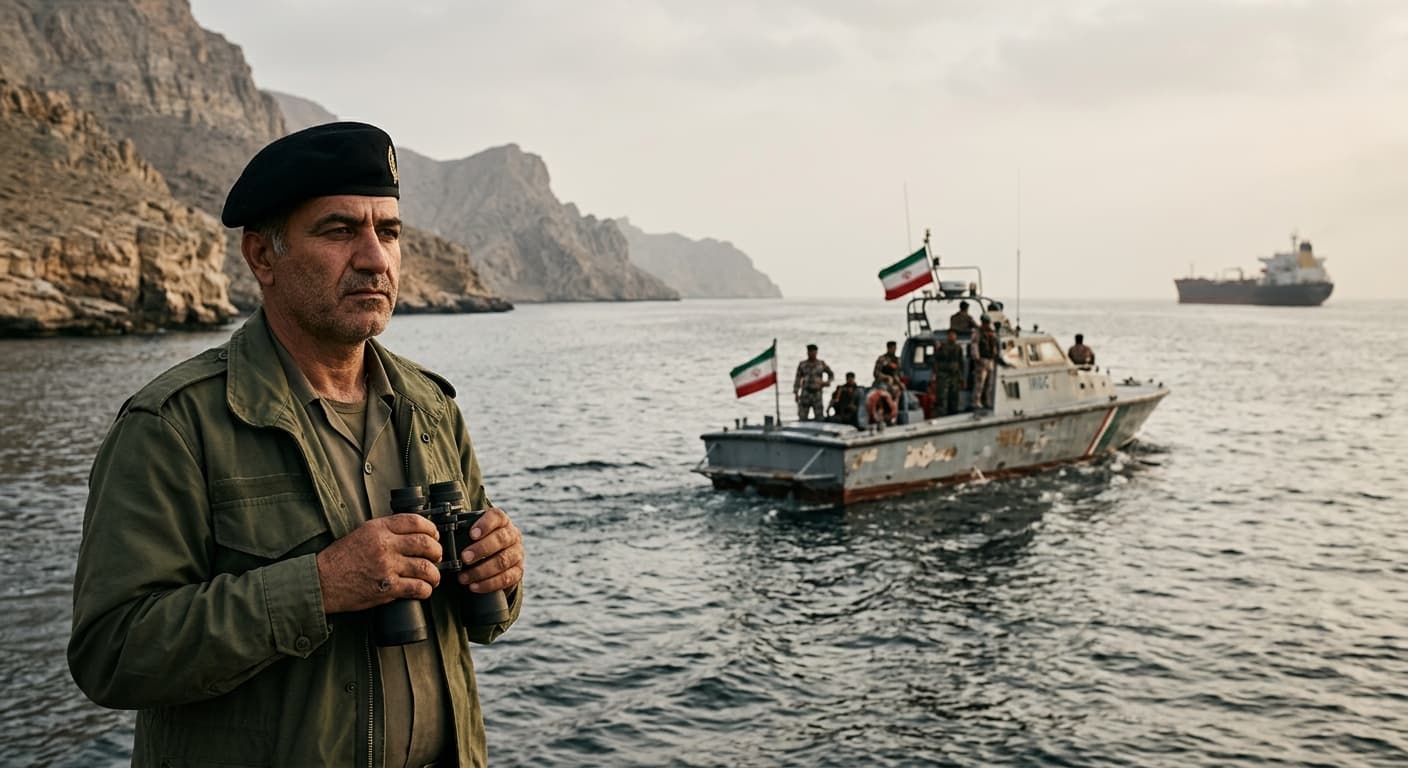
Hormuz Shipping Halts as Iran Cements Chokepoint Grip
Traffic through the Strait of Hormuz nearly stopped on July 9, 2026 after U.S.-Iran strikes broke the June 17 truce. Iran is using force to lock in route control.
Only 14 commodity carriers crossed the Strait of Hormuz on Wednesday, July 8 — the smallest count since the U.S.-Iran memorandum of understanding was signed on June 17 — and the U.S.-backed Omani corridor emptied entirely, according to ship-tracking data compiled by Kpler and reported by Transport Topics and
Anadolu Agency. The near-halt is not a slide back into open war. It is Iran demonstrating that the peace deal handed Tehran a permanent lever over 20% of the world's seaborne oil, and that any traffic through the strait now moves at Iranian discretion. The strikes shaking markets this week are the enforcement mechanism for a chokepoint Iran has already, in practice, won.
What actually happened between July 6 and July 9
The sequence matters because it reveals the pattern. On July 6, three commercial vessels — a Qatar-owned LNG carrier (the Al Rekayyat), a Saudi supertanker (the Wedyan), and a Liberia-flagged crude tanker (the M/T Cyprus Prosperity) — were struck in or near the Omani corridor, the southern lane recommended after June 17 by the Joint Maritime Information Center. All three were transiting outside the Iran-designated northern route. On July 7, U.S. Central Command retaliated with what it called "powerful" strikes on more than 80 targets, including coastal radar, missile launchers, and 60 fast boats, per the BBC. The Treasury simultaneously revoked its 60-day waiver on Iranian oil sales, effective 04:01 GMT on July 17, according to a notice published on its website and cited by
Al Jazeera.
On July 8, speaking at the NATO summit in Ankara, President Donald Trump declared the MOU "over" but left the door open to more talks. That night CENTCOM hit approximately 90 additional Iranian military sites along the coast; the IRGC fired on U.S. bases in Bahrain and Kuwait, and Qatar issued a security alert, NPR reported. By dawn July 9, only two tankers had transited the strait — the supertanker Berg 1 among them — per Reuters wire copy carried by
SRN News. Intertanko marine director Phil Belcher told BBC Radio 4 that vessel counts on the southern route had fallen to "single figures," down from a normal pre-war baseline of roughly 130 ships per day.
The Financial Times captured the pattern in a single line: "A backslide into wider conflict could prompt Iran to once more shut the strait, through which a fifth of global oil supplies usually flow, plunging the world into a new energy supply crisis," the FT wrote on July 8. It has not yet done so. It does not need to. The threat of another closure — combined with the pinprick strikes on Omani-route ships — accomplishes the same result at a fraction of the diplomatic cost.
The MOU was a Hormuz deal — and Iran read the fine print
Read closely, the June 17 agreement was never a nuclear settlement. It was a maritime access deal wrapped in nuclear language. Its fifth clause commits Iran only to "best efforts for the safe passage of commercial vessels with no charge for 60 days only from the Persian Gulf to the Sea of Oman," and directs Iran and Oman to jointly "define the future administration and maritime services in the Strait of Hormuz," per the U.S. account of the text published by NPR. That single word — "only" — is what Iran is now enforcing with missiles.
Iran's parliamentary speaker Mohammad Bagher Ghalibaf said on state television within hours of signing that the strait "will not return to pre-war conditions" and that Iran would "receive a fee for services," per BBC reporting from Versailles. Edward Fishman, director of the Council on Foreign Relations' Maurice R. Greenberg Center for Geoeconomics, put the number on it: Iranian officials believe they can generate up to $40 billion a year from monetizing Hormuz — roughly matching Iran's recent annual oil-export revenues, he wrote in a
CFR analysis published July 8.
That is the prize. The tanker strikes are the enforcement. Every ship the IRGC hits on the Omani route reinforces that only the Iran-approved northern lane, hugging the Iranian coast, is safe — and that using it will eventually cost money. Michael Wahid Hanna of the International Crisis Group told Al Jazeera that Iran wants to "re-emphasise those points while not shutting down navigation completely" — a controlled squeeze, not another closure. Mohsen Milani of the University of South Florida framed the same point more sharply in the same piece: "The idea to impose environmental or service fees, possibly with Oman, reflects Iran's effort to convert its sovereignty over half of the strait into lasting influence."
The MOU's other headline items are already unraveling on schedule. The $300 billion "reconstruction" fund is opaque — U.S. officials insisted on a media call that Washington would not pay "a cent" directly, per the BBC. The commitment to down-blend Iran's enriched uranium on site under IAEA supervision is a "significant concession," a senior U.S. official said, but the technical timeline was pushed into the 60-day negotiating window that has now been consumed by the shipping crisis. Nuclear diplomacy has been displaced by the chokepoint.
The primary document Congress is now reading
The Congressional Research Service captured the legal core in a brief updated for the House this spring. "An issue for Congress," CRS wrote, "is a potential change in the status of the Strait from its norm, long established by international law, as an open waterway free to navigation and unencumbered by any coastal state to one in which Iran seeks to maintain its present control over transit passage." Iran, more specifically the IRGC, "is charging tolls for ships to pass through," according to the CRS report — with some ships reportedly paying as much as $2 million per transit during the war.
The right at stake is transit passage under Part III of the U.N. Convention on the Law of the Sea, which Iran signed but did not ratify. Iran has moved shipping lanes closer to its coastline "under an unsubstantiated premise" about mine risk, CRS notes. The White House's own War Powers letter to Speaker Mike Johnson, dated February 28, 2026, cited "ensuring the free flow of maritime commerce through the Strait of Hormuz" as a core justification for the initial U.S. strikes. Washington has now committed itself, in writing to Congress, to a legal principle Iran is actively rewriting through kinetic means — an asymmetry the July strikes have exposed rather than resolved.
The humanitarian cost is documented in primary form too. The International Labour Organization's Maritime Labour Committee reported on April 24 that roughly 20,000 seafarers were stranded in and around the Strait, urging flag states to guarantee food, fuel and crew changes, per an ILO statement. The World Health Assembly, in
Resolution WHA79.6, formally recognized Hormuz as a "critical lifeline" whose disruption threatens the delivery of "medicines, vaccines, medical products and other health commodities." Both are unusual moves for IGOs that rarely name chokepoints in resolutions.
Markets are pricing in a permanent Hormuz risk premium
Brent crude jumped more than 4% on July 8 to $77.24 a barrel, a two-week high, before easing back below $78 on July 9, Al Jazeera reported. That is far below the April peak of $126 and the $120 range hit at the height of the closure. But the direction has reversed. Saul Kavonic, head of energy research at MST Financial, told Al Jazeera that Hormuz traffic could "remain below 50 percent of pre-war levels for many months, with periodic flare-ups in hostilities." AAA data cited in the same piece show U.S. gasoline at $3.79 a gallon on July 8 — well down from the May peak of $4.48, but still 27% above the $2.98 recorded on February 28 when the war began.
The real signal is not the headline oil price — it is insurance. War-risk premiums for Hormuz transit, roughly 0.25% of hull value before the war, spiked as high as 8% during the closure, according to shipping analysts cited by Al Jazeera. Even after the June deal, premiums fell back only to a 2.5–5% band — roughly ten times pre-war levels, per the same reporting. CMA CGM and Hapag-Lloyd have layered conflict surcharges of $1,500–$2,000 per twenty-foot equivalent unit on Gulf routes. Washington's own International Development Finance Corporation has stepped in with up to $40 billion in reinsurance capacity to keep vessels moving — an implicit public subsidy for a route Iran now effectively taxes.
Svein Ringbakken of the Norwegian Shipowners' Mutual War Risks Insurance Association told Al Jazeera in June that owners "must see a sustained period with no incidents before shipowners and insurers will consider that the risk has de-escalated enough." The July attacks reset that clock to zero.
Named winners and losers
The clearest winner is China, and it is winning by design. Beijing has built strategic petroleum reserves of roughly 900 million barrels — close to three months of imports — precisely to weather Gulf shocks, Ole Hansen of Saxo Bank told the BBC in an earlier phase of the crisis. Roughly 40% of China's crude imports transit Hormuz, and it buys more than 80% of Iran's sanctioned oil exports. When Washington revokes the sanctions waiver on July 17, Chinese refiners — particularly the "teapot" independents documented by Kpler — become Iran's only major customer again, at deep discounts. Iranian crude already trades at a 20% discount to Brent, per the
Al Jazeera analysis. Any Hormuz "service fee" China ends up paying is more than offset by that discount.
The clearest losers are the Gulf monarchies that signed onto the MOU expecting a return to freedom of navigation. Qatar and Saudi Arabia — whose flagged tankers were hit on July 6 — publicly blamed Iran, per BBC reporting. Their pipeline alternatives are marginal: Saudi Arabia's East-West Petroline can move roughly 7 million barrels a day of design capacity, the UAE's Fujairah bypass under 1.8 million — together a fraction of the roughly 20 million barrels per day Hormuz once carried, per the same Al Jazeera analysis. Iranian strikes cut Petroline throughput by an estimated 700,000 barrels a day in April; drones disrupted Fujairah loading. Gulf seaborne crude exports fell by roughly half between February and March.
Japan, which sources 70% of its Middle Eastern crude via Hormuz, has already tapped strategic reserves. The Philippines imposed a four-day work week; Indonesia has been rationing reserves that will last only weeks, the BBC reported. The
IMF warned that renewed conflict risks driving up inflation and weighing on growth; analysts cited in Al Jazeera's op-ed suggest global growth could slow to 2.8% in 2026 from 3.4% in 2025 if closure persists. Iran itself is a partial loser: crude exports collapsed more than 90% during the war, and its shadow fleet — 61 sanctioned vessels tracked crossing Hormuz between March 1 and April 15, per an
Al Jazeera investigation — cannot make up the volume. But if Tehran can institutionalize a toll regime, the trade-off works.
The historical parallel worth naming is not 1988's Tanker War, which was fought under a very different legal architecture. It is the 1956 Suez crisis: an incumbent power (Britain) discovered that a chokepoint it had long treated as a global commons could be nationalized by a determined coastal state, and that military action to reverse the nationalization was politically unsustainable. What Nasser did to Suez in 1956, Iran is now doing to Hormuz in 2026 — with the crucial difference that the customer paying the toll is likely to be China, not the United States.
What to watch next
- July 17: Treasury's revocation of the Iranian oil sanctions waiver takes formal effect at 04:01 GMT. Whether Iran retaliates on shipping — or waits — signals how much leverage Tehran still wants to reserve.
- August 16: The 60-day MOU negotiating window nominally expires. Trump said at the NATO summit that further talks were "a waste of time" but did not formally withdraw. Watch for Qatari and Pakistani mediators — who brokered the original deal — to push for an extension.
- The Omani corridor: If the JMIC-recommended southern route stays empty for more than a week, it is functionally dead. Iranian control of the northern lane becomes the de facto administration Ghalibaf described.
- Kharg Island: Trump renewed threats on July 8 to seize Iran's main oil terminal, which handles roughly 90% of Iranian crude exports, per the
BBC. A U.S. move on Kharg would end the MOU beyond ambiguity.
The Bottom Line
The bottom line: Iran did not need to close the Strait of Hormuz to win it — it needed a written U.S. concession that Tehran would "administer" the waterway, and it got one in the June 17 MOU. The July strikes are not the end of that agreement so much as its true form, an enforcement mechanism for a chokepoint regime that will outlast whichever ceasefire replaces this one. Global energy markets, and the Gulf states that signed onto the deal expecting a return to freedom of navigation, will spend the next decade paying the premium for that miscalculation.
Discover more
US Politics
House Ethics Committee Pushes Sexual Miscond.
The House Ethics Committee has shifted responsibility for sexual harassment settlement records to the Office of Congressional Workplace Rights, complicating disclosure efforts.
US Politics
SNAP Food Assistance Faces Legal Challenges
In 2026, SNAP faces stricter eligibility rules and mounting legal challenges, threatening food assistance for the millions of Americans who rely on the program.
US Politics
Congress Targets AI Chatbot Access for Terror
The House passed the Generative AI Terrorism Risk Assessment Act, focusing on AI's role in terrorism and potential surveillance implications.

Conflict & Security
Drone Warfare Killing Aid Workers at Unprec
Over 1,000 humanitarian workers killed in three years as cheap armed drones collapse legal protections. Gaza, Sudan, Ukraine, and DRC see deliberate targeting of aid convoys and hospitals with zero prosecutions.