Hassabis's AI Standards Body Is a Bid to Lock
Hassabis's FINRA pitch is a regulatory land grab before the UN or US acts.
Model Diplomat9 min readNorth America
Hassabis's AI Standards Body Is a Bid to Write the Rules Before Governments Do
[Google DeepMind CEO Demis Hassabis's July 14 call for a FINRA-modeled AI standards body is not a safety pitch — it is the frontier labs' attempt to lock in industry-led, US-governed oversight before the UN multilateral track or ad-hoc export controls crystallize into something they cannot control.]
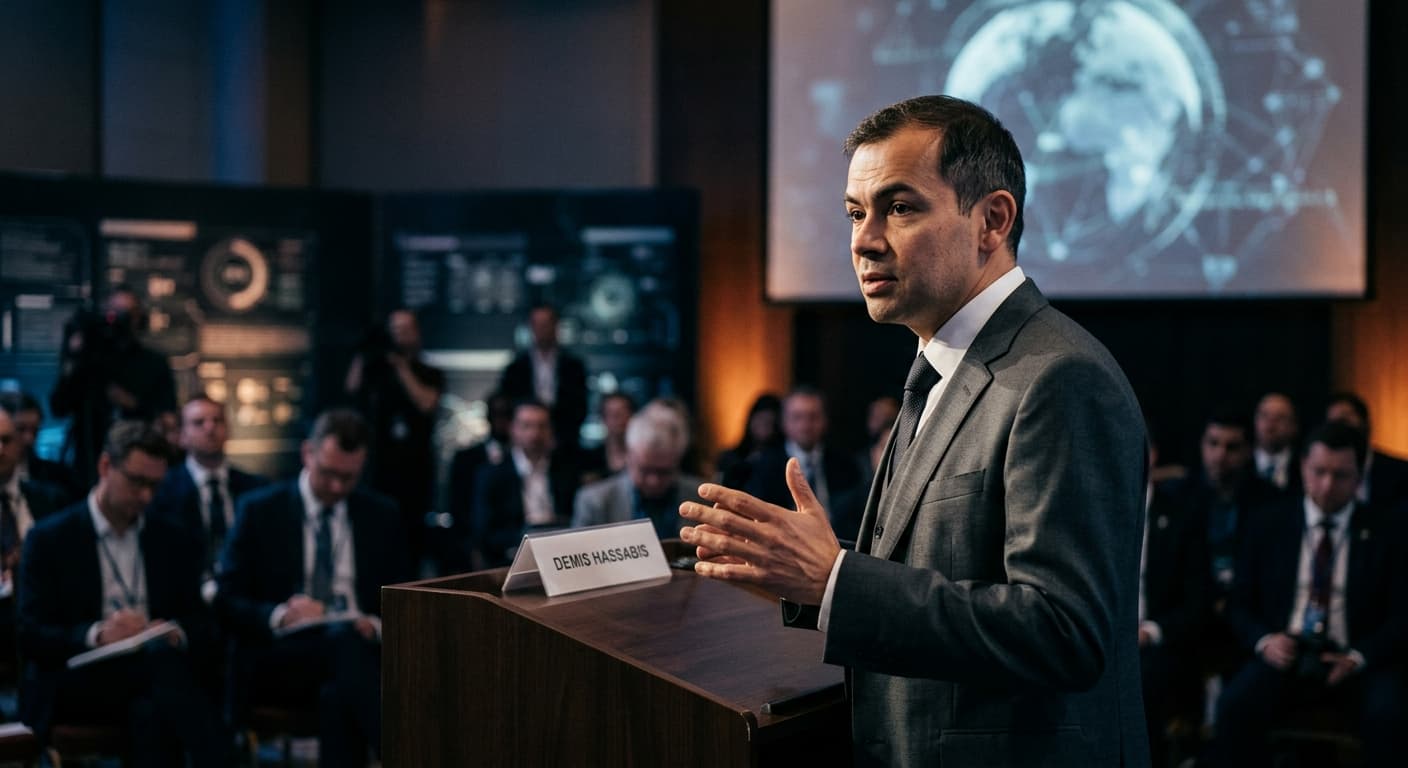
On July 14, 2026, Google DeepMind CEO Demis Hassabis published a Substack essay proposing a US-led, industry-funded standards body to evaluate frontier AI models before public release. The pitch landed eight days after 193 nations convened in Geneva for the first UN Global Dialogue on AI Governance, and six weeks after the Trump administration's chaotic imposition — and rapid lifting — of export controls on Anthropic's most advanced models. Hassabis's proposal is a regulatory land grab: the frontier labs want to design the oversight architecture before governments design it for them, and before the UN's slow-moving multilateral process produces something they like even less.
The timing is not accidental. The frontier labs have watched two governance tracks accelerate in parallel — one at the UN, where every country gets a seat, and one in Washington, where the Commerce Department has discovered it can shut down a model overnight by invoking export-control authority never before used for software. Neither track gives the labs a seat at the rule-writing table. Hassabis's proposal would change that.
The Proposal: FINRA for AI
Hassabis's essay, first reported by SiliconANGLE, calls for a nonprofit standards body modeled after the Financial Industry Regulatory Authority, or FINRA. FINRA regulates brokers and securities firms in the United States — a private nonprofit funded by the companies it regulates, operating under the supervision of the Securities and Exchange Commission. The legal architecture is codified in
Section 19 of the Securities Exchange Act, which gives the SEC power to approve, abrogate, or rewrite any FINRA rule, and to suspend the organization's registration if it fails to enforce securities laws.
Hassabis told Axios, according to SiliconANGLE, that he has held talks with the White House, European officials, and competing AI labs, and hopes to launch the body by year's end. The proposal would start with a voluntary risk-evaluation program — labs submitting their models 30 days before broad release — and then formalize: "Once the assessment protocol is shown to be effective and robust, formalisation could quickly follow, meaning that Frontier Models would be required to pass it to be deployed in the US market," Hassabis wrote.
The 30-day window is not a new idea. It is the exact provision in President Trump's June 2 executive order on AI cybersecurity, which established a voluntary framework for developers to give the government access to "covered frontier models" before release. CSIS analysis notes that the order was watered down from a 90-day period after industry lobbying, and that its tone is set by its first line: attributing US AI leadership to a refusal "to stifle this innovation with overly burdensome regulation."
The benchmarks Hassabis proposes would evaluate frontier models' capabilities in cybersecurity, biology research, and deception. Agentic AI tests would look for attempts to bypass safety guardrails. The watchdog's board would comprise "independent leading technical experts and open-source representatives," according to SiliconANGLE. The private sector would provide the bulk of the necessary compute infrastructure and technical talent — a critical concession, since testing a frontier model for risks requires substantial hardware that government lacks.
The FINRA Parallel — and Its Limits
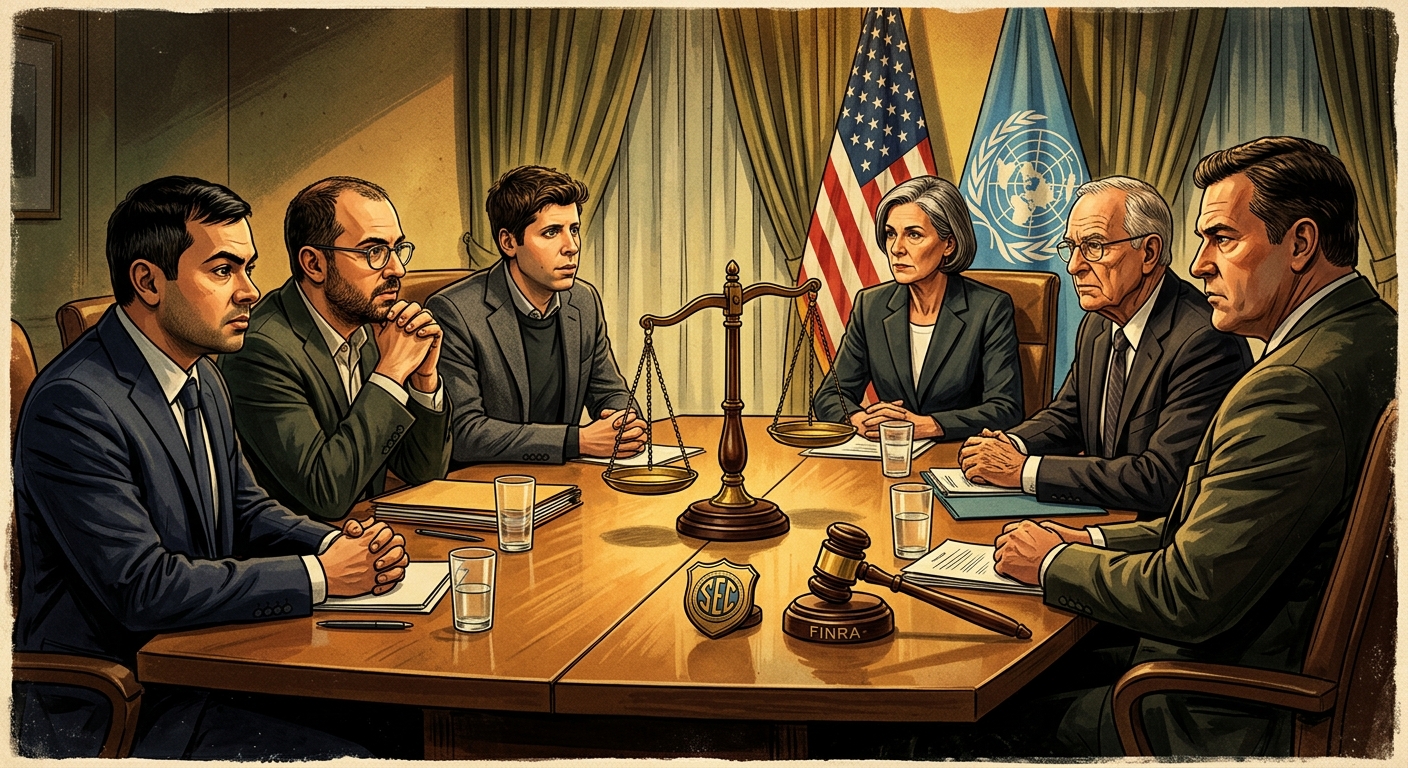
The FINRA model is not an industry free-for-all. Under 15 U.S.C. §78s, the SEC retains authority to review and approve any rule FINRA proposes, to abrogate rules unilaterally, and to conduct de novo review of FINRA adjudications. FINRA's governance structure, as detailed in
congressional testimony, includes 12 public governors, 10 industry governors, and one CEO seat — a structure designed to balance industry influence with public representation. The
Congressional Research Service classifies FINRA alongside other standard-setting bodies like FASB and PCAOB as private nonprofits whose authority is delegated by regulators but who are "not governmental entities."
The parallel has been championed by policy thinkers outside the labs. Brookings analysts Bill Baer and Jack Malamud argued that FINRA, the North American Electric Reliability Corporation, and the National Society of Professional Engineers all demonstrate that industry-government alliances can produce enforceable standards. They identified two structural weaknesses in voluntary codes: "the code's development and application is only as good as its weakest link," and "by their very definition, voluntary means the absence of enforcement."
Hassabis's proposal acknowledges the enforcement gap by building in a path from voluntary to mandatory. But the transition is not guaranteed. The Trump administration's own June 2 executive order kept the review framework voluntary, and CSIS concluded that "it is not clear that the EO will result in any practical differences in how model developers currently engage with the U.S. government."
The June Crisis: Why Hassabis Moved Now
The immediate backdrop is a six-week crisis that exposed the absence of any institutional framework for governing frontier models. On June 12, 2026, the Commerce Department sent Anthropic a letter imposing export controls on its Mythos 5 and Fable 5 models, barring all foreign nationals — including Anthropic's own foreign employees — from access. CSIS analysis noted that Commerce invoked authority under the Export Control Reform Act for "emerging and foundational technologies" that had never before been used this way, and for which no implementing regulation exists.
Anthropic suspended the models globally the next day. BBC News reported that Anthropic executives met with Commerce Secretary Howard Lutnick, and that the government's concern centered on a "jailbreak" method that could bypass Fable 5's safety restrictions. On July 1, Commerce lifted the restrictions after Anthropic agreed to "proactively detect and address security risks" and collaborate on future releases, according to
BBC News. Lutnick wrote that Anthropic had "addressed the risks," but reserved the right to reconsider.
Chatham House described the episode as "flip-flopping" that undermines trust in US governance. The think tank noted that the same ad-hoc approach has been applied to OpenAI's GPT-5.6 Sol, Terra, and Luna models, which were released only to "a small group of trusted partners" at the government's request. The pattern — sudden imposition, negotiation, partial lifting — is exactly the unpredictability Hassabis's proposal aims to replace.
Three CEOs, One Direction
Hassabis is not alone. A month earlier, Anthropic CEO Dario Amodei published an essay suggesting the US government create a regulatory framework modeled after the Federal Aviation Administration, according to SiliconANGLE. OpenAI's Sam Altman has previously called for "something like an IAEA for advanced AI systems," as documented by the
Council on Foreign Relations. At the G7 summit in June, Amodei, Altman, Hassabis, Mistral's Arthur Mensch, and Meta's Alexandr Wang sat alongside heads of government and proposed a common standards-setting framework, according to
Brookings.
The convergence is striking but not surprising. Each lab faces the same regulatory fragmentation problem: divergent state laws in the US, divergent national laws abroad, and an administration that alternates between deregulation and ad-hoc controls. Amodei told the G7 nations to "resist the temptation to splinter," as Brookings reported. A coherent, industry-shaped standard would reduce compliance costs and, critically, would be designed by people who understand the technology.
Who Wins, Who Loses
The primary beneficiaries are the frontier labs themselves — Google DeepMind, OpenAI, Anthropic, and to a lesser extent Meta and Mistral. A FINRA-modeled body funded by industry and staffed by technical experts would give them institutionalized input into the standards that govern their products. The Economist noted that Hassabis believes "if America moves unilaterally, the rest of the world will sign up to its system" — meaning US-led standards would become de facto global standards, locking in the competitive position of American labs.
The losers are twofold. First, the UN multilateral track. The first Global Dialogue on AI Governance convened on July 6-7 in Geneva with all 193 member states, as UN News reported. Secretary-General António Guterres warned that "the more AI advances without shared rules, the less say governments and people will have in the outcome," according to
UN press materials. A US-led, industry-designed standards body would make the UN process advisory at best — a forum for discussing standards written elsewhere.
Second, civil society and the public-interest advocates excluded from the board. Brookings analyst Cameron Kerry argued that the G7 proposal should be accepted "with material modification" — extending participation beyond companies to include government and civil society, and making the framework enforceable. "Voluntary compliance means the outcome is only a suggestion, not a standard," Kerry wrote. The
UN High Commissioner for Human Rights Volker Türk added that "we don't consider safety standards for medicines, cars or aircraft as obstacles to progress" — but those standards are written by regulators, not by the companies they govern.
The Gap Between Proposal and Reality
The structural problem is that FINRA's authority derives from statute — Congress delegated rulemaking power to the SEC, which in turn delegates to FINRA. No comparable statute exists for AI. The Biden administration's US AI Safety Institute, housed at NIST, was established on a temporary basis and has been reconstituted under the Trump administration as the Center for AI Standards and Innovation, or CAISI. Brookings analysts Mark MacCarthy and David Klaus argued that Congress should permanently authorize the institute in statute, fund it adequately, and staff it with nonpartisan technical experts. No such legislation has passed.
Foreign Affairs contributor Sebastian Mallaby observed that "neither government nor private-sector leaders believe that regulation is likely at the national or supranational level." The Trump administration's instinctive rejection of regulation, combined with the AI boom's contribution to US economic growth, has created powerful incentives to let the technology develop unimpeded. The release of Chinese models like DeepSeek has reinforced the administration's reluctance to slow domestic labs.
The result is a governance vacuum that the labs are now positioning to fill. Whether that is a problem depends on whether Congress writes the enabling statute that would give a FINRA-for-AI the legal authority to enforce its standards — or whether the body remains, like the June 2 executive order, voluntary in practice and light in touch.
Diplomat View
Hassabis's proposal will likely gain traction with the Trump administration because it solves a political problem: it creates the appearance of governance while keeping the substance in industry hands. The administration has already demonstrated its preference for voluntary frameworks over mandatory ones, and the FINRA model — industry-funded, industry-staffed, government-supervised — fits the deregulatory instinct better than any congressional mandate would. The risk for the labs is that Congress or a future administration rewrites the rules after a crisis; the risk for everyone else is that the standards body becomes a fig leaf.
The decisive variable is whether Congress passes enabling legislation that gives the body enforcement teeth. Without it, Hassabis's proposal is the AI equivalent of a voluntary code of conduct — which, as Brookings noted, is "only a suggestion, not a standard."
What to watch:
- September 2026: Hassabis's self-imposed deadline for launching the voluntary evaluation program. Whether OpenAI and Anthropic formally join will signal whether the labs are coordinating or competing.
- Congress: Representatives Jay Obernolte (R-CA) and Lori Trahan (D-MA) have circulated a discussion draft of the Great American AI Act, noted by
CSIS. If it moves, it could provide the statutory authority Hassabis's body would need.
- May 2027: The second session of the UN Global Dialogue on AI Governance convenes in New York. If the US-led standards body is operational by then, the UN track will face a fait accompli.
The Bottom Line
Hassabis's FINRA pitch is not about safety first — it is about governance architecture. The frontier labs are racing to build the institution that will regulate them before anyone else builds it instead, and they are betting that a US-led, industry-designed body will become the global default. If they succeed, they lock in their competitive position and shape the rules of their own oversight. If they fail — because Congress refuses to legislate, because the UN process produces a rival framework, or because another model crisis forces ad-hoc controls — the governance vacuum will persist, and the June Anthropic episode will look less like an anomaly and more like a preview.
Discover more

US Politics
SNAP Food Assistance Faces Legal Challenges
In 2026, SNAP faces stricter eligibility rules and mounting legal challenges, threatening food assistance for the millions of Americans who rely on the program.
US Politics
Congress Targets AI Chatbot Access for Terror
The House passed the Generative AI Terrorism Risk Assessment Act, focusing on AI's role in terrorism and potential surveillance implications.

India
Delhi CM Rekha Gupta Blasts Opposition's Delm
Delhi CM Rekha Gupta's remarks on women's quota defeat reveal BJP's strategy for the 2029 Lok Sabha elections, focusing on delimitation.

Conflict & Security
Drone Warfare Killing Aid Workers at Unprec
Over 1,000 humanitarian workers killed in three years as cheap armed drones collapse legal protections. Gaza, Sudan, Ukraine, and DRC see deliberate targeting of aid convoys and hospitals with zero prosecutions.