Hamas Transfers Gaza Power Amidst Stalemate
Hamas hands over governance to a body unable to enter Gaza.
Model Diplomat9 min readMiddle East
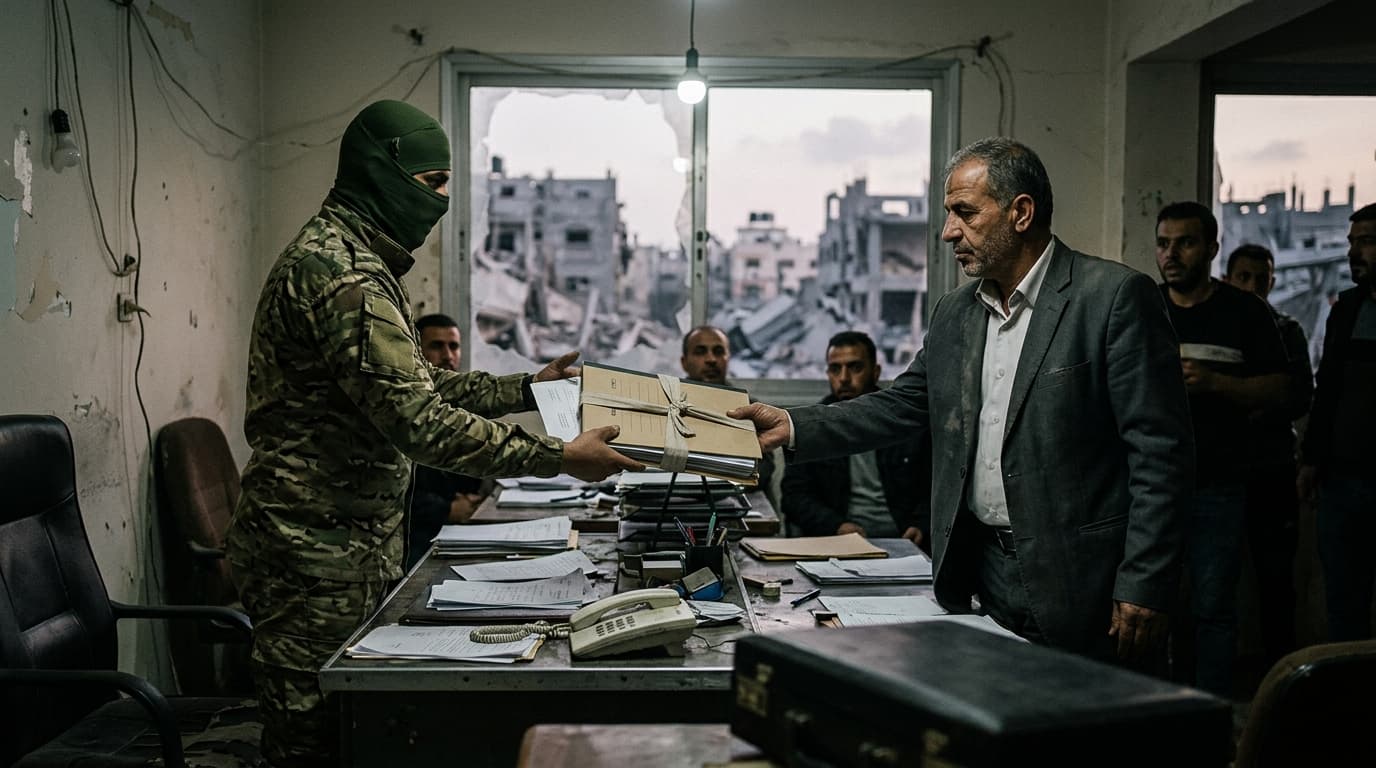
Hamas Cedes Gaza Government to a Body That Cannot Enter Gaza
Hamas dissolved its Gaza cabinet on July 6, 2026, handing power to a U.S.-backed technocratic committee — but the NCAG still cannot deploy, and Israel controls the ground.
Hamas formally dissolved the 15-member Government Emergency Committee that has run Gaza since 2007 on July 6, 2026, transferring civil authority to a U.S.-backed technocratic body — the National Committee for the Administration of Gaza (NCAG) — that has not entered the Strip and by its own account cannot do so until an International Stabilization Force is deployed, donor money returns, and Israeli forces pull back from the "Yellow Line" they still hold. The handover is a paper transfer of power, not a physical one, and it hardens rather than resolves the core dispute inside the Trump ceasefire plan: Hamas will vacate the ministries but not the armory, Israel will not withdraw until it does, and the technocrats meant to fill the vacuum are stuck in Cairo. The immediate beneficiary is the frozen status quo — roughly half of Gaza under Israeli military control, humanitarian aid throttled at a single crossing, and a Board of Peace whose own May report to the UN Security Council concedes that implementation has stalled on precisely the point Monday's announcement leaves untouched.
According to Al Jazeera, the announcement was made at a news conference outside Al-Aqsa Martyrs Hospital in Deir al-Balah. Israeli Foreign Minister Gideon Saar called it a "trick," accusing Hamas of trying to replicate the "Hezbollah model" — surrendering visible governance while keeping the guns. Hamas spokesman Hazem Qassem said the group was "ready to hand over," but the disarmament question, he added, would be settled "within a national framework" — Hamas code for a decision it does not intend to make on Washington's timeline.
What the ceasefire architecture actually looks like on July 8
The Trump 20-point plan, unveiled September 29, 2025, produced a ceasefire on October 10, 2025, and was endorsed by UN Security Council Resolution 2803 on November 17, 2025, by a vote of 13–0–2, with Russia and China abstaining. The resolution created three interlocking bodies. The Board of Peace, chaired by Donald Trump with former UK Prime Minister Tony Blair and former UN envoy Nickolay Mladenov among its principals, sits at the top as the transitional authority. The NCAG — 15 Palestinian technocrats led by civil engineer and former Palestinian Authority deputy minister Ali Shaath — is supposed to run day-to-day governance. An International Stabilization Force, drawn from unnamed contributing states, is supposed to secure the transition. All three are authorized until December 31, 2027.
None of them are yet operating inside Gaza in the role they were built for. The Council on Foreign Relations reports that 12 of 15 NCAG members have been confirmed and that the committee's first meeting was held in Cairo on January 15, 2026 — six months ago. It has not moved. A committee member told Al Jazeera in June that the body "categorically refuses" to operate behind the Israeli-held Yellow Line or to enter before the ISF is deployed in the buffer zones.
Shaath's own January 2026 mission statement — which pledged to rebuild Gaza "not just in infrastructure but also in spirit" — was already drafted around the same conditional language. That the committee is still in Cairo six months later confirms what its own architecture assumed: the political announcement would precede any operational reality by a wide margin.
The Board of Peace has already told the Security Council why this won't work
The strongest signal that Monday's announcement changes little is the Board of Peace's own report to the UN Security Council. In document S/2026/418, transmitted by U.S. Ambassador Michael Waltz on May 15, 2026, the Board wrote plainly:
"At this stage, the principal obstacle to full implementation remains Hamas' refusal to accept verified decommissioning, relinquish coercive control, and permit a genuine civilian transition in Gaza."
The report notes that all 251 hostages taken on October 7, 2023 have been accounted for — 168 returned alive, the last living hostage on October 13, 2025, the last deceased on January 26, 2026 — and that Israel released 250 life-sentence prisoners and roughly 1,700 Gazans detained after October 7. But it concedes that ceasefire violations are "near daily" and calls on the Council to "publicly, clearly and consistently" reiterate that decommissioning is a precondition for both reconstruction and a time-bound Israeli withdrawal.
Hamas's July 6 move is precisely calibrated against that language. The group is ceding the civilian ministries — governance without weapons — while explicitly refusing the second half of the Board's demand. Hamas politburo member Husam Badran told Al Jazeera in early June that when the NCAG arrives, "there will be no visible weapons in the streets and alleys of Gaza except the official weapons belonging to this committee." He then clarified: "We are not talking about handing them over."
This is the Hezbollah-model dispute in one sentence. It is also why Foreign Affairs analyst Matthew Levitt argues in The End of Hamas that Hamas's willingness to transfer authority is "better understood as a distress signal" than a tactical concession — the group's Shura Council has been unable to convene, its senior political bureau has been decimated, and it is bargaining from the weakest position it has held since 2006.
Why the transfer is stuck: Yellow Line, empty coffers, and Ayia Napa
Three concrete obstacles sit between Monday's announcement and any actual transfer of authority.
Israel controls the map. Under the October 10 ceasefire, Israeli forces pulled back to the "Yellow Line" but retained roughly 53% of Gaza — the first of three planned withdrawal stages, according to the BBC. Al Jazeera reports that Israeli deployment has since expanded to cover 60-70% of the Strip, and analyst Ahmed al-Tanani argues Netanyahu is exploiting "vague texts" of the ceasefire for domestic political gain. Prime Minister Benjamin Netanyahu personally laid a foundation stone this month for a new Israeli installation inside Gaza — a physical rebuttal to the idea of imminent withdrawal. Saar has publicly conditioned any further pullback on Hamas disarmament, and Israeli Cabinet Secretary Yossi Fuchs threatened in February to renew the war if Hamas did not disarm within 60 days — a deadline that came and went without action, but which now serves as a rhetorical baseline Israeli officials can revive at will.
The money isn't there. Per Al Jazeera, donors have reneged on $17 billion in pledges from a February 2026 conference, citing the fiscal fallout of the Israel-Iran 12-day war earlier in 2026. Without that capital, the NCAG cannot pay salaries, restore services, or begin reconstruction — even if Israel opened the crossings tomorrow. That single number reframes the entire transition: the technocratic committee was designed as a spending vehicle for Gulf and European reconstruction money, and without it the NCAG is a letterhead.
The Board of Peace is drifting toward parallel governance. The pilot project the Board is now designing at meetings in Ayia Napa, Cyprus focuses on Tal as-Sultan near Rafah — a "Hamas-free" enclave with humanitarian compounds guarded by a multinational force armed only with batons, from Camp Amitai on the Egyptian border. This is Article 17 of the Trump plan operationalized: reconstruction only in territory Israel controls, drawing displaced Palestinians out of Hamas-held areas. A leaked draft published by The Guardian, per Al Jazeera, showed the Board seeking sweeping legal immunity for members, forces and contractors, and authority to seize public property without compensation — provisions Palestinian analyst Mohanad Mustafa said would recast the Board as a "colonial occupation authority." The second-order effect is that even if Hamas fully complied on disarmament, the governance body Palestinians would inherit is one many already regard as an occupation authority in waiting.
The humanitarian arithmetic that will decide the transition
The OCHA humanitarian situation report of June 5, 2026 records 936 Palestinian deaths and 2,903 injuries in Gaza between the October 10, 2025 ceasefire and June 3, 2026, per the Gaza Ministry of Health figures OCHA cites — evidence that the Board of Peace's "guns have largely fallen silent" language is doing significant analytical work. On May 31, the UN Human Rights Office reported at least 26 Palestinians killed in the days around Eid Al Adha alone, including six women and seven children.
The OCHA update of June 12, 2026 reports that over 70% of Gazans depend on trucked water, that Kerem Shalom is the only functioning cargo crossing after Zikim's closure on May 24, and that a new Israeli checkpoint installed on June 1 has choked convoy flows through delays and screening malfunctions. Water production dropped 20% in May compared with two months earlier, driven by shortages of chemicals and spare parts.
Any interruption in Hamas's provision of basic services — even at the depleted level it currently manages — before the NCAG can actually deploy would be catastrophic. That is why Hamas has agreed that approximately 45,000 existing employees in health, education and interior security will remain in post during the transition, according to Al Jazeera's timeline. It is also why the "trick" argument has bite: those 45,000 include the security personnel Israel wants removed, and Israel has no way to distinguish a "Hamas ministry employee" from a "Hamas operative" without deploying inside Gaza itself — which the ceasefire prohibits.
The regional read: an audition for the Lebanon precedent
The strategic frame for Monday's announcement is not October 7, 2023 — it is November 2024. That is when Hezbollah accepted a ceasefire with Israel after a year of devastation, agreed to a nominal Lebanese army-led disarmament south of the Litani, and then quietly retained the bulk of its arsenal further north. Israel has responded with near-daily air strikes and continued occupation of parts of southern Lebanon 20 months later.
Israeli officials read Hamas's move through that lens because it is the strategy Hamas is openly emulating. As Foreign Affairs' Matthew Levitt writes in Hamas Is Not Done Fighting, Egyptian State Information Service head Diaa Rashwan has stated that what Hamas agreed to was to "freeze" its weapons, not disarm — a distinction American, Egyptian and Qatari mediators have not publicly resolved. Politburo member Mousa Abu Marzouk rejected disarmament outright. Hamas is betting that Israel — under fiscal strain, with Trump wanting a deliverable, and with donors withholding reconstruction funds — will accept a Lebanon-style ambiguity rather than restart the war.
The bet is not obviously wrong. The BBC noted that Resolution 2803 for the first time referenced "a credible pathway to Palestinian self-determination and statehood" — language pushed by European and Muslim states over U.S. reluctance — which Hamas can point to as political scaffolding that survives its disarmament refusal. Russia's UN ambassador Vasily Nebenzya warned during the Council vote that giving the Board of Peace "complete control" over Gaza on the basis of "Washington's promises" risked the ISF becoming "a party to the conflict."
There is also a Palestinian Authority hole at the center of the picture. The 20-point plan calls for the NCAG to eventually hand governance to a reformed PA in Ramallah — a transition Netanyahu, standing next to PA President Mahmoud Abbas at Sharm el-Sheikh in October 2025, publicly opposed even as he signed the framework. That contradiction is the structural fault line: the ultimate governance recipient designated by the plan is the actor the Israeli prime minister has spent his career preventing from governing Gaza.
What to watch
- Next Board of Peace report to the UN Security Council: due by mid-November 2026 under the six-month reporting cycle established by Resolution 2803. A formal declaration that Hamas has failed the decommissioning test would be the trigger for U.S. or Israeli escalation.
- Tal as-Sultan pilot in Rafah: Al Jazeera reports the Board of Peace plans to launch its first "Hamas-free" humanitarian compound "within weeks." Whether displaced Gazans actually relocate there — or refuse — is the on-the-ground test of Article 17.
- Cairo talks reconvening: the next round is expected to address tunnel maps and the disposition of family weapons, per Al Jazeera's June 23, 2026
reporting. No breakthrough on those items means no NCAG deployment.
- Israeli coalition politics: any realignment in Netanyahu's coalition — or an early election — could rapidly change Israeli tolerance for the ambiguity Hamas is now offering.
- UNSC Resolution 2803 sunset: December 31, 2027. Absent further Council action, the entire transitional architecture — Board of Peace, ISF, NCAG mandate — expires.
The Bottom Line
Hamas's July 6, 2026 dissolution of its Gaza government is a controlled political retreat, not a surrender: it hands over the ministries while keeping the weapons, betting that Israel, a fiscally cornered Board of Peace, and a Trump administration hungry for a legacy deal will accept the Hezbollah model in Gaza rather than restart the war. The move is unlikely to produce a functioning technocratic government inside Gaza in 2026 — the NCAG cannot deploy without an unformed ISF, donor money that has evaporated, and an Israeli withdrawal Netanyahu will not order until Hamas disarms. What Monday actually transferred was leverage, not power: Hamas now controls the pace at which the whole peace architecture either advances or exposes itself as a paper regime.
Discover more
Global Politics
Xi Jinping Calls China-Russia Ties 'Precious'
Xi Jinping's description of China-Russia ties as 'precious' reflects a strategic imbalance, with Beijing dictating terms in the partnership.
Global Politics
US-Iran Tensions Rise
Tensions escalate in the Strait of Hormuz as Iran and the US clash over maritime control, with a ceasefire hinging on a contested MoU paragraph.

US Politics
US Launches $166B Tariff Refund Portal
The US is launching a $166 billion tariff refund portal to aid importers hit by Trump-era tariffs, with major implications for trade and supply costs.

Conflict & Security
Drone Warfare Killing Aid Workers at Unprec
Over 1,000 humanitarian workers killed in three years as cheap armed drones collapse legal protections. Gaza, Sudan, Ukraine, and DRC see deliberate targeting of aid convoys and hospitals with zero prosecutions.