Hamas Dissolves Gaza Government, Cedes Power
Hamas transfers authority to UN-backed committee while retaining arms.
Model Diplomat11 min readMiddle East
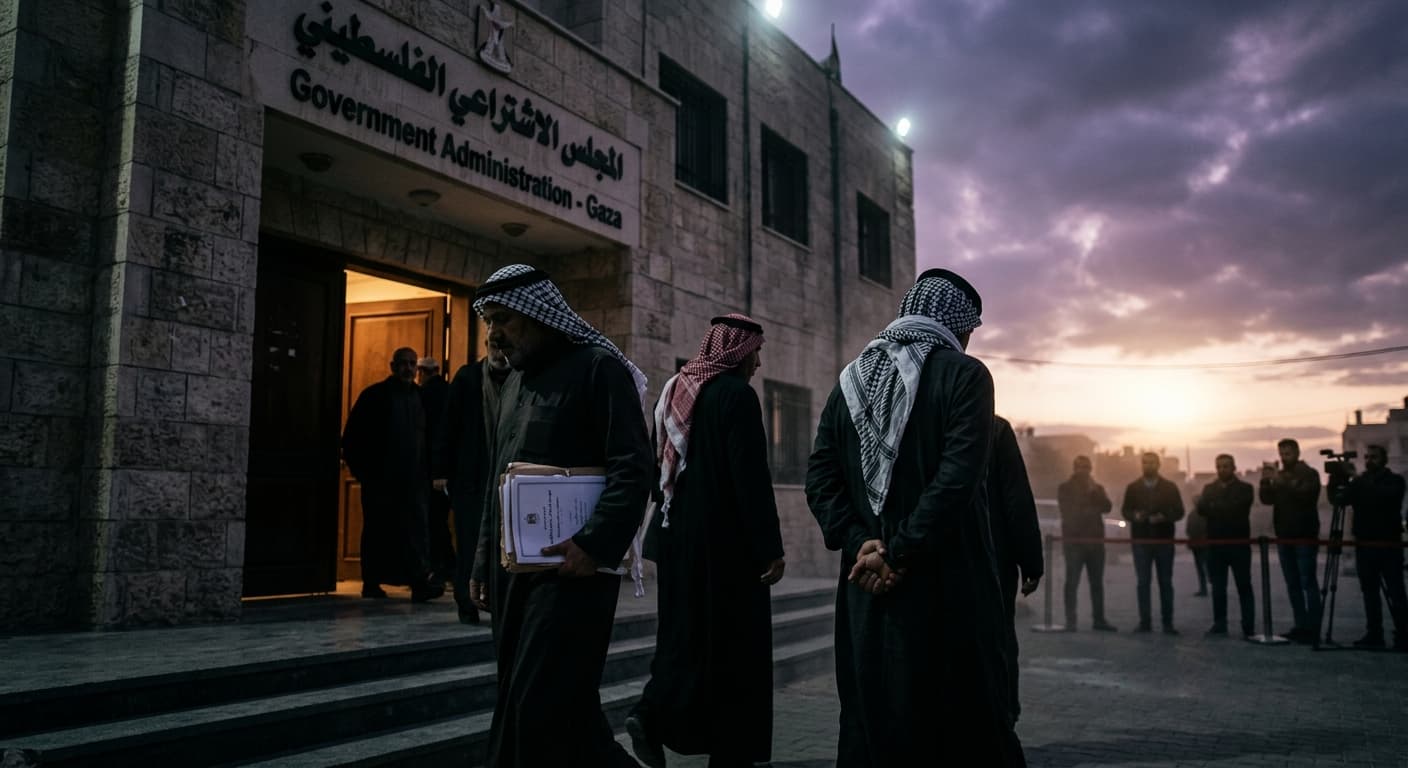
Hamas Dissolves Gaza Government, Hands Power to UN-Backed Panel
Hamas announced on July 6, 2026 it will dissolve its Gaza government and cede civilian rule to a UN-authorized technocratic committee — but keep its weapons.
Hamas on July 6, 2026 announced the dissolution of the ministries it has run in the Gaza Strip since 2007 and said it would transfer civilian authority to the National Committee for the Administration of Gaza (NCAG), the 15-member Palestinian technocratic body created under UN Security Council Resolution 2803. The move — reported by PBS NewsHour and confirmed by mediators in Cairo — looks like the biggest political concession Hamas has made since it seized Gaza from Fatah 19 years ago. It is not. The group is surrendering titles it can no longer exercise while keeping the one asset that has stalled the entire US-brokered peace architecture: its guns. The dissolution is a distress signal, not a handover — timed to a collapsed Iranian patron, a shattered ceasefire timetable, a $71.4 billion reconstruction bill nobody has funded, and Israeli elections in October that could bury the Trump plan altogether.
What was actually announced
Hamas said senior political and administrative officials would resign, while "technical and professional personnel" would stay on to "prevent a vacuum," according to a statement carried by ABC News. That caveat matters. The group is not evacuating the ministries; it is renaming its cadre. The NCAG, chaired by former Palestinian Authority planning official Ali Shaath, has been operational on paper since it held its first meeting in Cairo on January 15, 2026, but has never entered Gaza. Twelve of its 15 seats are filled, per a
Council on Foreign Relations briefing published in late June. Many of the confirmed members are former Palestinian Authority officials from the Abbas era, several with family ties to Gaza but none with an independent political base inside it.
The committee's remit is civilian: rule of law, water, health, aid distribution, reconstruction sequencing. It reports to the Board of Peace, a US-led transitional authority chaired by President Donald Trump, whose founding executive board convened in Washington in February 2026. The Board's response to Monday's announcement, delivered to News24, was that it would "judge Hamas by actions, not promises." Israel's foreign minister called the move "a stunt," according to
The Globe and Mail, and continued strikes killed five Palestinians in Gaza the same day the announcement was made.
UN Secretary-General António Guterres's spokesman Stephane Dujarric told reporters the UN "welcomes any step that contributes to the implementation of the ceasefire agreement" and added that the UN "continue[s] to support efforts toward unified Palestinian governance under the Palestinian Authority," according to Al Jazeera's live coverage. That second sentence is diplomatic code: New York does not accept the NCAG as an end-state, only as a bridge.
From ceasefire to dissolution: the transition timeline
Nine months into the Trump plan, the political architecture has been built and the security architecture has not. Every deadline that mattered has slipped.
- October 10, 2025: Trump-brokered ceasefire halts fighting; hostages released within weeks.
- November 17, 2025: Security Council adopts
Resolution 2803 by 13-0, with Russia and China abstaining. Mandate expires December 31, 2027.
- January 15, 2026: NCAG holds first meeting in Cairo under Ali Shaath's chairmanship.
- February 19, 2026: Trump chairs first Board of Peace meeting in Washington; Indonesia pledges 8,000 troops to the ISF.
- April 20, 2026: World Bank / UN / EU release the Rapid Damage and Needs Assessment at the Ad Hoc Liaison Committee in Brussels.
- June 2026: Twelve-day US-Israel war on Iran; Ayatollah Ali Khamenei killed; regional donors reportedly renege on $17 billion in pledges.
- July 6, 2026: Hamas dissolves Gaza government; disarmament and Israeli withdrawal remain unresolved.
The concession Hamas is not making
Read the fine print of the July 6 statement and the concession shrinks fast. Hamas is dissolving ministries; it is not dissolving the al-Qassam Brigades. In a June 5 interview with Al Jazeera, political bureau member Husam Badran said the group would "not be handing over" its arsenal — only agreeing that weapons would no longer be "visible" in the streets once the NCAG deploys. He described the ultimate fate of the arsenal as subject to a comprehensive Palestinian national dialogue and floated a long-term hudna, or truce, in place of surrender. Former UN Middle East envoy Nickolay Mladenov, now the Board of Peace's representative on the ground, presented a 15-point roadmap to the Security Council in May clarifying that "no Palestinian armed group will be required to transfer its weapons to Israel," with arms instead handed to the NCAG on a Palestinian-led decommissioning timetable.
That distinction is doing a lot of work. Resolution 2803 explicitly authorizes the International Stabilization Force "to use all necessary measures" to secure "the permanent decommissioning of weapons from non-state armed groups" — Chapter VII language, quoted verbatim in the UN document. The gap between "no visible weapons" and "permanent decommissioning" is the entire war.
The reason Hamas can shed the government without shedding much power is that the government was already gone. A senior Hamas lieutenant colonel told the BBC in June the group had lost roughly 80% of operational control across Gaza, that "about 95%" of its security leadership had been killed, and that "there's no leadership, no command, no communication." Six armed clans — notably Yasser Abu Shabab's Rafah-based network, which Israel confirmed it had armed — are filling the vacuum. Hamas has placed a bounty on Abu Shabab, fearing he could become a unifying figure for the group's many enemies. A June 2026
Foreign Affairs essay by Devorah Margolin and Matthew Levitt argues the January 2026 pledge to abolish its administrative bodies is best read "as a distress signal" — not a strategic pivot, but the visible edge of a collapse: no elected political bureau leader since Yahya Sinwar was killed in October 2024, a five-man interim council paralysed by infighting, and financial patrons in Tehran neutralised by the June war.
Put bluntly: Hamas is trading a title deed on ruins for the diplomatic cover to keep its rifles and its cadres.
The Trump plan, priced
The stakes attached to that trade are extraordinary — and this is where the story stops being about Hamas. UNSC Resolution 2803 built a transitional architecture with a hard sunset of December 31, 2027. The Board of Peace's July 2026 progress report to the Council, S/2026/418, quantifies what has to happen inside that window: clear 70 million tons of rubble, neutralize an estimated 350 kilometres of tunnels, rehouse at least one million people, cut unemployment from roughly 80% today by generating 250,000 jobs within five years. The joint World Bank, UN and EU Rapid Damage and Needs Assessment, published on April 20, 2026,
priced the ten-year bill at $71.4 billion, with $26.3 billion needed in the first 18 months alone.
The sectoral breakdown, per the full RDNA report, is uncompromising: housing needs $16.2 billion, agriculture and food systems $10.5 billion, health $10 billion, commerce and industry $9 billion. Debris removal alone is a $1.7 billion line item. Agriculture and food systems carry the single largest short-term financing need — $7.5 billion in the first 18 months — because Gaza cannot feed itself and the food-import architecture that existed before October 2023 has been destroyed.
The financing gap dwarfs the political theater. Al Jazeera reported on July 1 that donors have quietly reneged on $17 billion of pledges made at a February conference — largely because of the fiscal fallout from the June US-Israel war on Iran. The Gaza Reconstruction and Development Fund, launched under limited World Bank trusteeship according to the
World Bank, remains a shell without those flows. The World Bank's role is deliberately narrow — inflows and outflows only, with strategic direction ceded to the Board of Peace and the NCAG.
The Board of Peace's own report to the Council is blunt about the deadlock: "Reconstruction cannot commence where weapons have not been laid down." That is the leverage Hamas is trying to break by handing over the ministries: force the Board to open the crossings and the checkbook without disarming. Meanwhile Jared Kushner's Davos "master plan," a Kushner-led vision estimated by Brookings analyst Shibley Telhami at roughly $25 billion, sketches 180 coastal skyscrapers and 100,000 housing units in Rafah — a project entirely dependent on the disarmament that has not happened and the donor confidence that has evaporated.
What Israel and the ISF do next
The International Stabilization Force is the pivot. As of the last public update, five countries — Indonesia, Morocco, Kazakhstan, Kosovo and Albania — have committed troops, with Egypt and Jordan training police. Indonesian President Prabowo Subianto pledged up to 8,000 personnel, making Jakarta the deputy command, per Al Jazeera's February coverage. US Major General Jasper Jeffers III said the ISF is targeting an eventual 20,000 troops and 12,000 vetted Palestinian police, deploying "sector by sector" from Rafah outward. The
BBC reported that Israel's Kan broadcaster identified a barracks site between Rafah and Khan Younis already earmarked for the Indonesian contingent. But Prabowo's mandate explicitly forbids Indonesian forces from combat or "direct confrontation with any armed group" — which means they will not be the ones prising rifles from Hamas hands.
That force still has no operational presence inside Gaza. A committee member speaking to Al Jazeera in June said the NCAG will not deploy behind Israel's "Yellow Line" — the demarcation separating Israeli-held territory from areas outside its direct control — until the ISF is on the ground. Israel, in turn, refuses to withdraw until Hamas disarms. The Hamas dissolution announcement is engineered to break that logjam by shifting political cost onto Prime Minister Benjamin Netanyahu.
It may not work. Chatham House's Nadwa al-Dawsari wrote in January that Netanyahu has already dubbed the phase-two transition "symbolic," that the Israeli military has drawn contingency plans for a fresh ground operation in Palestinian-controlled Gaza if Hamas remains armed by March, and that more than 2,500 structures — homes and tunnels Israel says were booby-trapped — have already been demolished behind the Yellow Line since October. A separate July analysis from Chatham House's Yossi Mekelberg argues Netanyahu now enters the
October parliamentary elections unable to form a coalition, and having reportedly been called "crazy" in a phone call by an increasingly frustrated Trump. Netanyahu's incentive structure is now dominated by the coalition arithmetic: any concession that looks like Hamas survival costs him seats to his right.
Add a second Israeli obstacle: Turkey. The Board of Peace's Gaza Executive Board seats include Turkish Foreign Minister Hakan Fidan and Qatari senior diplomat Ali al-Thawadi. Netanyahu's office publicly opposed Turkish participation at the January Davos charter signing, according to the Council on Foreign Relations, and Israel has since sought to prevent Turkish political influence in Gaza. Any ISF pilot in a "Hamas-free" zone will run into an Israeli veto on Turkish personnel and a Turkish veto on operating without them.
The historical parallel worth naming
There is a template for what Hamas is attempting, and it is not encouraging. In 2014, Hamas nominally dissolved its Gaza administration to allow a Palestinian Authority "consensus government" — a deal that produced no reunification and lasted months. The July 2024 Beijing Declaration, signed by Hamas, Fatah and twelve other factions under Chinese mediation, promised an "interim national reconciliation government" — and never produced one.
The difference this time is external: the transitional authority is not a Palestinian Authority ministry but a Trump-chaired body backed by a Chapter VII-adjacent UN mandate and a stabilization force with "all necessary measures" authority, per the UN meeting record. The similarity is internal: the group with the guns has not agreed to give them up. In every prior Palestinian dissolution, the weapons kept the politics. That pattern is what the Board of Peace's report is warning is about to repeat.
What benefits, what breaks
The immediate beneficiary of Monday's move is Egypt. Cairo hosts the NCAG, trains the vetted Palestinian police, and — as Telhami noted in his Brookings review — operates the border crossing that will shape reconstruction flows. President Abdel Fattah el-Sisi gets a technocratic buffer between Hamas and the Palestinian Authority that keeps both weak and dependent on Egyptian mediation, plus a Rafah-first ISF deployment that puts foreign troops on the Sinai perimeter under Cairo's watchful eye.
The clearest loser is the Palestinian Authority. Under Resolution 2803, PA takeover of Gaza is contingent on reforms and on the Board of Peace's judgment that it can govern "securely and effectively." Palestinian Vice President Hussein al-Sheikh's statement backing "one system, one law, and one legitimate weapon" was welcomed by the White House but ignored on the ground. The technocratic committee's very existence formalizes the PA's exclusion from Gaza for the foreseeable future — a point Chatham House flagged in January and one that senior Fatah officials have privately conceded to mediators. Mahmoud Abbas is being routed around.
The second-order loser is the two-state framework itself. Resolution 2803's language on Palestinian statehood — the phrase "conditions may finally be in place for a credible pathway" — was the concession that got Arab states to sign on, per the NPR summary of the 13-0 vote. It is aspirational, not operative. Russia's ambassador Vassily Nebenzia said as much in his abstention statement, warning the resolution "shouldn't become a fig leaf for unbridled experiments." Every month the Board of Peace runs Gaza as a trust territory, the reality on the ground drifts further from a Palestinian sovereign entity and closer to something that resembles the post-2003 Coalition Provisional Authority in Iraq — with the same open question about who takes the keys when the mandate expires. Al Jazeera's Marwan Bishara framed the November 17 vote as "a reflection of the imbalance of power on the ground in Gaza in favour of Israel and the imbalance of power in the Middle East in favour of the United States." Nine months later, the July 6 announcement rests on that same imbalance.
Diplomat View
Hamas has surrendered the shell and kept the sword. Monday's announcement was choreographed to make the group look reasonable, put Netanyahu on the diplomatic back foot before the October election, and force the Board of Peace to open the crossings before the disarmament sequence begins. It will not work in that order — the Board's own July report to the Security Council makes disarmament the trigger for reconstruction, not the reverse. Expect Israel to test the concession in the next 30 days by demanding the NCAG deploy behind the Yellow Line, watch that offer be refused because the ISF is not yet deployed, and watch the ISF's Rafah pilot slip past its target date because the $17 billion in reneged pledges has not been replaced. What would change this forecast: a public Hamas commitment to a verifiable arms-decommissioning timetable — not a "long-term hudna," and not the Badran formula of invisible weapons under police control. Absent that, the July 6 dissolution becomes another entry in a 19-year ledger of Palestinian governance announcements that outlived their headlines by weeks.
What to watch
- July–August 2026: Board of Peace decision on whether to authorize NCAG deployment behind the Yellow Line without full Hamas disarmament; watch the Tal as-Sultan "Hamas-free" pilot near Rafah.
- September 2026: UN Security Council review of ISF pre-deployment; troop-contributor confirmation from Pakistan and Turkey.
- October 2026: Israeli parliamentary elections — a Netanyahu loss reopens phase-two negotiation space; a win locks in the current stall.
- December 31, 2027: Sunset of the Board of Peace and ISF mandate under Resolution 2803 unless renewed by the Council.
The Bottom Line
Hamas has dissolved a government it could no longer run to keep an army it will not surrender — a distress signal, not a handover, timed to a stalled ceasefire, a $71.4 billion reconstruction bill nobody has funded, and Israeli elections in October. Until Resolution 2803's disarmament clause is enforced by the International Stabilization Force, the National Committee for the Administration of Gaza will remain a Cairo letterhead, and the Board of Peace will remain a transitional authority governing a territory it cannot enter.
Discover more
Global Politics
Xi Jinping Calls China-Russia Ties 'Precious'
Xi Jinping's description of China-Russia ties as 'precious' reflects a strategic imbalance, with Beijing dictating terms in the partnership.

US Politics
US Launches $166B Tariff Refund Portal
The US is launching a $166 billion tariff refund portal to aid importers hit by Trump-era tariffs, with major implications for trade and supply costs.

US Politics
SNAP Food Assistance Faces Legal Challenges
In 2026, SNAP faces stricter eligibility rules and mounting legal challenges, threatening food assistance for the millions of Americans who rely on the program.

Conflict & Security
Drone Warfare Killing Aid Workers at Unprec
Over 1,000 humanitarian workers killed in three years as cheap armed drones collapse legal protections. Gaza, Sudan, Ukraine, and DRC see deliberate targeting of aid convoys and hospitals with zero prosecutions.