Gulf Capital Buys Africa's Infrastructure
Gulf sovereign wealth funds buy equity stakes as Chinese lending collapses 93%
Model Diplomat8 min readAfrica
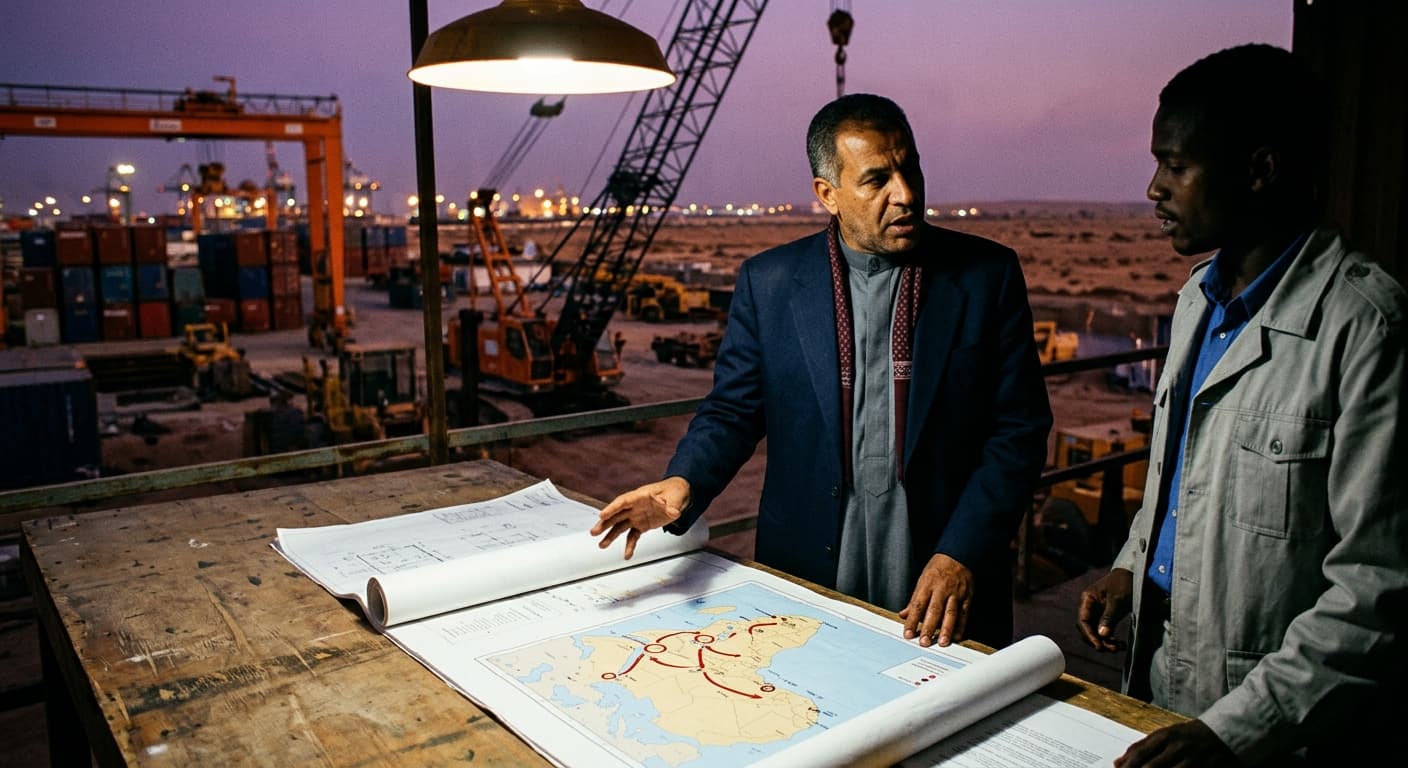
Gulf Capital Is Buying Africa's Infrastructure — Not Lending to It
As Chinese lending collapses to $2.1 billion, Gulf sovereign wealth funds are pouring $53 billion-plus into African ports, mines, and energy — acquiring ownership where Beijing once extended debt.
Chinese policy bank lending to Africa fell from a peak of $28.8 billion in 2016 to just $2.1 billion in 2024, a 93% collapse that opened the largest infrastructure financing vacuum on the continent in two decades. Into that gap has stepped Gulf capital, and the difference is structural: where Beijing lent against sovereign guarantees, Abu Dhabi and Riyadh are buying equity stakes, long-term concessions, and operational control over the ports, mines, and power grids that define Africa's economic geography. The Gulf wave replaces Chinese debt dependency with equity-based influence, concentrating it in the exact sectors that serve Gulf strategic interests rather than broad-based African development.
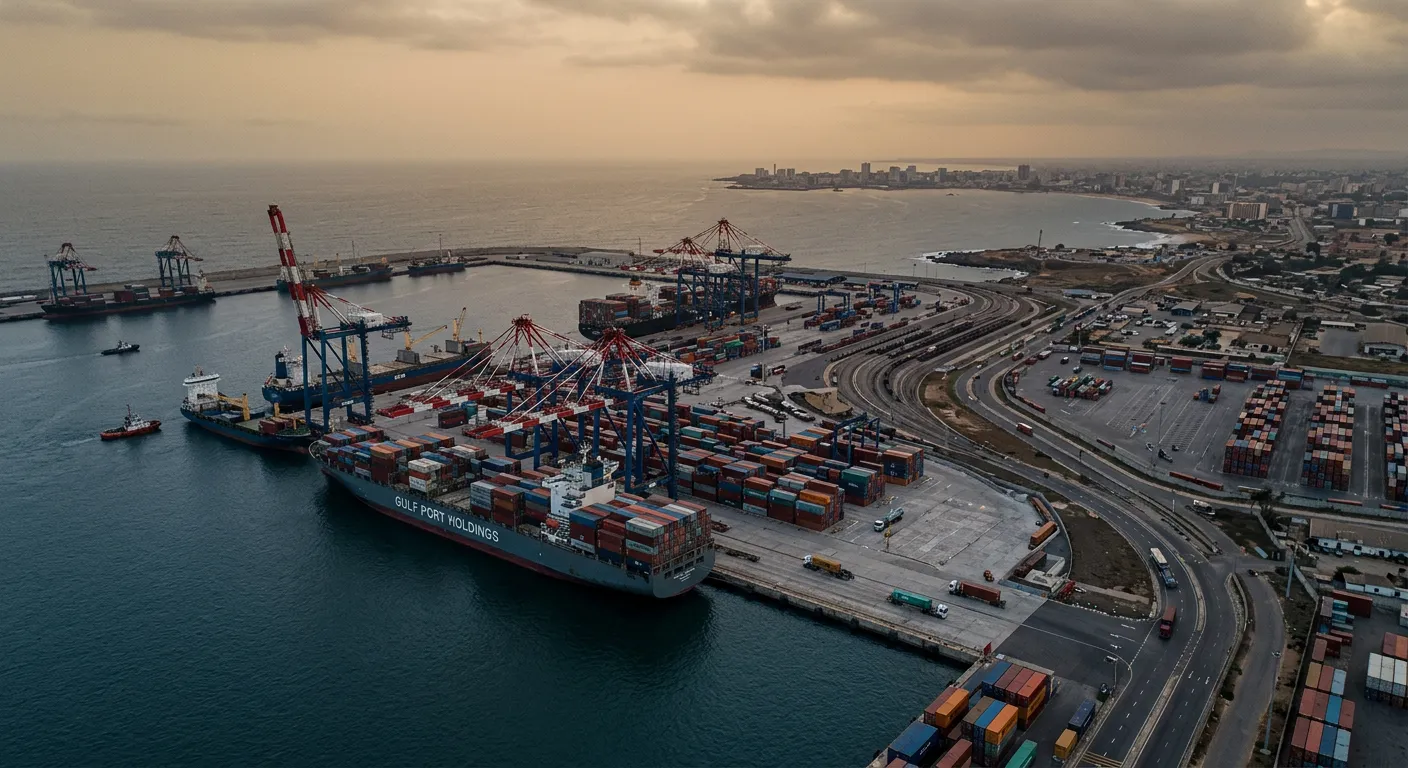
The Chinese retreat by the numbers
The data on China's pullback is unambiguous. According to the Boston University Global Development Policy Center, Chinese policy bank lending to Africa peaked at $28.8 billion in 2016 and has fallen every year since, landing at $2.1 billion in 2024 — roughly one-thirteenth of its peak value relative to regional GDP, according to an IMF analytical note. The IMF found that Chinese loan disbursements to sub-Saharan Africa now represent about one-eighth of their 2016 peak, and total loan commitments have contracted to roughly 4% of their peak value.
The retreat is driven by multiple factors. Beijing's own domestic economic slowdown, a property crisis, and record youth unemployment have constrained overseas lending capacity. A series of high-profile failures, from Sri Lanka's Hambantota port to an Ecuadorean dam with 7,000 cracks and Kenya's "railway to nowhere" that stops in the middle of the country, prompted a 2016–17 regulatory overhaul that clamped down on gargantuan foreign investments, as Foreign Affairs reported. At the 2021 Dakar FOCAC summit, China cut its Africa commitment from $60 billion to $40 billion and halved loan credits. The 2024 Beijing FOCAC offered a modest rebound to $50.7 billion, but
Brookings noted that only 30 connectivity projects were committed for 2025–2027 — a fraction of the more than 1,600 infrastructure projects China claims to have completed in previous years.
The flip side of the lending collapse is a repayment crisis. A Lowy Institute report found that 75 of the world's poorest countries owe China $22 billion in repayments in 2025 alone — a "tidal wave" of debt service that crowds out development spending on health, education, and food. As
NPR reported, more than a quarter of external debt in developing countries is now owed to China, and Beijing has shifted from lender to debt collector.
The Gulf fills the vacuum — on different terms
The Gulf response has been swift and large. Investors from Gulf Cooperation Council countries announced 73 foreign direct investment projects worth more than $53 billion across Africa in 2023, according to Global Finance Magazine. Between 2019 and 2023, Emirati investments alone exceeded $110 billion, including an estimated $70 billion directed at renewable energy. The UAE is now Africa's fourth-largest foreign investor, behind China, the EU, and the US, with GCC states collectively investing over $100 billion over the past decade, led by the UAE at $59.4 billion and Saudi Arabia at $25.6 billion, as
Chatham House documented.
The mechanism is fundamentally different from the Chinese model. Where Beijing's policy banks extended sovereign-backed loans for megaprojects built by Chinese contractors, Gulf sovereign wealth funds and state-owned enterprises acquire equity stakes, long-term concessions, and operational control. The $35 billion Ras El-Hekma development in Egypt, backed by ADQ, ranks among the largest FDI deals ever concluded on the continent. DP World now operates six African ports and logistics facilities, with concessions spanning nearly a dozen countries, including a 30-year contract to transform Dar es Salaam into a major trade hub. In Egypt, Angola, and the Republic of Congo, Abu Dhabi Ports has secured concessions of its own. On the renewable side, Masdar has committed $10 billion to develop 10 gigawatts of capacity across sub-Saharan Africa by 2030; its joint venture Infinity Power already operates 1.3GW in Egypt, South Africa, and Senegal, with 16GW under development.
An IMF working paper published in September 2025 confirmed the pattern: GCC cross-border investments are increasingly directed toward logistics, energy, and infrastructure, with sovereign wealth funds like ADIA, Mubadala, and Saudi Arabia's Public Investment Fund leading deal activity. The paper found a "significant positive relationship" between inward investments and GCC real non-hydrocarbon GDP. Medium-term GDP amplification from inward investments was three times larger than from domestic investments, confirming that African assets are integral to Gulf diversification strategies, not philanthropic side bets.
Strategic concentration, not broad-based development
The sectoral pattern reveals the strategic logic. Gulf capital concentrates in ports, logistics networks, critical minerals, food systems, and renewable energy: the exact assets that serve Gulf post-oil diversification and food security needs. Saudi Arabia's Manara Minerals, a joint venture between Ma'aden and the PIF, plans to deploy up to $15 billion in African copper, cobalt, and lithium. Abu Dhabi's International Resources Holding has acquired a majority stake in Zambia's Mopani copper mine and a controlling stake in a major tin mine in the Democratic Republic of Congo. Saudi Arabia has acquired 500,000 hectares of land in Tanzania; the UAE holds agricultural leases in Sudan and Uganda; Qatar has committed $500 million to African agricultural investments, externalizing Gulf food production onto African soil, as Chatham House documented.
The Chatham House analysis is blunt: "What matters is not the volume of Gulf investment in Africa, but its intent. Far from being development-driven, Gulf capital is concentrated in strategic sectors — ports, logistics, agriculture, energy and critical minerals — that shape trade flows, secure resources and embed long-term influence." The result is an emerging network of trade corridors linking African markets to the Gulf, giving Gulf states influence over maritime routes, export flows, and the movement of capital across strategically important supply chains.
The financial architecture is accelerating. In June 2026, sovereign wealth funds, commercial banks, and development finance institutions launched the Africa–Middle East Corridor at the Global Banking & Markets Middle East 2026 conference in Dubai, aiming to mobilize capital for infrastructure and deepen Africa's debt capital markets, according to Global Finance Magazine. First Abu Dhabi Bank announced plans in March to establish its first representative office in Lagos, making Nigeria its West African hub, and has already participated in financing the $1.13 billion Lagos–Calabar Coastal Highway. The UAE has ratified 13 Comprehensive Economic Partnership Agreements in three years, per an
IMF country report, including a CEPA with Kenya that was the first such deal between the UAE and a mainland African country.
The leverage question
African governments are not without bargaining power, but it is unevenly distributed. Morocco offers the clearest example of successful conditionality: Rabat has linked Gulf investment in renewable energy to domestic industrial goals, including local manufacturing requirements. South Africa has pursued a parallel strategy, with the World Bank approving in March 2026 a Credit Guarantee Vehicle expected to mobilize $10 billion over ten years for resilient infrastructure — a mechanism designed to crowd in private capital while reducing reliance on sovereign guarantees, giving Pretoria more negotiating leverage over external investors.
For most African states, the calculus is harder. Chatham House notes that control over land, critical minerals, and market access gives states real leverage "particularly when exercised collectively through institutions such as the African Union and the African Continental Free Trade Area." Yet for most, this power "remains constrained by debt, weak institutions and infrastructure shortages that make rapid Gulf financing difficult to refuse." Uganda's decision to award a $4 billion refinery project to an Emirati firm after abandoning a slower American bid illustrates the dynamic: speed and delivery outweigh procedural safeguards.
The security environment adds a new variable. The 2026 Iran war has forced Gulf governments to reassess overseas commitments through a security lens, as Chatham House noted. If tensions persist, sovereign wealth funds may redirect resources toward defense, domestic stabilization, and economic protection at home. Investment in Africa would likely continue but become more selective, politically conditional, and tied to strategic interests rather than development goals. The
CSIS has separately flagged that Gulf AI infrastructure investments, including a $1 billion UAE commitment to expand AI across Africa, face concentration risks from regional conflict, potentially disrupting compute and technology flows that are becoming part of the Gulf-Africa corridor.
The structural risk
The core analytical point is that the shift from Chinese debt to Gulf equity changes the nature of dependency, not its existence. Chinese lending left African governments owing money; Gulf investment leaves them sharing ownership of strategic assets with foreign state entities whose commercial decisions are inseparable from their sovereign patrons' strategic agendas. A port operated by DP World under a 30-year concession is not the same as a port built with a Chinese loan. The debt eventually gets repaid or restructured; the concession shapes trade flows for a generation.
Chatham House frames the stakes with precision: "If African states cannot coordinate their negotiating position through regional frameworks such as the African Mining Vision, the AfCFTA and more harmonized investment policies, Gulf investment may evolve from a source of opportunity into a new architecture of dependency. Strategic assets will remain externally influenced, domestic value creation will remain weak and political autonomy may narrow alongside economic choice."
The European Council on Foreign Relations reaches a similar conclusion: the shift from Chinese debt-heavy financing to Gulf equity-leaning engagement may reduce explicit debt dependency but creates new forms of equity-based influence. Without strong governance, transparent contracts, local capacity development, and clear dispute-resolution mechanisms, Africa risks substituting one form of dependency for another — where external actors gain recurrent influence over critical infrastructure and strategic sectors.
Diplomat View
The Gulf is not replacing China in Africa — it is succeeding China on more durable terms. Debt can be restructured, forgiven, or outgrown. Equity stakes and 30-year concessions cannot. If the current trajectory holds, the strategic infrastructure defining Africa's trade routes, energy systems, and mineral supply chains will be operated by Gulf state entities whose commercial logic tracks Riyadh's and Abu Dhabi's sovereign priorities, not the African Development Bank's lending criteria.
The forecast hinges on three variables. First, whether the 2026 Iran war forces Gulf sovereign wealth funds to retrench domestically — a sustained conflict would slow but not halt the wave, as Gulf investors would prioritize strategic assets over discretionary deals. Second, whether African governments can coordinate through the AfCFTA and the AU to harmonize investment terms — Morocco and South Africa show this is possible, but neither institution has yet functioned as an effective investment-negotiation bloc. Third, whether the Africa–Middle East Corridor, launched in Dubai in June, matures into a genuine capital-market platform or remains a signature ceremony.
What to watch:
- The operationalization of South Africa's Credit Guarantee Vehicle — targeted for late 2026, with development partners expected to confirm capital participation. Success would give Pretoria a template for de-risking external investment without ceding asset control.
- The first deals flowing through the Africa–Middle East Corridor framework — watch for whether they take the form of debt instruments (African sovereignty preserved) or equity concessions (Gulf ownership extended).
- Saudi Arabia's Manara Minerals deployment timeline — the announced $15 billion for African critical minerals has not yet been fully committed; the pace and terms of its first major acquisitions will signal whether Gulf mineral investment replicates the port-concession model.
The bottom line: The Gulf is buying Africa's infrastructure, not financing it. That distinction will shape the continent's economic sovereignty for the next three decades — and most African governments have not yet begun to negotiate accordingly.
Sovereign Wealth FundsInfrastructure InvestmentForeign Direct InvestmentDebt and DevelopmentGeopolitical Competition
Discover more
US Politics
Congress Targets AI Chatbot Access for Terror
The House passed the Generative AI Terrorism Risk Assessment Act, focusing on AI's role in terrorism and potential surveillance implications.
US Politics
House Ethics Committee Pushes Sexual Miscond.
The House Ethics Committee has shifted responsibility for sexual harassment settlement records to the Office of Congressional Workplace Rights, complicating disclosure efforts.
India
BJP's Delimitation Strategy
Congress leader K.C. Venugopal claims the BJP uses women's reservation to advance delimitation, raising fears over electoral fairness ahead of the 2029 polls.

Economics
Fed's Amex AML order puts correspondent banking on notice
Federal Reserve's Amex AML order requires board-level controls and a 90-day plan; OCC fined the bank $350 million over enterprise-wide deficiencies.