DeepMind UK Employees Unionize Over AI Ethics
UK staff vote overwhelmingly to unionise over military AI contracts.
Model Diplomat8 min readEurope
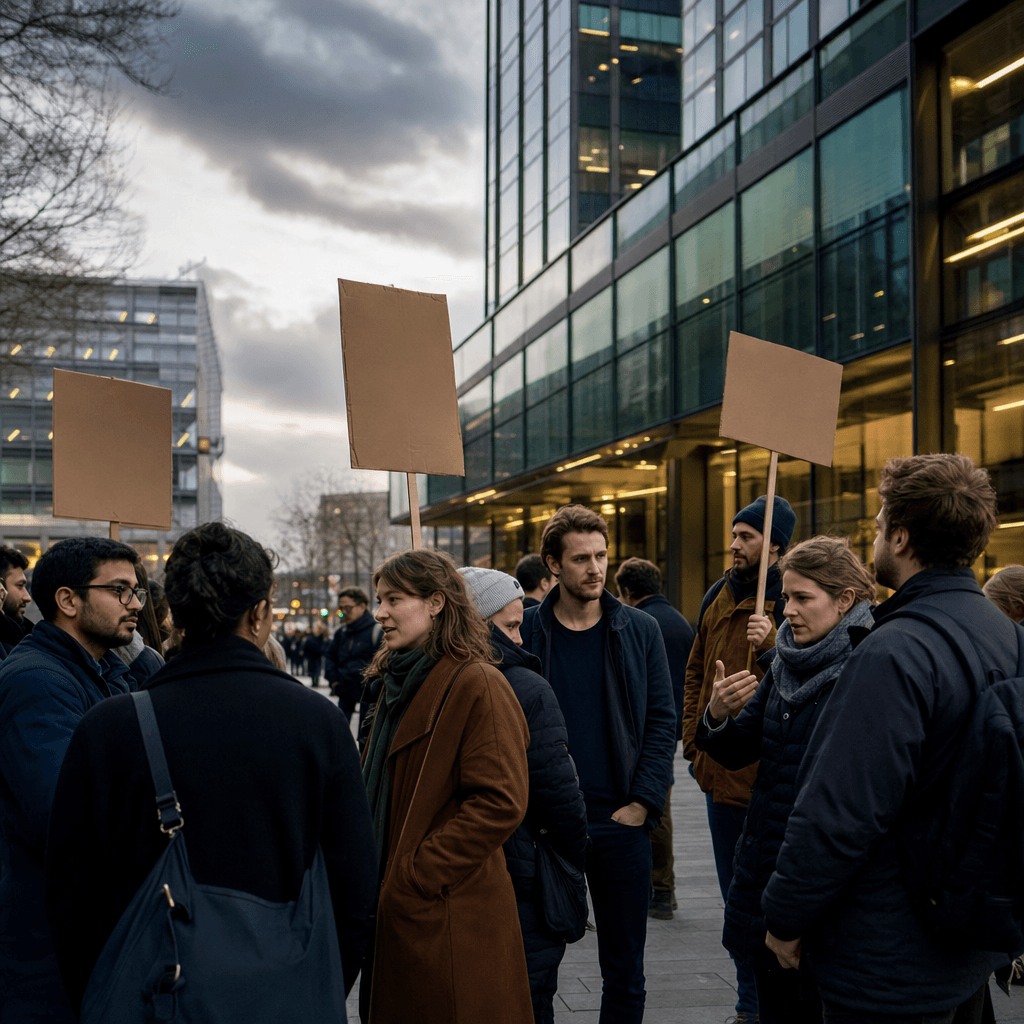
DeepMind's UK Union Bid: Ethics Fight Meets UK Labour Law
UK staff at Google DeepMind voted 98% to unionise with the CWU and Unite over military AI contracts. Here is what the fight is really about — and what to watch next.
The 98% vote by Google DeepMind's UK staff to join the Communication Workers Union and Unite the Union is not a labour dispute in any conventional sense. It is a governance takeover attempt — an effort to reimpose, through UK collective-bargaining law, the ethical constraints Google removed from its own AI Principles in February 2025, when senior vice president James Manyika and Hassabis co-signed a blog deleting the section that ruled out applications 'likely to cause harm'. The workers who built Gemini are trying to use British statute to do what Silicon Valley worker activism can no longer do on its own: veto military use of the models they train.
The bid, first reported by Fortune on 5 May 2026, would create the world's first recognised union at a frontier AI laboratory. Roughly 1,000 London-based staff are covered. The demands — end use of Google AI by the US and Israeli militaries, restore the scrapped "no weapons" pledge, install an independent ethics body, and grant a written right to refuse work on moral grounds — are unprecedented in scope. They are also being routed through a legal architecture designed for warehouse pay deals.
What actually happened, and when
DeepMind's UK employees delivered a formal recognition request to Google management on 5 May 2026, the day after the Pentagon announced eight simultaneous classified AI contracts with major US labs. The Verge, citing the letter, reported that staff asked for joint recognition of the CWU and Unite within ten working days or an agreement to mediated negotiations; otherwise, the unions would trigger the statutory route under Schedule A1 of the Trade Union and Labour Relations (Consolidation) Act 1992.
An earlier attempt had already failed. The Central Arbitration Committee's public record shows the two unions filed against "Google UK Limited" under case TUR1/1513(2025) — an application recorded on GOV.UK as withdrawn on 21 November 2025. That withdrawal matters: it tells us the current bid is the second attempt, and that the organisers have narrowed their bargaining unit to DeepMind's London office rather than Google UK as a whole.
Google is playing for delay. A DeepMind spokesperson told Fortune that "at this stage in the process, there has been no vote to unionize" — a technically defensible framing, because the 98% figure covers only CWU members inside DeepMind, not a company-wide ballot. If the parties cannot agree, the CAC will decide whether the proposed bargaining unit is "appropriate," conduct a membership check, and — under paragraph 22 of Schedule A1 — either grant recognition on majority membership or order a secret ballot. The Culina Logistics recognition decision published on GOV.UK this year is a reminder of how that machinery grinds through months of legal argument even in a warehouse case.
The trigger: a Pentagon deal for "any lawful purpose"
The proximate cause is a contract the DeepMind researchers did not sign but were told they would build for. The BBC reported that in early May the Pentagon inked agreements with Google, OpenAI, Amazon, Microsoft, SpaceX, Oracle, Nvidia and the start-up Reflection under language authorising "any lawful operational use," calling it the transformation of the US military into an "AI-first fighting force" — the first time Gemini was cleared for classified deployment. Google's Gemini, previously used in unclassified government work, was cleared for classified deployment for the first time.
The Trump administration then codified the policy. A June 2026 White House fact sheet announced a National Security Presidential Memorandum on AI in the National Security Enterprise, directing "rapid onboarding of the most advanced AI models from multiple vendors" and rescinding the Biden-era NSM-25. The memorandum is written as a supplier-management document: no company that wants classified US business can meaningfully hold ethical red lines against Washington's preferences.
The DeepMind staff read the terms and revolted. According to The Next Web, over 580 Google employees, including 20 directors and vice presidents, signed an internal letter urging Sundar Pichai to refuse the deal; a separate letter from more than 100 DeepMind staff demanded the models not be used for weapons development or autonomous targeting. Research scientist Alex Turner said publicly that Google "can't veto usage" and was relying on "aspirational language with no legal restrictions" — the precise gap the union bid is designed to close. Sir Demis Hassabis, who won the 2024 Nobel Prize in chemistry and previously told the
Financial Times that AI weapons and mass surveillance should never be built with the technology, has not spoken publicly on the deal.
The eight-year reversal
The historical parallel that reframes this story is 2018. When ~4,000 employees petitioned against Project Maven, Google walked away from the contract and published the AI Principles that included an explicit refusal to build weapons or mass-surveillance technology. That was possible because military revenue was rounding error against ad revenue.
That structure is gone. On 5 February 2025, senior vice president James Manyika and Hassabis co-signed a blog rewriting the principles, deleting the section that ruled out applications "likely to cause harm." Human Rights Watch called the reversal "deeply concerning," noting that "for a global industry leader to abandon red lines it set for itself signals a concerning shift." A peer-reviewed analysis in
Cambridge Forum on AI: Law and Governance situates the move in a broader industry pattern in which "prohibitions were removed" from voluntary codes as national-security spending scaled — the same paper notes four Silicon Valley executives were commissioned as US Army lieutenant colonels in June 2025 — a detail that reframes 'voluntary' ethics codes as structurally compromised.
The pattern of retaliation is documented. NPR reported the firing of 28 employees who staged sit-ins against Project Nimbus, the $1.2bn cloud contract with the Israeli government, in April 2024. The
BBC confirmed the terminations at the time. And in October 2025, according to a separate
BBC report, roughly 900 Google workers signed an open letter demanding the company cut ties with US Immigration and Customs Enforcement. Each of these campaigns lacked the one thing UK labour law provides: an employer's legal duty to bargain.
Why the UK, and why now
The unusual feature of this case is jurisdictional arbitrage. US labour law offers Google workers no statutory route to collective bargaining without a National Labor Relations Board election — a process the Alphabet Workers Union, formed in 2021 as a "minority union" affiliated with the Communications Workers of America and covering some 600 staff, deliberately did not pursue, NPR reported at the time. UK law is different. Under Schedule A1, if a majority of workers in an appropriate bargaining unit want recognition, the CAC must declare it — and once recognised, an employer is obliged to bargain over pay, hours, and holidays. The unions are trying to bootstrap the ethics fight onto that duty.
The politics are equally jurisdictional. On 11 December 2025, Technology Secretary Liz Kendall and Prime Minister Keir Starmer signed a partnership with Google DeepMind, described on GOV.UK as central to the UK's AI Opportunities Action Plan. The underlying
Memorandum of Understanding, a primary document running 36 months, states in plain terms:
"Both parties share a commitment to secure, responsible AI development. This strategic partnership will advance AI security and support the UK to safely capture the benefits of AI."
The MoU also commits DeepMind to give the UK AI Security Institute "priority technical access to its frontier models." That gives Whitehall a stake in how DeepMind's labour dispute is resolved: a protracted CAC fight embarrasses a government that has invested political capital in DeepMind as the flagship of British AI. It also gives the unions leverage — a public falling-out with staff over Israeli and US military use is not the reputational profile Kendall's department wants attached to the "Gemini for Government" pilot the MoU envisages.
The market signal Anthropic paid for
The Pentagon's May decision to designate Anthropic a supply-chain risk after it refused to drop restrictions on autonomous weapons and mass surveillance — a designation reported by Al Jazeera and now in litigation — is the market signal that drove the DeepMind vote. The AI lab that maintained its stated ethical limits was punished; the seven that dropped theirs were rewarded. From the researchers' perspective, no purely internal ethics process can survive that incentive. Only an external, legally enforceable check — a recognised union — can.
That reading is corroborated by Computer Weekly, which quotes CWU national officer for tech workers John Chadfield framing the campaign as an attempt to force Google to "stop circling the ethical drain of military-industrial contracts." The wider CWU campaign, per
Gizmodo and
Truthout, envisages "research strikes" — coordinated abstention from work on core products including Gemini. That is the leverage that matters: not ad revenue, but training and evaluation cycles that are, for now, still bottlenecked on scarce human expertise.
Who wins if this holds
Three winners, three losers. Winners: UK-based frontier researchers, who acquire a template for embedding ethics red lines into collective agreements; Anthropic, whose litigation posture is validated by peer-lab organising; and the CWU, which vaults from a legacy telecoms union into the defining labour institution of the AI age. Losers: Google management, which now faces a compliance overhead on every classified contract that touches London-trained models; Israel's Ministry of Defense and elements of the US Department of Defense, whose access to Gemini could carry contractual and reputational costs; and Sir Demis Hassabis personally, whose public silence has begun to strain against the ethical positions he articulated in the FT and elsewhere.
The Financial Times reported that "hundreds of DeepMind staff and Google Cloud staff wrote to Sundar Pichai trying to stop this, and they didn't. Demis has been silent on the issue." That silence is now the political fact around which the London union is organising.
Diplomat View
The DeepMind union is the first serious institutional check on the AI industry's post-2025 pivot to defence — and it will succeed as a governance instrument only if it wins recognition before Google can restructure the bargaining unit out of existence. My call: the CAC will accept a Unite/CWU application by Q4 2026 on a bargaining unit narrowed to DeepMind UK research staff, because majority membership among that population is now demonstrable and the statutory bar for recognition is empirical, not political. Google will not concede voluntarily; it will litigate the unit boundary and, failing that, negotiate a narrow pay-and-conditions agreement that explicitly excludes contract-selection decisions. The union will treat that as a defeat.
What would change the forecast: a CAC ruling that the appropriate bargaining unit is "all Google UK employees" (which the November 2025 withdrawal already hinted at), a Kendall-brokered voluntary agreement that trades recognition for continued MoU access, or a research strike that materially delays a Gemini release. Watch for the second CAC filing — likely within weeks — and for whether Hassabis breaks his silence before the next Pentagon deliverable. That silence is the story now.
What to watch next
- CAC filing deadline: the statutory 10-working-day window from the 5 May letter expired in late May; a second CAC application under Schedule A1 is imminent and will define the bargaining unit fight.
- UK Parliament: the Business and Trade Committee has jurisdiction to summon Google over any refusal to bargain; expect written questions before summer recess ends.
- Anthropic v. DoD: the supply-chain-risk designation litigation will shape whether ethical red lines have any legal purchase against classified contracting — the ruling is the single biggest external variable for DeepMind organisers.
Discover more
US Politics
Congress Targets AI Chatbot Access for Terror
The House passed the Generative AI Terrorism Risk Assessment Act, focusing on AI's role in terrorism and potential surveillance implications.

Global Politics
US Seizes Iranian Ship, Tensions Surge
The US seizure of the Iranian ship Touska highlights a shift in control over the Strait of Hormuz, favoring Iran's strategic position.
US Politics
House Ethics Committee Pushes Sexual Miscond.
The House Ethics Committee has shifted responsibility for sexual harassment settlement records to the Office of Congressional Workplace Rights, complicating disclosure efforts.

Conflict & Security
Drone Warfare Killing Aid Workers at Unprec
Over 1,000 humanitarian workers killed in three years as cheap armed drones collapse legal protections. Gaza, Sudan, Ukraine, and DRC see deliberate targeting of aid convoys and hospitals with zero prosecutions.