El-Obeid siege: Sudan's war hinges on Kordof
The fall of el-Obeid could partition Sudan further.
Model Diplomat8 min readAfrica
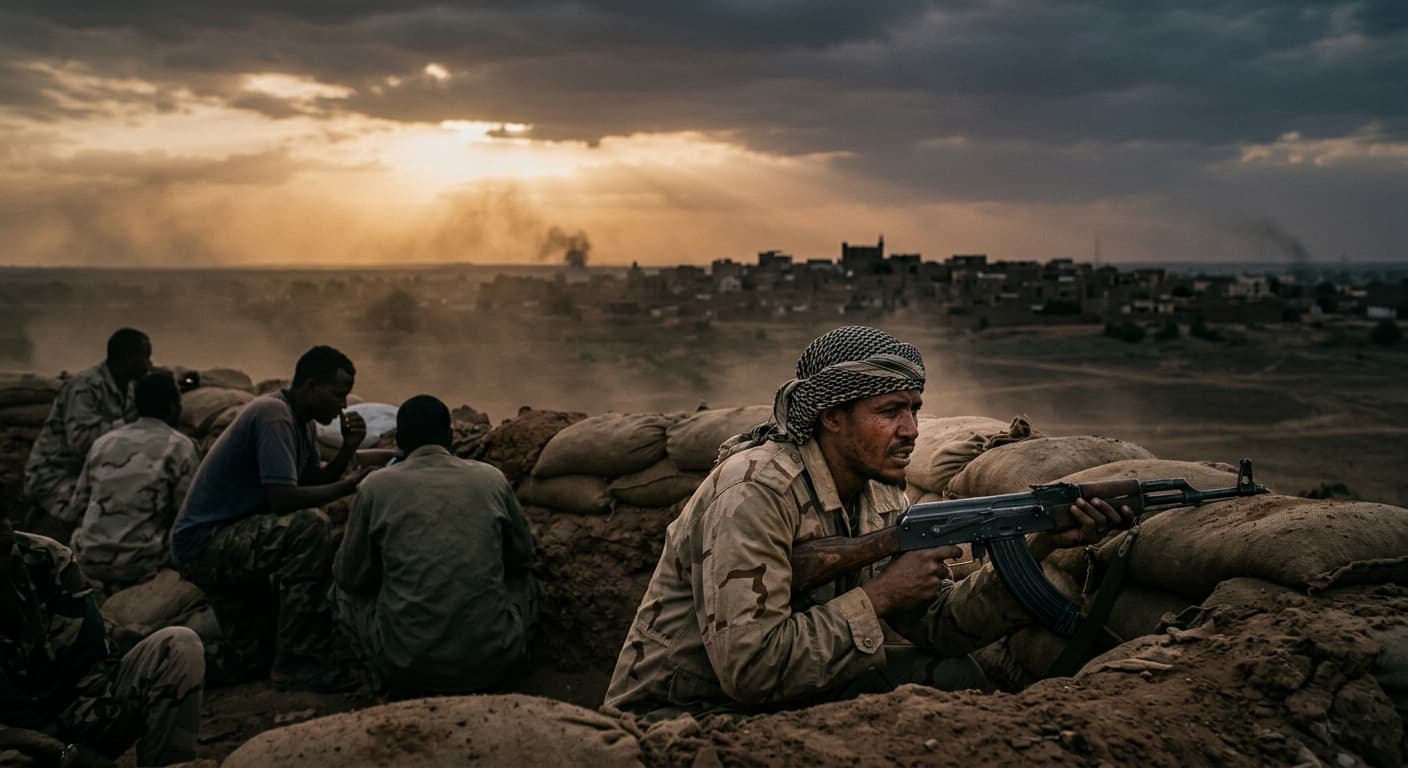
El-Obeid siege: Why Sudan's war now hinges on one Kordofan city
As RSF forces close on el-Obeid, the fall of North Kordofan's capital would sever Sudan's east from Darfur — and lock in de facto partition.
If el-Obeid falls, Sudan does not simply lose another city — it loses the geographic hinge that still holds the country together. That is the calculation now driving every capital from Geneva to Abu Dhabi as the Rapid Support Forces (RSF) mass around North Kordofan's capital. Between June 6 and 28, the UN human rights office documented 15 drone strikes on el-Obeid that killed at least 45 civilians, according to a July 3 briefing by High Commissioner Volker Türk at an urgent debate of the UN Human Rights Council. Roughly 500,000 residents and 100,000 internally displaced people are trapped inside. The city is the last Sudanese Armed Forces (SAF) forward base capable of projecting airpower into Darfur; its loss would formalise the Darfur–Kordofan bloc the RSF has been building since taking el-Fasher in October 2025 and Heglig oilfield in December, and push Sudan from a war of reunification into a negotiated partition.
The map explains the offensive
El-Obeid sits at the road-and-rail intersection linking Khartoum to Darfur, South Kordofan and the country's agricultural belt. According to the July 3 briefing by the UN's independent fact-finding mission for Sudan, delivered to the Human Rights Council by commissioner Mona Rishmawi, "the RSF now has control over all surrounding routes, except towards the East," UN News reported. That single sentence describes a nearly complete envelopment.
The strategic logic was set months ago. On October 26, 2025, the RSF overran el-Fasher, the SAF's last stronghold in Darfur, killing at least 6,000 civilians inside three days — a figure the UN Human Rights Office documented from 140 witness interviews and satellite analysis, NPR reported. On December 8, 2025, the RSF captured the Heglig oilfield in South Kordofan — Sudan's largest — forcing SAF units to retreat across the border into South Sudan, according to
Al Jazeera. Heglig processes 80,000–100,000 barrels per day, including the pipeline that carries South Sudanese crude to Port Sudan. Two days later, South Sudanese troops deployed under a tripartite deal between Salva Kiir, SAF chief Abdel Fattah al-Burhan and RSF commander Mohamed Hamdan Dagalo,
neutralising the field from combat. Both prizes were then consolidated. El-Obeid is the next node on the same line.
Yale Humanitarian Research Lab director Nathaniel Raymond framed the stakes in July 2025: "If SAF loses el-Obeid… they would lose a lot of their ability to project force outside of Khartoum," he told Al Jazeera. The SAF's fixed-wing bombers over Darfur stage from el-Obeid's airbase; any rescue mission for civilians still trapped in Kordofan runs through it; and it is the eastern anchor of the highway that supplies the army's southern front. Raymond also flagged the seasonal window now closing: the arrival of Sudan's rainy season would give the RSF cloud cover that neutralises the SAF's unguided aerial bombing while roads remain firm enough for RSF manoeuvre — "the sweet spot," in his words.
The Kordofan pivot: from unifying war to spheres of influence
The Kordofan region matters because it is the bridge between Darfur and the Nile. "Whoever controls Kordofan effectively controls the country's oil supply, as well as a huge chunk of Sudan," Oasis Policy Advisory analyst Amir Imam told the BBC. International Crisis Group's Alan Boswell told the same outlet that the RSF sees Kordofan as its route back "within striking distance of central Sudan, including the capital, again."
The pattern of RSF gains — Nyala, el-Geneina, el-Fasher, Babnusa, Heglig, and now the ring around el-Obeid — is not a march on Khartoum. It is the physical assembly of a state within a state. As one Al Jazeera field analysis put it after Heglig fell, "the Battle of el-Fasher was the 'battle of the west' and the Battle of Heglig could be the 'gateway to the south-central battle'" — one that could see the RSF "advance towards Dilling and Kadugli, and possibly Abu Jubeiha, in preparation for strangling el-Obeid," Al Jazeera reported. El-Obeid is the last SAF-held pin on the map west of the White Nile. Remove it, and the RSF holds a contiguous Darfur–Kordofan zone with oil, gold, and a Sahel-facing supply corridor. That is the negotiating position — not a march on Port Sudan — that Hemedti's forces are building.
The drone economy — and its foreign backers
The el-Obeid campaign is being fought with weapons neither side manufactures. UN human rights chief Volker Türk told the Human Rights Council in June that more than 1,000 civilians had been killed nationwide in drone strikes in the first five months of 2026 alone, Al Jazeera reported. ACLED has recorded over 3,000 air and drone strikes since the war began and at least 9,000 associated fatalities, according to a
CSIS analysis — which also puts total war fatalities at roughly 58,000 in the ACLED baseline, and up to 400,000 in higher estimates.
Behind the RSF's aerial reach sits the United Arab Emirates. Amnesty International's May 2025 investigation identified Chinese GB50A guided bombs and AH-4 howitzers — weapons "almost certainly re-exported to Sudan by the UAE" in breach of the UN's Darfur arms embargo. The GB50A is dropped from Chinese Wing Loong II and FeiHong-95 drones "used only by the RSF in Sudan," Amnesty found. A separate February 2026 investigation by the Conflict Insights Group,
reported by the BBC, tracked more than 50 Colombian mercenary phones from a UAE military training facility in Ghayathi, Abu Dhabi, through RSF drone hubs in Nyala and into el-Fasher during the October massacre. "The scale of atrocities and siege in el-Fasher wouldn't have happened without the drone operations the mercenaries provided," the group's lead investigator concluded.
That supply chain is the reason el-Obeid is under drone siege rather than ground assault. It is also the reason SAF chief Burhan has publicly rejected the Quad ceasefire process. On a Sunday video address last autumn Burhan called the latest US-Saudi-Egyptian-Emirati plan "the worst ever" and accused it of sidelining the army so long as the UAE remained at the table, the BBC reported. Trump envoy Massad Boulos rejected the charge of bias. The RSF, meanwhile, announced a unilateral three-month ceasefire "in response to international efforts, chiefly that of His Excellency US President Donald Trump" — which Sudanese analyst Kholood Khair told the BBC "seems to be largely a political ploy" designed to score a political win with Washington while the army digs in.
Why "another el-Fasher" is the operative fear
The parallel is not rhetorical. El-Fasher was besieged for 18 months before it fell in October 2025; el-Obeid has now been under siege-like conditions for the same period, Türk noted at the Human Rights Council. Both are ethnically mixed SAF strongholds serving as refuge for displaced civilians from RSF-held zones. Both host garrisons the RSF cannot bypass. The el-Fasher assault killed at least 4,400 people inside the city and another 1,600 fleeing, according to the UN human rights office's February 2026 report — a figure that "significantly" understates the actual toll.
The UK, in its statement to the Human Rights Council on July 3, delivered by Human Rights Ambassador Eleanor Sanders, put the concern in a single line:
"Last year, the world watched in horror as the Rapid Support Forces raped, pillaged, and murdered their way through El Fasher. This cannot be repeated."
Türk went further, invoking a mechanism that has rarely surfaced in a Sudan debate. "El Obeid is a classic case that shows why the use of the veto should be limited, as proposed by France and Mexico more than 10 years ago," he told the Council, UN News reported. Translation: he expects a Security Council resolution to be blocked, and he is pre-positioning the argument that Russia or China should be politically shamed for doing so.
The humanitarian ledger
The city is already living the siege. Türk described RSF and SAF drones "repeatedly striking markets, schools, fuel stations, water infrastructure and civilian vehicles." Residents interviewed by his office "are selling their belongings to finance their escape," while "constant attacks on vehicles along exit routes make leaving impossible." His office has documented "patterns of summary executions, abductions, torture and ill-treatment, sexual violence, and looting along the routes taken by displaced people across the Kordofan region," UN News reported.
The regional displacement figures give the scale. In a February 10, 2026 focused flash alert, the IOM Displacement Tracking Matrix recorded 1,007,006 internally displaced people across the Kordofan region — 57% of them children — with roughly 115,223 newly displaced since the October 2025 escalation. The agency told the Human Rights Council on July 3 that new displacement across Kordofan has risen "by nearly two-thirds in only three months," averaging one major incident every two to three days.
UN Emergency Relief Coordinator Tom Fletcher issued the operative warning on June 30: "We cannot allow El Obeid to become another El Fasher." Drone strikes have already disrupted "lifesaving drinking water and electricity," he said, and — with the rainy season landing — raised the risk of cholera. IOM Chief of Mission Refaat Mohamed said aid workers have been unable to reach civilians inside the city for two months: "We hear the stories from our enumerators on the ground who are assessing the needs that they have no access to water, electricity and they want a way out, but they cannot."
What to watch
- The Human Rights Council draft resolution. The UK on July 7 introduced a draft resolution at HRC 62 with a core group of Germany, Ireland, the Netherlands and Norway,
GOV.UK confirmed. Adoption — and whether it extends the Fact-Finding Mission's mandate with "full access across Sudan" — will set the accountability floor if el-Obeid falls.
- The rainy season. Yale's Raymond identified the narrowing weather window that favours an RSF assault: clouds ground SAF's unguided bombers before roads become impassable. Watch the next three to six weeks.
- The Quad track. Burhan has rejected the Trump-Boulos framework as long as the UAE is at the table; the RSF's unilateral three-month ceasefire announcement expires this autumn. Whether Washington leans on Abu Dhabi to throttle the drone-and-mercenary pipeline is the single most consequential external variable.
- Umm Sumaima and the eastern corridor. With the RSF controlling every route except east, the fight for the last exit road toward White Nile state — where fleeing civilians would go — is where the siege becomes a massacre or a managed collapse.
The Bottom Line
El-Obeid is not another besieged city; it is the last SAF pin holding Sudan's western half to its eastern half. If it falls, the RSF's Darfur–Kordofan bloc becomes a contiguous, oil-and-gold-funded territory with foreign drone backing and its own negotiating position — and Sudan's war stops being about who governs the country and becomes about how it is divided. The el-Fasher precedent tells everyone in Geneva, Abu Dhabi and Washington exactly what happens to the half-million civilians inside when that transition is forced by assault rather than agreement.
Discover more

US Politics
House Ethics Committee Pushes Sexual Miscond.
The House Ethics Committee has shifted responsibility for sexual harassment settlement records to the Office of Congressional Workplace Rights, complicating disclosure efforts.

US Politics
US Launches $166B Tariff Refund Portal
The US is launching a $166 billion tariff refund portal to aid importers hit by Trump-era tariffs, with major implications for trade and supply costs.
India
Rajnath Singh's Durga Squad for 2026 Polls
Rajnath Singh's Durga Squad promised women's safety in Bengal but has since disappeared from the agenda, revealing BJP's true priorities.
Global
Zimbabwe's 2030 Gambit: Mnangagwa's Rule
Zimbabwe's Constitutional Amendment No. 3 ends direct presidential elections, extending Mnangagwa's rule to 2030 and raising concerns over democratic integrity.