El Niño's Impact on Global Security Risks
El Niño's arrival poses geopolitical challenges ahead.
Model Diplomat7 min readGlobal
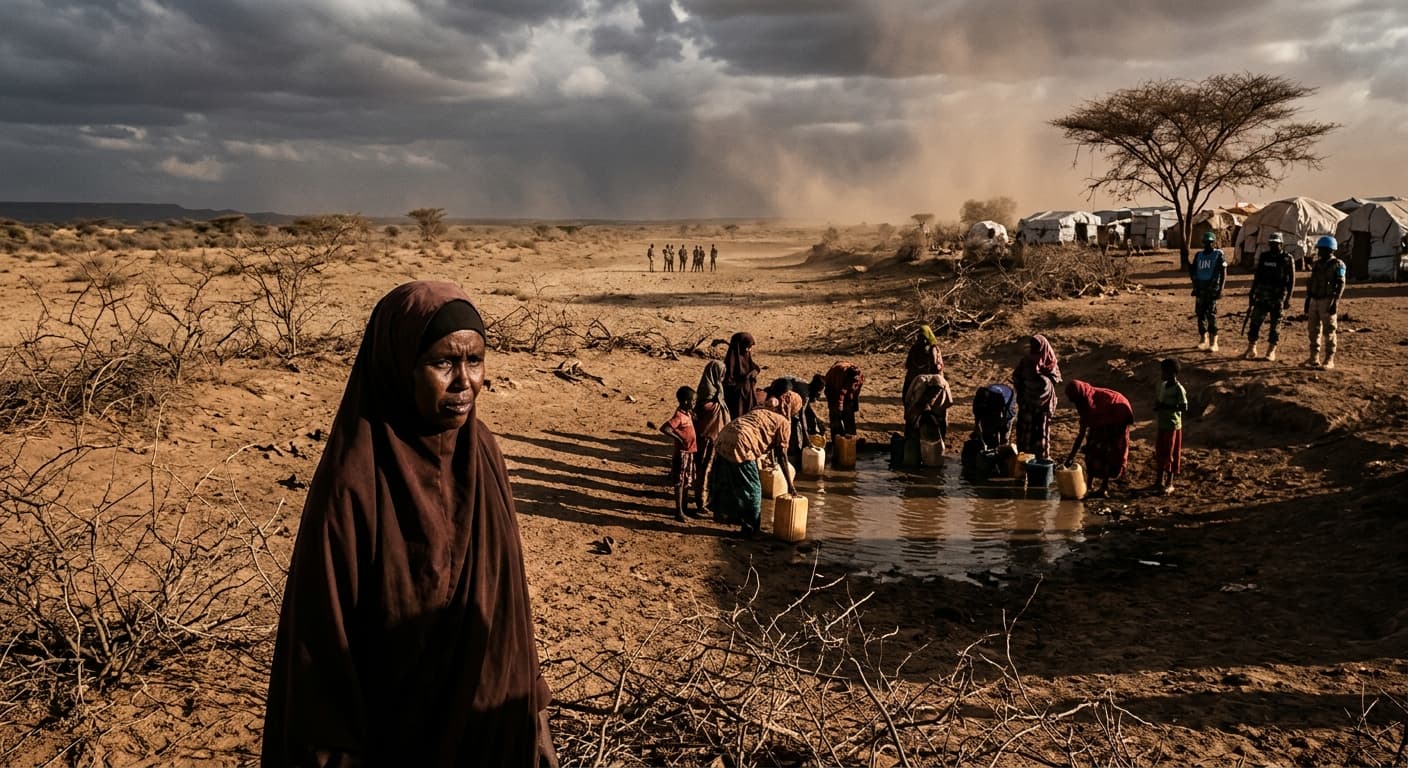
El Niño arrives on a fractured world: the security bill
The WMO says a Pacific warming event is 90% likely by November 2026 — layering drought, food inflation and shipping disruption onto a system already strained by the U.S.–Iran war.
The World Meteorological Organization on June 2, 2026 confirmed the onset of El Niño and put the probability of a fully developed event by November at 90%, with NOAA assigning a 63% chance the peak will rank as "very strong" — above 2°C in the tropical Pacific. The geopolitical read is sharper than the meteorology: an El Niño of that magnitude is not a weather story but a resource-redistribution shock, and it lands on a global food and shipping system whose buffers were already drawn down by the U.S.–Iran war. The countries with the least fiscal room to absorb it — a corridor from Central America through the Sahel to South Asia — are the same countries where prior El Niños triggered political violence and export bans. That is the story to plan around.
What the WMO actually said
The WMO's June 2 Global Seasonal Climate Update declared an 80% probability of El Niño conditions between June and August and 90% thereafter, warning of above-average temperatures "nearly everywhere," according to UN News. Secretary-General António Guterres, in a video statement released the same day, framed the announcement in unusually stark terms:
"The science is clear: El Niño is arriving on our doorstep in the coming months with 90% certainty. The world must treat it as the urgent climate warning it is."
Guterres's remarks are archived on the UN Secretary-General's site. NOAA's June outlook goes further than WMO's central case: it flags a 63% probability of a very strong event during the November–January window, which would rank "among the largest El Niño events in the historical record going back to 1950,"
BBC News reported, citing the agency's monthly diagnostic. Some U.S. and European models show Pacific sea-surface anomalies climbing above 3°C by year-end — territory only 1997–98 and 2015–16 have touched.
WMO chief Celeste Saulo was blunt about why the update matters beyond climatology: "The footprint of an El Niño travels far beyond its origins in the Pacific Ocean, impacting agriculture, energy supplies, trade, water resources, supply chains, and livelihoods across entire regions," she told reporters in Geneva, per UN News. The oceanographic backdrop is unusually hot: the EU's Copernicus Marine Service reported global sea-surface temperatures of 21.0°C in June 2026, the warmest June on record, with marine heatwaves affecting roughly 82% of the ocean, according to
Al Jazeera.
The compounding shock: Iran, fertilizer, food
The distinctive feature of this cycle is not the El Niño itself — the geometry is familiar — but the pre-existing damage to the system it hits. The World Resources Institute argues in its June 2026 briefing that "food systems around the world already face strains from the U.S.–Iran war and its resulting fuel and fertilizer shortages," and that a Super El Niño "would layer drought, heat or flooding risks onto an already fragile system, increasing the likelihood that high costs turn into real food shortages," per WRI. Nitrogen fertilizer, whose synthesis depends on natural gas, has become both scarcer and pricier since the Strait of Hormuz closures — a dynamic BBC Weather notes will "impact harvests in the months to come with a reduced food supply and higher prices," in comments from University of Reading climate-risk professor Liz Stephens to
BBC Weather.
The point is not that El Niño causes conflict. It is that it removes coping capacity from governments that have already spent theirs. A 2026 paper in the American Journal of Agricultural Economics by David Ubilava — the most rigorous recent quantification — finds that a strong El Niño can move harvest-linked political violence in exposed African croplands by up to 15% in the early postharvest season, working through crop-price and income channels, per the study abstract. Peace Research Institute Oslo's earlier PNAS work, still the reference, showed that drought's effect on conflict is concentrated in agriculturally dependent, politically excluded groups in poor countries — precisely the population El Niño 2026 will hit hardest, as documented by
PRIO.
Islamabad's Institute of Strategic Studies has already published a threat assessment framing the event as "a multidimensional challenge affecting water security, agriculture, food systems, public health, energy generation, infrastructure, disaster management, and economic stability" for Pakistan — a country that has not yet recovered fiscally from the 2022 floods, per ISSI. Expect similar assessments from finance and defense ministries across the Sahel and the Horn in the coming weeks.
The three chokepoints to watch
Rice. India recorded its driest June in 12 years — 39.8% below the India Meteorological Department's own forecast — with rice sowing down roughly 25% year-on-year as of end-June, according to
BBC News. Al Jazeera reported that cumulative monsoon rainfall was running 43% below average when Agriculture Minister Shivraj Singh Chouhan announced contingency plans covering 315 districts on June 23, per
Al Jazeera. India accounts for more than 40% of global rice exports; the 2023 non-basmati ban, imposed under similar El Niño pressure, drove global rice prices up sharply and forced West African importers into emergency procurement. Chouhan insists buffer stocks are adequate — government rice stocks stood at 39.7 million tonnes on July 1, nearly triple the buffer requirement, per the Ministry of Consumer Affairs data cited by
BBC News — but the political incentive to protect domestic prices before state elections tends to override statistical comfort. A repeat export ban is the single most likely global food-price shock of Q4 2026.
The Panama Canal. Lake Gatún, the freshwater reservoir that operates the locks, is fed by rainfall — and El Niño historically suppresses that rainfall. During the 2023–24 event, the Panama Canal Authority cut daily transits from 36 to 18 slots by February 2024, with some carriers paying up to $2 million to jump the queue, per NPR and
BBC News. A 2025 Asian Development Bank working paper quantified the container-shipping penalty at 133.8 additional hours per Asia–U.S. voyage during that drought, per
ADB. With the Red Sea still contested and the Iran conflict raising Gulf shipping insurance premiums, a second Panama drawdown would leave global container traffic without a functioning short route in either hemisphere.
African harvests. IFRC modeling for the 2026 event flags Central America and the Caribbean for "significant reduction in cumulative rainfall" and warns Southern Africa of "increased risk of severe droughts," according to the IFRC. WHO's public-health situation analysis for El Niño identifies malnutrition compounded by cholera, malaria and arboviral disease as the "most severe health risks" for humanitarian-vulnerable countries, per the
World Health Organization. In 2015–16, the "Godzilla" El Niño pushed roughly 60 million people into food insecurity worldwide, per UN OCHA — a benchmark humanitarian planners now treat as the floor, not the ceiling.
The quiet beneficiaries
Every climate shock has winners. Grain traders long on U.S. and southern-Brazil supply — regions El Niño tends to leave wetter — are already positioning. Cargill, ADM, and the ABCDs generally see margin expansion during Indian and Southeast Asian supply constraints; the WRI notes wetter conditions expected across "the southern United States, parts of Peru, Ecuador, eastern Africa and parts of the Middle East and Central Asia" per the European Centre for Medium-Range Weather Forecasts. Atlantic-basin insurers benefit from El Niño's suppression of hurricane formation — the BBC and IFRC both note a quieter Atlantic season is forecast — though Pacific reinsurers face the mirror image.
The strategic beneficiary is subtler. Any actor with sovereign grain stockpiles heading into 2027 gains leverage. China's state reserves, Russia's wheat surplus and Gulf sovereign-fund positions in African farmland all become more valuable in a food-scarce year. The Ubilava paper's other finding is politically inconvenient: El Niño actually reduces postharvest violence in croplands where the harvest arrives, by raising the opportunity cost of fighting, per the AJAE study. La Niña — the phase that follows — is the one that historically drives insurgent recruitment. The 2027–28 window, not 2026, is when the security bill actually comes due.
What to watch
- July 15, 2026 — India's Meteorological Department July rainfall update. A second consecutive deficit month raises the probability of a non-basmati rice export restriction before September.
- August–September 2026 — Panama Canal Authority monthly transit-slot announcements. Any cut below 30 slots per day signals Gatún drawdown and triggers freight-rate reactions.
- October 2026 — NOAA and WMO peak-intensity forecasts. A confirmed >2°C anomaly locks in the "very strong" classification and activates IFRC Phase 2 Early Action Protocols in exposed African and Central American countries.
- November 2026 – February 2027 — El Niño peak. Watch Ethiopia, Zimbabwe, Zambia and Malawi humanitarian declarations; watch Manila's rice-import tenders.
- Second half of 2027 — La Niña transition. Historical pattern says this is when postharvest conflict risk rises in the Sahel and Horn of Africa.
The Bottom Line
El Niño's arrival is 90% certain; its geopolitical shape is already visible. The 2026–27 event will not create new conflicts, but it will strip coping capacity from the exact governments — in the Sahel, the Horn, South Asia and Central America — that spent theirs on the last shock, and it will do so while the U.S.–Iran war keeps fertilizer scarce and shipping expensive. The countries with sovereign grain stockpiles and hydrological slack will accumulate leverage; the countries without will spend 2027 asking for it.
Read today's full |
Discover more

International Relations
U.S.–Iran Peace Deal
A narrow US-Iran deal on nuclear and regional issues could reshape Middle East diplomacy, offering a pragmatic path forward despite grand bargain obstacles.
US Politics
Washington's Scrutiny of Iran War Prediction
The Iran war prediction market scandal exposes political ties and regulatory challenges in Washington, as insider trading concerns rise.
Global Politics
Xi Jinping Calls China-Russia Ties 'Precious'
Xi Jinping's description of China-Russia ties as 'precious' reflects a strategic imbalance, with Beijing dictating terms in the partnership.

Conflict & Security
Drone Warfare Killing Aid Workers at Unprec
Over 1,000 humanitarian workers killed in three years as cheap armed drones collapse legal protections. Gaza, Sudan, Ukraine, and DRC see deliberate targeting of aid convoys and hospitals with zero prosecutions.