Egypt's Global Development Playbook
Cairo's model for climate finance gains traction worldwide
Model Diplomat7 min readMiddle East
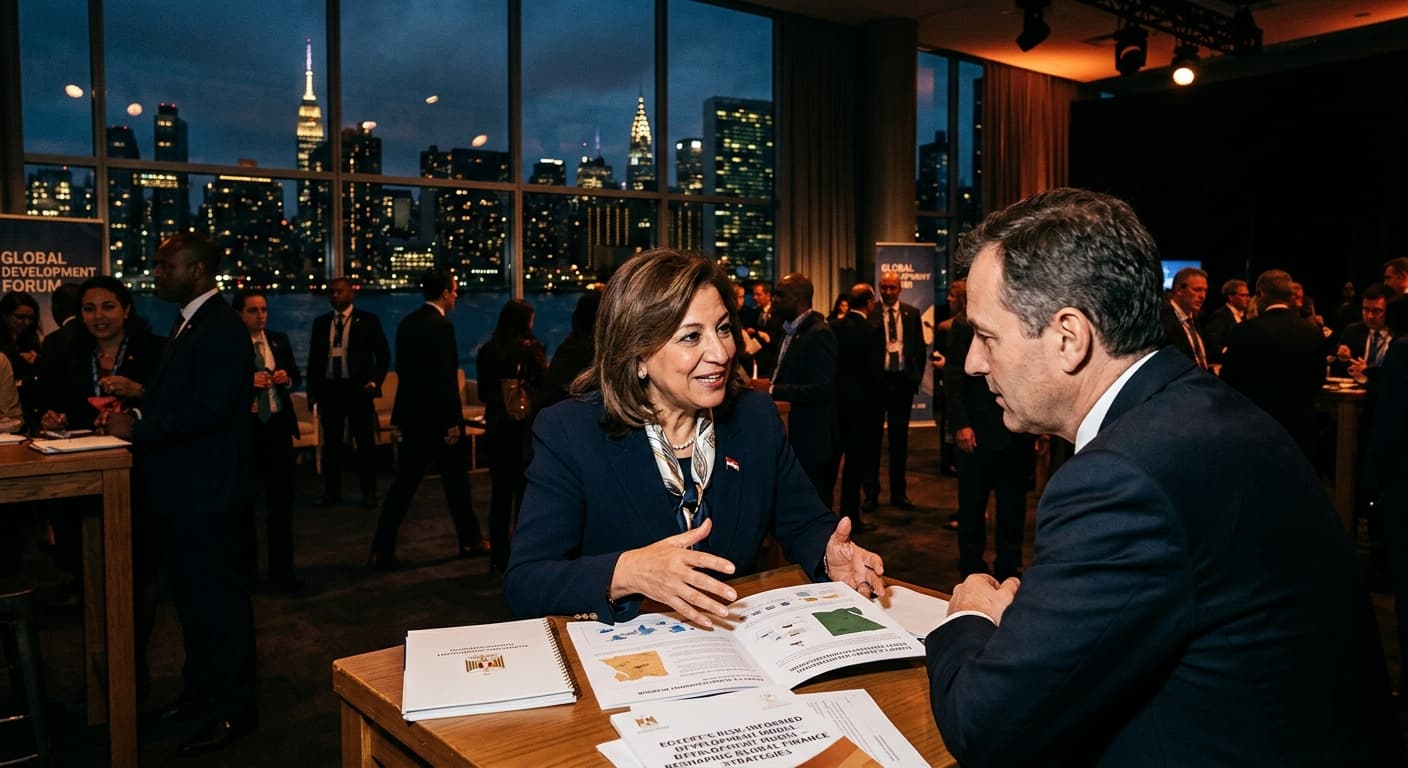
Egypt's Risk-Informed Development Playbook Goes Global
How Cairo turned climate vulnerability, IMF conditionality and donor fatigue into a country-platform model — and why other middle-income states are copying it in 2026.
Egypt's approach to development cooperation has quietly become a template that the IMF, the World Bank and the European Union are all now underwriting in parallel — and on April 20, 2026, UN Secretary-General António Guterres promoted its chief architect, Rania Al-Mashat, to run the UN's Economic and Social Commission for Western Asia. That single personnel decision is the strongest signal yet that Cairo's "risk-informed" playbook — bundling climate, macro-fiscal and social risk into one bankable country platform — is being institutionalised as a regional model. The winners are middle-income sovereigns squeezed between climate exposure and non-investment-grade debt; the loser is the donor-by-donor project logic that dominated development finance for two decades.
The stakes are concrete. The World Bank's Country Climate and Development Report projects that unchecked climate impacts could shave 2% to 6% off Egyptian GDP by 2060 — the exact "development gains" a risk-informed framework is meant to protect. Around that number, Cairo has stacked concessional finance, policy conditionality and one homegrown platform into a single stack the IMF now cites approvingly in its staff reports.
What "risk-informed" actually means in Cairo
The phrase is not marketing. The UN Department of Economic and Social Affairs Policy Brief #98 defines risk-informed finance as ensuring both that "financing is sustainable, risk-informed, and resilient" and that "sustainability, risk reduction and resilience are sufficiently financed." That double test — is the money risk-aware, and is the risk sufficiently funded? — is the doctrine Egypt's Ministry of Planning, Economic Development and International Cooperation has been operationalising since 2020.
Under Al-Mashat, the ministry built what an LSE case study by Marwa Abdou calls a "country-led multi-stakeholder platform" — a standing coordination table of 45 international institutions and 120-plus representatives. The point was to force donors, MDBs and the private sector into a single project pipeline linked to Egypt's Sustainable Development Strategy 2030 and the National Climate Change Strategy 2050, rather than each running parallel logframes.
At COP27 in Sharm El-Sheikh, that infrastructure gave birth to NWFE — the Country Platform for the Nexus of Water, Food and Energy. NWFE (Arabic for "fulfilling pledges") bundles nine priority projects extracted directly from the National Climate Change Strategy. According to the World Bank's December 2023 review, NWFE was designed to solve two problems at once: the "missing link of investable projects" and the information gap between capital providers and sovereigns rated non-investment grade.
Writing in the IMF's Finance & Development in September 2023, Al-Mashat framed the underlying market failure bluntly: 77% of developing economies hold sub-investment-grade sovereign credit ratings, which chokes off private climate capital irrespective of project quality. Country platforms exist to bridge that gap — pre-structuring projects, blending concessional and private tranches, and offering donors a single dashboard rather than 30 memoranda of understanding.
The stack: how three multilaterals underwrite one reform program
The distinctiveness of Egypt's approach in 2026 is not any single instrument. It is the layering.
The IMF anchor is a $8-billion Extended Fund Facility signed in March 2024 and now on its seventh review. On June 29, 2026, IMF staff and Egyptian authorities reached a staff-level agreement covering both the EFF and the second review of the Resilience and Sustainability Facility. The RSF — SDR 1 billion approved in February 2025 — is the explicitly climate-conditional tranche, and its language matters. According to the
IMF's March 2026 country report, implementation "supports reforms to accelerate decarbonization, strengthen environmental risk management, and enhance climate resilience," with two completed measures already: an implementation schedule for renewable-energy targets and a directive requiring banks to monitor and report exposure to climate transition risks.
The World Bank sits on top of that. The $1-billion GROWTH II Development Policy Financing, approved May 8, 2026, is the second in a programmatic series of three. It carries a $200-million UK credit guarantee — a de-risking layer explicitly designed to lower Cairo's cost of capital. The operation's social-protection design is the tell: beneficiaries of the Takaful and Karama cash-transfer programs are being automatically enrolled in Universal Health Insurance, so that reform-induced price shocks do not eat welfare gains. That is risk-informed sequencing in operation.
Deputy Minister of Foreign Affairs for International Cooperation Samar Al Ahdal framed the transaction in the same May 8 announcement:
"The reforms supported under this project will generate more and better jobs for Egyptians, protect our citizens in vulnerable situations, and ensure that growth is both sustainable and inclusive."
The European Union rounds out the stack with a €5-billion Macro-Financial Assistance package. Under Decision (EU) 2025/1267, Brussels made up to €4 billion in loans available on top of the €1 billion disbursed in December 2024, "in conjunction with the IMF programme" — meaning EU disbursement tranches are locked to IMF review completion. Three lenders, one conditionality lattice.
The instrument the model quietly runs on: debt swaps
The under-reported piece of Egypt's stack is the debt-for-development swap. According to Carnegie's March 2025 analysis, Egypt's swap program with Italy dates back to 2001 and has cumulatively converted $350 million of debt into local investments across food security, agriculture and wastewater. Germany's
KfW page on bilateral swaps lists Egypt as an active recipient — an earlier €240-million agreement, plus recent swaps focused on renewable energy and food security. China joined the club in 2023 with a $220-million climate-adaptation swap.
Debt swaps look modest against the $1-billion World Bank ticket, but their marginal utility is high. An IMF Economic Review paper by Chamon and co-authors argues that debt-for-climate swaps make sense when they "noticeably reduce debt risks while avoiding the costs of a full-blown debt restructuring" — precisely the corridor a large lower-middle-income sovereign with high gross financing needs occupies. Egypt is that sovereign.
Where the model strains
The evidence is not uniformly flattering. The IMF's February 2026 country report is candid: risks to the program are "significant and skewed to the downside," and the stalled state-owned enterprise divestment agenda "continues to weigh on medium-term growth, keeps gross financing needs high, and constrains fiscal space for priority social spending." Suez Canal revenues remain depressed by Red Sea shipping disruption from the Gaza war — a live geopolitical shock the risk-informed framework did not prevent, only cushion.
Governance indicators lag the financing architecture. The Carnegie analysis notes that while Egypt scores well on ease-of-doing-business metrics, accountability mechanisms and regulatory quality remain weak, a mismatch that constrains how much genuinely private capital NWFE can attract without concessional sweeteners.
And a July 2025 study in Scientific Reports found that a 1% increase in Nile water allocation is associated with a 7% reduction in Egyptian food security — indicating "systemic inefficiencies such as over-reliance on outdated irrigation, misallocation, or political disputes around water governance." Money alone does not fix that; institutional reform does.
Why other governments are copying it anyway
The reason Al-Mashat's promotion to ESCWA matters is not symbolic. It puts the operator of the model inside the UN commission that covers Iraq, Jordan, Lebanon, Tunisia, Morocco and the Gulf — every jurisdiction where a middle-income sovereign is now negotiating a climate-conditional IMF program or an EU MFA at the same time. According to the UN Secretary-General's April 20 statement, her mandate emphasises "innovative approaches to international cooperation and development finance through country-led multi-stakeholder engagement frameworks" — a nearly verbatim description of NWFE.
The World Bank has generalised the underlying logic. Its new Handbook for Livable and Resilient Cities prescribes exactly the same risk-first sequencing at the municipal level — restrict development in high-hazard zones, condition it on risk-reduction measures, promote growth toward lower-risk areas — that Cairo applies to bilateral finance. And the OECD's
Strengthening Climate Resilience guidance codifies the monitoring, evaluation and learning frameworks that country platforms need to be credible to donors.
For Egypt, the payoff is priced in dollars. The World Bank's Country Partnership Framework for FY2023–2027 carries a $7-billion lending envelope, the EU brings €5 billion, the IMF adds roughly $9 billion across the EFF and RSF. Absent the platform architecture, no rational donor committee would concentrate this much conditional exposure in one non-investment-grade sovereign in the middle of a regional war.
What to watch
- IMF Executive Board vote on the 7th EFF and 2nd RSF reviews, expected in the weeks following the June 29 staff-level agreement — the next release of RSF funds and, mechanically, the EU's next MFA tranche depend on it.
- NWFE Phase 2 pipeline update. Egypt has signalled an expansion beyond the initial nine water-food-energy projects into transport; the composition of the next tranche will show whether the private-capital-to-concessional ratio is improving or backsliding.
- Al-Mashat's ESCWA assumption of duties. The date she formally takes office in Beirut will be the moment to watch whether NWFE-style country platforms are pitched to Iraq, Jordan and Tunisia — the three regional candidates most exposed to the same climate-plus-debt bind.
- GROWTH III DPF (the third $1-billion tranche). World Bank management has signalled it as the closing operation of the CPF cycle; its climate and social-protection conditions will define what "protecting development gains" looks like into 2027.
The Bottom Line
Egypt has not solved climate vulnerability or its debt overhang. What it has done is invent an institutional shell — a country platform anchored by a single ministry, feeding one project pipeline into IMF, World Bank, EU and bilateral tranches simultaneously — that lets a non-investment-grade sovereign absorb $20-billion-plus of conditional finance without collapsing under coordination costs. The promotion of its architect to run UN ESCWA in April 2026 is the clearest signal that the multilateral system now views this model, not donor-by-donor project finance, as the default template for middle-income states caught between climate exposure and fiscal fragility.
Discover more
US Politics
House Ethics Committee Pushes Sexual Miscond.
The House Ethics Committee has shifted responsibility for sexual harassment settlement records to the Office of Congressional Workplace Rights, complicating disclosure efforts.
US Politics
Congress Targets AI Chatbot Access for Terror
The House passed the Generative AI Terrorism Risk Assessment Act, focusing on AI's role in terrorism and potential surveillance implications.
International Relations
Economist Impact Sustainability Week 2026
Economist Impact Sustainability Week 2026 spotlights the energy transition, AI in clean technology, and supply chain resilience as themes for global leaders.

Economics
Fed's Amex AML order puts correspondent banking on notice
Federal Reserve's Amex AML order requires board-level controls and a 90-day plan; OCC fined the bank $350 million over enterprise-wide deficiencies.