Egypt Steps In as AU Somalia Mission Collapse
US funding cut ends AU's 19-year Somalia mission; Egypt poised to fill vacuum.
Model Diplomat8 min readHorn of Africa
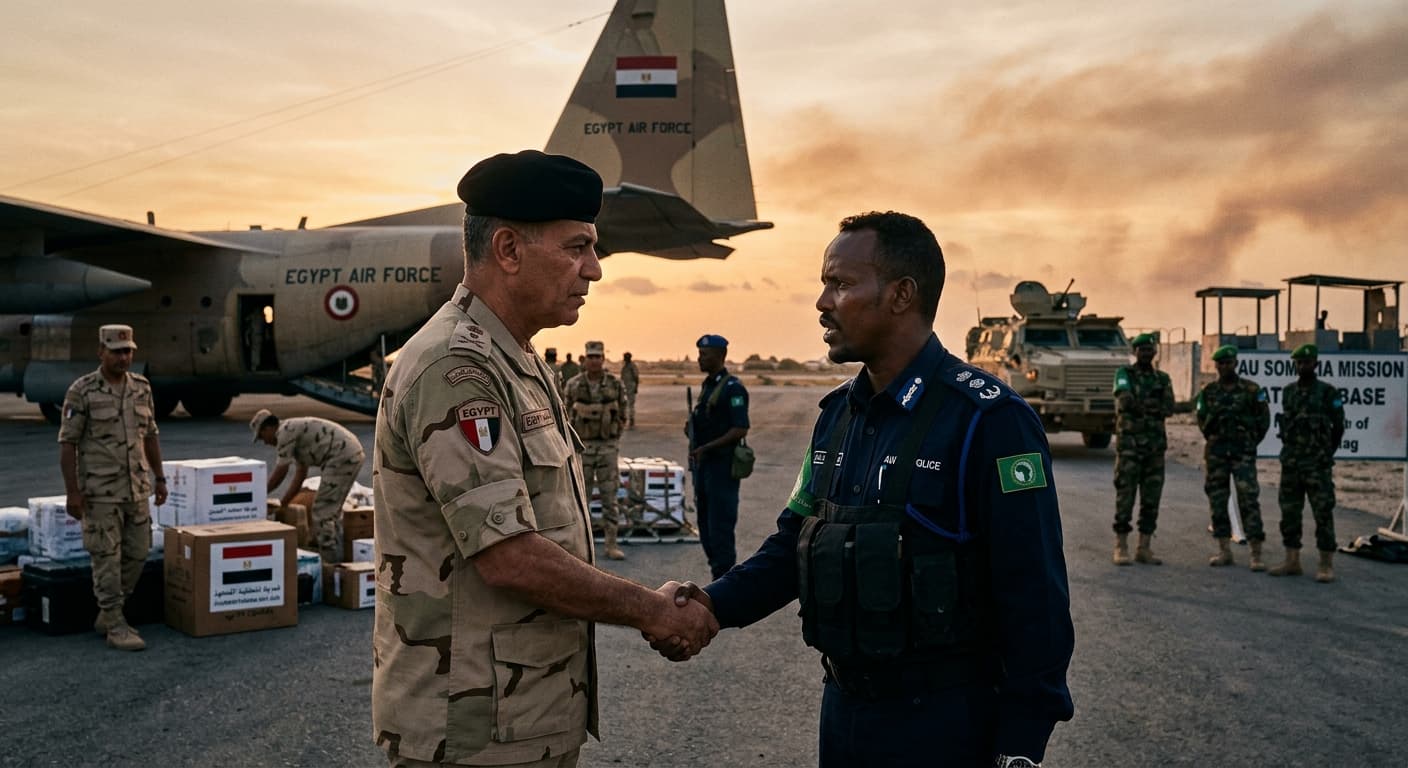
The AU's Somalia Mission Is Dying — and Egypt Is Writing Its Obituary
The US decision to cut $502 million in logistics funding on July 1, 2026, does not merely threaten one peacekeeping mission. It ends the African Union's 19-year experiment in externally bankrolled counterinsurgency — and the actor best positioned to shape what comes next is Cairo, not Mogadishu.
On July 3, 2026, military advisers to the African Union Peace and Security Council gathered for an emergency meeting in Addis Ababa. The agenda was a single document: a diplomatic cable from Washington, dated July 1, informing the AU that the United States would no longer fund the UN logistics apparatus that keeps 12,591 peacekeeping troops alive in Somalia. The cable arrived with no glide path, no transition plan, and no ambiguity.
Cameroon and Gabon broke the silence. "[Every] peace support operation eventually reaches a conclusion," their representatives told the room, according to minutes reviewed by The EastAfrican. The subtext was unmistakable: African states will not pick up a bill the Americans are walking away from.
The deadline is December 31, 2026. After that date, the UN Support Office in Somalia (UNSOS) — which provides fuel, rations, medical evacuation, aviation support, and strategic air mobility — ceases operations for AUSSOM. The $502 million annual logistics package that has underwritten every AU mission in Somalia since 2009 simply disappears. No replacement mechanism has been identified. None is in negotiation.
That is not a funding gap. It is a death warrant for a mission that was launched on January 1, 2025 with a five-year mandate and a budget that was already $70 million short of its $190 million troop-reimbursement target before Washington pulled the plug.
Three Names, One Problem
The AU's Somalia mission has been rebranded twice — from AMISOM (2007) to ATMIS (2022) to AUSSOM (2025) — but the structural problem has never changed. African governments supply the troops. Western donors pay the bills. Somali forces are supposed to take over. None of the three legs has ever been solid.
The mission has cost approximately 3,500 peacekeeper lives since 2007, according to AU figures cited by Al Jazeera. The European Union alone contributed roughly €2.8 billion ($3.19 billion) over two decades. The United States provided $1.6 billion in bilateral support to troop-contributing countries and another $2 billion through UNSOS, alongside substantial UK contributions.
That era is over. The US State Department confirmed to Reuters that Washington will not support UNSOS operations beyond 2026. In its diplomatic cable, the Trump administration delivered a blunt assessment of Mogadishu: "Internal rivalries and political infighting continue to undermine the fight against al-Shabaab and ISIS, [and] the benefit of international support will remain limited until Somali leaders unite to address the country's security and governance challenges."
The timing is devastating. Somalia is in the grips of its worst political crisis since the 2021 standoff that saw former President Mohamed Abdullahi Farmaajo cling to power a year past his mandate. President Hassan Sheikh Mohamud's term expired on May 15, 2026. Parliament extended it by a year through disputed constitutional amendments. Two federal states — Puntland and Jubaland — have withdrawn from the federal system. In early June, government forces and opposition militias exchanged heavy gunfire in central Mogadishu in fighting that the former prime minister said involved "heavy weaponry made for conventional battlefield operations," according to Al Jazeera.
Washington's message to the AU is effectively: we are not funding a logistics backbone for a government that is shooting at itself.
The Math That Makes the Decision Irreversible
The emergency meeting of AU military advisers examined three options: a phased withdrawal of AU troops, maintaining the current deployment with bilateral partners taking over logistics from UNSOS, or replacing AUSSOM with a smaller regional mission financed through bilateral or hybrid arrangements.
According to The EastAfrican's account, diplomats familiar with the discussions said the latter two options "attracted little enthusiasm." The reason is straightforward arithmetic. For the 2025/26 financial year, the AU secured only $120 million in confirmed pledges against a $190 million requirement for troop reimbursements alone. The UNSOS logistics package of $502 million — already reduced by 25% when Washington pulled its share in October 2025 — was the only assured funding line. With the US now blocking any UN Security Council extension of UNSOS beyond December 31, even that is gone.
UN Undersecretary-General for Operational Support Atul Khare confirmed during a recent Mogadishu townhall that a UN General Assembly-approved $481 million budget for UNSOS for the current financial year still needs to be fulfilled. The US has signaled it will block any attempt within the Security Council to fund the logistics provider beyond AUSSOM's current authorization.
ACLED senior research assistant Mohamed Daud Ismail told The EastAfrican that "without immediate alternative international funding, AUSSOM faces imminent operational collapse heading into 2027." He added that Somalia's army "remains overstretched and structurally unequipped to manage complex countrywide logistics independently."
That last point is not speculation. The International Monetary Fund reported in its June 2025 country assessment that foreign aid flows to Somalia could be around 20–30% of GDP, with preliminary estimates suggesting cuts of 3 to 4.5% of GDP in 2025 alone, according to the IMF. The Fund noted that "the cuts in foreign aid coincide with an expected broader decline in donor engagement, suggesting a potentially more severe and lasting impact." The same report flagged that "limited progress in securing funding for AUSSOM" was already compounding Somalia's security challenges.
Uganda Blinks — and That Changes Everything
Perhaps the most consequential shift in the July 3 meeting was not Cameron and Gabon's philosophical pronouncements. It was the quiet repositioning of Uganda.
Kampala has deployed the largest troop contingent to Somalia since AMISOM's inception in 2007. Its forces have absorbed the heaviest casualties. Its officers have commanded the mission. For nearly two decades, Uganda's commitment was the one variable no one questioned.
That changed. Officials in Kampala are now saying, in the words of The EastAfrican's sources, "we can't keep in Somalia forever." This is not a diplomatic nicety. It is the largest troop contributor signaling that it wants out.
The shift reflects a broader recalibration within the AU. Morocco told the July 3 meeting it would present its official position after consulting national authorities — diplomatic code for "we need to see who is paying before we commit." Ethiopia pledged continued support, but Addis Ababa's relationship with Mogadishu remains deeply fraught over the Somaliland port deal and the Ankara-mediated rapprochement remains fragile.
The Council on Foreign Relations' Global Conflict Tracker notes that the US diplomatic cable explicitly conditioned further support on Somali leaders ending political infighting, and that AUSSOM "plays a critical role in backing the government in Mogadishu and supporting counterterrorism operations against al-Shabaab," according to CFR.
When the troop contributors themselves are asking about the exit, the conversation has moved from "whether" to "when" — and "when" is increasingly "sooner than the Somali National Army is ready for."
Egypt's Gambit: Troops as Geopolitical Currency
No country has more at stake in the collapse of multilateral peacekeeping than Egypt — and no country is better positioned to benefit from the vacuum.
Cairo joined AUSSOM as a troop contributor when the mission launched in January 2025, deploying roughly 1,091 troops. It was the first new entrant to the Somalia mission in years. The deployment was never primarily about al-Shabaab. Egypt views Somalia as the southern flank of its strategic competition with Ethiopia — a contest that encompasses the Grand Ethiopian Renaissance Dam, Red Sea access, and the future architecture of Horn of Africa security.
Egypt's calculus, according to an analysis published by the Horn Review, is to use AUSSOM as a "multipronged instrument" — signaling deterrence against Ethiopian influence, securing training access and equipment roles in Somali security sector reform, and establishing a permanent security footprint near Ethiopia's borders in Gedo, Hiraan, and Lower Shabelle.
The US decision to kill UNSOS funding reshapes this calculus entirely. A multilateral mission that depended on Western logistics was a constraint on Egyptian ambitions — Cairo had to operate within AU command structures and share influence with Uganda, Burundi, Kenya, Ethiopia, and Djibouti. A mission that collapses or shrinks to a bilateral rump force removes those constraints. Egypt becomes the only external power with both the strategic incentive and the military capacity to sustain a meaningful troop presence in Somalia on bilateral terms.
The BBC reported that Ethiopia views the Egypt-Somalia alliance with growing alarm, seeing Cairo's military presence in the Horn as a direct encirclement play. An ORF analysis described the dynamic as a "geostrategic tug-of-war" in which Egypt's increased footprint near Ethiopia's borders could "harden the regional standoff" and incentivize Addis Ababa to pursue parallel security arrangements, according to
ORF.
The Ankara Declaration of December 2024, mediated by Turkey, temporarily cooled Ethiopia-Somalia tensions over Somaliland. Somalia and Ethiopia restored diplomatic ties and agreed to finalize Ethiopian troop numbers within AUSSOM, as reported by Voice of America. But that agreement assumed a functioning multilateral framework with predictable US-backed logistics. Remove that framework, and the fragile Ethiopia-Somalia détente faces a stress test it may not survive — precisely the instability that gives Egypt greater leverage.
The Somalia Nobody Is Ready For
The Somali National Army is not prepared to fill the security vacuum. A joint AU-Somali government assessment — cited by Reuters — acknowledged a shortage of approximately 11,000 trained personnel due to "high operational tempo" and "attrition." Analysts estimate the army at roughly 32,000 soldiers, but the force remains deeply fragmented along clan lines.
Al-Shabaab, meanwhile, has not been defeated. It has adapted. The group controls large swaths of southern and central Somalia, runs parallel taxation and court systems, and — according to the ACLED database — was responsible for the large majority of conflict deaths recorded over the past two decades. National fatalities reached a record high in 2025, as reported by Al Jazeera. Between January and July 2025 alone, nearly 60,000 people were displaced by fighting between government forces and the group in Middle Shabelle.
Al-Shabaab's resilience is not a mystery. The Chatham House assessment from 2020 — that the war had become "a war of attrition" and that "neither side is likely to achieve a decisive military victory" — remains accurate six years later, according to Chatham House. What has changed is that the external sponsor willing to sustain that attrition indefinitely has just walked away.
What to Watch
The December 31, 2026 deadline is the immediate catalyst, but three other dates will determine the shape of the post-AUSSOM landscape:
-
October 31, 2026: The UN Transitional Mission in Somalia (UNTMIS), the political mission focused on state-building and constitutional support, is also set to terminate. Its closure was planned — but doing so simultaneously with UNSOS removes the civilian counterpart that was supposed to offset the military drawdown. The
BBC Somali service confirmed the UN Security Council has approved the October shutdown.
-
May 15, 2027: The expiration of President Mohamud's contested one-year extension. If no electoral roadmap exists by then — and none exists now — Somalia faces a constitutional vacuum with no peacekeeping force to stabilize the capital. The June 2026 gunfights in Mogadishu were a preview.
-
Any bilateral security agreement between Egypt and Somalia: Watch for Cairo and Mogadishu to formalize a defense pact outside AU structures in the second half of 2026. The Horn Review notes that Egypt has already signaled willingness to deepen security cooperation with Somalia bilaterally, and the death of multilateral funding removes the main institutional obstacle to such an arrangement.
Discover more

US Politics
House Ethics Committee Pushes Sexual Miscond.
The House Ethics Committee has shifted responsibility for sexual harassment settlement records to the Office of Congressional Workplace Rights, complicating disclosure efforts.
India
Rajnath Singh's Durga Squad for 2026 Polls
Rajnath Singh's Durga Squad promised women's safety in Bengal but has since disappeared from the agenda, revealing BJP's true priorities.
India
Congress Accuses Modi of Stalling Women's Law
Congress accuses Modi of stalling women's reservation law by linking it to delimitation, revealing a deeper electoral strategy.

Economics
Fed's Amex AML order puts correspondent banking on notice
Federal Reserve's Amex AML order requires board-level controls and a 90-day plan; OCC fined the bank $350 million over enterprise-wide deficiencies.