Ecuador's Recall Push Tests CNE Before July 8
Nationwide vigils aim to pressure electoral council on recall petition.
Model Diplomat7 min readLatin America
Ecuador's Recall Push Against Noboa Tests CNE Before July 15
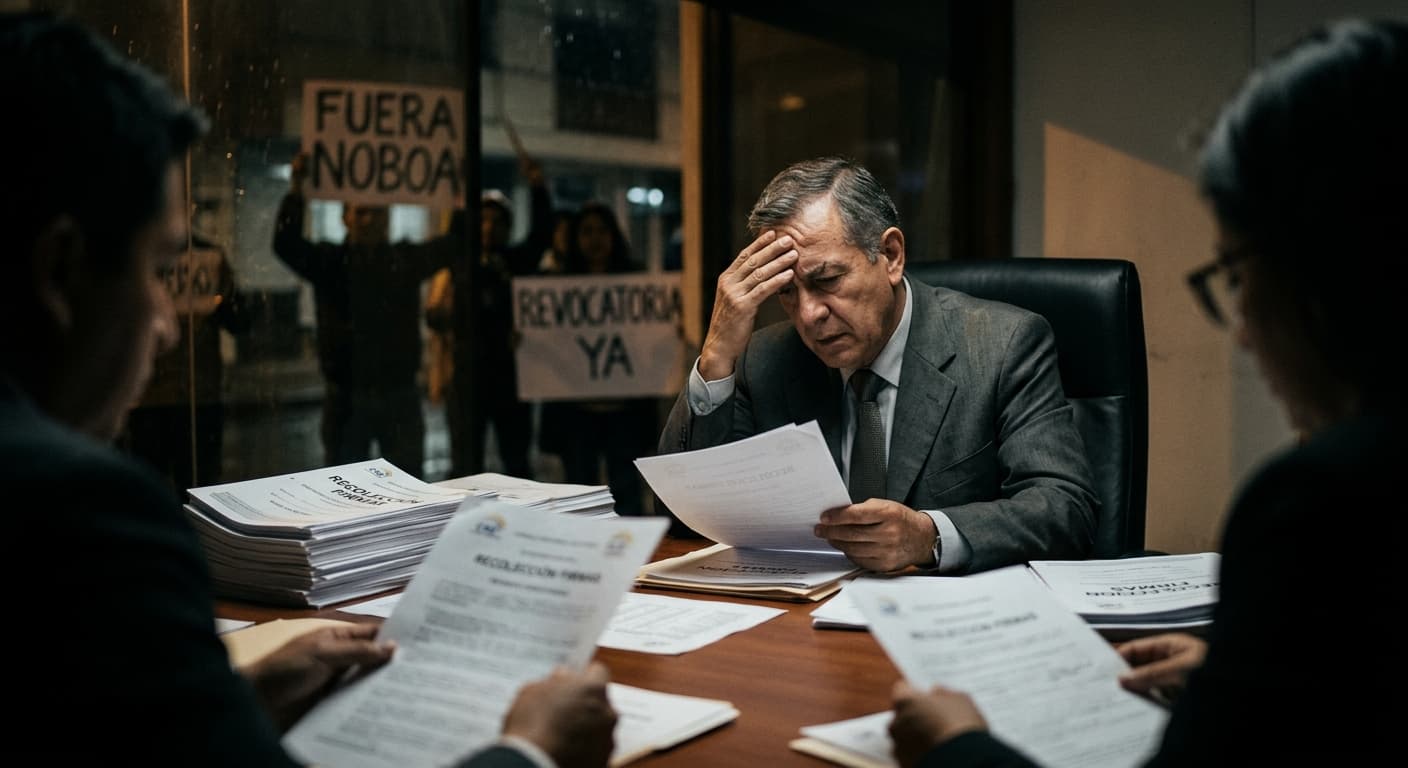
Organizers of the recall against President Daniel Noboa are staging nationwide vigils on July 8, 11 and 15, 2026 to force Ecuador's electoral council to rule on admissibility — a stress test of institutional independence.
Ecuador's recall movement against President Daniel Noboa is not a serious bid to remove him — the math makes that nearly impossible — but a calibrated stress test of the Consejo Nacional Electoral (CNE) that could break the aura of political invincibility Noboa has cultivated since his April 2025 landslide. Organizers led by the Plataforma Ciudadana Revoca EC will stage vigils in Quito on July 8, 11 and 15, the last day of the statutory 15-day window the CNE has to rule on admissibility, according to Confirmado. The real prize is not Noboa's chair; it is a public forced-choice for a CNE that his allies are positioned to reshape.
The move on the CNE
The recall petition against Noboa and Vice President María José Pinto was lodged in June 2026, one year and one month into his four-year term — the earliest opening under Ecuador's Ley Orgánica de Participación Ciudadana, which bars any request during the first year in office. The statute the promoters cite is unambiguous: "dentro del término de quince días, el Consejo Nacional Electoral resolverá la admisión a trámite de la solicitud presentada procediendo a entregar los formularios para la recolección de firmas," reads Article 27 of the law.
Fifteen days from filing lands the deadline squarely on July 15, 2026. Ecuadorian daily Expreso reports the collective is also preparing legal action if the council lets the clock run out. According to
Prensa Latina, two separate recall petitions are in play, filed by social organizations under the Revoca EC umbrella.
The Noboa government has asked the CNE to reject the petition on grounds that it relies on "referencias generales" and press clippings rather than a verifiable "incumplimiento del plan de trabajo." That is the escape hatch in the statute: Article 27 says motivation must be "clara y precisa" and cannot merely question the lawful exercise of the office. The CNE's five councillors now have to decide whether to hide behind that clause or move the petition to signature collection — a decision that will be scrutinized by the OAS, which noted "indications that public resources and the state apparatus were improperly used for proselytizing" in Noboa's 2025 re-election, according to the Congressional Research Service.
Why the math doesn't matter
On paper, the recall is a very long shot. Under Article 26 of the participation law, national officials in constituencies above 300,000 voters need signatures from 10% of the electoral roll — roughly 1.37 million valid signatures on an Ecuadorian padrón of about 13.7 million — within 180 days of receiving the forms. No presidential recall has ever cleared that bar in Ecuador. A study in
International Political Science Review documenting 78 activations between 2010 and 2012 found that when the CNE tightened admissibility filters, activations collapsed; the electoral management body, not popular anger, is the swing variable.
That is precisely why the movement's leaders — lawyer Washington Andrade and, more consequentially, former Pachakutik presidential candidate Leonidas Iza — are aiming their pressure at the CNE rather than at signature booths. Iza is the same figure who signed a short-lived pre-election alliance with Correísmo in March 2025 and whose CONAIE base led the September–October 2025 diesel strike that left three dead and 473 injured, according to Ecuador's Alliance of Human Rights Organizations cited by Freedom House. The recall is the next iteration of that same street coalition — legalized, dated, and pointed at a single institution.
A presidency already bleeding altitude
The petition would be a curiosity were Noboa still riding his April 2025 mandate. He is not. On November 16, 2025, voters rejected all four questions in the government-backed referendum: foreign military bases lost 60.55% to 39.45%, and a constituent assembly went down 61.61% to 38.39%, per BBC Mundo.
NPR called it a "major defeat" that quietly killed Washington's hopes of returning to the Manta base.
Then came the numbers. Ecuador closed 2025 with 9,216 homicides, a 30% year-on-year jump and the highest rate in decades, according to Al Jazeera. The BBC reported in April 2026 that Noboa had to deploy
75,000 soldiers and police to four provinces to restart his security narrative. Even the
IMF's Fifth Review under the Extended Fund Facility, published April 9, 2026, records that Ecuador missed its November 2025–January 2026 fiscal target by 1.1% of GDP, "underpinned" in part by "higher compensatory measures following the diesel subsidy reform."
The president who once polled north of 70% approval on security, as tracked by Comunicaliza and cited by the Wilson Center, is now the president who lost a referendum, missed an IMF target, and saw his motorcade attacked in Imbabura — a province he won in April 2025, as
Al Jazeera noted. The recall exploits that gap between mandate and grip.
The institutional stakes
Here is where the story stops being local. The CNE is one of 14 top state bodies whose leadership Ecuador's opposition-influence balance will renew in coming months. Political scientist Esteban Cahuasquí told BBC Mundo after the 2025 election that Noboa "va a jugar un papel relevante en lo que podría ser un proceso de concentración del poder" — including over the CNE, the Fiscalía General and the Defensoría del Pueblo. The recall petition arrives before that reshuffle is complete. If the current CNE rules on the merits — either way — it sets a precedent the next council will have to live with.
The Constitutional Court is the parallel front. As Marina Lacalle and Andrés Sáenz argue in the Journal of Democracy, Noboa has spent 2025 labeling the Court "enemy of the people" and floated impeaching its judges precisely because it forced him to route the foreign-bases question through the Assembly. The Court blocked his September 2025 impeachment proposal on judicial-independence grounds. That leaves the CNE as the softer institutional target. A ruling that dismisses the recall on Article 27 "vagueness" grounds would be legally defensible and politically useful — for Noboa. A ruling that admits it hands his opponents the one thing they lack: a 180-day, legally sanctioned mobilization runway.
Regional context: the recall as opposition weapon
Ecuador's recall statute is unique in Latin America for having produced 78 activations in three years (2010–2012), most against mayors, and none successful at the presidential level. But the pattern of opposition movements using recall not to win but to bleed a president is now visible across the Andes. In Peru — sorry, the more relevant parallel: Bolivia's 2008 recall, which Evo Morales survived with 67%; Venezuela's 2016 recall against Nicolás Maduro, which the Consejo Nacional Electoral killed at the admissibility stage; and Peru's serial vacancia motions against Pedro Castillo. In every case, the pivotal actor was the electoral or legal body, not the electorate.
That is the frame Iza and Andrade have adopted. It also explains why the Noboa government's response has been legal (asking dismissal on merit) rather than confrontational (attacking the petitioners). The government understands that the petition itself is not the threat; a CNE with a documented history of independence is.
What to watch
- July 8, 11 and 15, 2026 — Vigils in Quito, with promoters targeting 5,000 participants per event, per
Confirmado. July 15 is the statutory deadline for the CNE ruling.
- Late July 2026 — If the CNE dismisses, expect a Contencioso Electoral appeal and a possible acción de protección before the Constitutional Court, per organizer statements to
Expreso.
- August–September 2026 — If admitted, the 180-day signature-collection window opens for constituencies over 300,000 voters. Signature verification is where past presidential recalls have died.
- Late 2026 — Renewal of key CNE posts, part of the 14-institution designation cycle Noboa's ADN bloc, with 66 of 151 Assembly seats, is well positioned to influence.
Diplomat View
The recall against Noboa will almost certainly fail as an act of removal. It will almost certainly succeed as an act of political demolition. The signature threshold — 10% of the padrón, roughly 1.37 million valid firmas in 180 days, gathered in a country where CONAIE's mobilization capacity is real but geographically concentrated — is designed to be prohibitive. That is not the point. The point is that Ecuador now has a legally sanctioned, dated, opposition-led counter-narrative to Noboa's mandate, one the CNE cannot ignore without paying a legitimacy cost, and one Noboa cannot dismiss without appearing to fear precisely what he claims to relish: an electoral fight.
Our forecast: the CNE will find a way to slow-walk admissibility, most likely by demanding refiled motivation under the "clara y precisa" clause of Article 27, buying Noboa 60–90 days. What would change this call: a Constitutional Court injunction ordering CNE compliance with the 15-day statute, or a defection within the CNE's five councillors that produces a 3–2 admission ruling. Watch the vote breakdown, not the outcome. In Latin American democracies under stress, the story is rarely who wins — it is which institutions still function.
The Bottom Line
Ecuador's recall push is a test of the CNE, not of Noboa's electoral survival. If the council upholds the statute and admits the petition, it signals that Ecuador's electoral machinery still functions independently of a president who has spent a year attacking every horizontal check on his power. If it doesn't, the recall movement gets what it actually wants: proof that democratic backsliding in Ecuador is no longer hypothetical. Either way, July 15, 2026 becomes a date that outlives the vigils.
Discover more
India
Rajnath Singh's Durga Squad for 2026 Polls
Rajnath Singh's Durga Squad promised women's safety in Bengal but has since disappeared from the agenda, revealing BJP's true priorities.

India
Yamini Aiyar on Modi's Federalism Shift
Yamini Aiyar critiques Modi's shift from equity-based to performance-based federalism, highlighting implications for India's political landscape.
India
700 Activists Accuse PM Modi of MCC Breach
Over 700 activists allege PM Modi breached election code with a televised address attacking opposition parties just before state elections.

Economics
Fed's Amex AML order puts correspondent banking on notice
Federal Reserve's Amex AML order requires board-level controls and a 90-day plan; OCC fined the bank $350 million over enterprise-wide deficiencies.