Ecuador's Noboa Recall Effort and IMF Program
Government seeks to block recall petition against Noboa.
Model Diplomat8 min readSouth America
Ecuador moves to kill Noboa recall as IMF program comes under fire
Ecuador's government asked the CNE on July 7, 2026 to archive a second recall petition against President Daniel Noboa — a legal move that shields the $5 billion IMF program from a direct citizen vote.
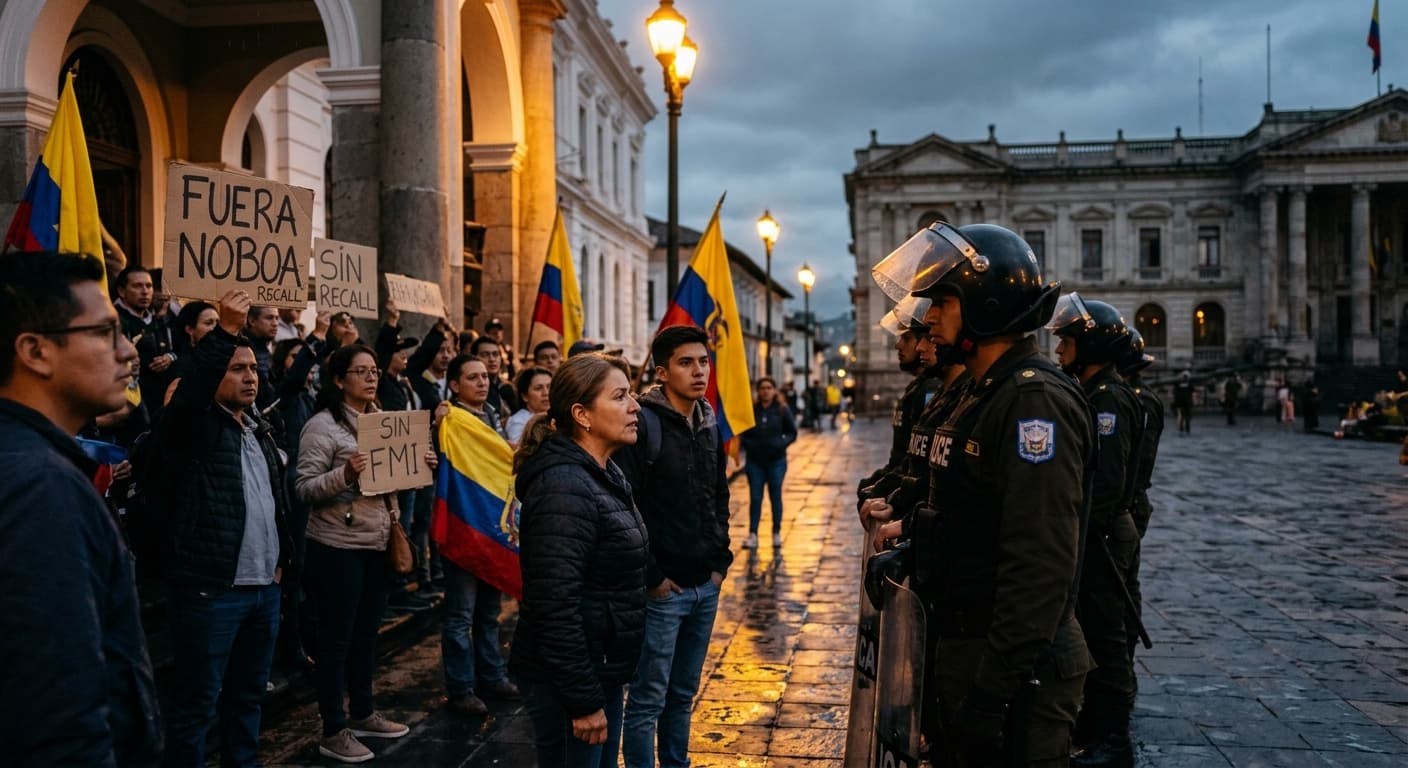
Ecuador's government on July 7, 2026 asked the National Electoral Council to throw out a second petition to recall President Daniel Noboa — and the target of that request is not really the petitioners but the $5 billion IMF program they want voters to nullify at the ballot box. The administration's legal argument, delivered in person by presidential legal secretary Enrique Herrería, is narrow and load-bearing: Article 27 of the Ley de Participación Ciudadana bars recall drives from challenging "public policy," and the government insists the deal with the International Monetary Fund is exactly that. If the CNE agrees, Noboa's fiscal consolidation survives street pressure that his own referendum could not; if it does not, the president who lost every one of his own referendum questions eight months ago will be forced to defend his economic model in front of a hostile electorate.
The filing, and why the wording matters
Herrería walked into the Consejo Nacional Electoral in Quito on Tuesday with what he called "an extensive brief glossing every mistake of this new recall request," according to reporting from Ecuavisa. The petition he is trying to bury was filed by Guido Perugachi, president of the Confederación Nacional de Organizaciones Campesinas, Indígenas, Negras y Montubias (Fenocin), together with the UNE teachers' union and the UGTE labor federation. Their proposed grounds, per the government's own summary, are that Noboa breached his campaign plan by signing an agreement with the IMF, and that he has violated unspecified constitutional obligations.
Herrería told reporters the request fails on both counts. "When a recall is requested, under Article 27 of the Ley de Participación Ciudadana, the motivations have to be properly grounded. In addition, the law itself and its regulations state that public policies of a government cannot be questioned," he said, in an account La República published Wednesday. On the second causal — alleged non-compliance with the constitution — the government said petitioners cite no specific norm that either Noboa or Vice President María José Pinto has broken.
This is the second such petition in weeks. The first, still under CNE review, was filed by CONAIE-linked Leonidas Iza — the Pachakutik candidate who took 5% in the 2025 first round — and correista lawyer Washington Andrade, as documented by Noticias SIN. A third front is opening on the street:
Prensa Latina reports social organizations have called vigils and mobilizations to pressure the CNE to rule.
The number the government is really defending
To understand why the palace is spending political capital on a procedural filing, look at what the recall petitioners actually want overturned. Ecuador's 48-month Extended Fund Facility was approved by the IMF Executive Board in May 2024 and augmented to $5 billion in July 2025, according to the IMF. The Fund completed its Fifth Review on April 22, 2026, releasing another $394 million and pushing total disbursements to roughly $3.7 billion. The program is the scaffolding of Noboa's fiscal strategy: a non-oil primary balance improvement of 6.6% of GDP across the program, a public-debt path targeted to fall to 40% of GDP by 2031, and — crucially — Ecuador's return to international capital markets in January 2026 with a $4 billion bond issue at an average 8.98% coupon and a $3 billion buyback, its first market re-entry since 2019, as detailed in the
IMF's Fifth Review.
That buyback lengthened maturities and, by the Fund's calculation, cut debt service by about $1.2 billion through 2028. Moody's raised Ecuador's rating two notches to Caa1; Fitch went up one notch to B–. In market terms, this is the most successful piece of Ecuadorian macro policy in a decade — and it is what a successful recall would put in front of voters as an up-or-down question. The administration's Article 27 argument is not legal pedantry; it is a firewall around the entire EFF.
The historical parallel the palace is quietly hoping for
Ecuador has run recall petitions before, and the electoral bureaucracy has been the graveyard for most of them. The seminal analysis of Ecuador's post-1998 recall regime by political scientist Yanina Welp, published in International Political Science Review, documents 78 provincial and municipal recall attempts between 2010 and 2012 alone — after the 2011 reforms tightened requirements, activation collapsed. Welp's core finding is that the CNE, an electoral management body, has been the decisive filter: signature validation rates and admissibility rulings, more than public dissatisfaction, determine whether a recall reaches a ballot.
The Yasuní precedent is the template. In 2014, environmental group Yasunidos delivered roughly 750,000 signatures to force a referendum on oil extraction; the CNE invalidated 66% of them and killed the drive on technical grounds, per BBC Mundo. Herrería's brief cites CNE precedent and Tribunal Contencioso Electoral jurisprudence — a legal move that reads, in context, as an invitation for the CNE to do again what it did to Yasunidos.
There is one difference this time. A 2024 analysis by the Konrad Adenauer Stiftung flags "political co-optation, lack of independence and weak control of electoral financing" at both the CNE and the Tribunal Contencioso Electoral, along with the irregular extension of councillor mandates past their November 2024 expiry — a status the Procuraduría General del Estado effectively blessed to avoid an institutional gap. That is a structural condition friendly to the government's request.
Who benefits, who loses
Winners if the CNE archives: Noboa, first and most obviously — his agenda survives a plebiscite it would probably lose. The IMF mission led by Patrizia Tumbarello, which negotiated the augmentation and the fiscal path, keeps its counterpart intact. Foreign bondholders who bought into January's issuance at 8.98% get another quarter of policy continuity. Multilateral lenders — CAF, the World Bank, the IDB — whose disbursements are "catalyzed" by the EFF, as the Fund itself notes, keep their programs on rails.
Losers: Fenocin, UNE and UGTE, whose institutional path to challenge Noboa closes. CONAIE, already bruised. The Indigenous confederation led an indefinite national strike in September–October 2025 against the elimination of the diesel subsidy — a cut that raised prices from $1.80 to $2.80 per gallon overnight and was central to the fiscal package the IMF praises. Al Jazeera reported one protester killed, more than 100 arrests, and Noboa's motorcade attacked with rocks by day 16. In November, a subsequent convoy was ambushed with Molotov cocktails and 17 soldiers taken hostage, according to the
BBC; CONAIE said one of its members, Efraín Fuerez, was shot dead by security forces.
The recall route is what these movements have left after two decisive institutional defeats: the failure of the October 2025 strike to reverse the diesel decree, and the referendum route Noboa himself opened and then lost.
The referendum that should have warned the palace
On November 16, 2025, Ecuadorians rejected all four of Noboa's referendum questions, with the Constituent Assembly proposal defeated 61.6% to 38.4% and the return of foreign military bases turned down 60.6% to 39.4%, according to CNE figures reported by BBC Mundo. Turnout exceeded 80%. Michael Shifter of the Inter-American Dialogue told
Al Jazeera the outcome was "a big setback" for a president the Trump administration had treated as its key regional ally.
That referendum is the political horizon in which the recall must be read. Noboa entered 2024 with over 80% approval on the back of his security push; by late 2025 he was under 50%, with the poverty rate rising two points to 28% and homicides still at 39 per 100,000, per BBC Mundo's pre-runoff analysis. In the first half of 2025 alone, Ecuador's Organized Crime Observatory counted 4,619 murders — "the highest in recent history," as
Al Jazeera put it. A recall vote today would not be a referendum on the IMF alone; it would be a referendum on Noboa's entire second term — and the November precedent suggests the government has reason to fear the ballot.
The IMF program the recall is really about
The scale of what is at stake for the multilateral relationship is easy to underestimate. Under the Fifth Review, the IMF projects Ecuador's real GDP growing 2.5% in 2026, with the current account still in "sizable surplus" and international reserves at record highs. That is the macro story Noboa's team sells at Davos and to Washington. It rests on the VAT hike from 12% to 15%, the diesel decree, and thousands of dismissed public workers — exactly the measures Fenocin and the unions want to relitigate through the ballot.
The IMF has an interest in the CNE ruling too. In its June 2025 Second Review staff statement, the Fund explicitly identified "additional challenges due to the recent global oil price shock and tighter external financing conditions" as the reason for augmenting from $4 billion to $5 billion. A successful recall would inject exactly the political noise the Fund has been trying to price out of the sovereign spread — currently at its lowest since 2018, per the Fifth Review.
Diplomat View
The most likely outcome is that the CNE archives both petitions — the Yasunidos precedent is strong, the government's Article 27 argument is textually clean, and the electoral council's political composition, extended by a Procuraduría opinion after its members' mandates expired in November 2024, is favorable. That is the base case. Watch three things that would force a revision. First, the CNE's ruling on the Iza–Andrade petition, which arrived first and does not rest solely on the IMF-as-public-policy argument; a decision to admit that one would make it politically harder to kill the Fenocin filing. Second, whether CONAIE — which overthrew three presidents between 1997 and 2005, as the BBC has documented — reconverges with the labor unions on the street after their split during the 2025 elections. Third, IMF Sixth Review talks, expected in the second half of 2026; any delay signals that Washington sees political risk the market has not yet priced. The bottom line: Noboa's team is not fighting the recall petitioners so much as the memory of November 16, 2025 — the day Ecuadorians proved they will use direct-democracy tools against him when given the chance. Killing this recall at the CNE is how the palace makes sure they are not given another.
What to watch
- CNE ruling on the Iza–Andrade recall petition, the first filed and already under review.
- IMF Sixth Review mission in late 2026 — a delay would be the market's first serious warning signal.
- Joint CONAIE–union mobilization: if Fenocin, UNE and UGTE align with CONAIE on a common calendar, the fight leaves the CNE and returns to the street.
Discover more
US Politics
House Ethics Committee Pushes Sexual Miscond.
The House Ethics Committee has shifted responsibility for sexual harassment settlement records to the Office of Congressional Workplace Rights, complicating disclosure efforts.
India
700 Activists Accuse PM Modi of MCC Breach
Over 700 activists allege PM Modi breached election code with a televised address attacking opposition parties just before state elections.
India
Rajnath Singh's Durga Squad for 2026 Polls
Rajnath Singh's Durga Squad promised women's safety in Bengal but has since disappeared from the agenda, revealing BJP's true priorities.

Conflict & Security
Drone Warfare Killing Aid Workers at Unprec
Over 1,000 humanitarian workers killed in three years as cheap armed drones collapse legal protections. Gaza, Sudan, Ukraine, and DRC see deliberate targeting of aid convoys and hospitals with zero prosecutions.