Earthquakes Erode Delcy Rodríguez's Power
Venezuelans demand elections over reconstruction post-quake.
Model Diplomat7 min readLatin America
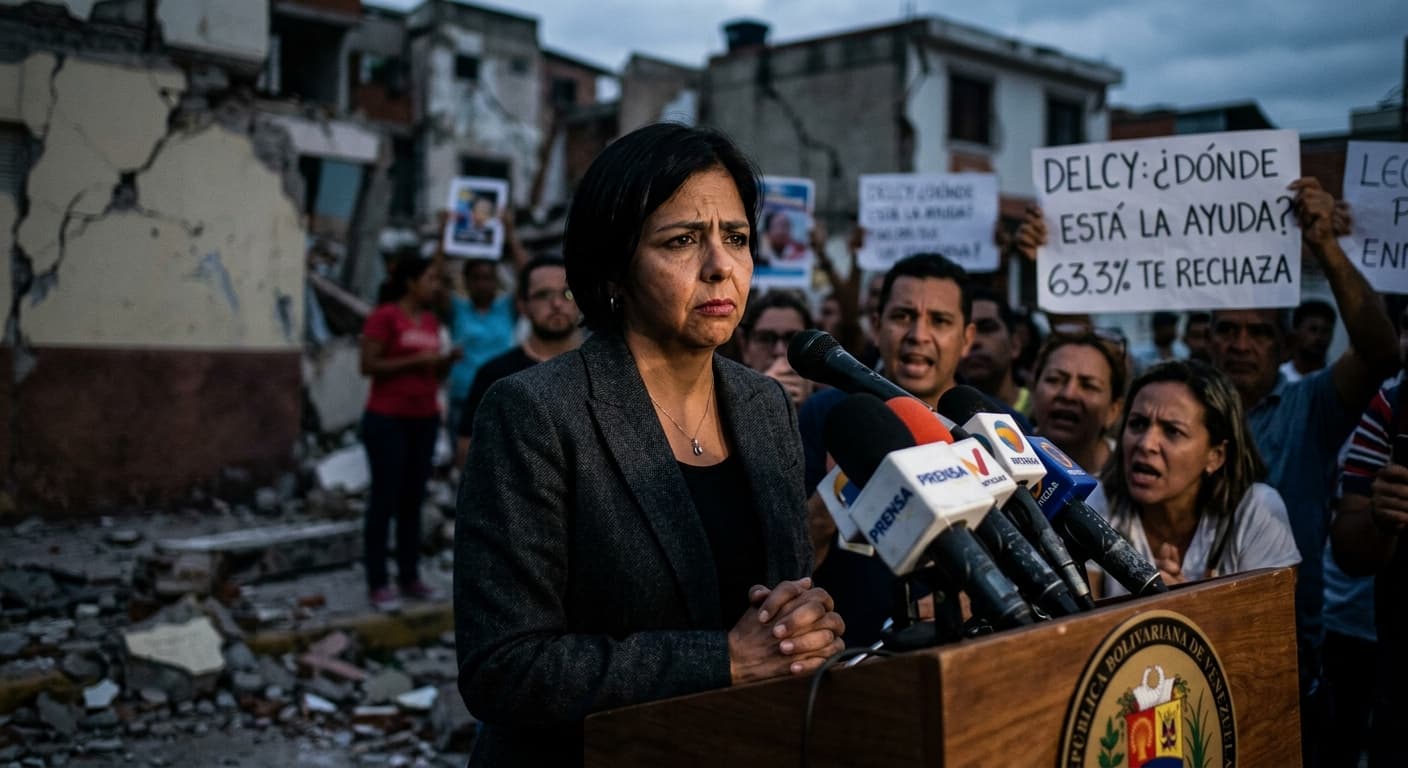
Earthquakes crack Delcy Rodríguez's hold on Venezuela
Post-quake disapproval of Venezuela's interim president hits 63.3% as 45.7% of voters now say a new election matters more than reconstruction.
Delcy Rodríguez's earthquake response has done what six months of US-brokered rule could not: it has turned the acceptance of her interim presidency into open rejection, with AtlasIntel/Bloomberg polling her disapproval at 63.3% and nearly half the country demanding early elections instead of reconstruction. That collapse matters because the Trump administration's Venezuela strategy — installed on January 5, 2026 after Nicolás Maduro's capture — rests on a single bet: that Rodríguez can deliver stability, oil, and a quiet transition on Washington's timetable. The rubble on the coast of La Guaira is now the load-bearing evidence that she cannot, and it hands María Corina Machado the leverage she has lacked since Trump sidelined her in January.
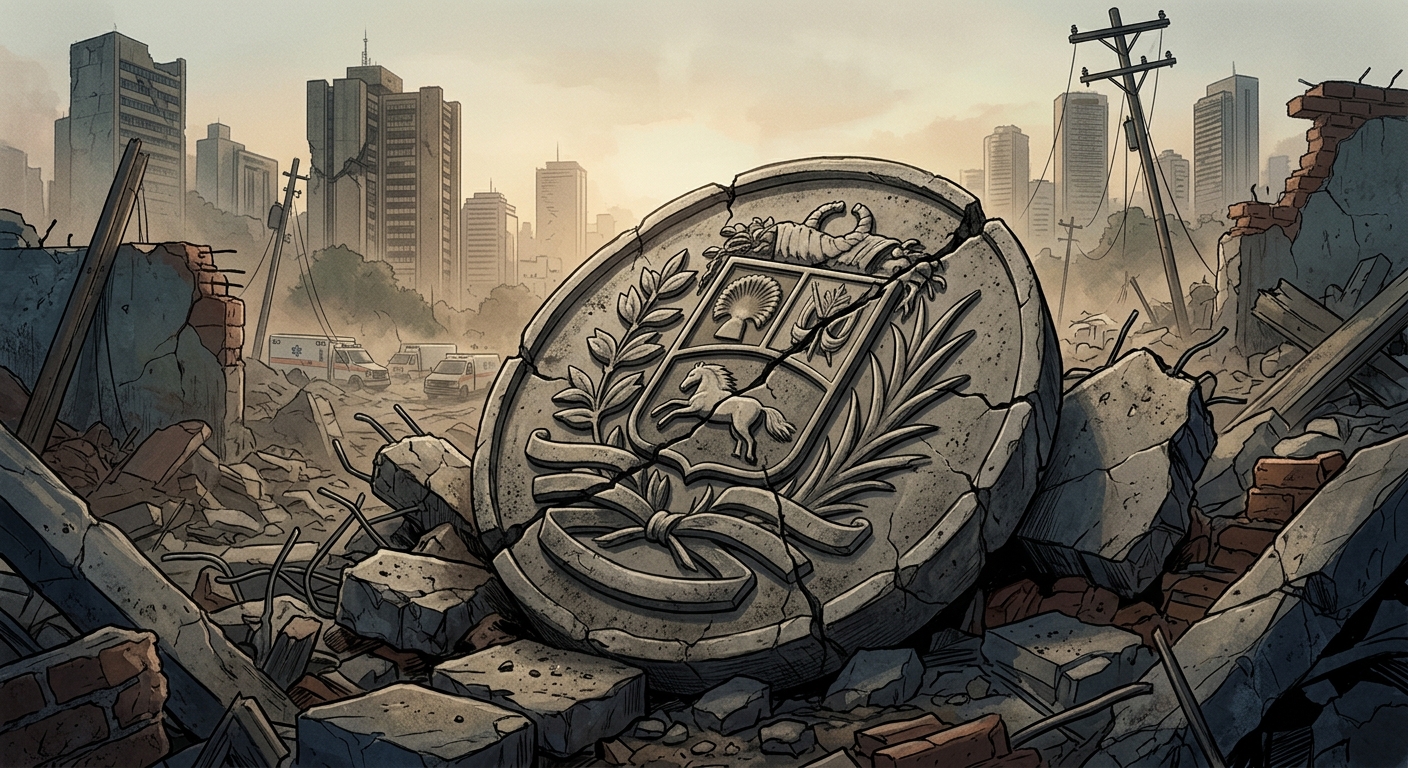
The numbers behind the collapse
The June 24 twin quakes — magnitudes 7.2 and 7.5, epicenters 10 miles southwest of Morón, per the US Geological Survey — killed at least 1,700 people by the government's own count and left more than 43,000 unaccounted for, according to reporting by
Al Jazeera. By July 1, official figures had risen to roughly 2,600 dead and 12,400 injured, with an opposition-backed registry counting more than 38,000 missing,
Perfil / Bloomberg reported.
The AtlasIntel/Bloomberg Latam Pulse survey, fielded June 26–30, is the first hard read on how Venezuelans processed that response. Disapproval of Rodríguez climbed to 63.3%, up almost five points from May. Some 52.4% called the government's disaster response "very deficient." Most striking, 45.7% now say choosing a new president is a higher priority than rebuilding, versus 32.6% who put reconstruction first, according to Perfil. María Corina Machado registered 53% favorability from exile, the highest of any Venezuelan public figure, per
Diario Frontera, which cited the same poll.
That is a swing from the baseline. Face-to-face polling by Gold Glove Consulting for the Atlantic Council in late January showed Rodríguez already unfavorable to 73% of Venezuelans, but her ministers ran hotter — Interior Minister Diosdado Cabello at 83% unfavorable, Defense Minister Vladimir Padrino at 81%. What the earthquake did was collapse the space between "tolerated caretaker" and "obstacle to reconstruction." Brian Naranjo, a former US diplomat with Venezuela experience, told
Bloomberg that "social unrest could become a problem" and that the disaster revived civic organization "at levels not seen in years."
The response that broke the arrangement
The specific failures are documented. Venezolana de Televisión's own broadcast timeline, later dissected by Bloomberg, showed Rodríguez did not address the nation until roughly 90 minutes after the second quake. The BBC reported that the first official rescue team — Venezuelan firefighters — reached the collapsed Bello Horizonte complex in La Guaira nearly two days after the tremors; Salvadoran and US teams arrived alongside them. A widely shared clip, cited by BBC Mundo, shows Cabello personally blocking international rescuers from a devastated zone.
At a June 30 press conference, Rodríguez called critics "miserable, heartless, inconsiderate to a people in anguish," according to BBC Mundo, and attributed the reporting to "laboratories" politicizing the emergency. The line is a rhetorical inheritance from Maduro; the polling suggests it is no longer bought. Carolina Jiménez, president of the Washington Office on Latin America, told
Al Jazeera that "in any other country, the first responder should be the state. In the case of Venezuela, the state has been the last responder."
The underlying deficit is structural, not communicative. The BBC's analysis of the response noted that for two decades the armed forces absorbed budget and status at the expense of civil-protection units, and that Chávez's 2007 nationalization gutted the domestic cement industry — a reason so many social-housing blocks pancaked. Rodríguez has already swapped generals for a civilian architect at Housing and an engineer at Electricity, per the same BBC reporting, but the timing suggests the personnel fix arrived a decade late.
Why this cracks Trump's Venezuela architecture
The Rodríguez presidency exists on two legal fictions that only worked while she was invisible. First, the Supreme Court declared Maduro's absence "forced" rather than permanent, allowing an initial 90-day interim under Article 233 of the constitution — which otherwise mandates fresh elections within 30 days of a "permanent" vacancy, as noted in a European Parliament Research Service briefing. Second, that 90-day cap quietly lapsed on April 6 with no public legislative vote, per the
Council on Foreign Relations tracker; the full 180-day window ended on July 3 — the same day the AtlasIntel numbers dropped.
The Trump administration built its policy around that legal ambiguity. A classified US intelligence assessment reported by the Wall Street Journal, summarized by the BBC, concluded Rodríguez was better placed than Machado to hold the country together and prevent security-force splintering. Trump publicly dismissed Machado as "not respected" and told NBC in January: "We have to fix the country first. You can't have an election." The Congressional Research Service's
Venezuela briefing documents the resulting posture: continued sanctions pressure on Maduro-aligned individuals, foreign-terrorist designations for Tren de Aragua and the Cartel de los Soles, and $50 million in FY2026 democracy assistance channeled through the State Department after USAID's dissolution.
The oil deal is the ballast. Under the framework announced in January and detailed in an Al Jazeera report, Venezuela is turning over 30–50 million barrels of sanctioned crude at market prices, with revenue banked in US-controlled accounts. Rodríguez pushed a Hydrocarbons Law reform through the National Assembly on first reading January 23, breaking Chávez's 2006 nationalization principles and formalizing what analysts call the "Chevron model." The first $300 million tranche of US crude sales landed in Caracas that same week. Rodríguez's political value to Washington is precisely her willingness to sign these papers; Machado's opposition coalition, per the
Journal of Democracy, would not accept a US-controlled escrow of Venezuelan oil revenue as a permanent arrangement.
That is the trade: legitimacy for oil access. The earthquake data suggests Venezuelans are no longer buying either half.
Machado's opening, Washington's dilemma
Machado's team has read the moment. Henry Alviárez, national coordinator for her Vente Venezuela movement, told Al Jazeera that "the indignation from this inaction is the regime's fault." The opposition's Manifiesto de Panamá, signed by Machado and Edmundo González in June, formally names Machado as coordinator of any transition talks and treats the Trump administration's three-phase "stabilization, reconstruction, transition" plan as the operative framework,
BBC Mundo reported. Machado has said she intends to return to Venezuela before the end of 2026 and will run for president.
The pressure numbers were already climbing before the quakes. According to the Observatorio Venezolano de Conflictividad Social, cited by Bloomberg, Venezuela recorded 1,926 anti-government protests in the first quarter of 2026 — up from 788 in the same period of 2025. The government has held back from the mass-repression playbook of prior years, in part because doing so would risk the US arrangement. That restraint is now the constraint: Rodríguez cannot both please Cabello's security wing and demobilize protests without breaking her Washington deal.
The US posture is quietly hedging. Chargé d'affaires John Barrett told Univision the US commitment to Rodríguez had "only strengthened" after the quake. But the Council on Foreign Relations argued on June 30 — six days after the disaster — that Washington should now push concrete democratic progress. The US Disaster Assistance Response Team deployed within 24 hours; Trump pledged $300 million and Secretary of State Marco Rubio committed search-and-rescue, medical, and humanitarian assistance, per the CFR analysis and
BBC News. That American aid, delivered visibly while Venezuelan security forces stood by, is itself a legitimacy transfer: Venezuelans in La Guaira credit foreign rescuers and volunteer neighbors, not the Bolivarian state.
Exxon CEO Darren Woods, at a January White House meeting reported by the BBC, called Venezuela "uninvestable" under current conditions — a verdict from the very sector Trump's arrangement is meant to reactivate, grounded in legal risk and political instability. The earthquake response has added mass mortality and street-level rage to that calculus.
Diplomat View
Rodríguez's political shelf life is now shorter than Washington's oil timeline, and that gap is where the next Venezuelan crisis will happen. The AtlasIntel numbers are not a normal approval swing — they are a public verdict that the interim mandate has failed on its founding premise of technocratic stability. The Trump administration has three viable moves: extend the fiction (renew Rodríguez's mandate quietly and absorb the reputational cost); force a scripted transition (a Rodríguez-Machado handoff with amnesty guarantees for Cabello and Padrino, likely rejected by both sides); or accept a snap election under Article 233 that Machado's coalition would win by roughly the same margin as González did in 2024. The base-case forecast is Option 1 through the fourth quarter — Washington will not risk the oil arrangement over a polling number — but the falsifying condition is street mobilization sustained above 2,000 protests a month, which would replicate the 2017 dynamic that shattered international tolerance for Maduro. Revise this call if Machado returns to Venezuelan soil before December, or if Cabello moves against Rodríguez internally; either would collapse the current architecture inside a fortnight.
What to watch
- July–August 2026: Whether the Maduro-aligned National Assembly formally declares the presidency permanently vacant under Article 233 or extends Rodríguez's mandate quietly; the 180-day term ended July 3.
- Fall 2026: María Corina Machado's stated intent to return to Venezuela "before the end of 2026" — the single most disruptive event on the calendar for the Rodríguez-Trump arrangement.
- Q3 oil revenue: US-controlled escrow flows from Venezuelan crude sales; a shortfall or Chevron pullback would strip Rodríguez of her main asset in Washington.
The bottom line: The June 24 earthquakes did not create Venezuela's legitimacy crisis — they exposed that the Rodríguez presidency was a stability product with no domestic demand. Trump bought it for the oil; Venezuelans are now pricing it at 24% approval. The question is no longer whether the arrangement holds through 2026, but which side — Washington or Caracas — writes the exit.
Discover more

US Politics
White House Pressures Congress for Crypto Leg
The Trump administration's push for the CLARITY Act aims to reshape crypto regulation, impacting trillions in market value and the Trump family's wealth.
Global Politics
U.S. Maritime Pressure on Iran
Washington escalates maritime security operations and sanctions on Iran, disrupting Gulf shipping and reshaping global energy flows in a major strategy shift.

International Relations
U.S.–Iran Peace Deal
A narrow US-Iran deal on nuclear and regional issues could reshape Middle East diplomacy, offering a pragmatic path forward despite grand bargain obstacles.

Conflict & Security
Drone Warfare Killing Aid Workers at Unprec
Over 1,000 humanitarian workers killed in three years as cheap armed drones collapse legal protections. Gaza, Sudan, Ukraine, and DRC see deliberate targeting of aid convoys and hospitals with zero prosecutions.