Duterte to Stand Trial: ICC Ruling Impact
ICC confirms charges against Duterte, reshaping accountability.
Model Diplomat8 min readAsia
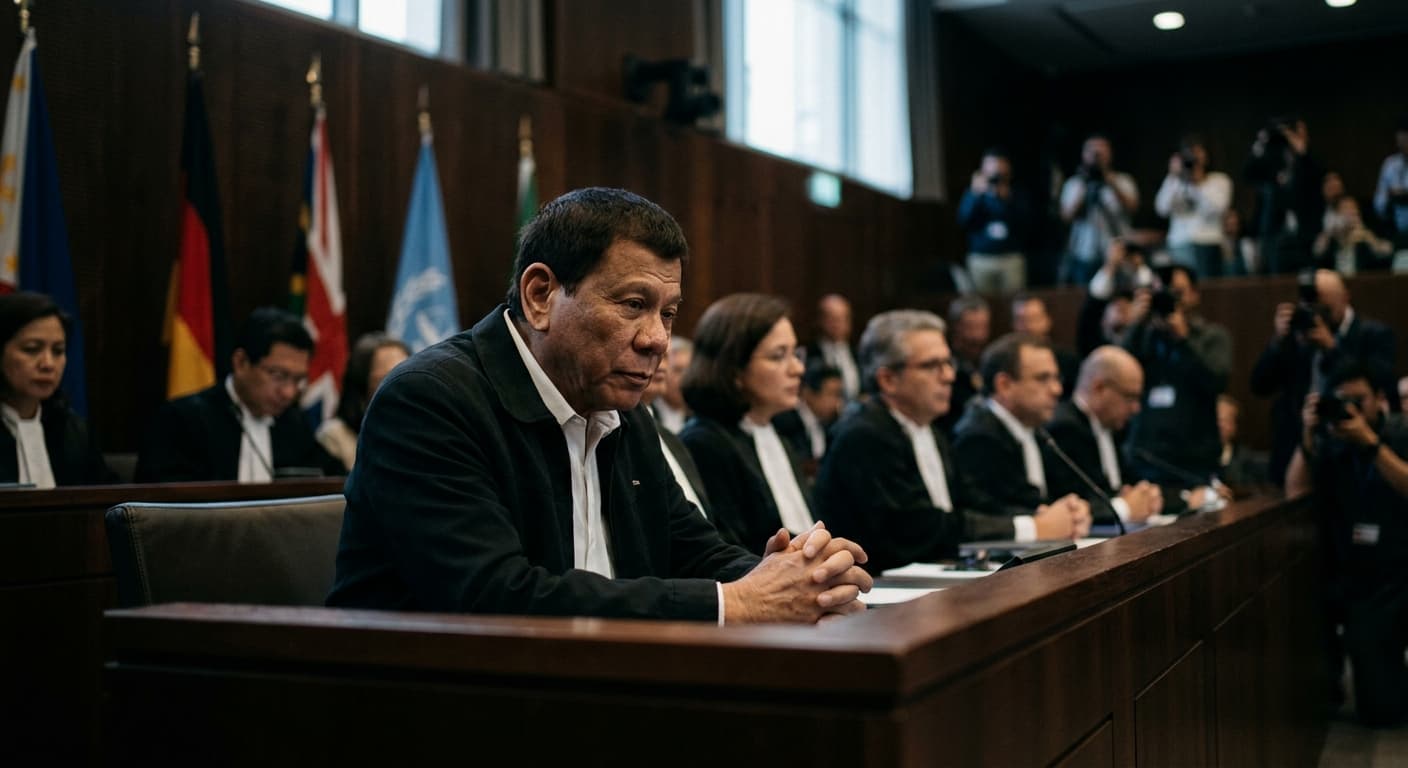
Duterte to stand trial: ICC ruling redraws the map of head-of-state accountability
ICC Pre-Trial Chamber I confirmed all crimes against humanity charges against Rodrigo Duterte on April 23, 2026, sending the former Philippine president to trial on November 30.
The confirmation of crimes-against-humanity charges against Rodrigo Duterte on April 23, 2026 does something no previous ICC ruling has done: it locks a former head of state — arrested at home, transferred by his own government — into a full trial for a signature domestic policy, and it does so over a state that had already walked out of the Rome Statute. That combination is the argument. Every other high-profile ICC target — Omar al-Bashir, Vladimir Putin, Benjamin Netanyahu, Min Aung Hlaing — remains at large. Duterte is in Scheveningen Prison. Article 127 of the Rome Statute, previously untested in a live prosecution of a departed leader, has now been read in a way that makes withdrawal a much narrower escape hatch than governments assumed.
The decision, filed as ICC-01/21-01/25-417-Red, commits Duterte on three counts of murder and attempted murder as crimes against humanity, covering Davao City between 2013 and June 2016 (the Davao Death Squad phase) and the entire Philippine territory from July 2016 through September 2018 (the presidential "war on drugs"). Pre-Trial Chamber I found "substantial grounds to believe" a common plan existed between Duterte and co-perpetrators "to neutralise" alleged criminals "through violent crimes including murder," according to the
Prosecution's response to the defence's leave-to-appeal motion. On July 3, Trial Chamber VII scheduled opening arguments for
November 30, 2026, according to the BBC.
What the ruling actually decides in international law
Two doctrinal questions have haunted ICC watchers for a decade. The Duterte ruling resolves one and squeezes the other.
The first is legacy jurisdiction over withdrawn states. The Philippines deposited its withdrawal notice on March 17, 2018 — six weeks after then-prosecutor Fatou Bensouda opened a preliminary examination — and left the Statute a year later. On April 22, 2026, the ICC Appeals Chamber affirmed that the court retains jurisdiction over crimes committed while the state was a party, reading Articles 12, 13 and 127 systemically. The chamber's language is the key: it would be "incompatible with the object and purpose" of the Statute to let a state "evade its responsibilities … by depositing a written notice of withdrawal once it discovers" it is under scrutiny. That is the practical burial of an argument Burundi and the Philippines had both tried to build — that withdrawal severs the court's reach.
Writing in the Asian Journal of International Law, legal scholar Rogier Bartels warned in 2024 that the court's silence on legacy jurisdiction was corrosive: "State parties cannot say with confidence that they are sure of the parameters of the Court's temporal jurisdiction," according to a Cambridge University Press article on the Philippines investigation. That gap is now closed on the terms most favourable to the prosecution: what matters is whether "any matter" was "already under consideration by the Court" before withdrawal took effect.
The second question is how prosecutors charge widespread patterns of killing when the alleged crime base runs into the thousands. The Pre-Trial Chamber endorsed a "non-exhaustive" charging model: 49 specific incidents and 78 named victims form illustrative examples, not the ceiling, of the case the Trial Chamber will consider. The defence, led by Nick Kaufman, has objected that this leaves the case "in an indeterminate and legally untested form," according to their request for leave to appeal. The chamber rejected that framing, citing Ntaganda and Said: for atrocity crimes involving mass victimisation, temporal and geographic scope may be defined while individual acts and victims are listed illustratively. That reading matters because it is the template prosecutors will now use against any leader accused of policy-level killing — the drone commander, the counter-insurgency planner, the strongman with a body count in the tens of thousands rather than a dozen.
Why this case, and not the others
Duterte is the only leader on that list in ICC custody. The reasons are less about international law than about domestic power balances — and that is the second-order implication policymakers should absorb.
The Center for Strategic and International Studies documented the arithmetic in a March 2025 analysis: "Marcos initially balked at ICC activity in the Philippines, announcing in January 2024 that his government would not cooperate with the investigation into Duterte. But as his relationship with Vice President Sara Duterte worsened, so did Marcos's resistance to the ICC." By November 2024, the Marcos administration had reversed itself and pledged Interpol compliance. On March 11, 2025 — hours after Duterte flew in from Hong Kong — he was on a plane to the Netherlands.
Brookings scholar Kelebogile Zvobgo makes the historical point that the wire copy has largely missed. The Philippines is only the second country to arrest a former head of state on an ICC warrant and hand him over — Côte d'Ivoire's transfer of Laurent Gbagbo in 2011 being the first. Gbagbo was acquitted. If Duterte is convicted, he will be the first former head of state ever found guilty at the ICC. That is a threshold — one the court has been trying to cross since Bashir's warrant in 2009.
The domestic politics driving The Hague
The Duterte case cannot be read apart from the collapsing Marcos–Duterte alliance. On July 6, 2026, the Philippine Senate opened the impeachment trial of Vice President Sara Duterte, the former president's daughter, on charges of misusing public funds and threatening the lives of President Ferdinand Marcos Jr., the first lady and the former House speaker. Two hundred and fifty-seven of 290 House members had voted to impeach her on a second attempt, the BBC reported — comfortably above the one-third threshold.
The Senate arithmetic is less favourable to Marcos. On May 11, Duterte loyalist Alan Peter Cayetano was installed as Senate president; the tie-breaking vote came from Senator Ronald "Bato" dela Rosa, Duterte's former police chief and now himself an ICC suspect, who emerged from hiding to cast it and then absconded again after a police-and-military standoff at the Senate, according to Al Jazeera. Two Philippine senators have been named as co-perpetrators in the ICC's Duterte case.
That is the structural fact The Hague cannot control. Sara Duterte holds a 17-point lead in early 2028 presidential polling. If she survives impeachment and wins, the Philippines will have a president whose father is on trial for crimes against humanity and whose top ally is an ICC fugitive. Marcos handed Duterte over when the domestic political price of doing so was lower than the price of protection. That calculation can reverse.
The numbers — and the gap between them
The size of the harm is contested in a way that matters legally. The Philippine Drug Enforcement Agency's official tally recorded 6,235 drug-related deaths between July 1, 2016 and February 28, 2022 in a submission to the UN treaty body process. The Office of the UN High Commissioner for Human Rights concluded in its 2020 report to the Human Rights Council that "the most conservative figure … suggests that since July 2016, 8,663 people have been killed — with other estimates of up to triple that number," according to the
OHCHR report to the Human Rights Council. Rights groups and Philippine journalists cite figures approaching 30,000.
The court's charging strategy sidesteps the dispute. The Prosecution has framed the 78 named victims as a lower bound, "illustrative examples" of a widespread attack. As the Pre-Trial Chamber noted in confirming the charges, "the number of victims mentioned in the [decision], whilst providing an indication of the scope of the case … [is] the lower limit." That is a doctrinal invitation to future prosecutions built the same way — a template that reaches from Manila to Yangon.
The counter-signal: an ICC under siege
The confirmation lands as the court itself is under unprecedented pressure. In December 2025, a Russian court convicted the ICC prosecutor and eight judges in absentia and sentenced them to prison in retaliation for the Putin warrant, according to Human Rights Watch. The United States has imposed sanctions on ICC officials over the Netanyahu warrants. Hungary announced its own withdrawal from the Statute in 2025. Read against that backdrop, the Duterte confirmation is the court's most concrete counter-signal: it can still deliver a former head of state to a courtroom.
Human Rights Watch's Maria Elena Vignoli, the group's senior international justice counsel, put the marker plainly: the trial "will send a powerful message that no one responsible for grave crimes is above the law, whether in the Philippines or elsewhere." That message travels only if it lands with a verdict. Gbagbo's acquittal — the last time a former head of state stood trial at The Hague — is the cautionary precedent.
What to watch
- November 30, 2026: Trial opens before Trial Chamber VII. The prosecution's opening will show whether it will confine itself to the 49 incidents or expand within the confirmed scope, which will define the case's realistic length (previous ICC trials have run three to five years).
- The Duterte defence's outstanding appeals: Pre-Trial Chamber I rejected leave to appeal the confirmation on May 21, 2026, per
ICC-01/21-01/25-445. A further challenge on charge specificity remains possible before the Appeals Chamber.
- Sara Duterte's impeachment verdict: A Senate acquittal, or a stalled trial, keeps her viable for 2028. A conviction bars her from public office and disrupts the family's leverage over Manila's ICC posture.
- Dela Rosa and the second warrant: The ICC has issued a warrant for Duterte's former police chief and now senator Ronald dela Rosa. His arrest — or continued shielding by the Senate — will test whether the Duterte precedent extends beyond one man.
- Philippine re-accession to the Rome Statute: Human Rights Watch has called on Marcos to begin the process. Any move in that direction, or against, will signal how the government reads the political cost of the trial itself.
The Bottom Line
The Duterte confirmation is the first time the ICC has taken a former head of state, arrested at home by his own government, all the way to a confirmed trial for a signature domestic policy — and the first time it has done so over a state that had already walked out of the Rome Statute. If a conviction follows, the practical doctrine of head-of-state accountability will have shifted from aspiration to precedent, and the "withdraw before they charge you" defence that Burundi, the Philippines and Hungary have pursued becomes materially weaker. The variable that decides whether this ruling reshapes international criminal law, or remains a one-off, is not in The Hague. It is in Manila, where the political alliance that delivered Duterte is now consuming itself.
Human Rights Watch statement on the confirmation:
"The ICC decision to send Duterte to trial opens the door to long awaited justice for the families of 'drug war' victims and is an important acknowledgment of their suffering."
Discover more
India
Rajnath Singh's Durga Squad for 2026 Polls
Rajnath Singh's Durga Squad promised women's safety in Bengal but has since disappeared from the agenda, revealing BJP's true priorities.

US Politics
SNAP Food Assistance Faces Legal Challenges
In 2026, SNAP faces stricter eligibility rules and mounting legal challenges, threatening food assistance for the millions of Americans who rely on the program.
US Politics
Congress Targets AI Chatbot Access for Terror
The House passed the Generative AI Terrorism Risk Assessment Act, focusing on AI's role in terrorism and potential surveillance implications.

Economics
Fed's Amex AML order puts correspondent banking on notice
Federal Reserve's Amex AML order requires board-level controls and a 90-day plan; OCC fined the bank $350 million over enterprise-wide deficiencies.