Durban Camps Highlight South Africa's Refugee
Refugees in Durban face dire conditions amid crisis.
Model Diplomat9 min readSouthern Africa
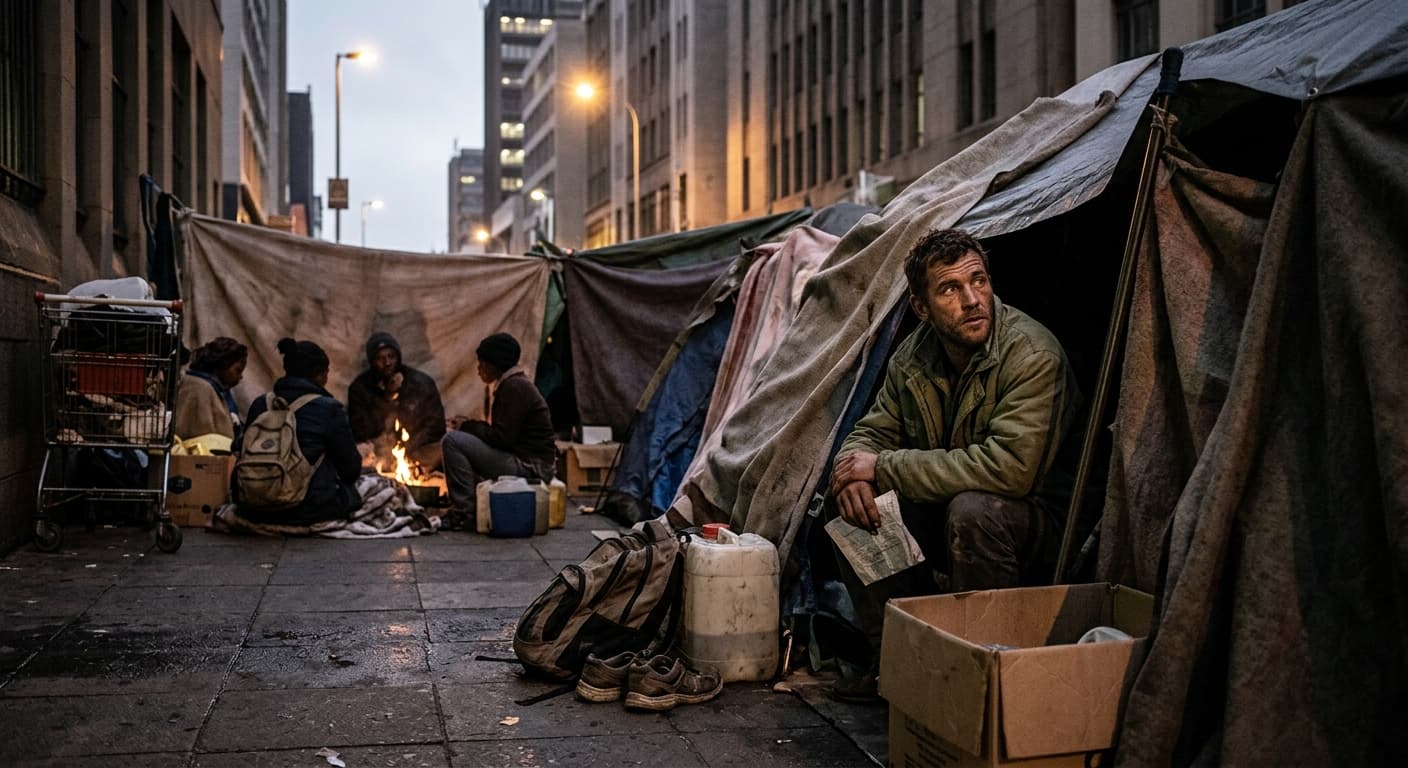
Durban Pavement Camps Expose South Africa's Refugee Shelter Crisis
Documented refugees are sleeping outside Durban's Home Affairs office as anti-migrant protests, a stalled asylum system and a 25,000-person exodus test South Africa's constitutional order.
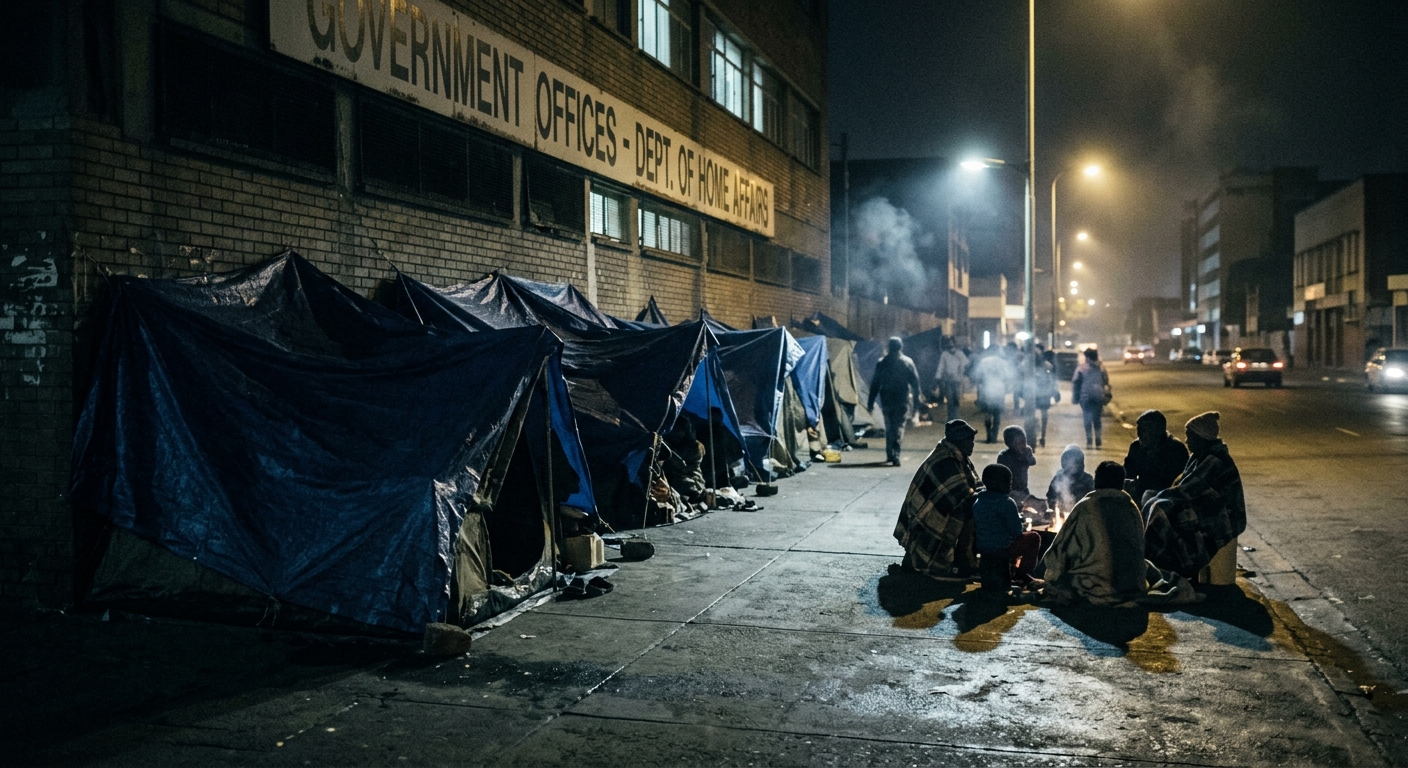
The pavement camp outside the Durban Refugee Reception Centre on Che Guevara Road is the most legible political symbol in Southern Africa this month: people the South African state has already recognised as refugees are choosing concrete over their own homes, because neither the government nor its allies will guarantee their safety anywhere else. That fact — not the wider anti-migrant marches, not the airlifts of Nigerians and Malawians — is what pushes this from a xenophobia story into a regional human-rights test. It exposes an asylum system that predates the current crisis by more than a decade, a constitutional guarantee the executive is quietly narrowing, and an African Union process, triggered by Ghana, that could reframe the entire episode as a Charter violation before the November 4 local elections.
The camp, in precise terms
Roughly 100 to 150 refugees and asylum seekers — men, women and children from the Democratic Republic of Congo, Burundi, Ethiopia, Zimbabwe and Somalia — have lived in a pavement camp outside Durban's Refugee Reception Office (RRO) for more than a month, according to reporting by IOL and
Central News South Africa. Their spokesperson, Bishop Raphael Bahebwa, told
The Citizen they were displaced from townships in and around Durban by door-to-door intimidation, and cannot go home because their papers do not shield them from the mob. Food, blankets and children's supplies are being provided by Gift of the Givers, the SA Palestine Movement and local churches — not by any organ of the state.
Nine kilometres away, in the Sherwood suburb, a separate and much larger informal camp swelled from about 3,000 Malawians on June 10 to as many as 7,000 by month-end, according to Al Jazeera and the
BBC. That population is overwhelmingly undocumented and wants out; the Che Guevara Road group is documented and wants in. Both camps exist because the same actor — the KwaZulu-Natal wing of the March and March movement, tacitly endorsed by Jacob Zuma's uMkhonto we Sizwe (MK) party — enforced an unofficial June 30 deadline for foreigners to leave, and the state, despite condemning it, has not disrupted the underlying campaign of intimidation.
The deadline day itself was contained but ugly. Deputy National Police Commissioner Tebello Mosikili said 108 of 120 protest marches were peaceful; 12 required police intervention, and more than 900 people were arrested nationwide for public violence, robbery and immigration offences, Al Jazeera reported on July 2. One person was shot dead in Johannesburg's Alexandra township during the looting of foreign-owned spaza shops; two more were injured, one a 17-year-old, when soldiers were deployed to Hillbrow. March and March leader Jacinta Ngobese-Zuma told supporters demonstrations would continue "every Thursday until the government enforces stricter border controls."
The exodus the state did not organise but cannot reverse
The Durban camps sit inside the largest voluntary movement of African nationals out of South Africa since democracy. About 25,000 nationals of other African countries have left in the past month, BBC News reported, on repatriation flights and bus convoys organised by their own governments. Nigeria's acting High Commissioner Alexander Ajayi has begun documenting properties and businesses abandoned by more than 600 repatriated Nigerians, and Foreign Ministry spokesperson Kimiebi Imomotimi Ebienfa has told the BBC that Abuja will seek compensation from Pretoria "at the highest levels." South Africa's Department of International Relations, through spokesperson Chrispin Phiri, said "transparent claims for compensation can be assessed on the facts and a case-by-case basis" — a phrasing that concedes the principle of liability while stalling on the amount.
Malawi has quietly done the more consequential thing. It relocated its returnee reception centre from Kamuzu Stadium in Blantyre to the Joyce Chitsulo stadium in Mwanza, BBC Pidgin reported, to place immigration clearance, health screening and humanitarian assistance directly at the South African border. That is not a temporary humanitarian gesture; it is the infrastructure of expected, continuous return flow. Ghana, Mozambique, Zimbabwe and Nigeria have all built parallel evacuation channels. The point is regional: SADC states now assume, for planning purposes, that South Africa cannot protect their citizens.
Why the pavement, not a shelter
The reason documented refugees prefer a Durban pavement is administrative, not accidental. Only three of South Africa's original six Refugee Reception Offices remain operational — Durban, Musina and Pretoria's Marabastad — after Johannesburg, Cape Town and Port Elizabeth were closed to new applications between 2011 and 2012, according to a 2019 Amnesty International report that documented the collapse of the system. The Supreme Court of Appeal ordered Cape Town's office reopened by March 2018; the Department of Home Affairs (DHA) simply ignored the ruling, as
refugee-law research in the Journal of Asian and African Studies laid out. Durban's office was closed to new applications in late 2017 and, on Amnesty's evidence, was already turning away Congolese and Burundian applicants and issuing appointments as far ahead as March 2019 — that is, telling asylum seekers to come back a year later while leaving them undocumented in the meantime.
That produced the backlog now driving the pavement crisis. Amnesty and Lawyers for Human Rights have documented individual claimants waiting 11 to 15 years for a first-instance decision. The Refugees Amendment Act 11 of 2017, which came into force on January 1, 2020, further narrowed the substantive rights of asylum seekers in ways
refugee-law scholarship on SSRN argues breach both South Africa's Constitution and its obligations under the 1951 Refugee Convention and the 1969 OAU Convention. Courts have repeatedly ordered the DHA to renew asylum permits and reopen offices; the department has repeatedly failed to comply. That decade of quiet non-compliance is the ground on which the current camp sits.
President Cyril Ramaphosa's June 7 national address then hardened the trajectory rather than reversing it. He announced, according to the BBC, the relocation of refugee reception centres to border posts, refusal of asylum claims from applicants who had travelled through other "safe" countries, quotas on the naturalisation of citizens, biometric registration of "every person in the country," and dedicated courts to accelerate deportations. He also boasted that the Border Management Authority had intercepted more than 450,000 people trying to enter South Africa illegally in the past year, and announced 10,000 new inspectors to punish employers of undocumented workers. The measures answer the political demand — but each narrows the asylum channel keeping the Durban pavement group alive. Moving RROs to border posts, in particular, means people already inside the country and already recognised as refugees will have to travel to Musina or Beitbridge to renew permits, exactly the pattern the courts have already ruled unconstitutional.
The primary document that reframes the story
The most consequential document in this file is not South African. It is the statement by UN Secretary-General António Guterres, issued on Freedom Day, April 27, 2026, in which he explicitly named KwaZulu-Natal and Eastern Cape as sites of xenophobic attacks and demanded investigations that are "prompt, thorough, independent and impartial":
"Violence, vigilantism and all forms of incitement to hatred have no place in an inclusive, democratic society governed by the rule of law and respect for human rights."
That framing matters because it sits outside the domestic political fight and anchors the standard against which the African Union will judge Pretoria at the mid-year coordination meeting in El Alamein, Egypt, on June 24–27, 2026. Ghanaian Foreign Minister Samuel Okudzeto Ablakwa formally requested the AU place the attacks on its agenda, BBC Pidgin reported, and Ghana's petition framed the attacks as a "clear violation of the African Charter on Human and Peoples' Rights," inconsistent with both Pan-Africanism and the African Continental Free Trade Area. South Africa's Minister of International Relations, Ronald Lamola, called Ghana's escalation "regrettable" on May 8, but agreed to engage if the AU took up the item.
The African Commission on Human and Peoples' Rights (ACHPR) has already, in Al Jazeera's account, called on South African authorities to investigate abuses, ensure accountability and protect migrants' access to justice. Human Rights Watch researcher Nomathamsanqa Masiko-Mpaka noted in the same reporting that the constitutional right to protest "does not include permission to commit violence." For the first time since the 2008 pogroms, a fellow AU member state has invoked the Charter against Pretoria — and the ACHPR, an African treaty body, has publicly aligned with that framing.
Who benefits, who pays
The beneficiaries are political and specific. Herman Mashaba's ActionSA, Jacinta Ngobese-Zuma's March and March, and Operation Dudula have moved anti-migrant grievance from the fringe into the electoral mainstream ahead of the November 4 local elections, which parties are already treating as a referendum on Ramaphosa's weakened coalition. MK, which finished third nationally in 2024 and dominates KwaZulu-Natal, has, through its representative Bonginkosi Khanyile, endorsed the sentiment behind the deadline while formally declining to endorse the deadline itself — an efficient way to reap the political benefit at zero legal cost. The Institute for Security Studies observes that Ramaphosa's ANC-led coalition has now effectively adopted the crackdown frame it once contested, and separately warns in a July 1 analysis that
coordinated online amplification around the June 30 protests should be treated as a warning for the election period. SAHRC's Eileen Carter is quoted there saying the risk "is not only what happens on the street but how online influence, paid amplification, harmful narratives and platform algorithms prepare the ground for real-world harm."
The losers are equally specific. The Congolese, Burundian and Ethiopian families on Che Guevara Road cannot access the very system meant to protect them because the Durban queue is a decade deep and the amendment act narrows what protection even means. At least two Mozambicans, an Ethiopian and a Malawian have been killed in xenophobic violence in the past two months, according to AFP figures cited by Al Jazeera, with a further murder of a 29-year-old Malawian
under investigation in Pietermaritzburg. Mozambique publicly stated five of its citizens had been killed in the Western Cape; South Africa's foreign minister disputed the figure, saying only two were confirmed — a diplomatic gap that will now be litigated inside the AU rather than between capitals.
The historical parallel — and where it fails
The obvious comparison is the May 2008 riots, in which 62 people were killed and tens of thousands displaced. In 2015, 2016 and 2019, further waves left more dead, mostly Malawian, Zimbabwean and Mozambican. But 2026 is not 2008 in one decisive respect. In 2008, the state responded chaotically after the fact; in 2026, the executive is pre-emptively adopting the protesters' policy vocabulary — "safe third country" refusals, naturalisation quotas, RROs relocated to border posts — while still denouncing their vigilantism. That is what makes the pavement camp on Che Guevara Road historically distinct: the residents are not fleeing a policy vacuum, they are fleeing a policy consensus.
What to watch next
- The AU response. Whether the African Commission on Human and Peoples' Rights follows Ghana's petition with a fact-finding mission, as Accra explicitly requested. That would be the first formal Charter-based scrutiny of South Africa's treatment of migrants.
- Weekly protests. March and March has committed to demonstrations every Thursday until border controls tighten; the next flashpoints are the local-government voter registration weekends and the November 4 ballot itself.
- Constitutional litigation. Lawyers for Human Rights and the Kopanang Africa Against Xenophobia coalition are the most likely challengers to the Refugees Amendment Act's "safe third country" provisions and the border-post relocation of RROs.
- Compensation talks. Nigeria's formal claim, if pursued, sets the precedent for whether affected states can extract state liability from Pretoria for property losses.
The Bottom Line
The Durban pavement camp is not a shelter story — it is the point at which South Africa's asylum system, its coalition politics and its regional standing collide. When documented refugees choose winter concrete over their own homes, and a fellow AU state invokes the African Charter against Pretoria, the question is no longer whether the state condemns xenophobia; it is whether the executive's own five-point crackdown, coupled with a decade of ignored court orders, has itself become the shelter crisis.
Discover more
US Politics
U.S. House Passes Alert Act for Aviation
The House passed the ALERT Act 396–10, replacing the ROTOR Act after Pentagon intervention, impacting aviation safety regulations.

US Politics
White House Pressures Congress for Crypto Leg
The Trump administration's push for the CLARITY Act aims to reshape crypto regulation, impacting trillions in market value and the Trump family's wealth.

India
Yamini Aiyar on Modi's Federalism Shift
Yamini Aiyar critiques Modi's shift from equity-based to performance-based federalism, highlighting implications for India's political landscape.

Conflict & Security
Drone Warfare Killing Aid Workers at Unprec
Over 1,000 humanitarian workers killed in three years as cheap armed drones collapse legal protections. Gaza, Sudan, Ukraine, and DRC see deliberate targeting of aid convoys and hospitals with zero prosecutions.

