DR Congo Customs Clearance Crisis
How M23 checkpoints hinder humanitarian aid
Model Diplomat7 min readAfrica
DR Congo customs clearance: the humanitarian bottleneck no one fixes
How DGDA procedures, ASYCUDA World and M23 checkpoints now shape whether food, medicine and shelter reach 15 million Congolese in need.
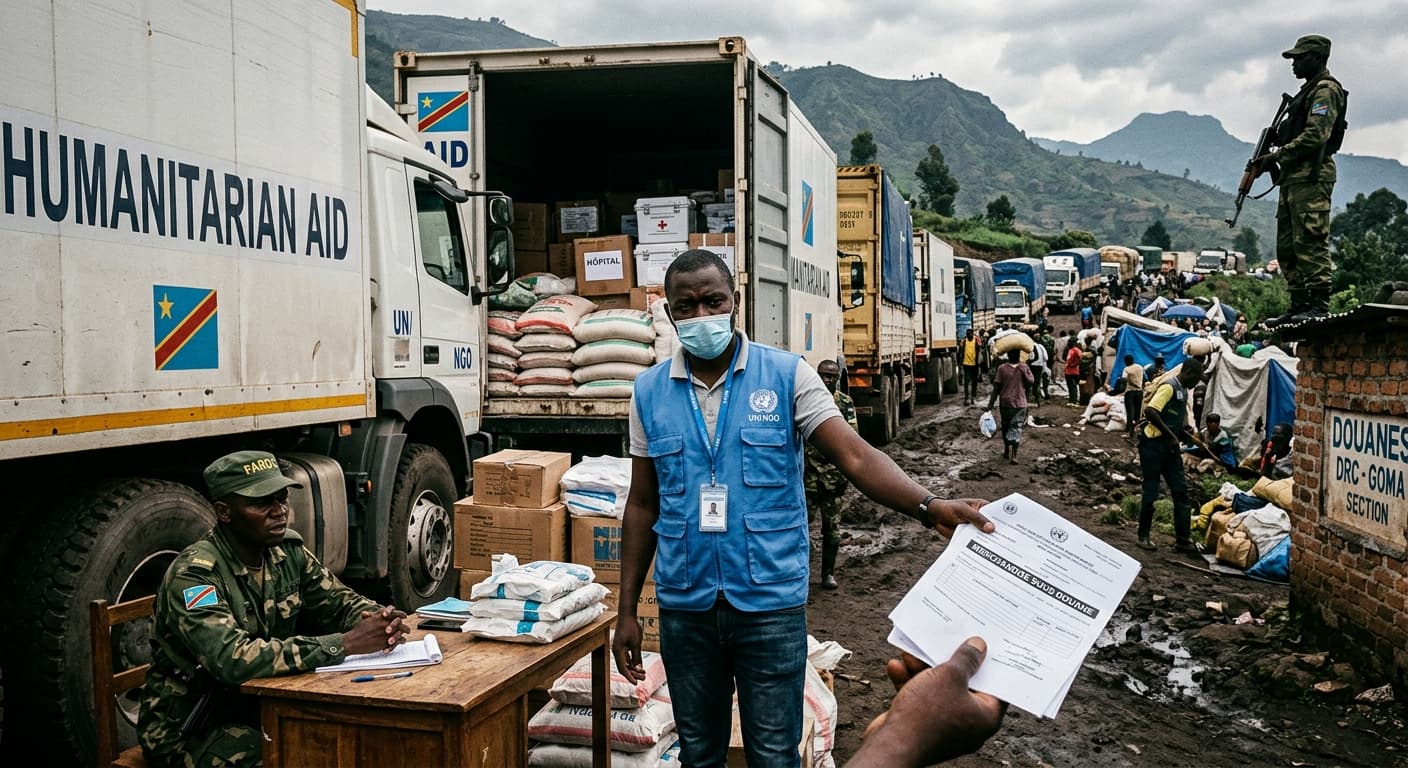
The Democratic Republic of Congo's humanitarian pipeline no longer runs on paperwork — it runs on parallel jurisdictions, and the biggest one is not the state. On paper, an NGO importing food or medicine clears goods through the Direction Générale des Douanes et Accises (DGDA), files a declaration on ASYCUDA World via the GUICE single-window, and claims an exemption anchored in Article 23 of the 2002 Investment Code or a headquarters agreement. In practice, since Kigali-backed M23 took Goma on 27 January 2025 and Bukavu on 16 February 2025, roughly one-third of the intended beneficiaries sit behind a rebel customs line that Kinshasa's DGDA cannot cross — and where, according to the International Crisis Group, the AFC/M23 is now pressing aid agencies to pay "tax" to its administration. The clearance file is now a political document.
The thesis is simple. Congolese humanitarian logistics is no longer a technical problem of forms and franchises; it is a two-state customs problem, and the transporters and NGOs who fail to grasp that are the ones whose containers sit on the tarmac.
The legal architecture — and where it stops working
Duty relief for humanitarian imports in the DRC rests on three overlapping legal instruments, none of which is self-executing. First, the 2010 Customs Code administered by the DGDA allows franchise regimes for "envois de secours" and temporary admission — the same categories the WTO's Trade Facilitation Agreement, ratified by Kinshasa, obliges members to fast-track under Article 7 on release and clearance. Second, the 2002 Investment Code, still cited by the US State Department's
2025 Investment Climate Statement, exempts approved projects from import duties on machinery, materials and equipment — but not from the 2% administrative fee or VAT (recoverable, in theory). Third, the accord-de-siège an international NGO signs with the Ministry of Foreign Affairs and its follow-on registration under
Law 004/2001 on non-profit associations unlocks case-by-case ministerial exemption letters ("lettre de franchise") signed by the Minister of Finance.
The gap between text and practice is quantifiable. An IMF technical assessment found DRC customs required a minimum of 22 days to prepare documents for goods to clear — before any humanitarian-specific dossier — and flagged that GUICE was not yet interconnected with ASYCUDA World, forcing manual re-entries. The 2024 IMF Article IV notes that discretionary exemption regimes cost the central government an estimated 5.7% of revenue, which is precisely why the finance ministry treats every NGO franchise letter as a fiscal loss to be scrutinised, not a right to be honoured. That scrutiny is the friction point where a container full of therapeutic food waits three weeks at Matadi.
What the pipeline actually looks like today
Aid enters the DRC through a short list of gateways, each with its own logistical grammar. The MONUSCO procurement expression of interest published on 21 January 2026 enumerates them for a reason: N'Djili (Kinshasa), Goma, Lubumbashi, Kisangani, Bunia, Bukavu, Beni, Matadi and Boma inside DRC, plus Entebbe, Kigali, Mombasa, Dar es Salaam and Durban as external transit hubs. The UN's own average is 1,980 tonnes of cargo moved per month for MONUSCO alone. Matadi handles the deep-sea inflow — recently upgraded by a
JICA-funded container terminal project worth 2.489 billion yen — and remains the single most important bottleneck for bulk food. Kinshasa's N'Djili takes airfreight for medicines and rapid-onset response.
Everything east of that is now contested. Goma airport has been closed to civilian and humanitarian aviation since 27 January 2025, when the WHO's Public Health Situation Analysis recorded that 70% of North Kivu health facilities were non-functional and five Mpox treatment centres evacuated. The airport's closure alone has pushed medical supply routes onto small aircraft into Kavumu (Bukavu) — itself now under M23 — or on to overland routes through Uganda (Kasese–Beni) and Burundi (Bujumbura–Uvira), each adding a border and a set of duties.

The M23 tax problem
The most consequential shift in Congolese humanitarian procedure is not a new decree. It is that a de facto second customs authority now sits between Goma's Grande Barrière and every warehouse in North Kivu. The Crisis Group's March 2026 briefing states plainly that AFC/M23 authorities are "pressing [aid workers] to pay 'tax' to their new administration," while Kinshasa is "wary of any organisation or group that is seen as legitimising the rebels' occupation." That leaves transitaires — the freight forwarders humanitarian agencies contract — with a compliance problem no manual solves: paying M23 risks violating EU and US sanctions regimes; refusing to pay risks the cargo. The
EU sanctions framework consolidated in December 2024 does carve out a humanitarian exemption for UN agencies, ICRC and NGOs participating in OCHA-coordinated response plans — but only for financial-flow controls, not for local extortion.
The cost is measurable at the roadblock. Human Rights Watch documented on 14 April 2026 that Wazalendo militias — nominally aligned with Kinshasa — had erected at least 10 barriers between Baraka and Fizi, each demanding 1,000 to 2,000 Congolese francs (US$0.43–0.86) per passage over a 130-km stretch. The tax is small per axle; multiplied across a WFP convoy of 20 trucks, it becomes a line item humanitarian donors are not allowed to reimburse.
The clearance dossier that still works — and the one that doesn't
For an INGO clearing goods through Matadi or N'Djili today, the operational checklist is unchanged from 2023 but each step now takes longer. It begins with the accord-de-siège or ministerial registration; then a project-specific exemption letter countersigned by the ministries of Finance and of Humanitarian Action; then an ASYCUDA World declaration filed by a licensed transitaire; then GUICE validation and DGDA inspection; then release. Even in the best case the World Bank's 2025 Subnational B-READY report documents "recurrent connectivity issues with the central GUCE bureau" and confirms that files move only after an "expected 'motivation fee'" is paid to agents — a discretionary payment humanitarian actors are also barred from making.
The dossier that no longer works is the one anchored solely on Kinshasa authority when the goods are destined for Goma, Bukavu, Minembwe or Rutshuru. There, the Bureau of the Coordination of Humanitarian Affairs has classified access as "severe," and MONUSCO withdrew entirely from South Kivu in June 2024 — a decision the Institute for Security Studies argues left a policing vacuum the UN mandate has not filled since the Council extended it to 20 December 2026.
The funding shock that reframes the procedure
The customs procedure question would matter less if the money were flowing. It isn't. The UN's Deputy Special Representative and Humanitarian Coordinator Bruno Lemarquis told reporters in early February 2025 — as reported by the BBC — that the DRC was "the largest recipient of US humanitarian assistance last year," with roughly 70% of the country's aid coming from Washington. A Cambridge academic study of eastern DRC's humanitarian sector,
published in the Review of International Studies, documented that Congolese aid workers were losing jobs by end-2025 as USAID contracts terminated, and that diversified-funding agencies were the only ones cushioned. The paradox is stark: as clearance procedures grew more complex, the money to navigate them shrank. The 2025 Humanitarian Needs and Response Plan targeting 11 million people carried an appeal of US$2.54 billion, per the
UN Peacebuilding Fund's country analysis; the 2026 plan targets 15 million, per the UN's
Spotlight on DRC page.
What the transitaire actually does — the best-practice stack
Practically, the humanitarian freight forwarders that still move volume in the DRC do five things right. They pre-file the exemption letter with DGDA regional offices before the shipment sails, not after. They keep an ASYCUDA World declarant on staff or under retainer — the country's
WTO Doha Programme review confirms Sydonia has been rolled out but the fracture numérique remains multidimensional. They route perishable and medical cargo through Kinshasa airfreight, not overland, to avoid multiple provincial DGRAD checkpoints. They pre-position stocks close to but outside contested zones — the modelling in
Baraka & Yadavalli's 2021 paper on Eastern Congo prepositioning is now standard practice at WFP and UNHAS. And they document every unofficial payment demanded, so their donor audit trail survives a US Treasury OFAC review of any funds that touched M23 territory.
The State Department's summary of the June 2025 DRC–Rwanda Peace Accord explicitly requires the parties to "create conditions conducive to the delivery of emergency relief and guarantee humanitarian agencies free, safe, unhindered and unconditional access" — with Congolese local authorities named as responsible, "under the supervision of the central government of the DRC." The document is legally binding on Kinshasa and Kigali. It is not binding on the M23 administration in Goma, which is not a signatory.
What to watch
- The next UNSC session on DRC (mandate expiry 20 December 2026): whether the Council conditions MONUSCO's remaining envelope on M23 humanitarian corridors — the point
Amnesty International pressed after Goma fell.
- Goma airport: any reopening announcement — closed since 27 January 2025 — would collapse airfreight costs for the entire eastern response. Expect the AFC/M23 to seek recognition as a precondition.
- US Treasury OFAC guidance: after the
6 July 2026 sanctions on Gasabo Gold Refinery and affiliated Kalima entities, watch whether OFAC clarifies whether transitaire payments at M23-controlled crossings count as prohibited transactions with a sanctioned group.
- The 2026 HRP shortfall: the funding gap that opened when Washington cut aid in January 2025 has not closed. If donors do not fill it before Q4 2026, the customs question becomes moot for the 4 million newly displaced people the
SIPRI climate-security assessment documented in eastern Kivus.
The Bottom Line
The bottom line: clearing humanitarian goods in the DRC is no longer a customs procedure — it is a sovereignty negotiation conducted through freight forwarders. Kinshasa's DGDA still controls the paperwork at Matadi and N'Djili, but M23's parallel administration now controls the last mile to the people who most need the cargo, and the transitaires caught between them are the pressure point the Washington Accord did not resolve. Until Goma's airport reopens and the informal "tax" at eastern checkpoints is either legalised or eliminated, every 22-day clearance timeline the IMF measured is a floor, not a ceiling.
Discover more

US Politics
White House Pressures Congress for Crypto Leg
The Trump administration's push for the CLARITY Act aims to reshape crypto regulation, impacting trillions in market value and the Trump family's wealth.
US Politics
U.S. House Passes Alert Act for Aviation
The House passed the ALERT Act 396–10, replacing the ROTOR Act after Pentagon intervention, impacting aviation safety regulations.

India
Yamini Aiyar on Modi's Federalism Shift
Yamini Aiyar critiques Modi's shift from equity-based to performance-based federalism, highlighting implications for India's political landscape.

Conflict & Security
Drone Warfare Killing Aid Workers at Unprec
Over 1,000 humanitarian workers killed in three years as cheap armed drones collapse legal protections. Gaza, Sudan, Ukraine, and DRC see deliberate targeting of aid convoys and hospitals with zero prosecutions.