Why Delhi Police Retreated From Confronting ‘Cockroach’ Protesters
India’s security apparatus chose facilitation over force at Jantar Mantar, signaling acute political risk as exam-leak anger spreads among middle-class youth.
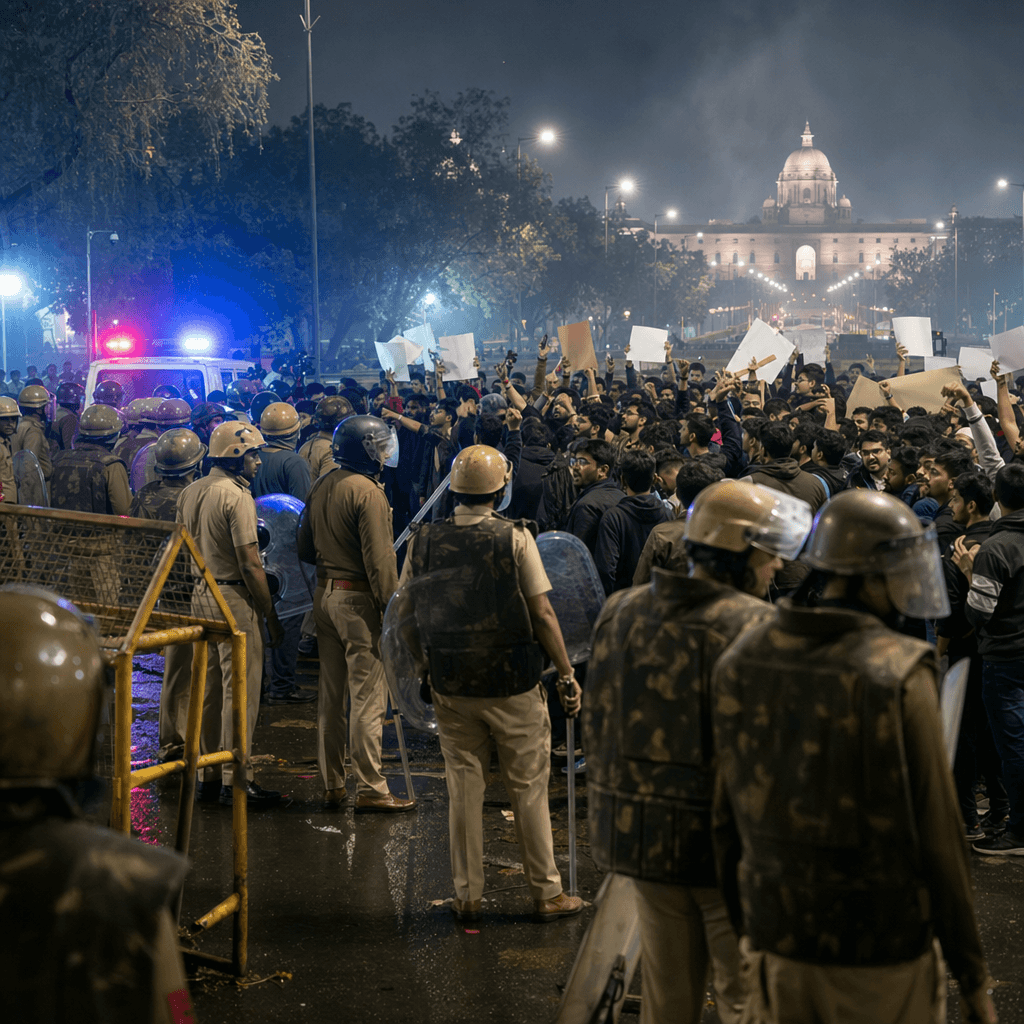
On June 6, 2026, the Delhi Police executed a rare tactical pivot by choosing coordination over their typical coercive blueprint during a massive youth protest in the capital. According to  The Indian Express, senior police officials issued strict interior directives to avoid any confrontation with thousands of demonstrators aligned with the satirical Cockroach Janta Party (CJP). Instead of employing the barricades, razor wire, and water cannons frequently deployed in the
  international hub against opposition marches, security forces facilitated safe passage for CJP founder Abhijeet Dipke directly from Indira Gandhi International Airport to Delhi's designated protest site.
The Leverage of 22 Million Followers
The state’s sudden restraint is a calculation driven by a rapid power shift. Born just weeks ago as an online parody of a judicial comment that compared unemployed youth to "cockroaches," the CJP has transformed into a political juggernaut, commanding over 22 million Instagram followers—nominally surpassing the ruling Bharatiya Janata Party’s (BJP) own social reach, as documented by  Al Jazeera. This digital scale completely changes the risk-reward calculus of physical state repression. Peaceful, middle-class students protesting systemic failures in the national NEET medical entrance exams are highly sensitive targets; a heavy-handed crackdown would trigger catastrophic blowback for the federal government. By permitting the assembly, the Home Ministry insulated itself from viral outrage while attempting to defuse a highly volatile student movement.
Winners, Losers, and Strategic Restraint
This tactical accommodation stands in stark contrast to previous policing patterns in the capital. For instance, when Ladakh-based educationalist and environmentalist Sonam Wangchuk attempted a march to Delhi in late 2024, he was promptly detained at the city's border, as reported by  BBC News Hindi. On Saturday, however, Wangchuk stood freely alongside Dipke at Jantar Mantar, demonstrating how the CJP has united highly respected mainstream activists with Gen-Z digital organizers. Under this dynamic, the CJP leadership emerges as the clear winner, successfully converting virtual memes into concrete, street-level negotiating power. The primary loser is Union Education Minister Dharmendra Pradhan. By allowing the protests to proceed without state-backed disruption, federal authorities have effectively isolated Pradhan, leaving him to absorb the absolute brunt of the public's anger over academic corruption.
What to Watch Next
The immediate decision point hinges on how long the state will tolerate an open-ended demonstration in the heart of New Delhi. Dipke has publicly declared that his supporters will occupy Jantar Mantar until Pradhan resigns. While Delhi's official guidelines generally restrict protests at the site to 1,000 participants and require seven days' advance permission, as detailed by BBC News Hindi, police have actively bent these rules to avoid friction. Keep a close eye on whether the BJP leadership forces a cabinet reshuffle in the coming days to quietly eliminate the source of the friction, or whether they eventually resort to late-night evictions once national media attention begins to drift.