De La Espriella's Ultimatum on ELN in Catatum
Colombia's new president targets ELN with a 30-day ultimatum.
Model Diplomat7 min readLatin America
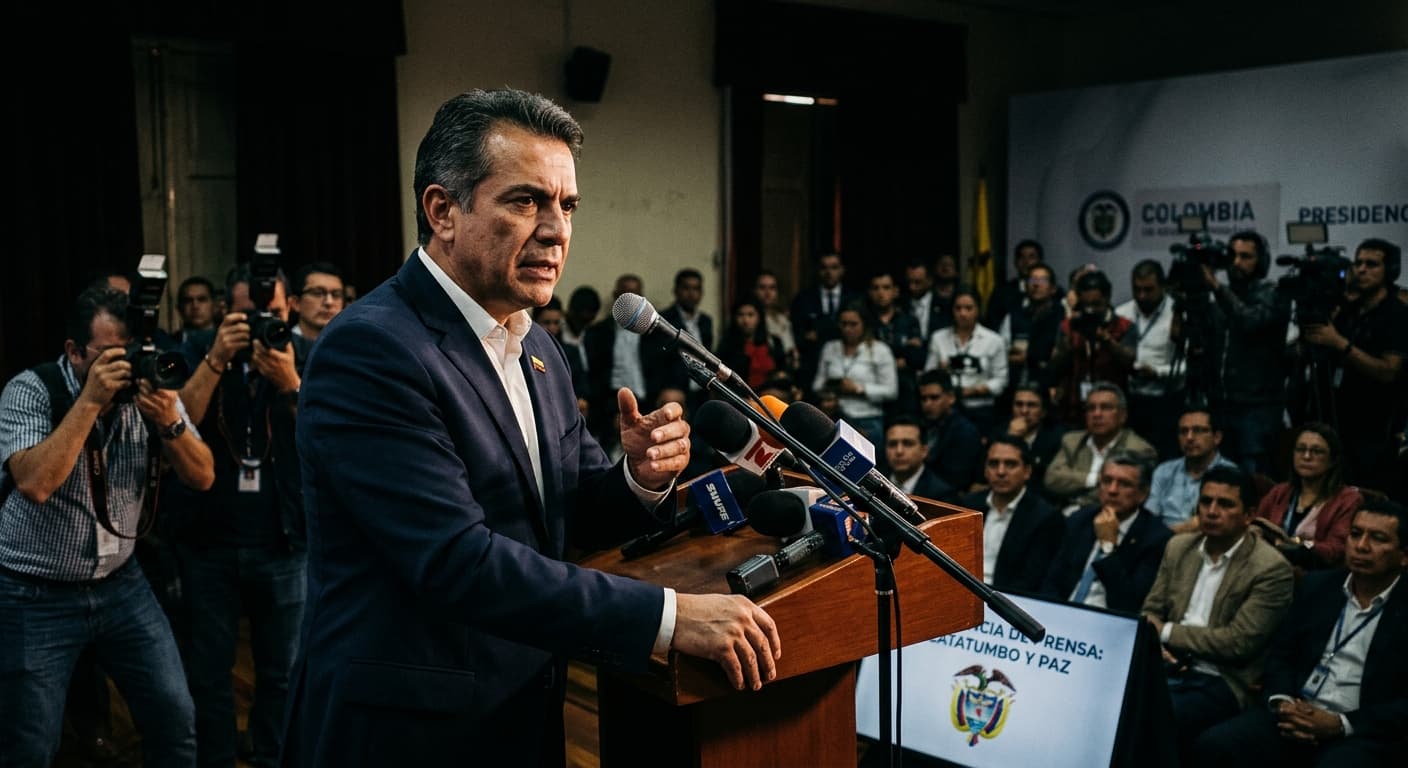
De La Espriella's Catatumbo ultimatum: Colombia's new war on the ELN
Colombia's president-elect gave the ELN and Frente 33 thirty days to surrender before his August 7, 2026 inauguration — reversing Petro's "total peace" and opening a US-aligned front on the Venezuelan border.
On July 8, 2026 in Cúcuta, Colombia's president-elect Abelardo De La Espriella declared the top commanders of the National Liberation Army (ELN) and the Frente 33 FARC dissidents "military objectives," gave them thirty days to surrender, and instructed his defense minister designate to reactivate every outstanding arrest warrant the moment he takes office on August 7. The move formally buries Gustavo Petro's "paz total" and turns Catatumbo — a coca-and-cocaine corridor on the Venezuelan border where roughly 100,000 people have been displaced since January 2025 — into the opening theatre of a US-backed counter-cartel campaign that will define Andean security for the next four years.
According to Semana, De La Espriella singled out "alias Alfred," commander of the ELN's Frente de Guerra Nororiental, and "alias Andrey," head of the FARC-dissident Frente 33. "Tienen un mes para entregarse; de lo contrario, vamos a ir por ustedes y les vamos a dejar caer todo el peso de la ley y del Estado de derecho," he told reporters at the end of his first regional handover meeting in Norte de Santander, according to
La FM. At the same event, incoming defense minister Gen. (r) Jorge Enrique Mora announced that on August 7 "se reactivan todas las órdenes de captura para todos los cabecillas del nivel nacional."
Why Catatumbo, and why now
Catatumbo is not a symbolic choice. It is the single most concentrated humanitarian collapse in Colombia since the 2016 peace accord. UN OCHA reported that by March 2025 the ELN's offensive against Frente 33 had affected 91,879 people; one year later, the UN Verification Mission put cumulative displacement at
roughly 100,000 — about half the region's population. The UN humanitarian coordinator released $3.8 million from CERF in the emergency's first weeks; 38 NGOs later suspended operations when the Trump administration froze US humanitarian assistance, cutting projected access for another 120,000 people,
UN News reported.
The Fundación Ideas para la Paz estimates the ELN's Nororiental Front now fields about 2,000 combatants against roughly 500 Frente 33 fighters, with drones increasingly used against civilians — the Defensoría del Pueblo has documented nine civilians killed by drone-launched explosives. Catatumbo is also the only Colombian department where coca cultivation has consistently expanded, according to
UNODC monitoring data, with national coca area reaching a record 253,000 hectares in 2023 and potential cocaine production hitting 2,664 tons.
For De La Espriella, this is the ideal opening battlefield: a discrete geography, a discredited peace process, a binational enemy in the ELN — which Colombian analysts describe as an "ejército binacional" operating in tandem with Venezuelan security forces, per BBC Mundo — and a civilian population desperate enough to accept a militarized state return.
The Petro inheritance he is dismantling
The evidence that "paz total" has collapsed is now unambiguous, even from its sympathizers. The FIP's January 2026 balance found that armed-group membership grew 23.5% in a single year, passing 27,000 combatants and support personnel across 13 active dispute zones — nearly double the number at the start of Petro's term. Displacement rose 85% in 2025, kidnapping 133%, attacks on medical missions 142%. The International Crisis Group concluded that Petro's ceasefires
"put security forces at a major disadvantage and led to a loss of state control" in wide swaths of the country.
Petro himself acknowledged in January 2025 that "the state failed" in Catatumbo, and reactivated arrest warrants against 31 ELN commanders, BBC reported. His late-term military ramp-up — the Fuerza Pública moved from 174 to
234 major operations between 2024 and 2025 — produced the December 2025 bombings that killed at least 15 minors in Amazonas, Guaviare and Arauca, provoking a Constitutional-level clash with the Ombudsperson's office, according to
BBC Mundo. Petro's own strategy had drifted, as FIP put it, from "peace territorial" to "peace político-militar" to what it now calls a "peace electoral" — never coherent, never articulated with a security policy.
De La Espriella won on that failure. His 0.96-point runoff margin over Iván Cepeda on June 21, 2026 — about 250,000 votes out of nearly 13 million cast, the narrowest in modern Colombian history according to BBC — was small, but the mandate on security is not. Cepeda offered continuity with Petro's negotiated approach. De La Espriella promised the opposite: ten Bukele-style megaprisons, extended sentences, shoot-down authority on suspected narcotics aircraft, US military bases on Colombian soil, and no negotiation.
The Washington vector
This is the piece the wire copy has missed. De La Espriella is not merely reversing "paz total" — he is grafting Colombia onto Donald Trump's "Shield of the Americas," the counter-cartel coalition Trump launched in Doral in March 2026 and which had, notably, excluded Colombia, Mexico and Brazil. At Doral, Trump told regional leaders: "The only way to defeat these enemies is by unleashing the power of our militaries. So we have to use our military. You have to use your military." De La Espriella has publicly accepted the invitation to join, and Ecuador's Daniel Noboa lifted retaliatory tariffs on Colombia within a week of his victory in return for a promise of joint cross-border operations,
BBC reported.
The Atlantic Council's assessment of Shield of the Americas is instructive: the initiative's core weakness is that "cartels succeed not primarily because of military capability, but because governance gaps allow transnational organized crime groups to infiltrate police forces, judicial systems, and political parties," the Council wrote. Colombia's problem in Catatumbo is textbook governance vacuum, not primarily firepower.
That matters because De La Espriella's own advisers acknowledge capacity constraints. Analyst Kyle Johnson-adjacent researchers cited by Al Jazeera noted before the election that "the Colombian state does not currently have the trained personnel and operational capacity to carry out large-scale military operations across the country," and that key planks of the platform — life imprisonment, mass trials — have previously been struck down by the Constitutional Court. Colombia's Penal Code and the Corte Constitucional's Sentence C-225/95 embed Protocol II of the Geneva Conventions with constitutional rank, per Colombia's
official filing with the UN General Assembly Sixth Committee, which forbids treating civilian objects as military objectives and requires proportionality in every strike.
What "objetivo militar" really means
The president-elect's language matters legally. Declaring named individuals "military objectives" is not, in itself, a violation — under international humanitarian law, members of an organized armed group with a continuous combat function can be lawfully targeted in a non-international armed conflict. Colombia's Constitutional Court has repeatedly held that IHL applies to state operations against the ELN and FARC dissidents. What is legally fraught is the political framing: a 30-day surrender ultimatum implies a threshold event on day 31, and any operation that follows will be tested against Protocol II's principles of distinction and proportionality — the same standard on which Petro's December 2025 bombings are now being challenged.
Human Rights Watch, which spent 2025 documenting ELN and Frente 33 abuses in Catatumbo — killings, disappearances, forced child recruitment — has also warned that any policy shift must clear the accountability standards embedded in the 2016 FARC accord and Colombia's cooperation agreement with the ICC Office of the Prosecutor. De La Espriella has promised to dismantle the Jurisdicción Especial para la Paz. That fight is coming.
Diplomat View
De La Espriella's Catatumbo ultimatum is not primarily a military plan; it is a signalling operation aimed at three audiences at once — Washington, Caracas and the Colombian center that gave him a one-point margin. The forecast: expect visible strikes on Frente 33 in Tibú and El Tarra within 60–90 days of inauguration, a joint operational memorandum with US Southern Command by year-end, and a legislative push to gut the JEP that will be blocked or diluted by the Pacto Histórico-led Congress. What will not happen: the strategic defeat of the ELN. Its Frente de Guerra Nororiental's rear guard sits inside Venezuela, and neither Bogotá nor Washington has a workable answer for that sanctuary short of the kind of extraterritorial operation Trump used against Maduro in January 2026. If ELN attacks migrate to Cúcuta and Bogotá in retaliation — the pattern in the 2020 ELN "paro armado" — De La Espriella's honeymoon ends fast. Revise the forecast if: the Constitutional Court fast-tracks a ruling blocking life-imprisonment or mass-trial statutes; the JEP formally opens proceedings against incoming security officials for past conduct; or Venezuela's post-Maduro transition produces a government willing to expel ELN cadres. Any one of those would reset the strategic map.
What to watch next
- August 7, 2026: Inauguration at a military garrison. Gen. Mora's blanket reactivation of arrest warrants against ELN, EMC, EMBF and Clan del Golfo leaders takes effect the same day.
- September 8, 2026: The 30-day ultimatum expires. First test of whether "military objective" translates into strikes on 'Alfred' and 'Andrey'.
- October 2026: Congressional session opens with a fragmented legislature. Watch the Ministry of Justice bill designated to replace the "paz total" legal framework — the incoming justice minister has already announced it.
- December 2026: Brazil's presidential runoff. A right-wing win would bring the second largest cocaine-transit country into Shield of the Americas and change the regional geometry entirely.
The Bottom Line
De La Espriella's Catatumbo ultimatum ends the era of "paz total" and re-anchors Colombia inside Trump's Shield of the Americas — but the enemy it names lives across a border Bogotá cannot cross, in a criminal economy that grew 85% under the very approach he inherited. The next four years will be judged not by whether alias Alfred and alias Andrey surrender by September 8, but by whether the Colombian state can rebuild governance in the 13 dispute zones Petro is leaving behind. On current capacity, the honest forecast is that the war widens before it narrows.
Discover more

US Politics
House Ethics Committee Pushes Sexual Miscond.
The House Ethics Committee has shifted responsibility for sexual harassment settlement records to the Office of Congressional Workplace Rights, complicating disclosure efforts.
US Politics
Congress Targets AI Chatbot Access for Terror
The House passed the Generative AI Terrorism Risk Assessment Act, focusing on AI's role in terrorism and potential surveillance implications.

US Politics
SNAP Food Assistance Faces Legal Challenges
In 2026, SNAP faces stricter eligibility rules and mounting legal challenges, threatening food assistance for the millions of Americans who rely on the program.

Conflict & Security
Drone Warfare Killing Aid Workers at Unprec
Over 1,000 humanitarian workers killed in three years as cheap armed drones collapse legal protections. Gaza, Sudan, Ukraine, and DRC see deliberate targeting of aid convoys and hospitals with zero prosecutions.