De La Espriella's Governance Begins in Crisis
Colombia's new president tests institutions with bold decrees.
Model Diplomat8 min readLatin America
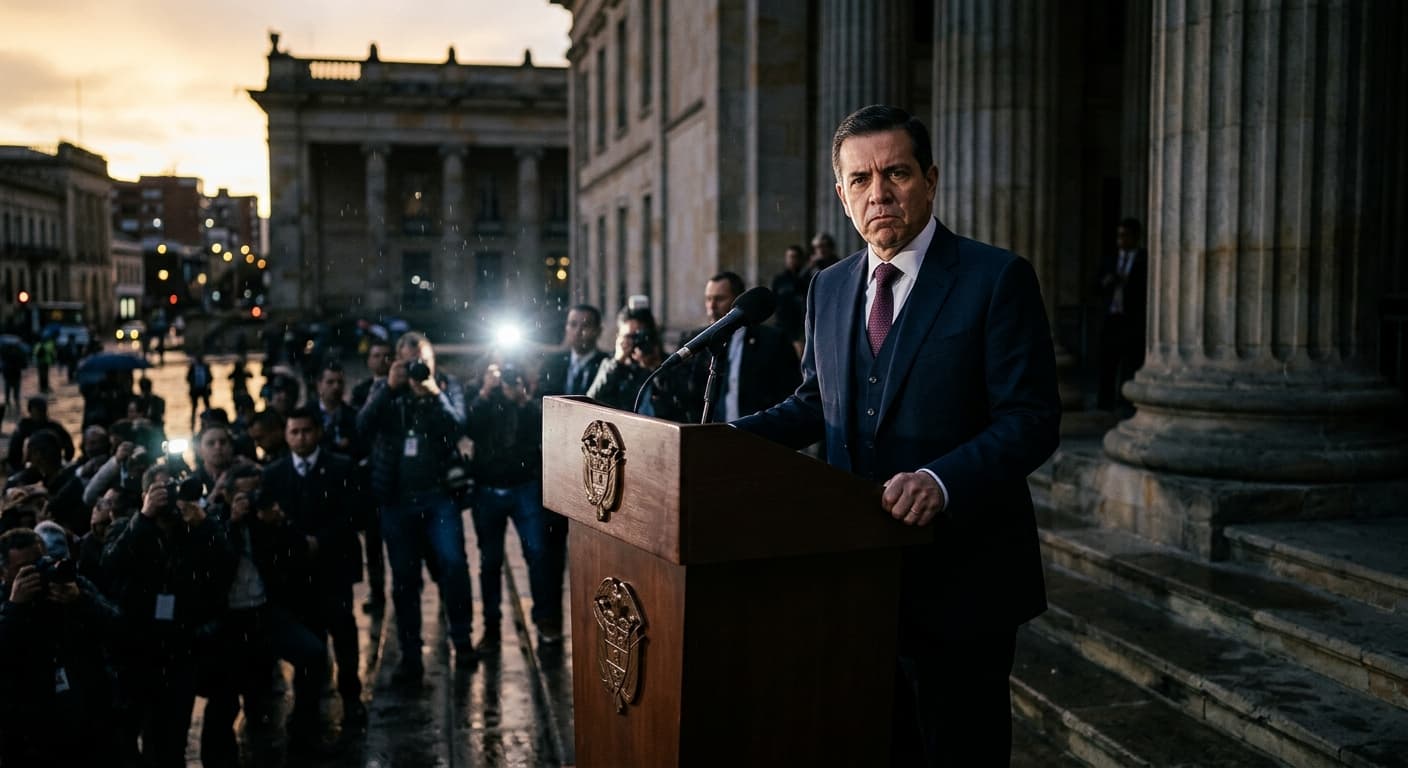
De La Espriella's first decrees test Colombia's institutions
Colombia's president-elect Abelardo De La Espriella opens governance with spending-cut decrees, a Washington debt mission and a 90-day security shock — and a divided Congress that will decide how far he goes.
Colombia's president-elect Abelardo De La Espriella used his second Sunday livestream on July 5, 2026 to instruct his designated finance minister, Miguel Gómez Martínez, to draft decrees cutting "unnecessary" public spending and lowering the tax burden, dispatch a delegation to Washington to renegotiate sovereign debt, and open 32 regional transition reviews beginning in Cúcuta on the Venezuelan border. The load-bearing claim of this feature is simple: the package looks technocratic on paper, but it is designed to concentrate policy authority in the executive before an unfriendly Congress can push back — and its success or failure will decide whether Colombia consolidates a Bukele-style illiberal turn or reverts to the checks that have historically restrained its right.
De La Espriella, elected on June 21 by 49.7% to 48.7% over left-wing senator Iván Cepeda, took office-elect on the narrowest margin in Colombian presidential history, according to Al Jazeera. He inherits, on August 7, a country the IMF describes as fiscally stressed and a Congress in which the Pacto Histórico of outgoing president Gustavo Petro remains the largest single bloc. Everything he announced this week is meant to move around that arithmetic — not through it.
The fiscal opening: decrees first, Congress later
The economic package announced on Caracol Radio has two components that are being underplayed. First, the vehicle is a set of presidential decrees rather than a tax bill — a sequencing choice that lets Miguel Gómez Martínez cut spending on Day One without Congress. Caracol Radio reported that De La Espriella ordered the minister-designate to prepare a "paquete de decretos" aimed at reducing spending and lightening the tax burden. Second, the delegation heading to Washington to refinance public debt is led by the same finance minister-designate, giving him a mandate that fuses fiscal policy with foreign relations from the outset.
The macro backdrop justifies the urgency, but not the method. According to the IMF's 2025 Article IV Consultation, Colombia's central government deficit widened to 6.7% of GDP in 2024, gross public debt reached 61.2% of GDP, and the government activated the fiscal rule's escape clause through 2027. IMF directors flagged that the policy framework has "weakened considerably" from the "very strong" rating required for continued qualification for the Flexible Credit Line, and the Atlantic Council notes the Fund
suspended Colombia's US$9.8 billion FCL access in 2025 over precisely those concerns. Two of the three major agencies downgraded Colombia to high-yield.
That gives the incoming government real cover to consolidate. It also creates a tension the president-elect has yet to explain: the IMF's own path to restore the fiscal rule by 2028 requires a structural adjustment of more than three percentage points of GDP, built on both spending and revenue measures. De La Espriella has committed publicly only to the spending side and to tax relief. Restrepo, his vice president and a former Duque finance minister, will know that math. Analyst Patricia Muñoz of Javeriana University told
Al Jazeera that "alarm bells are already ringing regarding the resources the state will have at its disposal" for any ambitious program.
The Washington mission is the second-order play. Debt-refinancing conversations with the US Treasury and multilaterals give the new government a domestic story of "renegotiation" while, in practice, tying Bogotá to a US administration that has already made Colombia a strategic priority. The US Congressional Research Service, in its June 2026 In Focus, notes that De La Espriella has vowed to join President Donald Trump's "Americas Counter Cartel Coalition" and "Shield of the Americas" initiatives — commitments that will make lower borrowing costs politically cheaper in Washington than they were under Petro.
The environmental fig leaf, and what it hides
The environmental announcements are calibrated. De La Espriella instructed his designated environment minister, Fabio Arjona — long the director of Conservation International Colombia — to strengthen protection of páramos and national water heritage, and to develop a national animal-protection system, per Caracol Radio's reporting. Arjona is a technically respected figure whose scholarly work has focused on cloud-forest hydrology, according to a co-authored study in
Ecosystem Services.
That appointment is doing two jobs. It buys credibility for a government whose platform, as summarised by CIDOB, promises to "revise the mining-energy policy to make renewable generation compatible with extractivism — hydrocarbons included." The páramo and water-heritage rhetoric is genuine — Colombia's Constitutional Court has long protected páramos from mining, and any incoming president must at least gesture toward that jurisprudence. But animal welfare and páramo defence are also cheap wins that let De La Espriella pivot investor messaging toward reopening oil and gas exploration, which Petro paused in 2022. The Atlantic Council's Kristie Pellecchia Loiacono argued in its
expert reaction that "a coherent energy strategy" is now the single condition for capital flows to return, after Colombian FDI dropped 33% from 2022 to 2025.
Empalme as instrument
The 32 regional transition reviews, starting July 8 in Cúcuta, are being framed as anti-corruption housekeeping. They are more than that. Alongside the national empalme process, the president-elect has already announced what he calls the discovery of "hundreds of irregularities" in Petro's government and pledged criminal complaints from day one, according to BluRadio. El Espectador
documented that the president-elect's second live broadcast singled out fiscal management, "paz total" and the health system as the three domains of alleged malfeasance.
Two things are worth noticing. First, starting in Cúcuta is deliberate: it is the country's principal crossing with Venezuela, ground zero of the migration, ELN and Clan del Golfo problems that give De La Espriella his political mandate. The empalme there will produce evidence for a security operation, not just an administrative handover. Second, "empalme anticorrupción" — his term — has become the vehicle for delegitimising the outgoing government's institutional appointments before they leave office. It is the same rhetorical move Nayib Bukele used in El Salvador to justify replacing attorneys general and constitutional judges in his first months.
The pushback is coming. Petro announced on July 6 that he would call Colombians into the streets on July 20 — the country's independence day — to defend his reforms and stage his public farewell, per Caracol Radio. That gives the outgoing president two weeks to mobilise a base that still delivered 48.7% of the runoff vote.
The democratic-restoration frame is the wrong one
Washington's default reading — echoed by Jason Marczak of the Atlantic Council's Adrienne Arsht Latin America Center, who called the election a "welcome return" to the traditional US-Colombia relationship — treats De La Espriella's win as a course correction after Petro's constitutional overreaches. That reading is not wrong on the specifics. Petro did try to bypass Congress on labour reform via presidential decree in June 2025; the Council of State suspended the decree; the Senate later approved the reform, as Carnegie's field study documented. Colombian institutions worked.
The question is whether they will keep working under a president who, per Al Jazeera's reporting, has filed dozens of legal complaints against journalists, proposed withdrawing Colombia from the United Nations, and framed sovereignty as rejection of oversight by the Inter-American Court of Human Rights. Security analyst Jorge Mantilla, quoted in the same piece, calls this "something more radical than Uribismo… a non-institutional right wing that often sees journalism as an obstacle."
The BBC's Spanish service noted that De La Espriella has been likened to leaders whose parties "in every election say they accept the Constitution, but then change it in their image." His campaign was financed in part through his personal wealth, though a
La Silla Vacía investigation — reported by BBC Mundo — found that many of the 35 companies he claims are dissolved, in debt, or losing money, and 11 US Democratic congressmembers formally asked the State Department, DOJ and Treasury to investigate the origin of funds behind his US investments.
None of that guarantees democratic backsliding. It does mean the framework Washington and multilateral lenders are using — that "the adults are back" — understates the risk. Colombia's Constitutional Court has repeatedly struck down life imprisonment provisions and heavily limited aerial glyphosate fumigation, both centrepieces of the security platform. The confrontation between the president-elect's decree-first approach and the Court's jurisprudence is the story to watch, not the cabinet's pedigree.
Regional geometry: Venezuela, the US, and the coca frontier
The debt-refinancing mission to Washington is the visible layer of a broader alignment. De La Espriella has US citizenship since 2023 and, per BBC News, is a donor to the Republican Party. His pledge to launch a 90-day US-backed air campaign against dissident groups, if executed, would mark the deepest Colombian re-embed with US counter-narcotics operations since Plan Colombia. It would also, by design, complicate any Petro-era rapprochement with Caracas. Petro reopened the Colombia-Venezuela border in 2022 and restored trade,
BBC Mundo reported, and Venezuela is now again Colombia's neighbour of security consequence — the border where the ELN, dissident FARC factions and Tren de Aragua contest territory.
The president-elect's team appears to have calculated that a hard Venezuela line will earn Washington's fiscal indulgence. That is a bet. Trump's own Venezuela policy has been transactional, and De La Espriella has less leverage than Petro to broker any transition in Caracas. The Colombian defence establishment — now under retired general Jorge Eduardo Mora López, named this week per Caracol Radio — will have to deliver operational results in the first six months to keep the political story of restoration alive.
Diplomat View
The bet here is not economic and not environmental. It is procedural. De La Espriella is trying to govern by decree in the first 90 days to lock in fiscal cuts, security operations and a Washington realignment before a Congress dominated by Petro's Pacto Histórico can organise resistance and before the Constitutional Court is asked to test the boundaries of executive authority. If Restrepo and Miguel Gómez Martínez can deliver a credible fiscal package that revives IMF Flexible Credit Line access, foreign direct investment will rebound and the democratic-backsliding narrative will lose oxygen — that is our base case for the next 12 months.
The forecast changes if two things happen: the Constitutional Court strikes down early security decrees, forcing De La Espriella to legislate through a hostile Congress; or the 90-day military campaign produces a mass-casualty event that resurrects the human-rights critique Petro leveraged in 2022. Either would tip Colombia from a right-wing restoration into an institutional confrontation of the kind Peru and El Salvador have already lived through. What we would not bet on is a return to the pre-2022 status quo. That country is gone.
What to watch
- July 8, 2026 — Regional empalmes open in Cúcuta; watch the security and border framing.
- July 20, 2026 — Petro's independence-day mobilisation is the outgoing government's leverage test.
- August 7, 2026 — Inauguration and the first tranche of decrees on spending and taxes; the Constitutional Court challenges will follow within weeks.
- Late 2026 — IMF decision on any restored Flexible Credit Line access, contingent on Restrepo's fiscal package.
Read today's full |
Discover more
India
Rajnath Singh's Durga Squad for 2026 Polls
Rajnath Singh's Durga Squad promised women's safety in Bengal but has since disappeared from the agenda, revealing BJP's true priorities.
India
Congress Accuses Modi of Stalling Women's Law
Congress accuses Modi of stalling women's reservation law by linking it to delimitation, revealing a deeper electoral strategy.
Global Politics
Trump's Conflicting Messages on Iran War
Trump's mixed messages on Iran reflect a strategy of audience management, benefiting Tehran amid a complex geopolitical landscape.

Conflict & Security
Drone Warfare Killing Aid Workers at Unprec
Over 1,000 humanitarian workers killed in three years as cheap armed drones collapse legal protections. Gaza, Sudan, Ukraine, and DRC see deliberate targeting of aid convoys and hospitals with zero prosecutions.