De la Espriella Freezes Colombia Transition
Political standoff escalates before inauguration
Model Diplomat8 min readLatin America
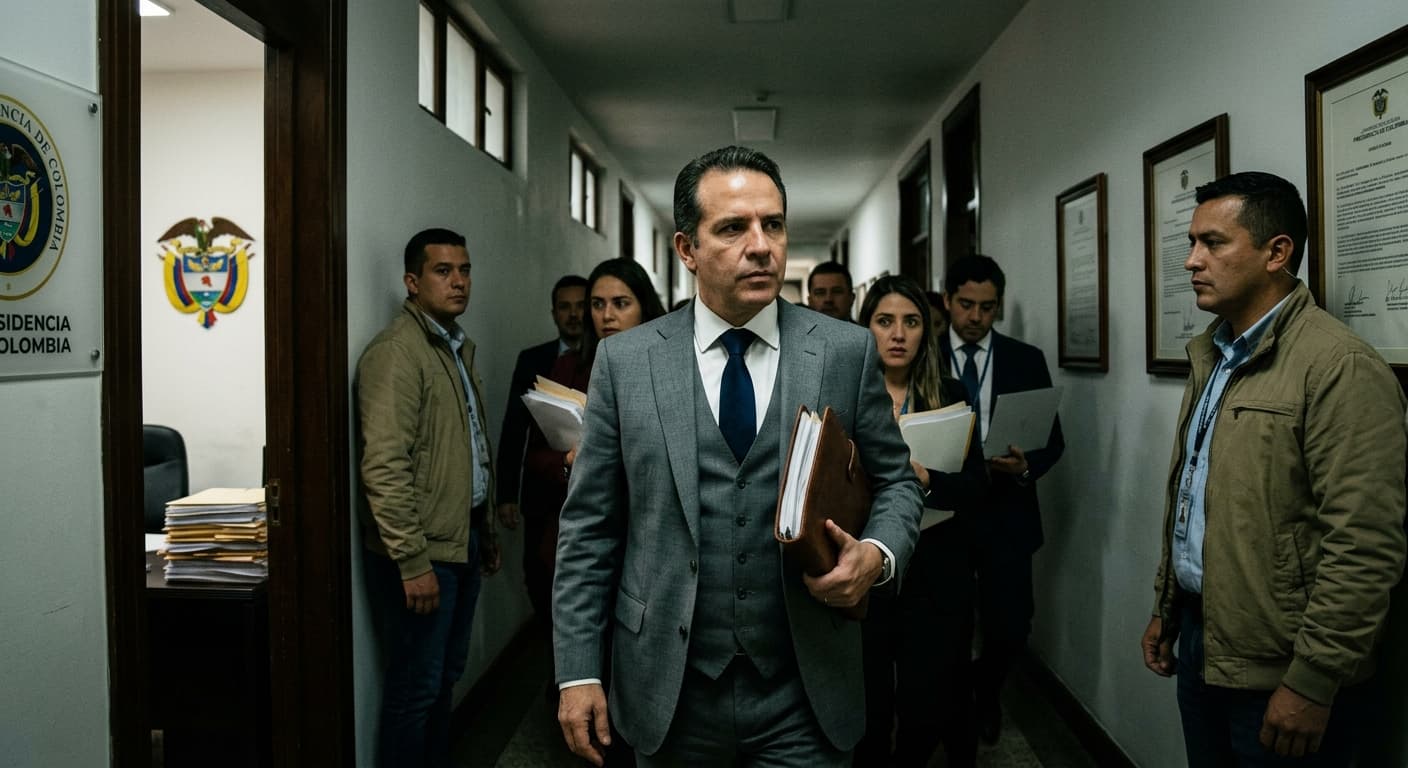
De la Espriella Freezes Colombia Transition, Threatens Petro Prosecution
Colombia's president-elect Abelardo de la Espriella suspended the empalme with Gustavo Petro on July 7, 2026 — turning a routine handover into an anti-corruption stand-off one month before inauguration.
Colombia's president-elect froze the constitutional handover of power on July 7, 2026, ordering his vice-president to suspend all transition meetings with Gustavo Petro's cabinet and reframing the empalme as an "anti-corruption audit" that will end in criminal referrals against the outgoing government. The rupture, announced by Abelardo de la Espriella on X and confirmed within 90 minutes by Finance Minister Germán Ávila, converts the four-week runway to the August 7 inauguration into a legal and institutional cliff — and it hands De la Espriella the political frame he wants for day one: not "successor," but prosecutor. That is the story. The empalme is not being paused for logistics. It is being weaponised.
According to EL PAÍS, which broke the story on Tuesday morning, De la Espriella wrote: "Acabo de darle instrucciones al señor vicepresidente electo de la República para que suspenda de manera inmediata el proceso de empalme con el gobierno corrupto que termina su periodo." The vice-president in question is José Manuel Restrepo, an economist who served as Iván Duque's finance minister and had been leading working-level talks with Ávila since the last week of June. Those talks had, until Tuesday, "advanced con normalidad" despite the political tension around them.
The rupture, in specifics
The empalme in Colombia is not a courtesy. It is a legally regulated inventory of budgets, contracts, staffing, litigation and classified files that the sitting cabinet is obliged to deliver to the incoming one, a process anchored in the country's public-administration statutes and coordinated by the Procuraduría. Skipping it is not illegal, but it strips the incoming government of the paper trail it needs to execute policy on August 8.
De la Espriella's team is not walking away from that information — it is renaming it. On Sunday July 5, in his second weekly address as president-elect, De la Espriella told Colombians the transition had already surfaced "cientos de irregularidades," per Infobae, and announced a "Comité de Empalme Anticorrupción" whose stated mission is to "identify, document and denounce, without fear or contemplation, any focus of corruption." He offered three headline findings: a fiscal "bomb," failures of the paz total policy, and a "humanitarian crisis" in the health system. He named no officials and produced no documents.
Ávila's counter-move — reading a letter to Procurador General Gregorio Eljach on national radio requesting oversight of the empalme, and then declaring that data would be delivered "to citizens" rather than to De la Espriella's team — is the first sign that the outgoing government intends to treat the incoming one as an adversary in the courts, not a successor in the ministries. Ávila also called out a specific member of De la Espriella's committee, Carlos Alonso Lucio, a former M-19 comrade who has publicly demanded Petro's prosecution.
The angle: this is not about corruption, it is about the courts
The Petro-era numbers give De la Espriella real material to work with. Colombia's central-government deficit blew out to a projected 7.1% of GDP in 2025, according to the IMF Article IV staff report published in September 2025, after the government invoked the fiscal-rule escape clause to suspend Colombia's anchor policy framework through 2027. Two of the three major rating agencies pushed Colombia into high-yield territory during Petro's term, and on October 1, 2025 Bogotá cancelled its $9.8bn Flexible Credit Line arrangement, per the
IMF, after directors concluded the country no longer met the "very strong" policy bar the FCL requires. The
Atlantic Council frames this as a structural inheritance problem: "persistent deficits, public spending, suspension of the fiscal rule, tax-revenue shortfalls… gave investors serious pause."
So the fiscal "bomba" is not fabricated. But suspending the empalme does not defuse it — it accelerates a different clock. De la Espriella's move signals three things to three different audiences:
- To the Fiscalía and the Procuraduría, that his government intends to open criminal files on outgoing ministers as its first act, using empalme documents as evidence rather than as briefings.
- To markets and Washington, that a hard fiscal reset — the Atlantic Council notes he has floated cutting the state apparatus by 40% and eliminating some taxes — will be framed as clean-up, not shock therapy.
- To Petro's base, that reconciliation is off the table, forcing Iván Cepeda's threatened "civil disobedience" out of the abstract and into the streets.
That last audience is the one that has been under-analysed. Petro is not going quietly.
Petro's counter-play
Petro has never accepted the June 21 result. On July 6 he wrote on X that De la Espriella "no ganó" and that he does not recognise the legitimacy of the government that will take office August 7, per La Revista Diaria. He has repeatedly alleged Israeli and US interference in the vote, claims that Attorney General Eljach dismissed as unsupported by evidence, according to
Al Jazeera. The Consejo Nacional Electoral certified the results on June 24.
Cepeda, the defeated candidate and presumptive opposition leader, has been more surgical. In a June 26 interview with BBC Mundo, he warned: "Si el señor De la Espriella no renuncia a su condición de ciudadano estadounidense… nosotros vamos a responder con la desobediencia civil. No es una acción violenta. No reconoceremos al señor De la Espriella." That is the line the Historic Pact — the largest bloc in the Senate that seats on July 20 — is expected to run with.
The US Congressional Research Service, in its June 2026 briefing to lawmakers, flagged the transition as the pivot point: "The Petro administration's de-emphasis of coca eradication has coincided with record cocaine production… The government's 'total peace' negotiations involving ceasefires with illegally armed groups may have bolstered such groups' power." De la Espriella's July 7 announcement, per
Infobae, doubled down: he will request the Fiscalía reinstate arrest warrants suspended under paz total and pledged that the ELN, FARC dissidents and the Clan del Golfo will be "on the radar" from day one.
The historical parallel — and where it breaks
Colombia has seen fraught handovers before. Iván Duque's 2018 transition with Juan Manuel Santos was hostile enough that the International Crisis Group urged Bogotá to designate a dedicated empalme representative to insulate ELN peace talks from political rupture. It did not work: Duque suspended those talks within months. Petro's 2022 empalme with Duque was tense but institutionally complete.
What is happening now is different in kind. Duque did not accuse Santos of criminality. Petro did not accuse Duque of it. De la Espriella has explicitly floated extraditing Petro to the United States — a rhetorical line his adviser Carlos Alonso Lucio repeated on July 6 — and his campaign centred on the idea, per BBC Mundo, that Petro is a "tirano, corrupto e inmoral." The empalme suspension operationalises that campaign line. The
Atlantic Council warned before the vote that "de la Espriella's promises to purge public bureaucracy and penalize the outgoing administration threaten to paralyze state agencies and provoke sustained social mobilization led by Petro's base." That prediction is arriving three weeks early.
The second-order effect is the one policy-makers should be tracking: a paralysed empalme means the president-elect's own economists — Restrepo above all — will not have audited balance-sheets when they inherit a 7.1%-of-GDP deficit, a suspended fiscal rule, and no IMF backstop. Governing by "hallazgo" is easier than governing by budget.
Who benefits, who loses
The immediate winner is De la Espriella's political brand. He wins twice: if the criminal referrals produce indictments, he cements his outsider identity; if they do not, he can blame the Fiscalía and the Procuraduría, institutions he already treats with suspicion. His running mate, José Manuel Restrepo — a Duque-era finance minister with orthodox credentials — is the one carrying real institutional cost, because he now has to reset the Ministry of Finance without the documents.
The immediate loser is Ávila, and behind him the Historic Pact's legislative agenda. By declaring he will "deliver information to citizens" rather than to Restrepo, Ávila has effectively burned the professional bridge that his own ministry's continuity depends on. Middle-managers at the Ministry of Health, DIAN and DNP now face a month in which they answer to two hostile principals. Investors will read that as elevated execution risk.
The strategic winner is Washington. De la Espriella has pledged to join the Trump administration's "Americas Counter Cartel Coalition" and "Shield of the Americas" initiatives, per the CRS, and to restore relations with Israel, per
Al Jazeera. A politicised empalme that ends with Petro's ministers under investigation is, for Washington, the cleanest possible framing of a policy pivot it wanted anyway.
The wild card is the Constitutional Court. De la Espriella holds US citizenship. Cepeda has already signalled that the opposition will treat his August 7 inauguration itself as legally contestable. The Court dismissed pre-election challenges to his eligibility on the grounds no formal cause of incompatibility had been proven, per BBC Mundo, but a president who governs by executive decree — as the Atlantic Council expects — will end up back in court within weeks.
What to watch
- July 20, 2026: the new Congress seats. The Pacto Histórico is the largest bloc in the Senate. Its posture toward the incoming government's first bills — and whether it opens censure or investigative motions against Restrepo's transition team — will signal whether Cepeda's "civil disobedience" is rhetoric or a legislative programme.
- August 7, 2026: inauguration in Bogotá. Watch whether Petro attends, whether the traditional presidential-sash ceremony proceeds without incident, and whether any legal challenge to De la Espriella's US citizenship is filed with the Consejo de Estado in the following 72 hours.
- First 30 days: the empalme committee has promised to publish "daily" findings on a citizen-facing platform. The first named referrals to the Fiscalía — and whether Attorney General Eljach, who dismissed Petro's fraud allegations, accepts them for prosecution — will define whether this is a governing strategy or a permanent campaign.
- Late Q3 2026: the market test. Colombian sovereign spreads, already elevated after the FCL cancellation, will price in whether Restrepo can credibly commit to returning to the fiscal rule by 2028 without a functioning handover file.
Diplomat View
The suspension of the empalme is not a procedural squabble. It is De la Espriella locking in a governing style — prosecutorial, executive-heavy, permanent-campaign — before he has taken the oath, and doing it because the underlying fiscal and security inheritance is too damaging to run on quietly. Our call: the empalme partially resumes within two weeks, under Procuraduría supervision, because Restrepo needs the numbers to avoid a market accident in Q4; but the criminal referrals against Petro-era officials proceed regardless, and become the defining domestic policy of the first 100 days. This forecast breaks if either (a) Petro moves from rhetorical non-recognition to a formal institutional challenge — for instance, refusing to sign the transfer act on August 7 — or (b) the Constitutional Court accepts a citizenship-based challenge to De la Espriella's inauguration. Either would push Colombia from a contested transition into an open legitimacy crisis, and the region — from Caracas to Washington — would treat it accordingly.
Discover more
India
Rajnath Singh's Durga Squad for 2026 Polls
Rajnath Singh's Durga Squad promised women's safety in Bengal but has since disappeared from the agenda, revealing BJP's true priorities.
India
700 Activists Accuse PM Modi of MCC Breach
Over 700 activists allege PM Modi breached election code with a televised address attacking opposition parties just before state elections.
India
Modi's Women’s Convention in Varanasi
Modi's Varanasi rally frames women's reservation as a national mission, targeting the 2027 Uttar Pradesh elections with a strategic narrative.

Conflict & Security
Drone Warfare Killing Aid Workers at Unprec
Over 1,000 humanitarian workers killed in three years as cheap armed drones collapse legal protections. Gaza, Sudan, Ukraine, and DRC see deliberate targeting of aid convoys and hospitals with zero prosecutions.