Dangote Dollar Pivot Breaks Nigeria's Naira-C
Dangote refinery ends naira pricing, exposing crude supply gap
Model Diplomat11 min readAfrica
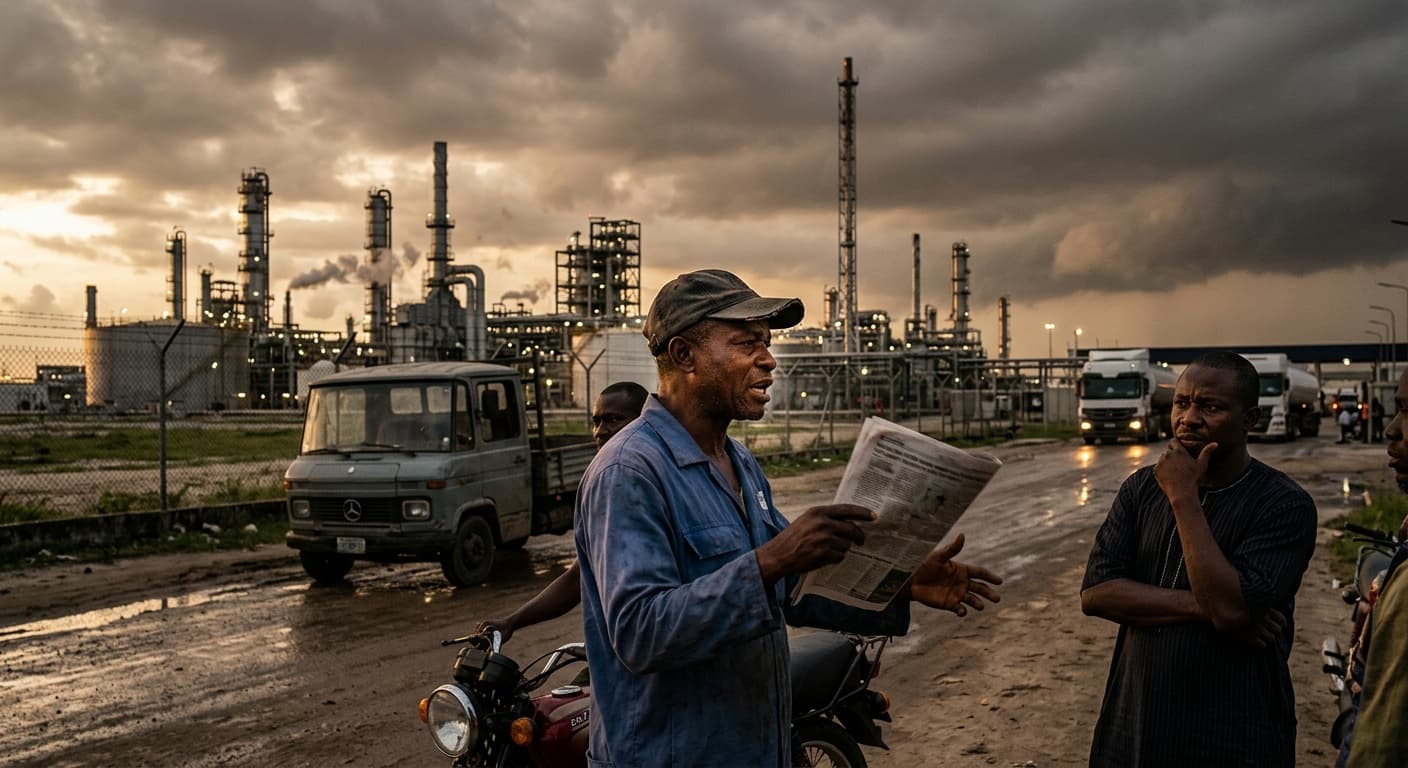
Dangote's Dollar Pivot Exposes Nigeria's Naira-for-Crude Crack
Nigeria's flagship refinery began quoting petrol, diesel and aviation fuel in dollars on July 13, 2026, ending a naira-pricing arrangement that anchored Tinubu's currency-stability story. The move exposes a crude-supply gap the government cannot close.
On July 13, 2026, Dangote Petroleum Refinery notified marketers that petrol, diesel and aviation fuel would now be priced in U.S. dollars — petrol at $0.779 per litre, diesel at $1.087, aviation fuel at $0.942, with coastal petrol pegged at $1,044.62 per metric tonne — and voided all naira-denominated invoices issued days earlier Discoverer Nigeria. The decision does not, by itself, change what Nigerians pay at the pump; payments remain in naira, converted at the prevailing exchange rate. What it changes is who carries the currency risk. The shift is a structural verdict: Nigeria's largest refinery cannot source enough domestic crude in naira to keep its revenue in naira, so it has dollarized its sales to match its dollarized costs. The casualty is the naira-for-crude policy that President Bola Tinubu's government built its currency-stability narrative around.
The supply gap that forced the shift
The refinery needs 13 to 15 crude cargoes a month to run near its 650,000-barrel-per-day capacity. In May 2026, the Nigerian National Petroleum Company Limited (NNPCL) supplied seven — up from roughly five previously, but still less than half the requirement Discoverer Nigeria. The balance must be bought on the international market in dollars. For months, Dangote absorbed the mismatch: buying crude in dollars, selling fuel in naira, and waiting on dollar allocations that arrived late or not at all. The company told marketers it had "incurred substantial losses while waiting for the allocation of dollars" and could no longer subsidize the country after the government withdrew its own fuel subsidy
Punch.
The trigger was partly external. Renewed Middle East conflict pushed Brent above $80 a barrel in early July, raising both the cost and the dollar urgency of the refinery's offshore crude purchases Bloomberg. Nigerian crude itself trades at a $3-to-$6 premium to Brent, plus $3.50 a barrel in freight, meaning landed costs ran between $88 and $91 even before refining margins
BBC News Pidgin. Earlier in the year, during the peak of the U.S.-Israel-Iran conflict, Brent had spiked near $120 before falling back below $90 after President Donald Trump described the war as "very complete"
BBC News Pidgin. That volatility amplified the refinery's dollar exposure: every $10 swing in crude altered its dollar needs by hundreds of millions across a month's cargoes.
The regulator has signed off. Senior officials at the Nigerian Midstream and Downstream Petroleum Regulatory Authority told Punch the Petroleum Industry Act permits operators that incur costs in dollars to recover those costs in dollars, and that the naira-for-crude deal was "not to Dangote's advantage right now" given the offshore sourcing Punch. One official was blunt: "It is between the refinery and the dominant crude market supplier, which is the NNPC. Why are they not supplying the refinery? Why does it have to do the dominant purchase offshore?"
The supply gap is not a recent phenomenon. Nigeria's oil production has fallen from roughly 2.1 million barrels per day in 2018 to around 1.3 million in 2023, and NNPC has pre-sold millions of barrels against a $3 billion Afreximbank loan that requires repayment in crude BBC. The Africa Oil+Gas Report estimated that NNPC could not supply Dangote with more than 300,000 barrels per day even under instruction
BBC. The arithmetic was always against the naira-for-crude policy.
The naira-for-crude bet, and what just broke
The naira-for-crude arrangement was Tinubu's signature currency intervention. On October 1, 2024, the Federal Executive Council directed NNPC to sell crude to Dangote and other local refiners in naira, with the 450,000 barrels per day earmarked for domestic consumption offered in naira and the exchange rate fixed for the duration of each transaction BBC News Pidgin. Zacch Adedeji, chairman of the Federal Inland Revenue Service and a member of the Presidential Committee on the Sale of Crude Oil and Refined Product, announced that NNPC would supply about 385,000 barrels per day to Dangote in naira, with the refinery supplying equivalent-value refined products to the domestic market in return
BBC News Pidgin.
The logic was clean: take Dangote's crude-import dollar demand out of the foreign-exchange market, supply refined products in naira, and reduce the FX pressure that had driven the naira from 460 to over 1,600 against the dollar between May 2023 and late 2024 BBC. Bayo Onanuga, a presidential spokesman, called it a "game-changing intervention" that would eliminate the need for international letters of credit and save Nigeria billions of dollars previously spent importing refined fuel
BBC News Pidgin.
The World Bank, which anchored the policy in its fiscal-reform tranche-release document, certified the arrangement as meeting a condition requiring all fiscal transfers — including crude oil sales — to be executed at the market-prevailing exchange rate World Bank. The bank noted that the move addressed the "implicit subsidization of PMS which had returned when the naira-denominated price of gasoline was not adjusted upwards, particularly after January 2024 when the parallel FX premium was eliminated." Since the reform's start in mid-2023, gasoline prices had increased more than fivefold
World Bank.
The design assumed NNPC could deliver enough crude in naira to cover the refinery's needs. It could not. NNPC owed suppliers roughly $6 billion for fuel brought into the country as of late 2024 BBC. Dangote himself complained that international oil companies operating in Nigeria refused to sell crude to the refinery or charged above the official price set by the Nigerian Upstream Petroleum Regulatory Commission
BBC News Pidgin. The Petroleum Industry Act's "willing buyer, willing seller" framework meant NNPC could not compel private producers to supply the refinery at naira-denominated terms.
"We are in a free zone, and that's how it's normally done. When we sell in naira, we are not being given dollars. We have a huge accumulation of requests for dollars piling up, and we are being given very little crude against the naira. It is not our fault. We are buying products in dollars. It is the other party that has failed to uphold the crude-for-naira agreement."
— Senior management source, Dangote Group, quoted in
Punch
This is not a Dangote problem dressed up as a currency problem. It is a crude-production problem dressed up as a pricing problem. Nigeria exports more than one million barrels of crude daily, yet its flagship refinery still relies on imported cargoes to meet its needs Discoverer Nigeria.
The inflation pass-through, and why this time differs
The immediate naira-equivalent of Dangote's dollar prices is roughly in line with where retail fuel already sat — petrol at $0.779 converts to about N1,072 per litre at the official rate of N1,376.54, close to the N1,075 gantry price the refinery set in March 2026 after cutting prices by N100 following a brief easing of oil prices Guardian (Nigeria);
BBC News Pidgin. The arithmetic has not yet moved the pump price.
What has changed is the transmission mechanism. Under naira pricing, Dangote's wholesale price was a negotiated naira figure reviewed periodically; exchange-rate movements fed through with a lag and through the discretion of the pricing committee. Under dollar pricing, every naira depreciation now flows directly and immediately into wholesale costs. The IMF's 2026 Selected Issues Paper on Nigeria found that the exchange-rate pass-through to inflation, while variable by shock type, is real and structural: a contractionary U.S. monetary shock depreciates the naira by about two percentage points over 12 months and lifts Nigerian CPI by roughly 0.6 percentage points over 24 months, with a conditional pass-through ratio of approximately 0.3 IMF. The paper also documented a counterintuitive finding: oil supply disruptions that appreciate the naira through higher export revenues still raise inflation, because the direct cost-push effect of higher fuel prices dominates the currency benefit
IMF. Dollar-denominated fuel pricing sharpens both channels.
The IMF's May 2026 Article IV staff report already projected inflation ticking up to 17 percent at end-2026 — about 3.5 points higher than pre-war forecasts — driven by higher fuel, fertilizer and food prices from the Middle East conflict IMF. Petrol and diesel prices had already risen 22.5 and 16 percent respectively in March compared with pre-war levels, according to the same report. The CBN's own monetary policy trajectory shows the stakes: the Monetary Policy Rate has been held at 27.50 percent since early 2025, with the Cash Reserve Ratio at 50 percent for deposit money banks — among the tightest settings in Nigeria's history
CBN. Headline inflation had eased from 31.7 percent in 2024 to 15.15 percent by December 2025, supported by declining food prices, improved exchange rate stability, and a reduction in monthly inflation momentum
CBN. That disinflation path now faces a fuel-pricing channel that is structurally more dollar-sensitive than the one it was designed against.
The last time the refinery paused naira sales, in March 2025, depot prices climbed toward N900 per litre Discoverer Nigeria. Pricing data from petroleumprice.ng already showed petrol rising by as much as N113 per litre and diesel by N150 at some depots within days of the July 13 announcement
Punch. During the earlier Iran-war price spike, pump prices had reached near N1,400 per litre in many parts of the country, with Dangote raising petrol from N1,200 to N1,275 and diesel to N1,800 per litre
BBC News Pidgin. Independent marketers, who must source dollars to buy from the refinery and then sell in naira at the pump, have rejected the dollar-pricing arrangement, warning it will intensify FX pressures
Punch.
Named winners and losers
The beneficiaries of the shift are narrow and specific. Dangote Group aligns its revenue currency with its cost currency, stemming losses it says were mounting as it waited for dollar allocations Bloomberg. The refinery operates in a free zone, where foreign-currency transactions are legally routine
Punch. Off-takers with dollar access — primarily NNPC and a handful of large marketers — gain pricing clarity and can hedge their positions. International crude traders who supply the refinery's offshore cargoes benefit from a buyer whose pricing is now transparently linked to the same currency in which they invoice.
The losers are broader and more politically consequential. Nigerian consumers face fuel prices that now track the dollar in real time; any naira depreciation feeds immediately into transport costs and, from there, into goods prices across the economy. The IMF noted that higher fuel, fertilizer and food prices will "likely aggravate poverty and food insecurity" in its 2026 baseline IMF. Small independent marketers — members of the Independent Petroleum Marketers Association of Nigeria (IPMAN) — lack reliable dollar access and are squeezed between a dollar-priced supplier and a naira-priced retail market. Alhaji Yakubu Puka, an IPMAN member, told BBC Pidgin that marketers could import from abroad if Dangote's price was uncompetitive, but that option itself requires dollars
BBC News Pidgin. The CBN loses a key anchor: its disinflation campaign, which had been supported by improved FX market functioning and exchange-rate stability
CBN, now contends with a fuel-pricing regime that transmits currency movements into CPI faster and more completely than before.
There is a political loser too. Tinubu's economic reform narrative — fuel subsidy removal, naira float, naira-for-crude, was sold to Nigerians as a sequence that would end with stable prices and a stronger currency. The naira did appreciate 10 percent year-on-year by March 2026, and gross international reserves rose to $49 billion by end-March 2026 from $40 billion at end-2024 IMF. But Dangote's dollar pricing is an admission by the country's most powerful industrialist that the naira leg of that sequence does not work at scale. The government says the naira-for-crude framework remains in place and that discussions with NNPC are ongoing
Discoverer Nigeria. But a policy that depends on NNPC supplying crude it has already pre-sold against loan obligations is not a policy that can be willed back into function by statement. The World Bank's own compliance document noted that NNPC "moved ahead and made the change immediately, thereby overachieving the TRC" — but overachievement of a tranche condition is not the same as solving a crude-supply deficit
World Bank.
The historical parallel
Nigeria has been here before — not with a refinery of this scale, but with the same structural mismatch. The country's four state-owned refineries — two in Port Harcourt, one each in Kaduna and Warri — were built to end import dependence but sat largely non-functional for decades, forcing NNPC to swap crude for refined products abroad and import fuel at premium BBC News Pidgin. The Dangote refinery was supposed to break that cycle. Instead, it has reproduced a variant of it: Nigeria still exports raw crude and imports the feedstock its own refiner needs, because domestic production cannot fill the gap. The Economist, in a March 2026 podcast, noted that Dangote's refinery had delivered genuine benefits — ending fuel queues, saving dollars previously spent on imports, and giving Nigeria energy security for the first time in 50 years. But the refinery's monopolistic position and its dependence on imported crude meant the country was "slightly less" rattled by global oil shocks, not immune
The Economist. Dangote himself told the podcast that the refinery was "not even about price, it's about availability, which we have now actually delivered."
The difference now is that the refinery has made the dollar dependence explicit in its pricing, rather than absorbing it silently. That is an honest accounting. It is also a political problem.
The Bottom Line
Dangote's dollar-pricing shift is not a refinery flexing pricing power. It is the market pricing in a structural fact Nigeria's government has not confronted: the country cannot supply enough crude to its own flagship refiner to make a naira-denominated fuel economy work. Until domestic crude production rises to fill the 8-to-10 cargo monthly gap, every naira-for-crude arrangement will be a partial solution, and every fuel price in Nigeria will be a dollar price wearing a naira label. The naira's 10 percent appreciation and the IMF's projected disinflation path both now rest on a foundation of stable fuel pricing that the refinery just made explicitly conditional on the exchange rate.
Diplomat View. The forecast hinges on a single variable: whether NNPC can raise its crude allocation to Dangote above 10 cargoes a month before the next fuel-price pass-through cycle bites. If it can, through accelerated production, loan restructuring, or reallocation of export-bound cargoes, the naira-for-crude framework survives in modified form and Dangote can revert to partial naira pricing. If it cannot, expect three things in sequence by Q4 2026: a CBN monetary-policy response to fuel-driven inflation at the September MPC meeting, renewed FX pressure as marketers bid for dollars, and a political reckoning over a fuel-subsidy removal that no longer delivers the price stability it promised. The revision condition is concrete: a sustained Brent below $75 combined with NNPC cargo supply above 10 per month. Absent both, the dollar-pricing regime entrenches.
- CBN Monetary Policy Committee meeting — September 2026. First rate decision since the dollar-pricing shift; the question is whether the committee responds to fuel-pass-through inflation.
- NNPC crude allocation data — August/September 2026. Whether NNPC raises cargoes above 7 per month will determine if naira pricing returns.
- IMF Article IV next review — mid-2027. The Fund's 17 percent end-2026 inflation projection collides with the new pricing regime within months.
Discover more
US Politics
House Ethics Committee Pushes Sexual Miscond.
The House Ethics Committee has shifted responsibility for sexual harassment settlement records to the Office of Congressional Workplace Rights, complicating disclosure efforts.
India
Rajnath Singh's Durga Squad for 2026 Polls
Rajnath Singh's Durga Squad promised women's safety in Bengal but has since disappeared from the agenda, revealing BJP's true priorities.
US Politics
SNAP Food Assistance Faces Legal Challenges
In 2026, SNAP faces stricter eligibility rules and mounting legal challenges, threatening food assistance for the millions of Americans who rely on the program.

Economics
Fed's Amex AML order puts correspondent banking on notice
Federal Reserve's Amex AML order requires board-level controls and a 90-day plan; OCC fined the bank $350 million over enterprise-wide deficiencies.