Cuba's Otero Alcántara Disappears Before Due
Luis Manuel Otero Alcántara is missing after prison removal.
Model Diplomat8 min readAmericas
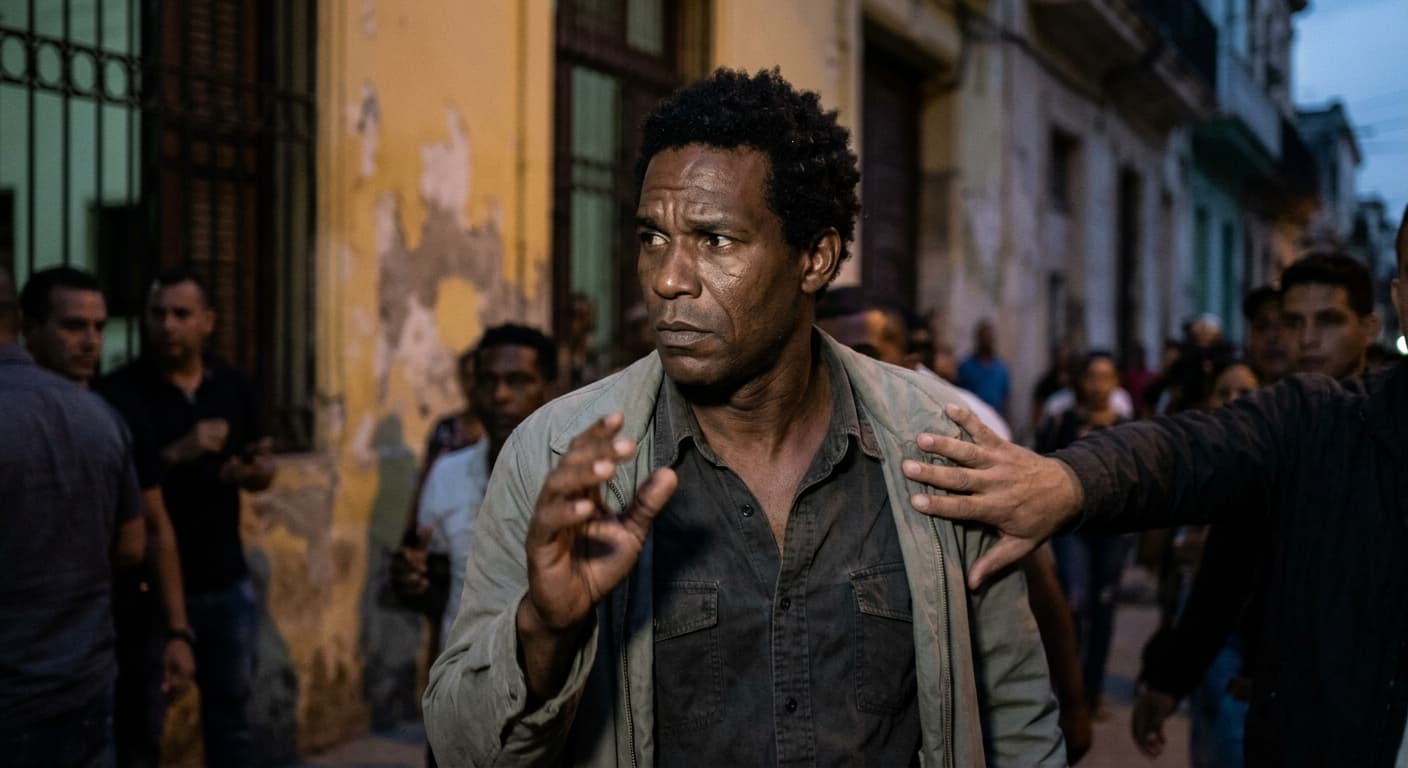
Cuba's Otero Alcántara Vanishes Two Days Before Release
Cuban authorities removed artist Luis Manuel Otero Alcántara from Guanajay prison on July 7, 2026, hours before his sentence expired — activist Anamely Ramos says he is now missing.
The Cuban state pulled its most internationally recognizable political prisoner out of Guanajay maximum security prison on the afternoon of July 7, 2026 — two days before his five-year sentence was set to expire — and refuses to say where he is. Speaking from Washington, curator and San Isidro Movement co-founder Anamely Ramos told supporters that Luis Manuel Otero Alcántara is "missing, not free or released," according to Cuba Headlines. The disappearance is not administrative confusion. It is the choreography Havana has used repeatedly against its most inconvenient dissidents: coerced exile — destierro — presented as freedom, with the state controlling location, timing, and terms. It lands three weeks after the European Parliament voted, 283–199, to push targeted sanctions against President Miguel Díaz-Canel personally over a record political-prisoner count.
What is known, and what is not
Otero Alcántara, a self-taught Afro-Cuban visual artist and co-founder of the San Isidro Movement, was extracted from the Artemisa-province facility "amid a heavy operation," according to activist Idelisa Diasniurka Salcedo Verdecia, who received a call from inside the prison quoted by CiberCuba. His family had been told his release date was July 9, 2026. As of the morning of July 8, Cuban authorities had made no public statement about his whereabouts, and neither his family nor his lawyer had been notified of a destination, according to Cuban outlet
El Vigía de Cuba.
Spain's El Periódico Mediterráneo framed the extraction as a release, reporting that he "left" a Cuban prison "four days" before completing his sentence, per El Periódico Mediterráneo. Ramos rejected that framing in the Cuba Headlines account: no communication, no legal-status update, no confirmation of physical safety. Cubalex and the Otero Alcántara Studio had spent June coordinating a global artist countdown to July 9, 2026, calling on colleagues worldwide to mark the sentence's completion with performance work, per
Cuba Headlines. The state moved before that mobilization could crystallize outside a prison gate.
The playbook: exile disguised as release
The pattern matters more than the individual case. Since a January 14, 2025 deal brokered with the Vatican and the outgoing US administration, Cuba has selectively released at least 211 people detained for political reasons — a process Amnesty International called "opaque," marked by "arbitrary conditions" and lacking any state recognition of the abuses committed, per Amnesty International. Opposition leader José Daniel Ferrer left for the United States in October 2025 saying he had agreed to exile after enduring torture; fellow dissident Félix Navarro was re-imprisoned in April 2025 when the deal collapsed, per the
Freedom House Cuba 2026 report.
Otero Alcántara had explicitly refused this bargain. Human Rights Watch and Amnesty International reported in May 2022 that authorities had repeatedly offered to release him in exchange for leaving the country indefinitely — "a historic practice by the Cuban government that has been applied to other critics in recent months, in violation of the right to enter one's own country" — and that he "publicly rejected the offer," according to Human Rights Watch. The mechanics of July 7 fit the coercion template. A heavy security operation. No prior notice to family. No lawyer present. No public destination. In earlier cases — Ferrer, several 11J defendants, and dozens of San Isidro and 27N artists whom, as Amnesty documented in its Spanish-language version of that same statement, Cuba has "encarcelado, perseguido penalmente y forzado al exilio," per
Amnistía Internacional — the same choreography ended with an aircraft to Miami, Madrid, or Managua and a passport stamp that made return impossible.
Why the state moved 48 hours early
The two-day gap is the analytical crux. Under Cuban penal procedure, a sentence expiring on July 9 must be discharged on that date; a prisoner walked out under his own power on July 9 would be free of parole conditions and free to speak. Removing him on July 7 preserves the state's leverage. He is technically still a serving prisoner. Any statement, any act of defiance, any refusal to board a flight can be recategorized as a disciplinary infraction and answered with fresh charges under the 2022 Penal Code — the same instruments used to convict him in the closed-door trial of May 30–31, 2022, when the Havana tribunal found him guilty of ultraje a los símbolos de la patria, desacato and desórdenes públicos, per BBC Mundo.
Amnesty International anticipated precisely this move. In its June 24, 2026 statement marking four years since the sentence, Americas Director Ana Piquer wrote:
"La liberación de Luis Manuel Otero Alcántara en julio, al cumplir esta injusta condena, debe ser plena e incondicional. No puede haber libertad plena bajo vigilancia, restricciones arbitrarias o amenazas de volver a prisión."
That warning appears in Amnesty's June 2026 Cuba release. Piquer's phrasing named the mechanism now unfolding: the state converts release into a regime of surveillance, arbitrary restriction, and reincarceration threat, deployed against exactly the prisoners of conscience whose freedom the international community has demanded. Amnesty's list — Sayli Navarro Álvarez, Félix Navarro Rodríguez, Loreto Hernández García, Donaida Pérez Paseiro, Roberto Pérez Fonseca and Maykel Castillo Pérez "Osorbo" — is the barometer against which any Cuban "gesture" should be measured.
The numbers behind the case
Cuba's political-prisoner population has climbed, not fallen, through two rounds of headline-grabbing pardons. On April 2, 2026, Havana announced the release of 2,010 prisoners as a "humanitarian gesture" — the second such gesture of the year and the fifth mass pardon since 2011 for a total of more than 11,000 released, per Al Jazeera. Neither Human Rights Watch nor Cuban rights groups Justicia 11J or Prisoners Defenders identified a single political prisoner among those freed, and among the more than 700 still held HRW named Otero Alcántara specifically, per
Human Rights Watch. The BBC, on the ground during the April releases, reported Prisoners Defenders' Javier Larrondo confirming that "todos son presos comunes de cárceles de trabajos forzosos," per
BBC News Mundo.
The European Parliament, in its June 18, 2026 resolution, called Cuba "close to being a failed state," cited 89% of Cuban families living in extreme poverty, and pinned the humanitarian emergency on "the regime's own model and failures," per the European Parliament. MEPs demanded targeted measures under the EU global human rights sanctions regime against Díaz-Canel personally and against the leadership of GAESA, the military conglomerate controlling close to half the island's economy. In the absence of movement toward transition, they said, the EU should suspend the Political Dialogue and Cooperation Agreement altogether. Freedom House, writing days later, warned that the January and April 2026 releases "coincided with US negotiations" and that prisoners are being "leveraged as bargaining chips while the system itself and the humanitarian conditions facing ordinary Cubans remain unchanged," per
Freedom House.
The July 7 removal reads as a controlled variable. Havana is releasing thousands of common prisoners it does not fear while quietly moving the one artist whose July 9 walk-out — coordinated with a global artist campaign and Amnesty's high-profile individual case file — would have produced the images the regime least wants circulated: a free Otero Alcántara, still in Cuba, still speaking.
Winners, losers, and the historical parallel
The winners in the near term are narrow. The Cuban Interior Ministry buys a news cycle of ambiguity in which some Western wires — as El Periódico Mediterráneo did on July 8 — report a "release," diluting the story before Ramos, Cubalex and Amnesty can reframe it. The Díaz-Canel presidency gets a talking point to deploy in any subsequent negotiations with Washington: we let him out. GAESA and the security apparatus retain their strategic asset, a serving prisoner whose freedom can be dangled or withdrawn.
The losers are the harder story. The San Isidro Movement loses its physical center: Otero Alcántara's home at Damas 955 in Old Havana had been the movement's headquarters since 2018. His network — Anamely Ramos herself was named a prisoner of conscience alongside him after the November 26, 2020 raid on the San Isidro headquarters, per Amnesty International — has been steadily thinned by exile and imprisonment. Amnesty documented in December 2020 that at least six activists faced "near-permanent surveillance," and that Ramos herself was driven around Havana for more than 12 hours by rotating State Security vehicles before being released under watch, per
Amnesty International. Ramos left the island; Otero Alcántara did not. The regime is now closing that last gap.
The historical parallel is not the 1980 Mariel exodus but the éxodo of the mid-1960s and the actos de repudio of 1980 in reverse: the individualized expulsion of intellectuals — Reinaldo Arenas, Heberto Padilla — under conditions calibrated to strip political capital from dissent while retaining international cover. Padilla's 1971 "self-criticism" and eventual departure produced the Caso Padilla that ruptured a generation of Latin American intellectuals from Havana. Otero Alcántara, an Afro-Cuban artist working in performance and public space, occupies the analogous slot in 2026 — with the crucial difference that his case file at Amnesty is open, his precautionary measures at the Inter-American Commission remain in force under Resolution 14/2021, and the European Parliament has, for the first time, put GAESA and Díaz-Canel personally on a proposed sanctions list.
The enforced-disappearance question
International lawyers will now weigh whether the July 7 removal crosses the legal threshold for enforced disappearance. Under Article 2 of the International Convention for the Protection of All Persons from Enforced Disappearance, the elements are (i) deprivation of liberty by state agents, (ii) refusal to acknowledge the deprivation or concealment of fate or whereabouts, and (iii) placement outside the protection of the law. Cuba is not a party. But the UN Working Group on Enforced or Involuntary Disappearances routinely accepts communications on non-party states, and Amnesty's 2025 comparative reporting on Venezuela — where the group documented 15 political disappearances following the July 28, 2024 election and concluded they formed part of "a systematic and widespread attack" constituting a possible crime against humanity, per Amnesty International — provides the regional template Cubalex and Justicia 11J are likely to invoke.
The concept is not new to Cuba's own dissident vocabulary. In 2023, Anamely Ramos, speaking at Cuba's UN Universal Periodic Review, described José Daniel Ferrer as having spent "more than three months under enforced disappearance" in isolation cells, per Amnesty International. The language has now migrated from advocacy to the fact pattern of July 7, 2026.
The Bottom Line
The bottom line: Havana did not release Luis Manuel Otero Alcántara on July 7, 2026 — it took control of him 48 hours before it would have lost that control, in the same coercive-exile choreography that has processed at least 211 political prisoners since January 2025. With a record 1,281 political prisoners on the island, an EU sanctions push targeting Díaz-Canel personally, and Amnesty's most-watched Cuban case file open, whether Otero Alcántara resurfaces in Havana, in Miami, or not at all will define whether the international community treats Cuba's "humanitarian gestures" as reform or as laundering.
What to watch
- July 9, 2026: the formal expiration date of Otero Alcántara's five-year sentence. Any continued state custody past this date strengthens the enforced-disappearance case at the UN Working Group.
- Next EU Foreign Affairs Council: MEPs have asked the Commission to move on targeted sanctions against Díaz-Canel and GAESA leadership under the EU global human rights sanctions regime; the June 18, 2026 resolution passed 283–199 with 85 abstentions.
- July 11, 2026: fifth anniversary of the 11J protests. Cubalex, Justicia 11J and the Otero Alcántara Studio have already staged commemorative artist actions; the state's handling of the anniversary will indicate whether it intends to produce Otero Alcántara publicly, in exile, or not at all.
Discover more
US Politics
Virginia's Redistricting Referendum
Virginia's redistricting referendum is drawing a flood of dark money, shaping future elections and the fight for congressional control amid party stakes.

US Politics
Virginia GOP Rallies Rural Voters Against Red
Virginia Republicans are mobilizing rural voters against a Democratic-led redistricting referendum, a fight seen as pivotal to control in the 2026 midterms.

Global Politics
US-Iran Tensions Rise
Tensions escalate in the Strait of Hormuz as Iran and the US clash over maritime control, with a ceasefire hinging on a contested MoU paragraph.

Conflict & Security
Drone Warfare Killing Aid Workers at Unprec
Over 1,000 humanitarian workers killed in three years as cheap armed drones collapse legal protections. Gaza, Sudan, Ukraine, and DRC see deliberate targeting of aid convoys and hospitals with zero prosecutions.