Cabo Verde's Atlantic Playbook
Exploring Cabo Verde's strategic foreign policy
Model Diplomat4 min readafrica
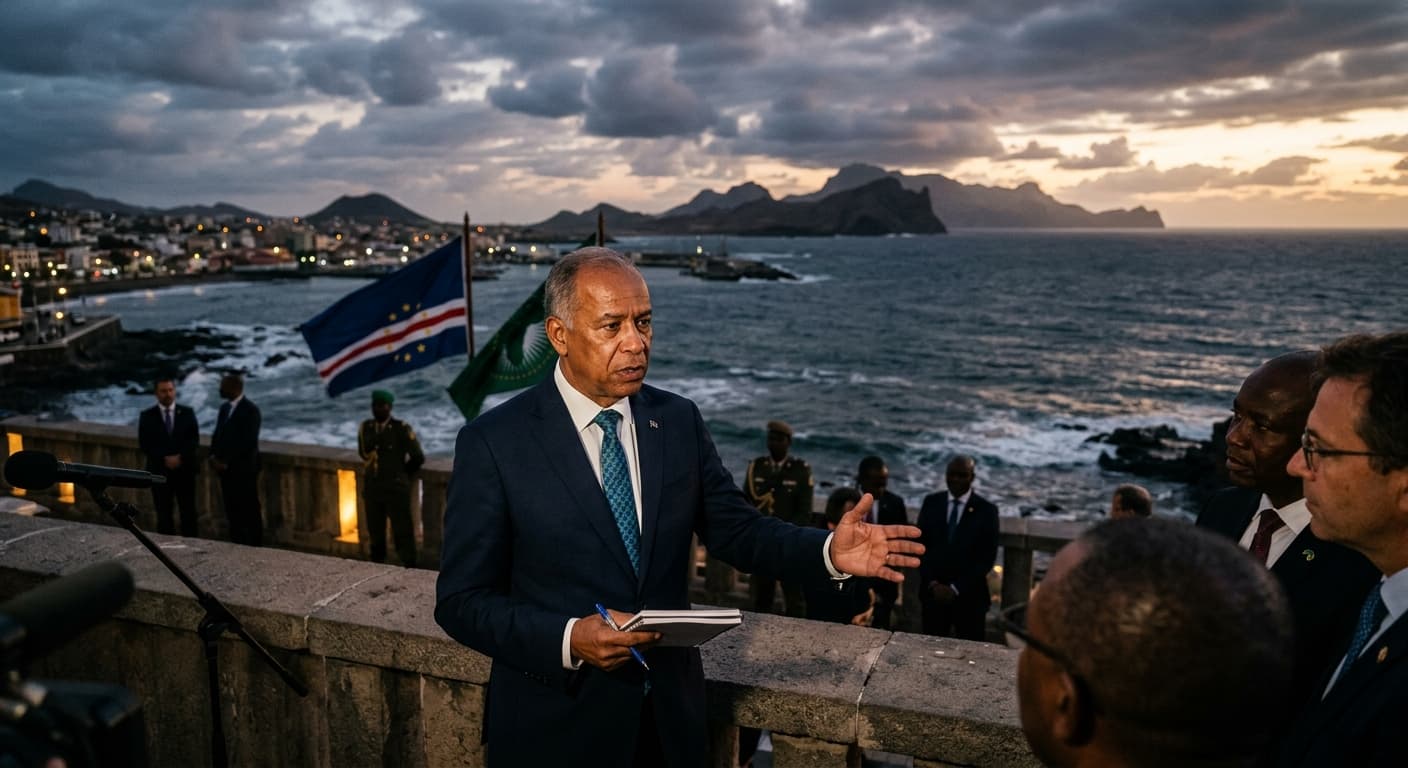
Cabo Verde's Atlantic Playbook — Why a 525K-Person Island Punches Far Above Its Weight
The archipelago's foreign policy trades democratic credibility and mid-Atlantic geography for outsized diplomatic leverage — and the great powers are paying attention.
Cabo Verde is not a country that commands headlines. It commands something rarer: a currency peg to the euro, a debt-for-climate swap with Portugal, €400 million in EU Global Gateway financing, and a prime minister who can walk into both Brookings and CSIS to explain his multivector strategy without triggering alarm bells. That is the power of democratic predictability — and it is the asset Praia is cashing in on.
The Model Diplomat country profile captures the architecture: a defensive, economically driven foreign policy built on sovereignty, good governance, development, and international partnership. Survival priorities — maritime security, food and energy access, climate resilience — dominate. Regime security barely registers as a concern because the country has never experienced a coup and has alternated power peacefully between the center-left PAICV and center-right MPD since 1991, as the
Africa Research briefing notes.
That stability is not a passive condition. It is an active diplomatic instrument.
The power dynamic: multivector by necessity, not ideology
Cabo Verde's foreign policy is not nonalignment as principle. It is nonalignment as survival calculation for a country of 525,000 people with virtually no natural resources, an ocean territory 200 times its landmass, and a diaspora estimated at roughly twice the resident population.
Prime Minister José Ulisses Correia e Silva laid out the calculus in plain terms at a Brookings event in May 2025. The escudo has been pegged to the euro since 1998. Most tourists come from Europe. The diaspora — concentrated in Portugal, the Netherlands, the United States, and Senegal — sends remittances that anchor the balance of payments. "That guides some of our decisions in the government because we want to protect this relationship," Silva said.
But the same prime minister sat at CSIS in March 2025 to discuss China ties, acknowledging that Chinese construction and financing — predating the wider China-Africa push — were "instrumental" to the country's development. The difference is how the relationships are structured: China is a development partner; Europe is the structural economic anchor; the United States is a diaspora and security partner. Each relationship serves a distinct function, and none is exclusive enough to foreclose the others.
Who benefits: the EU, the lenders, and the middle powers
The European Union is the largest single beneficiary of Cabo Verde's stability — not sentimentally, but operationally. The EU's €400 million Global Gateway package finances transformative programs in the blue economy and trans-shipment infrastructure. Portugal converted bilateral debt into a climate and environment fund, a landmark debt-for-climate swap that strengthens fiscal sustainability while locking in Praia's commitment to renewable energy targets (50% by 2030, nearly 100% by 2040).
The IMF, meanwhile, projects 5.2% growth in 2025 following 7.2% in 2024, driven by tourism and resilient consumption, with inflation stable around the 2% target and international reserves adequate to protect the peg, per the February 2026 Article IV consultation. The country is nearing the end of its political cycle — legislative elections in April 2026, presidential in October — but the IMF's assessment signals no alarm about democratic disruption.
The multilateral lenders benefit from a reliable borrower. The EU benefits from a stable mid-Atlantic partner that can host maritime security cooperation without triggering sovereignty anxieties. NATO benefits from a cooperative state in the crossroads between Brazil, the Gulf of Guinea, and Europe — a zone where drug trafficking, human smuggling, and illegal fishing transit through Cabo Verde's waters even if they don't originate there. As Silva told Brookings: "We are close to NATO, which is in terms of strengthening conditions for ensuring cooperative maritime security."
Who loses: no one obvious — and that is the point
Cabo Verde's multivector strategy produces no clear losers because it generates no clear enmities. It maintains diplomatic relations with China, Russia, the United States, and every major European power. It sits in ECOWAS, the African Union, the CPLP, and AOSIS. Its UN voting record, tracked by Model Diplomat, reflects a small-state multilateralism that avoids picking sides in great-power contests unless the issue touches directly on climate, maritime jurisdiction, or small-island development finance.
The CSIS analysis "The Strategic Significance of Africa's Smallest Democracies" makes the case explicitly: small states like Cabo Verde punch above their weight precisely because they offer niche capabilities — diaspora networks, Lusophone ties to Brazil and Macau, multilateral diplomacy skills — that larger anchor states cannot replicate. The United States, the analysis argues, should not abandon its focus on Nigeria or South Africa but should pursue a parallel approach that invests in these small-state relationships.
What to watch next
Two decision points matter. First, the April 2026 legislative elections — the first test of whether the MPD can hold power after a decade of Correia e Silva's premiership or whether the PAICV returns. The policy orientation is unlikely to shift dramatically regardless of outcome, but the pace of blue-economy implementation and the warmth of NATO-adjacent security cooperation could vary with the personality in charge.
Second, the fifth UN SIDS Conference, which Cabo Verde is positioned to host. For a country that defines its foreign policy through the small-island-developing-state frame, hosting the premier multilateral forum on SIDS issues is the diplomatic equivalent of a home game. The conference will test whether Cabo Verde can convert its reputation for democratic governance into concrete leadership on climate finance access, blue-carbon accounting, and the ocean-governance architecture that will define the next decade of Atlantic diplomacy.
Discover more

US Politics
White House Pressures Congress for Crypto Leg
The Trump administration's push for the CLARITY Act aims to reshape crypto regulation, impacting trillions in market value and the Trump family's wealth.
US Politics
Washington's Scrutiny of Iran War Prediction
The Iran war prediction market scandal exposes political ties and regulatory challenges in Washington, as insider trading concerns rise.
US Politics
Virginia's Redistricting Referendum
Virginia's redistricting referendum is drawing a flood of dark money, shaping future elections and the fight for congressional control amid party stakes.

Conflict & Security
Drone Warfare Killing Aid Workers at Unprec
Over 1,000 humanitarian workers killed in three years as cheap armed drones collapse legal protections. Gaza, Sudan, Ukraine, and DRC see deliberate targeting of aid convoys and hospitals with zero prosecutions.