Colombia's Transition Crisis Ahead of Hando
Political tensions rise as Colombia's power transfer nears.
Model Diplomat7 min readLatin America
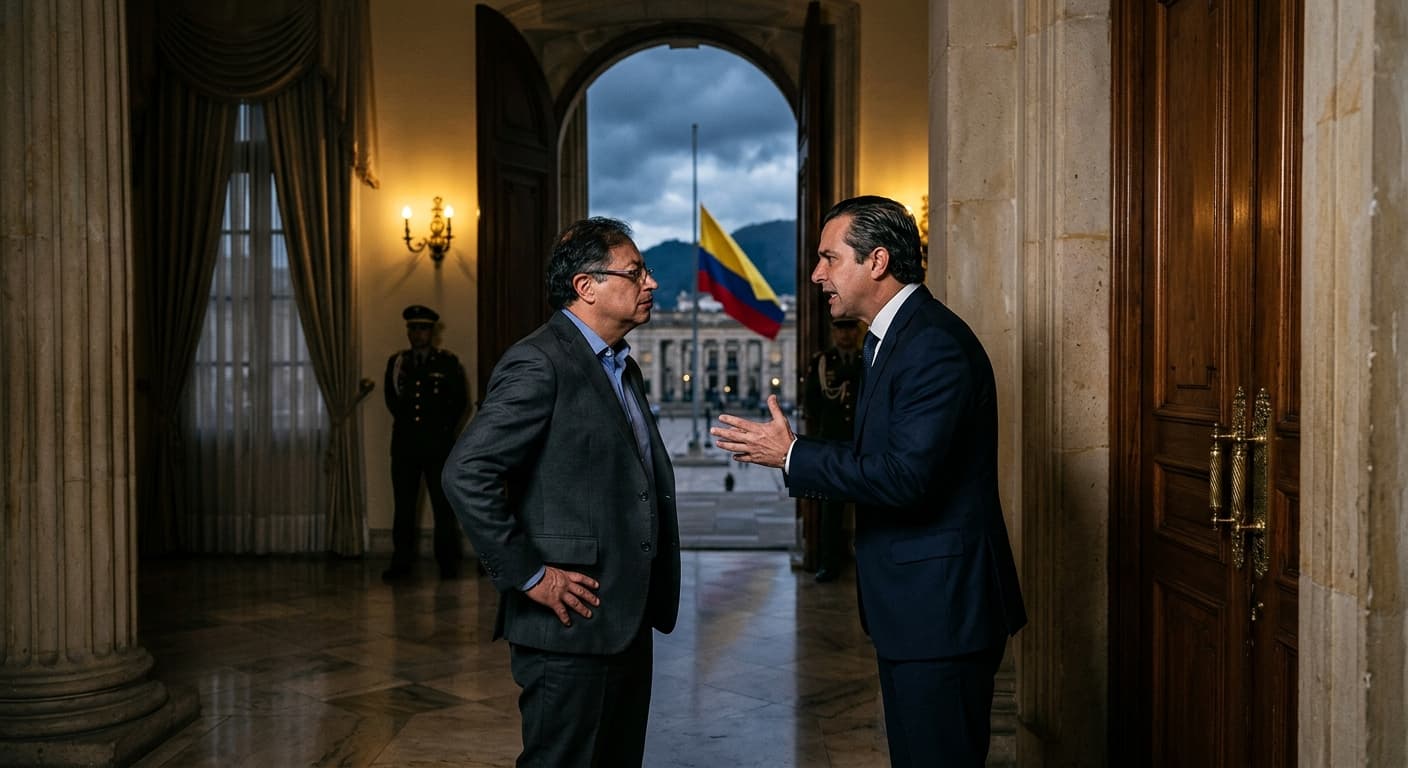
Colombia's Stalled Transition Collides With a Certified Result
Colombia's Petro–De La Espriella empalme is frozen a month before the August 7 handover. The CNE's certified count and Ley 951 make the outcome irreversible; the fight is about leverage, not legitimacy.
Colombia's presidential transition seized up on July 8, 2026, and the fight is not about who won — the Consejo Nacional Electoral certified that on June 24 — but about who gets to define the terms on which power changes hands on August 7. The empalme between outgoing leftist Gustavo Petro and president-elect Abelardo De La Espriella collapsed after Carlos Alonso Lucio, of the incoming team, floated that Petro might soon face a judge, and Petro publicly cast doubt on whether De La Espriella won cleanly. The technical handover is a legal obligation under Ley 951 of 2005, and every serious Colombian jurist agrees it will happen; what is being contested is the political price each side pays before it does.
The stakes are unusually concrete. Petro leaves office under U.S. Treasury sanctions imposed on October 24, 2025. De La Espriella arrives with Donald Trump's personal endorsement and a promise to extradite Petro "if requested." The empalme dispute — dressed up as a fight over honor, legitimacy, and defamation — is the opening skirmish of that post-presidency reckoning.
What actually collapsed on July 8
The rupture was mutual and, in institutional terms, largely symbolic. Constitutional lawyer Juan Manuel Charry, writing in Semana, notes that "the law does not speak of pauses": Ley 951 of 2005 obliges every outgoing public servant to deliver an informe de gestión within 15 business days of leaving office, and the incoming administration has 30 days to verify it. There is no provision to suspend anything. What both sides suspended, in practice, were the informal working tables — meetings that carry no legal status.
De La Espriella, as president-elect, holds no formal power to halt the process; he can only withdraw his own team, which is what he did after Petro suggested on X that "hundreds of thousands of votes were added" through impugned tables. Petro's government then mirrored the move, as HSB Noticias reported, announcing it would only resume "when there are guarantees for respectful, institutional work." Both sides left the door ajar. Neither has closed it.
The government has also said it will file criminal complaints against Lucio for allegedly harming the president's honor. Under Colombian jurisprudence, criticism of a public official is protected speech; accusing someone of a specific crime without evidence is not. That is the narrow legal question — and it is a sideshow to the real one.
The result the fight cannot touch
The most consequential fact in the Semana column, and in every legal analysis of the empalme dispute, is that the election itself is over as a matter of law. De La Espriella won the June 21 run-off with 12,959,542 votes (49.66%) to Iván Cepeda's 12,708,712 (48.70%) — a margin of roughly 250,000 on 63.6% turnout, the highest since 1991, according to BBC Mundo. The Registraduría Nacional del Estado Civil reported that the preconteo coincided with the official escrutinio to 99.997% — a divergence of about 0.003%, or well under 10,000 votes across the country.
Cepeda conceded on June 24, telling supporters he did so "as an act of democratic responsibility" while accusing the Trump administration of "open and improper foreign interference," per BBC Mundo. The CNE then proclaimed De La Espriella president-elect the same day. The CNE later dismissed a challenge to the winner's eligibility based on his U.S. citizenship, ruling that "no constitutionally provided cause of ineligibility or disqualification" applied,
according to BBC Mundo's interview with Cepeda. Real Instituto Elcano's observation mission, invited by the CNE, described the balloting as showing "absolute normality of the Colombian electoral system,"
in its post-election commentary.
Only the Council of State can annul the result, and no such demand has been filed. Until it is, the August 7 inauguration is a matter of arithmetic, not politics.
Why Petro is escalating anyway
If the result is unassailable, the question is why the sitting president keeps pressing. Two facts, taken together, explain it.
First, Petro is not a private citizen on August 8. He is a former head of state who has been on the U.S. Treasury's Specially Designated Nationals list since October 24, 2025, when OFAC designated him alongside his wife Verónica Alcocer, his son Nicolás Petro and Interior Minister Armando Benedetti under Executive Order 14059's counter-narcotics authorities. Treasury Secretary Scott Bessent said in the accompanying statement that Petro "has allowed drug cartels to flourish and refused to stop this activity,"
as reported by NPR. Petro replied that he would fight the designation in U.S. courts and vowed "not one step back, never on our knees."
Second, De La Espriella's team is signalling that Petro will face domestic legal exposure once his immunity as head of state lapses. Lucio's remark about "a judge" was not a slip; it was a marker. That is the wider frame the Bogotá press has largely missed — the empalme is not really about ministerial briefings. It is the first negotiation over what a Petro post-presidency looks like under a government that has already publicly threatened extradition.
The political calculus is straightforward. Every day Petro raises doubts about "33,000 impugned tables" — a claim the CNE, the Registraduría and international observers have all rejected — he raises the cost to De La Espriella of pursuing him after August 7. It is a legitimacy trade: Petro concedes the office but denies the incoming government the mandate to unwind his legacy or prosecute his inner circle. Cepeda, in his concession speech, explicitly reserved the right to challenge any rollback of the pension, agrarian and minimum-wage reforms — a signal that the Pacto Histórico intends to govern from the streets.
The historical parallel that matters
Colombian commentators have reached for 2018, when Iván Duque and Juan Manuel Santos ran a frosty but functional empalme. The better parallel is not Colombian. It is the transition Trump-Biden — an outgoing administration that refuses to concede narrative legitimacy while the incoming one arrives with an explicit prosecutorial posture. In both cases, the technical handover proceeds because law compels it; the political handover does not, because neither side has an incentive to grant the other closure.
The Colombian case has one important difference: the electoral authority itself is not in dispute. Petro is contesting the meaning of a certified count, not the count. That is a weaker position than U.S. election deniers occupied, and it is why Cepeda, who has actual standing to sue, chose to concede rather than fight. Yolanda Ruiz argued in El Espectador that "the campaign did not end on June 21" — and that is the analytically important observation. The transition period has become an extension of the run-off by other means.
Who benefits, who loses
De La Espriella benefits most from the empalme collapse, not Petro. A stalled handover lets the incoming president enter office on August 7 blaming the outgoing government for any early administrative failure — missing files, unfunded liabilities, hidden contracts. It also gives him political cover to purge the bureaucracy without the usual courtesy of institutional continuity. La República's editorial page called out this dynamic, arguing that an empalme "cannot be pugnacious" if the state is to function, in its July commentary — but pugnacity is exactly what serves De La Espriella now.
Petro benefits second-order: by refusing to legitimize his successor, he keeps his movement mobilized for the 2028 legislative window and preserves the "media Colombia" narrative that Cepeda invoked on June 24. The losers are the Colombian civil service, which will inherit a chaotic first 100 days, and the international investors watching a country whose president-elect has promised to reverse the peace policy of 2016, expand oil and gas, and build ten Bukele-style megaprisons.
The Contraloría and Procuraduría are the swing institutions. If either intervenes to demand documented compliance with Ley 951 — as HSB Noticias flagged is possible — the transition becomes a technical exercise again. If they stay silent, it stays political.
What to watch
- July–early August 2026: Whether the Procuraduría General or Contraloría General formally invokes Ley 951 to compel ministerial documentation. Silence favors De La Espriella; intervention forces both sides back to the table.
- August 7, 2026: The inauguration itself. Petro's presence or absence, and the tone of the transfer, will signal whether the confrontation is theatrical or structural.
- Post-August 7: Any move by the incoming Fiscalía or judicial system on Petro, his family, or Benedetti. The OFAC designation gives the new government a ready-made pretext; extradition proceedings would be the maximalist move.
- The 15-business-day informe de gestión deadline (roughly late August). Non-delivery would trigger control-organ action and give De La Espriella a documented grievance to campaign on for the 2028 midterms.
The Bottom Line
Colombia's transition crisis is not an electoral-integrity dispute — the Consejo Nacional Electoral certified De La Espriella's 250,000-vote margin on June 24, and the preconteo matched the official escrutinio to 99.997%. It is a pre-negotiation over what happens to Gustavo Petro after August 7, conducted in the language of empalme meetings and defamation complaints. The August 7 handover will occur because Ley 951 and the 1991 Constitution leave no room for it not to. What is genuinely at stake is whether Colombia's first leftist president leaves office as a defeated adversary or as a prosecutorial target — and the incoming government has already told the country which it prefers.
Related coverage: Colombia.
Discover more
India
Rajnath Singh's Durga Squad for 2026 Polls
Rajnath Singh's Durga Squad promised women's safety in Bengal but has since disappeared from the agenda, revealing BJP's true priorities.
US Politics
House Ethics Committee Pushes Sexual Miscond.
The House Ethics Committee has shifted responsibility for sexual harassment settlement records to the Office of Congressional Workplace Rights, complicating disclosure efforts.
India
BJP's Misunderstanding of Women's Quota Needs
The BJP's linking of the Women Reservation Bill to delimitation risks delaying women's empowerment in India, misreading the aspirations of female voters.

Economics
Fed's Amex AML order puts correspondent banking on notice
Federal Reserve's Amex AML order requires board-level controls and a 90-day plan; OCC fined the bank $350 million over enterprise-wide deficiencies.