Colombia's Knife-Edge Election Redraws Latin
De la Espriella's win reshapes Colombia's security landscape.
Model Diplomat9 min readLatin America
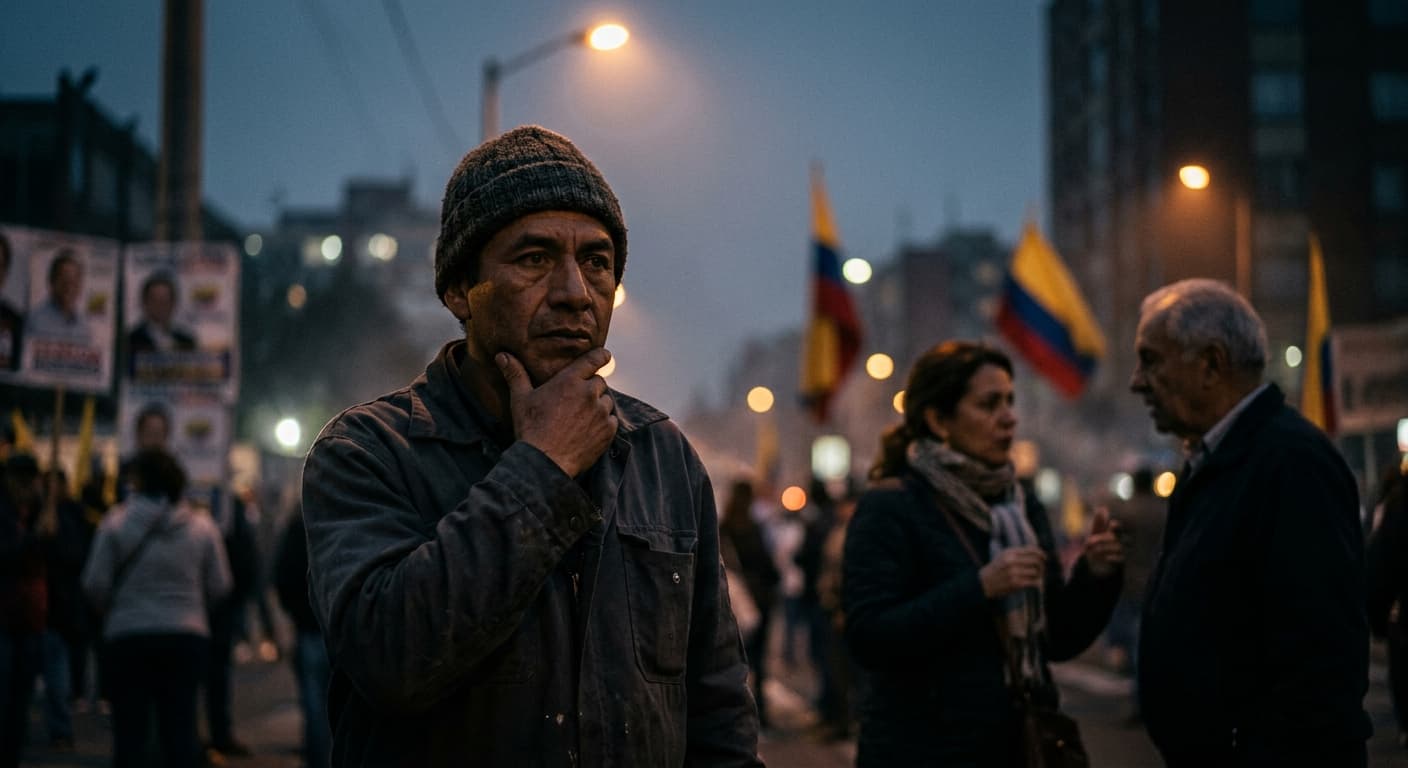
Colombia's Knife-Edge Election Redraws Latin America's Security Map
Abelardo de la Espriella's 49.7%–48.7% win on June 21, 2026 ends Colombia's leftist experiment and pulls Bogotá into Trump's hemispheric crackdown coalition — with a divided country in the way.
Colombia's presidential runoff on June 21, 2026 was decided by roughly 250,000 votes out of nearly 26 million cast, and the sub-one-point win by right-wing outsider Abelardo de la Espriella over leftist Senator Iván Cepeda does more than close Gustavo Petro's four-year experiment with the left. It slots the last major Latin American holdout into Donald Trump's "Shield of the Americas" security architecture, greenlights a Bukele-style crackdown on Colombia's fragmented armed groups, and hands the incoming government a country almost mathematically split in two — a design defect that will constrain every hard-security move de la Espriella has promised. The angle worth watching is not the ideological pivot but the operational one: whether an under-resourced Colombian state, checked by a hostile Congress and Constitutional Court, can execute a war-footing security policy without triggering the very backlash that ended Petro's Total Peace.
A country cut in half, again
According to the BBC News Mundo preliminary count with 99.9% of tables reporting, de la Espriella took 49.7% to Cepeda's 48.7% — a gap of just under 245,000 votes on record turnout of 63%, the highest since Colombia adopted its 1991 constitution. Both candidates outperformed Petro's 2022 tally; Cepeda's roughly 12.8 million votes broke the left's ceiling and still lost. On June 24, after Colombia's National Registry certified the preliminary count as 99.997% accurate, Cepeda formally conceded, telling supporters in a livestreamed address reported by
Al Jazeera that he accepted the result "as an act of democratic responsibility."
President Petro did not. In a March 3, 2026 official address posted by the presidency, Petro attacked the private-contractor "preconteo" system as extra-legal, invoking a 2018 Council of State ruling that ordered a state-owned electoral software and was, in his telling, never implemented. After the runoff he refused to declare de la Espriella president-elect until the manual scrutiny concluded, according to a statement from the
Colombian presidency. Cepeda's concession three days later, as
Sergio Guzmán of Colombia Risk Analysis told Al Jazeera, signals a "schism between Petro and Cepeda" — the latter is now expected to lead Historic Pact opposition from the Senate.
Geographically, the map barely moved. BBC Mundo's precinct-level analysis noted the 2026 result is virtually identical to 2022, 2018 and the 2016 peace-accord plebiscite: Cepeda swept the peripheral departments (Chocó at 81%, Vaupés 81%, Putumayo 79%), Bogotá and four of the five biggest cities; de la Espriella dominated Antioquia, Norte de Santander (77%), Casanare (69%) and the overseas Colombian vote. This is not a rightward wave. It is structural polarization along a coca frontier — a country choosing crackdown by geography, not persuasion.
The regional context: Petro was the last man standing
De la Espriella's victory closes what Konrad-Adenauer-Stiftung analysts describe as a historic "conservative turn" across Latin America. According to a KAS regional review, of 15 major democracies, right-leaning forces now dominate the region's leadership for the first time in more than two decades — with José Antonio Kast's 58% win in Chile in November 2025, Rodrigo Paz ending 20 years of MAS rule in Bolivia in August 2025, Milei's Argentine midterm boost in October 2025, and a right-wing sweep in Honduras all preceding Colombia. Aljazeera's runoff wrap
correctly notes that voters in Chile, Argentina, Costa Rica, Bolivia and Ecuador have all recently elected right-wing presidents.
But the Colombia case is qualitatively different. Kast, Paz and Noboa are conservative institutionalists. De la Espriella, as Colombian security analyst Jorge Mantilla told Al Jazeera, represents "something more radical than Uribismo — a non-institutional right wing that often sees journalism as an obstacle and understands sovereignty as rejection of external oversight from organisations like the UN or the Inter-American Court of Human Rights." His platform includes withdrawing Colombia from the United Nations and the OAS, ten privately run mega-prisons on the Bukele model, aerial glyphosate fumigation of coca fields, and — in his own recorded pledge — shooting down planes suspected of carrying drugs.
The strategic implication is what matters. Trump's March 7, 2026 "Shield of the Americas" summit at Doral launched the Americas Counter-Cartel Coalition, a bloc of politically aligned governments committed to "unleashing the power of our military" against traffickers. Twelve countries attended; the region's three heavyweights — Brazil, Mexico and Colombia — did not. That absence was the coalition's single largest strategic gap. Petro was replaced by an admirer of Bukele who has openly courted US military cooperation. On June 24
de la Espriella pledged to restore Colombia's relations with Israel, which Petro cut in 2024. According to
BBC News, the president-elect and Ecuador's Daniel Noboa reached an agreement on June 1 to drop Ecuadorean tariffs on Colombia in exchange for a "joint fight against narcoterrorism" and the handover of Ecuadorean criminals. The linchpin has swung.
The security reality de la Espriella inherits
The empirical case against Petro's "Paz Total" is hard to argue. The International Crisis Group documented that homicide rates stabilized in conflict areas but child recruitment, extortion, and confinement rose sharply as ceasefires let armed groups consolidate territory. The Fundación Ideas para la Paz's August 2025 assessment recorded a
140% increase in attacks on infrastructure and a 111% rise in attacks against security forces during the Petro years, with 22% more mass forced displacement in 2025 alone. The Council on Foreign Relations calculated in a
June 2025 briefing that homicides remain 20.9% above 2016 levels, child recruitment by armed groups is up 1,000% over four years, and the ELN and Gulf Clan each now operate in at least a fifth of Colombia's municipalities.
The coca data is the political dynamite. The UN Office on Drugs and Crime's most recent official monitoring report, for 2023, put coca cultivation at a record 253,000 hectares — a 10% annual increase — with potential cocaine production up 53% to roughly 2,660 tonnes. UNODC has
acknowledged methodological limitations, but even Petro-friendly analysts at FIP concede the trend is real. At the UN's 2026 World Drug Report launch, UNODC noted that
by May 2026 Colombia had seized the largest amount of cocaine recorded anywhere in the world — a figure that reflects supply glut, not enforcement success. That is the number that let Trump justify decertifying Colombia and threatening tariffs during Petro's final year.
The UN High Commissioner for Human Rights' February 2025 country report documents the resulting gap: Petro's National Comprehensive Programme for the Substitution of Illicit Crops stalled because of non-payment, weak implementing partners, and the presence of non-state armed actors extorting projects in Caquetá, Cauca, Nariño, Norte de Santander and Putumayo. Substitution failed on the ground. Eradication was politically forbidden. The vacuum was filled by dissident FARC factions, the ELN, and the Gulf Clan. That is the country de la Espriella inherits.
Why the crackdown will underperform its promises
De la Espriella's mandate is thin and his tools are limited. Three constraints matter.
First, Congress. According to BBC News Mundo's March legislative wrap, Petro's Pacto Histórico consolidated its position as the single largest bloc after the March 8, 2026 legislative vote, taking 23% of the Senate vote and 25 seats. Uribe's Centro Democrático grew to 17 seats. De la Espriella's own Movimiento Salvación Nacional vehicle won just three or four Senate seats. He arrives without a working coalition in a fragmented Congress that spent Petro's four years blocking reforms. Cepeda, now heading the Senate opposition, retains the largest single bloc.
Second, the courts and the security forces. As Mantilla told Al Jazeera, "Ideas like life imprisonment have, on several occasions, been struck down or limited by the Constitutional Court." Colombia's 2016 Peace Accord is constitutionally protected across three presidential administrations through 2030, per a Constitutional Court ruling. Slow-walking implementation is possible; wholesale demolition is not. The armed forces are exhausted: CFR's assessment notes that the Colombian state "does not currently have enough trained personnel and operational capacity to carry out large-scale military operations across multiple conflict zones at once."
Third, fiscal space. Political analyst Munoz told Al Jazeera that "alarm bells are already ringing regarding the resources the state will have at its disposal." Ten mega-prisons, expanded military operations, aerial fumigation, tax cuts and a Milei-style state "chainsaw" are mutually incompatible on Colombia's balance sheet. Something breaks.
The regional second-order effects
The bigger story is regional. Chatham House's Christopher Sabatini argued in March 2026 that Trump's Shield coalition was destined to fail without Brazil, Mexico and Colombia. Colombia now joins. That gives the US administration a Pacific-to-Caribbean anti-narcotics corridor running Ecuador–Colombia–Panama–Dominican Republic, plus a post-Maduro Venezuela that Washington intends, in Trump's word, to "run." According to
Al Jazeera's January 2026 reporting, the US removal of Maduro in a military operation last winter has already destabilized the 2,219 km Colombia-Venezuela border, where the ELN — deeply embedded in cocaine trafficking on both sides — controls most of the frontier. Crisis Group's Elizabeth Dickinson warned publicly of ELN retaliation against Western targets.
De la Espriella's plan is to hand the US extensive latitude in that theater. He has proposed a US-backed 90-day air campaign against dissident groups. He would coordinate cross-border operations with Noboa's Ecuador. He would end negotiations with the ELN and Gulf Clan. And he would restore relations with Israel — likely re-opening a defense-technology channel that had gone dormant.
For neighbors, the consequences are asymmetric. Ecuador gets an ally against the transnational trafficking chains that made it the region's most violent country. Venezuela's post-Maduro transition gets a friendly southern flank. Brazil under Lula gets a hostile northwestern neighbor and a Trump encirclement it will resent. Mexico, the region's other holdout, becomes more exposed. And the Council on Foreign Relations warned in its 2025 contingency assessment that if a new Colombian administration reframes the 2016 accord as incompatible with security imperatives, "internal collapse" of the peace architecture is possible — a scenario in which 11,000 demobilized former combatants could abandon reintegration. Since the accord's 2016 signing, 487 ex-combatants have already been killed, roughly one per week.
What to watch
- August 7, 2026: Inauguration. First cabinet — particularly Defense and Foreign Affairs — signals whether de la Espriella governs as a Bukele or a Duque. Watch whether José Manuel Restrepo's presence as vice president moderates the fiscal chainsaw rhetoric.
- First 100 days: Any executive move to suspend or reframe the Peace Accord's implementation, or to formally withdraw Colombia from the OAS or the Inter-American Court of Human Rights, triggers immediate Constitutional Court challenge.
- Late 2026: Reactivation of aerial glyphosate spraying — banned in 2015 on Constitutional Court order — will be the first legal-political test. Announcement of the first US-Colombia joint air operation against armed groups will be the first strategic test.
- UNODC's 2024 coca report, expected within weeks per
FIP, will reset the baseline the new government must beat.
Diplomat View
Our forecast: de la Espriella's honeymoon lasts one quarter. He will secure early wins on symbolism — an Israel embassy reopening, a Doral visit with Trump, a signed cooperation framework with Noboa — but stall on execution. The Constitutional Court blocks life-imprisonment and reservoir provisions of his security package by mid-2027; Congress dilutes his tax and labor reforms; the Peace Accord survives, hollowed but intact, because striking it down triggers automatic judicial review. The ELN and Gulf Clan respond to intensified operations with urban attacks that erode approval, and the homicide rate rises before it falls. By 2028 midterm, de la Espriella is a diminished president governing by decree and social-media proclamation. The forecast changes if two conditions hold: US direct kinetic support for Colombian operations against dissident FARC arrives before end-2026, AND the Constitutional Court composition shifts to a right-wing majority through pending vacancies. Under those conditions, Colombia becomes the region's second Bukele — and the 2016 peace architecture is functionally dead. Absent both, the country stays split, the drug economy stays record-high, and the pendulum readies its next swing.
Colombia's election did not resolve anything. It ratified a divided country's exhaustion with the left and delivered it into a hemispheric project whose limits its own institutions will define. For the Latin America file, that is the story: not a rightward wave, but a structural stalemate now armed with harder tools.
Discover more
India
700 Activists Accuse PM Modi of MCC Breach
Over 700 activists allege PM Modi breached election code with a televised address attacking opposition parties just before state elections.
US Politics
Congress Targets AI Chatbot Access for Terror
The House passed the Generative AI Terrorism Risk Assessment Act, focusing on AI's role in terrorism and potential surveillance implications.
US Politics
House Ethics Committee Pushes Sexual Miscond.
The House Ethics Committee has shifted responsibility for sexual harassment settlement records to the Office of Congressional Workplace Rights, complicating disclosure efforts.

Conflict & Security
Drone Warfare Killing Aid Workers at Unprec
Over 1,000 humanitarian workers killed in three years as cheap armed drones collapse legal protections. Gaza, Sudan, Ukraine, and DRC see deliberate targeting of aid convoys and hospitals with zero prosecutions.