Colombia's Hunger Crisis: La Guajira & Chocó
Exploring food insecurity in Colombia's vulnerable regions
Model Diplomat8 min readLatin America
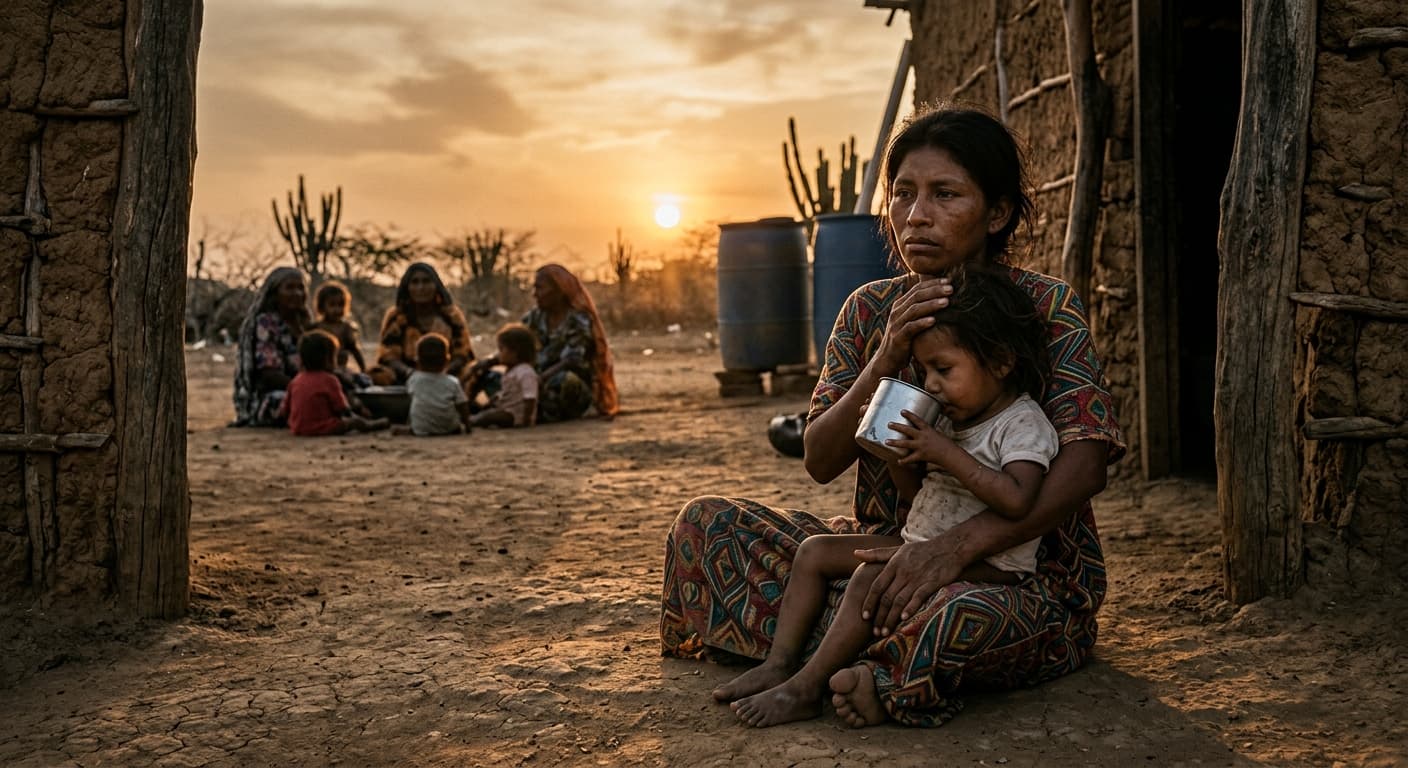
Colombia's Twin Hunger Zones: Why La Guajira and Chocó Break First
Colombia's 2026 food security outlook puts La Guajira and Chocó in IPC Phase 3 Crisis as drought, armed group expansion, and a shrinking humanitarian response converge before a new government takes office.
The shocks driving Colombia's food security into Crisis (IPC Phase 3) in La Guajira and Chocó between June 2026 and January 2027 are not new — but the way they now compound is. La Guajira's structural drought is meeting a fiscal squeeze on Wayuu nutrition programs; Chocó's chronic flooding is meeting an expanded Clan del Golfo and a stalled negotiation in Doha. The result: two departments where the food emergency is no longer episodic but locked in, and where the humanitarian arithmetic gets worse in the six months after Colombians elect Gustavo Petro's successor. The population that loses is already identified in the government's own mortality data — indigenous and Afro-descendant children under five.
The thesis in one number
According to the World Food Programme's Colombia country brief for March 2026, roughly 7 million people — 37% of households in the 15 most-vulnerable departments — face moderate or severe food insecurity, and "departments such as Atlántico, Sucre and La Guajira" lead on severe food insecurity (ReliefWeb). Extrapolated nationally, food insecurity sits stubbornly at about 25%. That baseline number is the story: after three years of "Total Peace," the aggregate has not moved, while the tails — La Guajira in the arid northeast, Chocó on the wet Pacific — have deteriorated.
The UK Home Office's March 2026 country policy note, drawing on WFP's own assessment, records that La Guajira registers 59% household food insecurity, the highest of any Colombian department, against a national rate near 25% (GOV.UK). The World Bank classifies La Guajira and Chocó together in "Region 4" — low incomes, high unmet basic needs, great natural wealth — a grouping designed to explain why national growth passes both departments by (
World Bank).
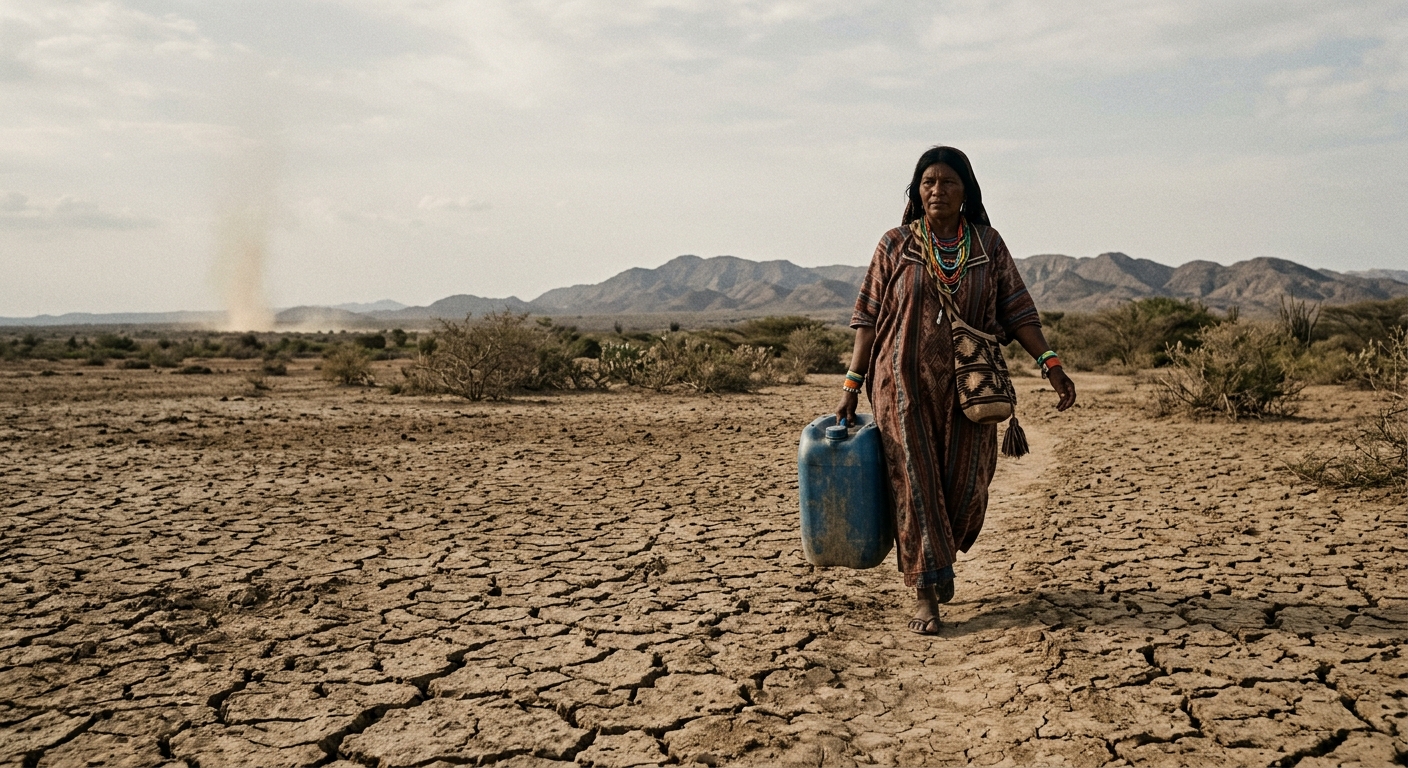
La Guajira: drought layered on corruption, layered on migration
La Guajira's crisis is the older of the two, and the more legible. Rainfall in the peninsula has reached historic lows since 2012, with residents in some years reporting no rain at all; Human Rights Watch documented that this coincided with a persistent rise in child mortality from malnutrition, "nearly six times the national average" for children under five in the department (HRW). Bank of the Republic economists Bonet-Morón and Hahn-De-Castro traced the structural roots — a dispersed rural Wayuu population, low sanitary conditions, and an economy historically oriented toward Venezuela and the Caribbean rather than the Colombian interior (
RePEc).
Two shocks then stacked onto that structure. The first is climate: end-of-century projections cited by HRW put La Guajira's temperature 4.14°F higher and rainfall 30–40% lower (HRW). The second is Venezuela: Colombia's Migration Colombia registry counted 2,831,561 Venezuelan nationals in country in mid-2025 — of whom roughly 106,000 have settled in La Guajira, compressing food and water demand in the poorest municipalities (
Amnesty International).
The corruption dimension is the reason humanitarian dollars don't close the gap. HRW reported that only three of roughly 60 investigators in La Guajira are assigned to more than 900 corruption cases; the Comptroller General had recovered just 8 million pesos of an estimated 6.4 billion allegedly lost in food and healthcare contracts since 2016 (HRW). Human Rights Watch's August 2025 submission to the UN Committee on Economic, Social and Cultural Rights recorded that Colombia's under-5 acute malnutrition mortality rose 43.5% between 2017 and 2023, with Chocó at 65.8 and La Guajira at 52.5 per 100,000 — the department's rate now roughly eight times the national mean (
HRW CESCR submission).
Chocó: conflict is the shock, climate is the amplifier
Chocó's IPC Phase 3 trajectory runs on different mechanics. Here the primary driver is armed conflict — specifically, the territorial reconstitution of the Autodefensas Gaitanistas de Colombia (Clan del Golfo, or EGC) alongside a resurgent ELN. The UK government's March 2026 note on armed groups classifies both as dominant non-state armed groups exercising "control over territory through violence and threats, kidnappings, the use of explosive ordnance, and human trafficking" (GOV.UK).
The Fundación Ideas para la Paz (FIP) put a number on the expansion: the Clan del Golfo grew from roughly 4,061 members in 2022 to about 10,000 in 2025, extending presence from around 200 municipalities to 338 (FIP). Total armed-group membership crossed 27,000 by December 2025, a 23.5% year-on-year jump; Colombia now has 13 to 14 active disputed zones — nearly double the 2022 figure — and Chocó is one of them (
FIP).
The International Committee of the Red Cross in May 2026 called 2025 "the worst humanitarian consequences" of the conflict in a decade: 235,619 people individually displaced, mass-displacement events more than doubling to over 87,000, and confinement events rising by nearly 100% (Al Jazeera). FIP's June 2026 tally put mass displacement at more than 96,000 people in 2025 and confinement at roughly 155,000 — with Chocó named among the epicenters (
FIP).
Confinement is the mechanism by which armed contestation becomes IPC Phase 3. When the Clan del Golfo and ELN fight over the Atrato and San Juan river corridors — cocaine routes to the Pacific — they mine the paths, blockade the rivers, and cut communities off from their crops and markets. The pattern is not new; a BBC Mundo dispatch as early as 2019 documented Indigenous communities in northern Chocó "confined and unable to obtain first-necessity food supplies" because of ELN–Clan del Golfo combat (BBC Mundo). What has changed is scale: the European Parliament's March 2026 written question flagged that more than 65,000 hectares in the Bajo Atrato are now under pressure from cattle, mining and monoculture — the same territory contested by armed groups and inhabited by Afro-descendant and Indigenous communities whose collective title is the last barrier to displacement (
European Parliament).
Then comes weather. NUPI's climate-security fact sheet notes that Chocó "is among the hardest hit by climate change and violent conflict" — the compounding is not incidental but constitutive; when La Niña brings the second rainy season from August to November, flood and landslide risk overlays territories where humanitarian access is already blocked (NUPI). A 2026 study in Natural Hazards confirms that La Niña phases significantly raise soil moisture ahead of Colombia's Andean rainy peaks in April–June and September–November — the exact window of this Outlook (
Springer/RePEc).
The macroeconomic layer nobody prices in
Banco de la República researchers modeled it plainly: ENSO events depress agricultural output and push food inflation without denting headline GDP much — meaning the shock lands entirely on the food budgets of the poorest (RePEc/Graduate Institute). Separate Central Bank work found excessive rainfall episodes reduce formal rural employment by 2.2–3% in affected municipalities, with irrigation acting as a buffer that Chocó and Alta Guajira largely lack (
RePEc). Translation: the same La Niña that floods Chocó's crops erodes the wages that would let households absorb the price shock. IPC Phase 3 is where those two curves cross.
Who benefits, who loses
The beneficiary of the status quo is not, contrary to reflex, "the armed groups." A recent Nature Food analysis suggests IPC classifications globally may understate the number of people in Phase 3+ by roughly 29% — meaning that even the current Crisis designation in La Guajira and Chocó is likely conservative (Nature Food). The beneficiary is the political economy that keeps humanitarian response episodic: local contractors in La Guajira whose water and school-feeding contracts remain under investigation but not resolved, and the Clan del Golfo, whose payroll — FIP puts it at roughly USD 1.5 million a month — is sustained by extortion revenue in the exact departments where the state's food response is thinnest (
FIP).
The losers are named in the mortality tables. HRW reported that in 2023 Indigenous children accounted for 26% of acute malnutrition cases and 60% of deaths from malnutrition in Colombia (HRW CESCR submission). The 2026 Humanitarian Response Plan targets 6.9 million people for food security and nutrition assistance, but as WFP notes, the political calendar — congressional voting in March, the presidential runoff around 21 June — has heightened tensions and diverted government focus (
ReliefWeb;
BBC Mundo).
The historical parallel that reframes it
The historical parallel worth naming is not Catatumbo — although that crisis, which displaced roughly 92,000 people between January 2025 and January 2026, is what has consumed government bandwidth (FIP). It is the 2010–2011 La Niña "Ola Invernal," which a Bank of the Republic case study called one of the worst natural disasters in Colombian history (
RePEc). The state response then took years to reconstitute affected municipalities. If the second 2026 rainy season delivers even a fraction of that impact in Chocó — while ICRC-documented explosive violence continues to block humanitarian corridors — the response capacity available to the incoming government is materially weaker than it was fifteen years ago.
What to watch through January 2027
Three inflection points structure the outlook. First, the Doha negotiation: the Clan del Golfo agreed on 5 December 2025 to establish Temporary Location Zones in Tierralta (Córdoba), Belén de Bajirá and Unguía (Chocó) beginning 1 March 2026 — a deadline FIP already considered unlikely to be met, and whose slippage keeps Chocó's Atrato basin contested (FIP). Second, the presidential runoff between Iván Cepeda and Abelardo de la Espriella: Cepeda has embraced Total Peace; de la Espriella has promised to end it, a shift that would rewrite the security posture in Chocó and, by extension, the humanitarian access map (
Al Jazeera). Third, the WFP funding curve into January 2027: with the 2026 HRP targeting 6.9 million and donor appetite for Latin America shrinking against Sahel and Middle East demands, any shortfall is likely to tip additional Chocó and La Guajira municipalities from Stressed (Phase 2) into Crisis (Phase 3).
The Bottom Line
Colombia's June 2026–January 2027 food security outlook is the story of two departments — one arid, one wet — arriving at IPC Phase 3 by opposite mechanical routes but the same institutional failure: a state that treats La Guajira's Wayuu and Chocó's Afro-descendant and Indigenous communities as chronic exceptions rather than the load-bearing test of its social contract. The incoming government inherits a Clan del Golfo twice its 2022 size, a humanitarian caseload the ICRC calls the worst in a decade, and mortality tables showing Indigenous children absorbing 60% of malnutrition deaths. Whether the crisis is contained in 2027 will be decided less by rainfall than by whether Bogotá can protect food corridors in Chocó's river basins and rebuild trust in Alta Guajira's water and nutrition programs before the next La Niña.
Discover more
Global Politics
Xi Jinping Calls China-Russia Ties 'Precious'
Xi Jinping's description of China-Russia ties as 'precious' reflects a strategic imbalance, with Beijing dictating terms in the partnership.

US Politics
White House Pressures Congress for Crypto Leg
The Trump administration's push for the CLARITY Act aims to reshape crypto regulation, impacting trillions in market value and the Trump family's wealth.
US Politics
US-Brokered Ceasefire in Lebanon
A US-brokered ceasefire in Lebanon sends thousands of displaced residents home, but deep underlying tensions persist, leaving the fragile calm far from assured.

Conflict & Security
Drone Warfare Killing Aid Workers at Unprec
Over 1,000 humanitarian workers killed in three years as cheap armed drones collapse legal protections. Gaza, Sudan, Ukraine, and DRC see deliberate targeting of aid convoys and hospitals with zero prosecutions.