Colombia's Hunger Crisis: Chocó and La Guaj
Food insecurity rises in La Guajira and Chocó due to multiple shocks.
Model Diplomat6 min readLatin America
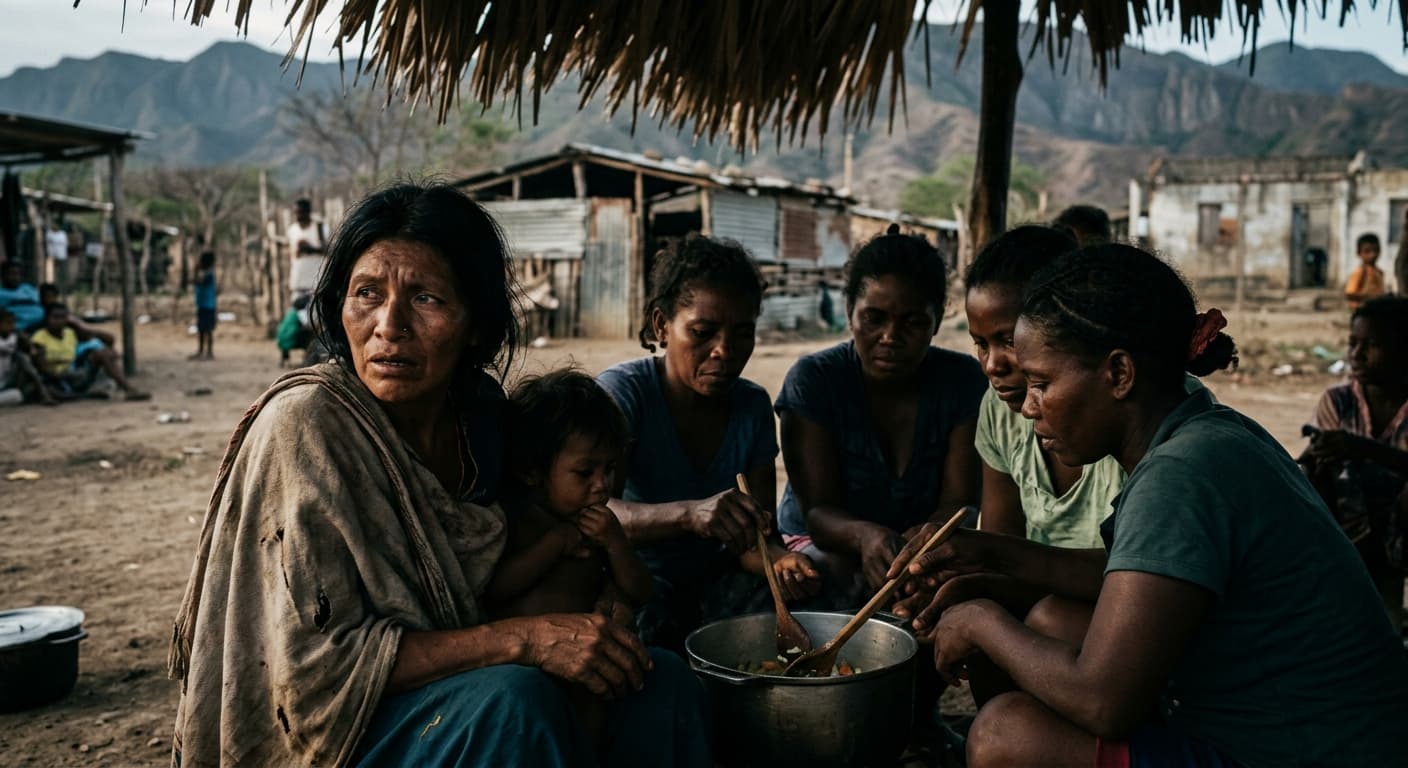
Colombia's Hunger Belt: Chocó and La Guajira Slip Into Crisis
Multiple shocks — armed conflict, climate extremes and a fraying peace — push La Guajira and Chocó to IPC Phase 3 through January 2027.
Colombia's food-security map for June 2026 through January 2027 has hardened around two departments — La Guajira and Chocó — where the collision of armed-group expansion, climate whiplash and post-election policy uncertainty is projected to keep populations at IPC Phase 3 (Crisis) even as national aggregates hold steady. The World Food Programme's March 2026 country brief pegs national moderate-to-severe food insecurity at roughly 25%, but in the 15 most vulnerable departments the figure jumps to 37%, or about 7 million people, according to the WFP Colombia Country Brief. The story of the next six months is not the national number. It is the concentration — and what a change of government in Bogotá will do to it.
The three-shock model, translated to two departments
Colombia's food emergency is now analytically legible as the overlap of three curves: armed conflict, climate variability and household economics. The SIPRI–NUPI Climate, Peace and Security fact sheet frames Chocó as "among the hardest hit by climate change and violent conflict," a department where the erosion of Afro-Colombian and Indigenous livelihoods makes communities "increasingly vulnerable" to non-state armed groups. La Guajira is the mirror case: the
World Bank's Trajectories report records two in three residents living in poverty, with formal employment below 20% and Wayuu communities isolated at the country's arid northern edge.
The UK Home Office's March 2026 country policy note records that the WFP's late-2023 assessment already placed food insecurity in La Guajira at 59% — the highest of any Colombian department. That baseline never recovered. The 2026 shocks are stacking on top of it, not resetting it.
Conflict: the peace dividend has been withdrawn
The proximate driver of the 2026 outlook is the collapse of President Gustavo Petro's "Total Peace" architecture. Al Jazeera reports that the number of active fighters across Colombia has roughly doubled from about 13,000 in 2022 to 27,000 by end-2025, according to Fundación Ideas Para la Paz. The
ICRC's 2025 balance recorded 235,619 individual conflict displacements — a doubling year-on-year — and 965 people killed or injured by explosive devices, the highest in a decade. Confinement events rose by nearly 100%.
Chocó is the paradigm case. The Council on Foreign Relations documents that since talks between the government and the National Liberation Army (ELN) broke down in August 2024, the ELN and Colombian security forces have clashed openly in Chocó and Arauca, with the Gulf Clan (AGC) filling the vacuum in Pacific corridors. The mechanism runs through food. When Embera, Wounaan and Afro-Colombian river communities are confined — barred from hunting, fishing and reaching their swidden plots — subsistence collapses within weeks. Amnesty International documented the pattern in the Truandó and San Juan river basins as
confinement forcing communities into "grave alimentary and health conditions".
La Guajira sits inside a different conflict geometry. It is a smuggling frontier rather than a battlefield. But the March 2026 UK Home Office armed-groups note records coffee growers in Magdalena, Cesar and La Guajira being extorted by the Autodefensas Conquistadoras de la Sierra — a taxation model that erodes rural incomes without producing headline displacement.
Climate: the whiplash between droughts and floods
The Human Rights Watch investigation into Wayuu child mortality set out the physical baseline: rainfall in La Guajira at historic lows since 2012, temperatures projected 4.14°F higher by century's end, rainfall 30–40% lower. In 2023, according to Colombia's National Institute of Health,
70 children under five died of acute malnutrition in La Guajira alone — the highest departmental total in the country.
Chocó runs the opposite risk. Colombia's WFP joint assessment flags severe climate-related emergencies in the first 45 days of 2026, with more than 330,000 people impacted by weather-related events. A recent arXiv ENSO forecast puts the probability of El Niño onset in 2026 at only around 37.5%, with a neutral event most likely and La Niña at roughly
18% probability — a distribution that, for Chocó, means continued heavy Pacific rainfall regimes and flood risk through the outlook window. The SIPRI/NUPI fact sheet estimates that 84% of Colombians live in areas exposed to multiple hazards, with 2.7 million already hit by El Niño drought in 2024 and 18.6 million reporting insufficient food consumption.
Economics: the second-order effect nobody names
The overlooked shock is macro. A Graduate Institute study of weather shocks in Colombia finds that ENSO fluctuations reliably transmit into food-price inflation without denting headline GDP — meaning that Bogotá can post decent growth numbers while La Guajira grocery baskets become unaffordable. The
OECD's 2026 paper on inclusive food systems documents how Afro-Colombian and Indigenous small-farmer reliance on informal markets keeps them exposed to precisely these price shocks, without formal risk-sharing infrastructure.
Layered on top: 2.8 million Venezuelan migrants remain in Colombia, per the WFP brief, with La Guajira absorbing an outsized share along the border. And the Cambridge public health nutrition study on Colombian rural households shows the compounded result: 62% of rural Colombian households food-insecure, with stunted children and overweight mothers cohabiting — the "double burden" that IPC classifications tend to under-count.
That under-counting matters. A VoxDev summary of new research on the IPC methodology finds it systematically misses roughly one in five people at Phase 3 or worse. Applied to Chocó and La Guajira, the operative assumption should be that Crisis-level populations are materially larger than published figures suggest.
The political variable: Cepeda vs. de la Espriella
The outlook window straddles a change of government. Colombians voted on May 31, 2026, with a runoff on June 21 between left-wing senator Iván Cepeda and right-wing outsider Abelardo de la Espriella. The European Parliament Research Service briefing records public security as the top voter concern, more than 16 points ahead of unemployment. Cepeda has pledged to continue Total Peace negotiations; de la Espriella has pledged 10 mega-prisons, an end to talks and a military campaign. The BBC reports his platform as
imposed peace "through weapons".
For food security the divergence is direct. A militarised campaign against the ELN and Clan del Golfo in Chocó will produce more confinement events and interrupted river transport before it produces territorial control — the ICRC has already documented that fear of explosive ordnance keeps families indoors, restricting access to crops and vital services. A continuation of regional dialogues, as CFR analysts recommend, could stabilise Chocó pockets but leaves La Guajira's structural drivers untouched.
The legal wildcard
The second-order beneficiary of the crisis may be Colombia's legal system. In May 2026 Congress passed Law 2577, formally recognising climate change, environmental degradation and natural disasters as valid causes of forced displacement — the first such law in Latin America, according to the Carnegie Endowment. The law obliges the government to draft a national climate-mobility policy within six months and, notably, singles out food security and the rights of women and girls as protected interests. It sits atop a Constitutional Court
tutela ruling T-123/24 treating environmental displacement as a rights violation.
Whether Law 2577 delivers before January 2027 depends on which president is signing decrees. Cepeda's team helped draft the framework. De la Espriella's platform does not mention it. That six-month drafting deadline — running to roughly November 2026 — falls squarely inside the IPC outlook window and is the single most tractable variable in what is otherwise a story of structural inertia.
What to watch
- June 21, 2026 runoff result. A Cepeda win preserves negotiation channels in Chocó and continuity on Law 2577 implementation. A de la Espriella win front-loads military operations that historically produce short-term displacement spikes.
- November 2026 policy deadline. The Law 2577 mandate to publish a national climate-mobility policy is the concrete test of whether the framework touches La Guajira's Wayuu communities or remains a legal artefact.
- October–December 2026 rainy season in Chocó. ENSO-neutral to weak La Niña conditions imply above-normal Pacific precipitation. IDEAM flood forecasts and any confinement events along the Atrato, San Juan and Baudó rivers will be the leading indicator of Phase 3 severity through January 2027.
- Coffee harvest window in Sierra Nevada de Santa Marta. Extortion pressure documented in Magdalena, Cesar and La Guajira will test whether the Autodefensas Conquistadoras' rural taxation model widens under a hardline government or narrows under continued negotiation.
The Bottom Line
Colombia's 2026 hunger crisis is not a national failure. It is a geography — two departments where three shocks compound because the state was never there to absorb the first one. The evidence points to Chocó and La Guajira holding at IPC Phase 3 through January 2027 regardless of who wins the runoff, because the drivers — armed-group fragmentation, desertification and flooding, and household-level price shocks — operate on timescales longer than any single administration. The variable to watch is not the WFP brief; it is whether Law 2577 survives the transition intact.
Discover more
Global Politics
Xi Jinping Calls China-Russia Ties 'Precious'
Xi Jinping's description of China-Russia ties as 'precious' reflects a strategic imbalance, with Beijing dictating terms in the partnership.

US Politics
White House Pressures Congress for Crypto Leg
The Trump administration's push for the CLARITY Act aims to reshape crypto regulation, impacting trillions in market value and the Trump family's wealth.

India
Yamini Aiyar on Modi's Federalism Shift
Yamini Aiyar critiques Modi's shift from equity-based to performance-based federalism, highlighting implications for India's political landscape.

Conflict & Security
Drone Warfare Killing Aid Workers at Unprec
Over 1,000 humanitarian workers killed in three years as cheap armed drones collapse legal protections. Gaza, Sudan, Ukraine, and DRC see deliberate targeting of aid convoys and hospitals with zero prosecutions.