Colombia's Coca Bet: De la Espriella's Plan
Can Colombia's new president cut coca cultivation?
Model Diplomat7 min readLatin America
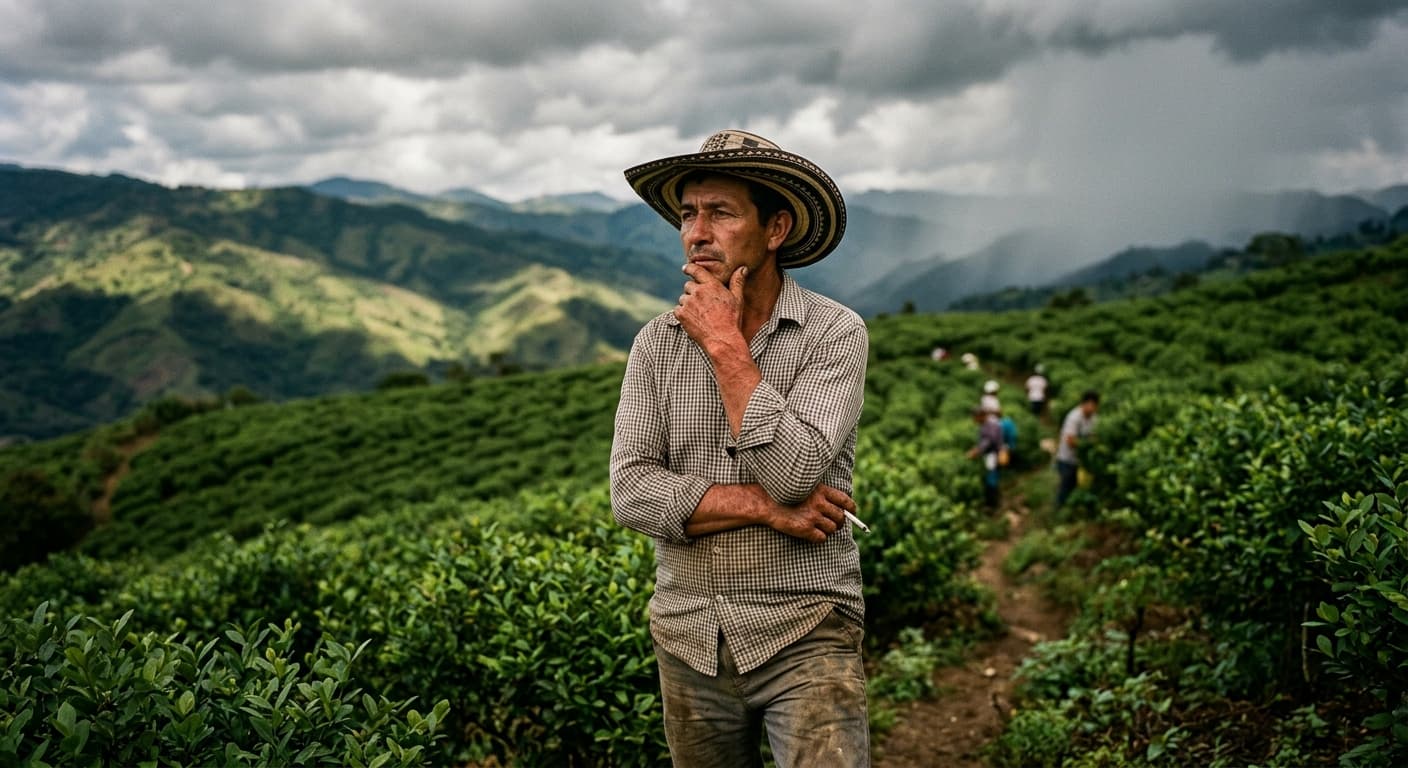
Colombia's Coca Bet: Can De la Espriella's Iron Fist Cut 261,000 Hectares?
Colombia's new hard-right president inherits a record 261,000 hectares of coca — 47% of it in just 10 municipalities. Whether he can eradicate it will define U.S.-Latin America drug policy in 2026.
Colombia registered 261,000 hectares of coca in 2024, a 3.5% increase over the previous year, according to the UNODC monitoring report released on June 25, 2026 — the same week right-wing lawyer Abelardo de la Espriella won the presidency by less than a percentage point. That data hands the incoming government something no Colombian president has had in a decade: a concentrated target set. Nearly half of all coca now sits in ten municipalities across four departments. The thesis of this piece is narrow and unfashionable: geography, not ideology, is the reason De la Espriella's iron-fist plan could bite in the short run — and precisely why it will still fail on the metric that matters, cocaine output, unless Washington accepts a longer sequencing than Donald Trump's decertification timeline allows.
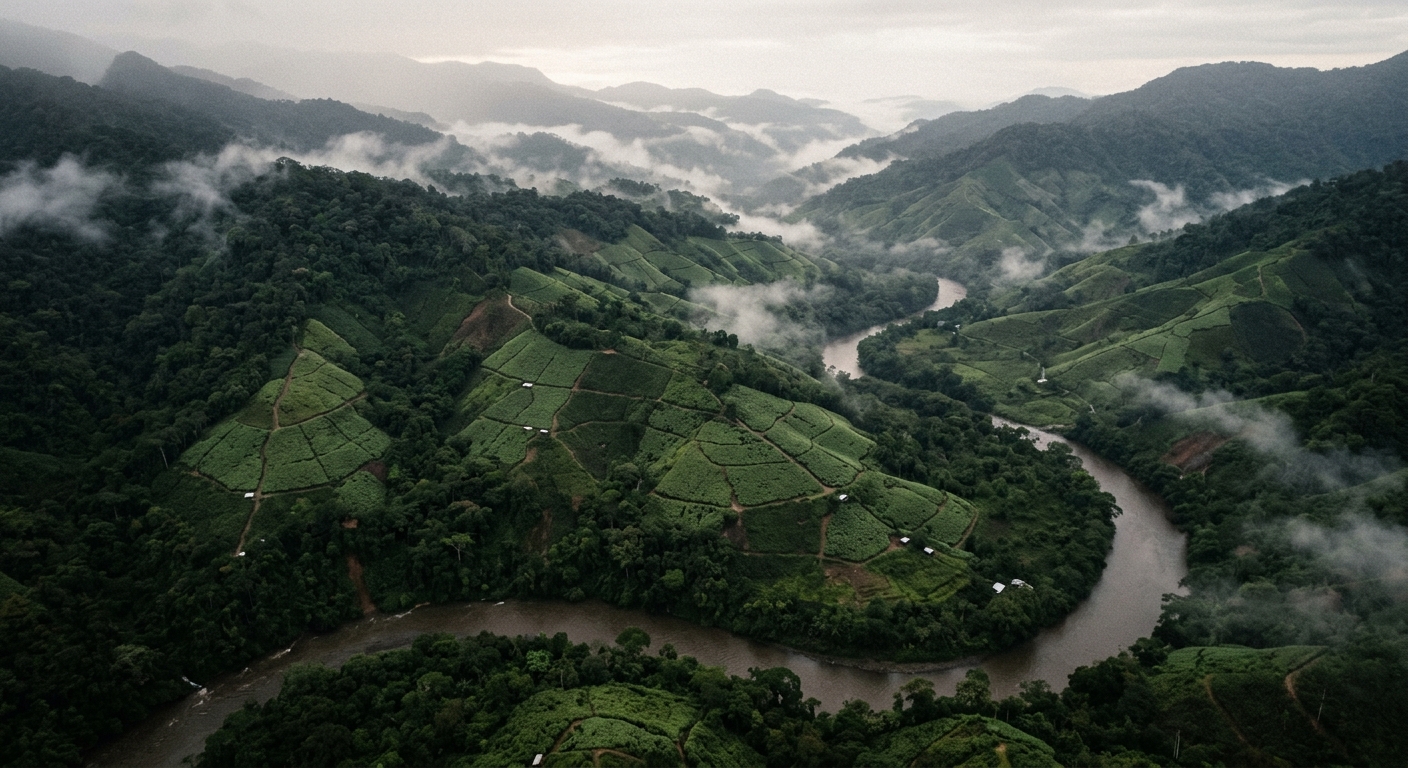
The map has narrowed. The politics have not.
The story hidden inside the UNODC number is not the 3.5% headline. It is the collapse of geographic spread. According to InSight Crime, Nariño alone accounts for 74,547 hectares — up more than 9,500 on the year — with the Pacific municipality of Tumaco holding 31,300. Norte de Santander's Catatumbo region jumped to second at 48,739 hectares, concentrated around Tibú. Putumayo (44,473) and Cauca (36,876) round out what UNODC's country representative Amado de Andrés called an "increasingly industrialized" enclave pattern.
Leonardo Correa, UNODC's regional monitoring coordinator, put the concentration bluntly to BBC Mundo: "Half of the cocaine produced in Colombia comes from those enclaves, which occupy about 15% of the country's coca-growing territory." Plant density has doubled — from 4,000–6,000 to as many as 10,000 plants per hectare — and the fields sit almost entirely on the Ecuadorian and Venezuelan borders. In counter-narcotics terms, that is a targeting problem waiting for a decision-maker.
De la Espriella intends to be that decision-maker. His victory speech in Barranquilla on June 22, 2026, followed a campaign built explicitly around "mano de hierro" — the iron fist. BBC News reported he won 49.7% to Iván Cepeda's 48.7%, endorsed by Donald Trump and, per
Al Jazeera, promising to "bomb, fumigate, and strike with an iron fist" against traffickers. His platform floats a "Plan Colombia 2.0" jointly financed by the United States and Israel, aerial spraying resumed via drones, and mega-prisons modelled on Nayib Bukele's CECOT. He is inaugurated on August 7, 2026.
The Petro inheritance: record coca, collapsed eradication
The scale of the policy reversal is easier to see once the Petro-era numbers sit next to Duque-era ones. Under Iván Duque, forced manual eradication ran above 100,000 hectares annually in 2020–2021. The Petro government cut that goal to 20,000 hectares in 2023 and only 10,000 in 2024 — about 4% of identified coca, as the Bogotá-based Fundación Ideas para la Paz (FIP) documented in its first-year policy review.
The U.S. Congressional Research Service, in an October 2025 insight brief on Colombia's decertification, put the collapse at 83% between 2022 and 2024. Petro's argument was that forced eradication punishes campesinos while the state offers no alternative livelihoods; a 2024
Journal of Illicit Economies and Development study showed the flagship voluntary substitution programme (PNIS) actually increased coca in participating municipalities by an average of 791 hectares each — roughly 40,000 hectares nationally — because the promise of future payment incentivised planting to qualify. Neither strategy has moved the top-line number in the direction its architect promised.
The result is Colombia entering 2026 producing more cocaine than at any point since satellite monitoring began. UNODC estimated cocaine output rose 53% in 2023 to 2,664 metric tons, driven less by more land and more by better yields and more efficient extraction. Colombian security forces seized nearly 800 tons in 2024 — record interdictions layered on top of record production.
Why the enclave map favours a hard line — briefly
Concentration is what makes De la Espriella's arithmetic look tempting. If 47% of the crop sits in ten municipalities, an aerial campaign — even a legally constrained one — could plausibly cut national hectarage by 15–25% inside eighteen months. That would give Washington a headline number to certify against, and give Bogotá short-term leverage in a badly deteriorated bilateral file. President Trump suspended U.S. subsidies to Colombia in October 2025 after decertifying it in September, calling Petro an "illegal drug leader." U.S. anti-narcotics aid, worth roughly $380 million a year according to
Al Jazeera, has been in limbo since.
De la Espriella's team believes the enclave concentration lets Colombia deliver a fast, visible win. His signalled instruments — reconnaissance and spraying drones instead of Cessna crop-dusters, bioherbicides instead of glyphosate — are designed to survive the Constitutional Court's 2017 ruling (T-236), which permitted aerial eradication only under strict health, environmental and prior-consultation guardrails. He also plans to reactivate the National Narcotics Council authorisation, dormant since 2015, when Colombia grounded the U.S.-funded PECIG programme after the WHO's cancer research arm reclassified glyphosate as "probably carcinogenic," a decision documented at length in the International Court of Justice case Ecuador v. Colombia.
Why it still fails the "cocaine output" test
Every serious econometric review of Colombian eradication over the past decade points to the same finding: the coca–cocaine linkage has broken. A 2019 LSE Latin America and Caribbean Centre analysis found that once regional and time controls are applied, the post-2015 coca surge is not explained by the suspension of aerial spraying. Yields per hectare, plant density and extraction efficiency drive cocaine output more than raw hectarage. Brookings' Vanda Felbab-Brown warned in her
2020 Colombia counternarcotics paper that even drone-delivered eradication "does not avoid the vast political ramifications of forced eradication without alternative livelihoods in place." That warning has aged well: cocalero protests in Nariño turned deadly under Duque, and the 2023–2024 UNODC data show cultivation rebounding fastest exactly where prior eradication cycles were most intense.
The Quincy Institute reached a similar conclusion in its June 2026 review, "Demilitarizing Counternarcotics: 25 Years of Evidence from Colombia": neither Cepeda's continuity of Petro's voluntary substitution nor De la Espriella's militarised eradication has ever produced durable reductions on its own. The variable that has moved the needle historically is state presence — permanent institutional capacity in the enclaves — not spray hours.
And the enclaves are, by design, where the state does not sit. Tumaco, Tibú, Argelia and El Tambo are corridors held by ELN, the Gulf Clan (Clan del Golfo), FARC dissidents (Estado Mayor Central, Segunda Marquetalia) and, in Catatumbo, Venezuelan-linked structures. As the CRS brief noted, an armed group used a drone in August 2025 to shoot down a Colombian anti-narcotics helicopter, killing 12 police eradicators — a live demonstration of what "targeting the enclaves" costs when the state arrives without holding force.
Washington's leverage — and its limit
De la Espriella's plan is legible only against Trump's timetable. The president-elect has already accepted an invitation to join Washington's proposed "Shield of the Americas," a hemispheric anti-cartel bloc, and pledged to restore relations with Israel, whose military-industrial suppliers are central to a "Plan Colombia 2.0" concept. The Council on Foreign Relations warned in September 2025 that decertification risked pushing Bogotá toward Beijing — an argument that
CFR fellows urged the administration to weigh before "blunt force" became the default.
The math from the U.S. side is unforgiving too. A February 2026 NBER working paper estimates that each additional hectare of Colombian coca translates to roughly $45,000 in U.S. statistical-life value lost per year via overdose mortality — implying 1,000 to 1,500 additional annual U.S. cocaine deaths attributable to Colombia's post-2015 boom. That is the number that will drive Trump's certification decision in September 2026, one month after De la Espriella takes office. If the new government cannot show a visible drop in hectarage by then, the aid file gets worse, not better.
Diplomat View
The forecast: De la Espriella can deliver a reduction in coca hectarage in 2027, perhaps 20,000 to 40,000 hectares net, by concentrating drone-delivered spraying on the ten enclave municipalities. He cannot deliver a proportional reduction in cocaine output, because yield gains and processing efficiency now dominate the production function. Washington will nonetheless certify Colombia in September 2027 — the visible metric is hectarage, not tonnage, and Trump needs a Latin American win. The forecast breaks if two things happen: first, if the Constitutional Court blocks drone spraying on Afro-Colombian and Indigenous collective lands in Tumaco and Cauca (highly plausible given its 2017 doctrine); second, if armed groups in Catatumbo escalate to sustained attacks on eradication assets, forcing a ground-force commitment Colombia's military, per Bogotá analyst Alejandro Mantilla in Al Jazeera, is not currently sized for. The hard-line approach will look like it is working long enough to reset the U.S. bilateral file. It will not stop the spread of coca; it will relocate it — probably to Chocó and southern Bolívar, both underreported in the current UNODC baseline.
What to watch:
- August 7, 2026 — De la Espriella's inauguration; expect an executive decree reactivating the National Narcotics Council authorisation for aerial spraying within the first week.
- Late 2026 — Constitutional Court challenge on drone-delivered spraying over collective-title lands in Tumaco (Consejo Comunitario Alto Mira y Frontera). A ruling by mid-2027 will decide whether the plan is legally executable.
- September 15, 2027 — Next U.S. drug-cooperation certification determination. First hard test of whether hectarage reductions translate into recertification and restored anti-narcotics aid.
The Bottom Line
The bottom line: Colombia's 47%-in-ten-municipalities concentration gives De la Espriella the cleanest eradication target set any president has had since Plan Colombia — and the shortest window before politics, courts and armed-group retaliation shut it down. His hard-line approach can move the hectarage number that Washington uses to certify him, but not the cocaine output number that drives U.S. overdose deaths. That gap between what is measurable and what is meaningful is the entire story of Colombian drug policy for the next four years.
Discover more

India
India-South Korea $50B Trade Expansion Plan
India and South Korea target $50 billion in bilateral trade by 2030, focusing on industrial cooperation and strategic alignment amid US pressures.

US Politics
Virginia GOP Rallies Rural Voters Against Red
Virginia Republicans are mobilizing rural voters against a Democratic-led redistricting referendum, a fight seen as pivotal to control in the 2026 midterms.

India
700 Activists Accuse PM Modi of MCC Breach
Over 700 activists allege PM Modi breached election code with a televised address attacking opposition parties just before state elections.

Economics
Fed's Amex AML order puts correspondent banking on notice
Federal Reserve's Amex AML order requires board-level controls and a 90-day plan; OCC fined the bank $350 million over enterprise-wide deficiencies.